
The One Line Definition #
“Machine learning is teaching computers to learn from data without being explicitly programmed for every rule.”
The Traditional Way vs Machine Learning #
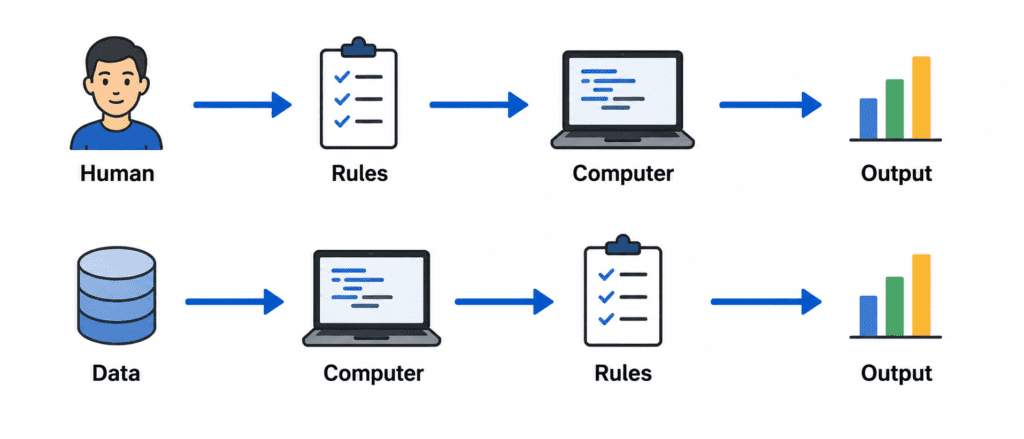
Traditional Programming:
Rules + Data → Answer
You write rules. Computer follows them. Simple.
Machine Learning:
Data + Answer → Rules
You give examples. Computer figures out the rules itself.
Real Example: Email Spam Filter #
Traditional Way:
You write rules:
- If email contains “lottery” → Spam
- If email contains “click here” → Spam
- If email contains “million dollars” → Spam
Problem: Spammers change words. You keep writing rules forever.
Machine Learning Way:
You give 10,000 emails already labeled “Spam” or “Not Spam”
Computer reads them and learns: “Aha! Words like ‘free’, ‘win’, ‘urgent’ often mean spam”
Now computer writes its own rules. When new email arrives, it decides instantly.
The Formal Definition (For Reference) #
Tom Mitchell (1997):
“A computer program is said to learn from experience E with respect to some task T and some performance measure P, if its performance on T, as measured by P, improves with experience E.”
Translation:
- E = The data you show it
- T = The job you want it to do (predict, classify)
- P = How you measure success (accuracy)
If showing more data makes it better at the job, it has learned.
What Machine Learning Actually Does #
At its core, ML does one thing:
Finds patterns in data.
That is it. Every ML application—from ChatGPT to self-driving cars—is just pattern finding at different levels of complexity.
| Application | Pattern Being Found |
|---|---|
| Spam filter | Which words appear in spam emails |
| Recommendation system | What similar users liked |
| Face recognition | Which pixel arrangements form a face |
| Speech recognition | Which sound waves form which words |
| Price prediction | How features affect price |
The Three Ingredients #
You need three things for machine learning:
1. Data
Examples to learn from. The more, the better.
2. Features
The characteristics you measure. Useful information.
3. Model
The mathematical pattern finder.
Without any one of these, ML does not work.
Simple Analogy: Learning to Ride a Bike #
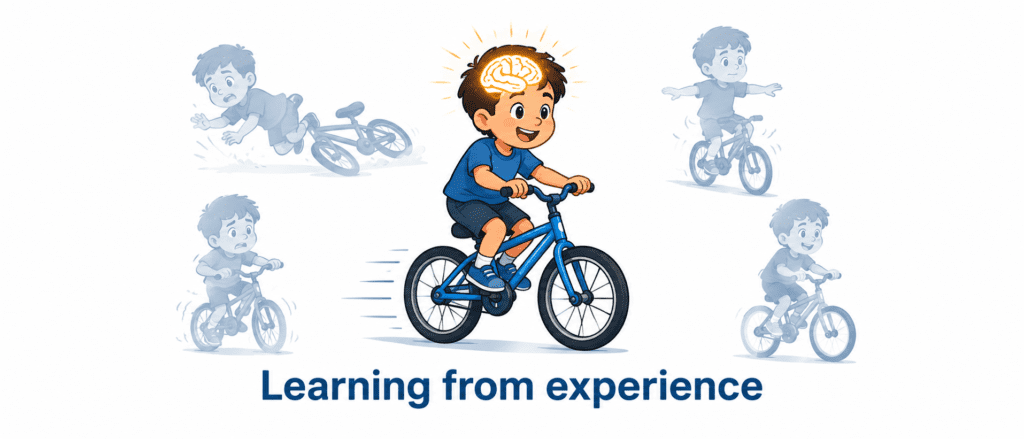
Traditional Programming:
Someone gives you a physics book. You learn balance equations. You calculate exactly how much to lean. You still fall.
Machine Learning:
You try to ride. You fall. You try again. You adjust. After many tries, your brain (the model) has learned the pattern. You do not know the physics rules. You just know how to balance.
You learned from experience (data), not from explicit rules.
What ML Is NOT #
| Misconception | Truth |
|---|---|
| ML is magic | No. It finds patterns. Nothing more. |
| ML understands like humans | No. It finds correlations, not meaning. |
| ML works with any data | No. Garbage in, garbage out. |
| ML is always accurate | No. It makes mistakes. Sometimes often. |
| ML replaces thinking | No. It is a tool for people who think. |
The Big Picture #
Think of machine learning as a detective:
- You give the detective many past cases (data)
- Detective studies them (training)
- Detective finds clues that repeat (patterns)
- New case arrives (new data)
- Detective uses past patterns to solve it (prediction)
The detective did not memorize the answers. The detective learned how to think about the problem.
One Sentence Summary #
“Machine learning is the science of getting computers to learn from examples instead of being told exactly what to do.”
Quick Quiz #
Q1: You write an if-else statement to decide if a number is even. Is this machine learning?
A1: No. You wrote explicit rules. The computer did not learn anything.
Q2: You show a computer 1000 photos of cats and 1000 photos of dogs. It learns to tell them apart. Is this ML?
A2: Yes. The computer learned the pattern from examples.
Q3: What are the three ingredients of ML?
A3: Data, Features, Model.
Key Takeaways (3 Lines) #
- ML = Learning from examples, not rules.
- ML finds patterns in data. That is all it does.
- You need data, features, and a model. Missing any one, ML fails.