
The Core Question: How does the model actually “know” the answer when it sees new data in Model Based Learning systems?
Instance-Based Learning #
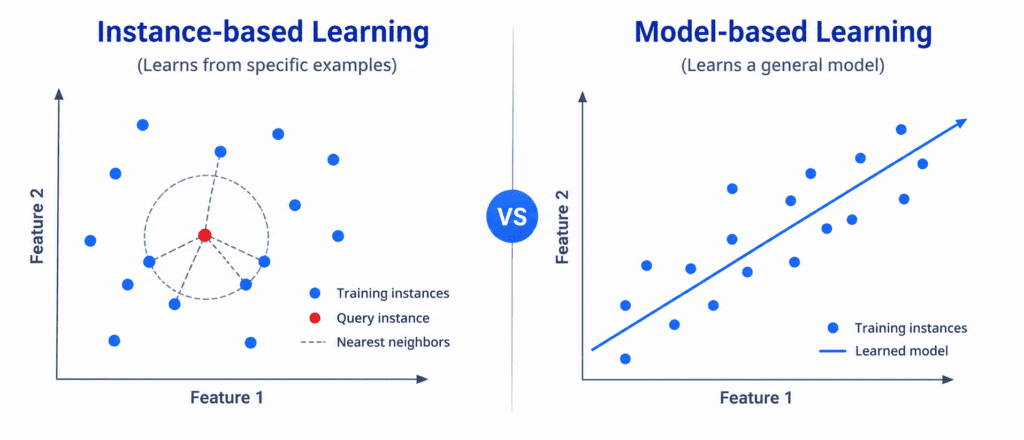
The Core Idea: The system memorizes the training examples. When a new instance arrives, it finds the most similar examples in its memory and makes a prediction based on them.
How It Works Step by Step:
- The system stores all training examples in memory
- A new data point arrives that needs a prediction
- The system measures the similarity between the new point and every stored example
- It finds the K most similar examples (nearest neighbors)
- For classification: It takes the majority vote of those K neighbors
- For regression: It takes the average value of those K neighbors
- It returns that as the prediction
Real-World Example:
Recommendation systems. When Netflix wants to recommend a movie to you, it looks at users who are most similar to you (same age, same location, same viewing history). It then recommends the movies those similar users liked. Netflix does not need a complex formula. It just finds similar people and copies their preferences.
Simple Visual Example:
Imagine you have a dataset of fruits with features (weight, size, color). You store all examples. A new fruit arrives. You calculate which stored fruits are most similar to this new one. If the 3 nearest neighbors are all apples, you predict this new fruit is an apple.
The Similarity Measure:
The system needs a way to measure “similarity.” Common methods include:
- Euclidean distance (straight-line distance between points)
- Manhattan distance (city-block distance)
- Cosine similarity (angle between vectors)
Pros and Cons:
| Pros | Cons |
|---|---|
| Simple to understand | Must store all training data (takes memory) |
| No training time (just memorize) | Predictions can be slow with large datasets |
| Works well with complex patterns | Sensitive to irrelevant features |
| Naturally handles new data points | Sensitive to noise and outliers |
Simple Memory Trick: Instance-based = The model lives by the saying “Tell me who your friends are, and I will tell you who you are.”
Model-Based Learning #
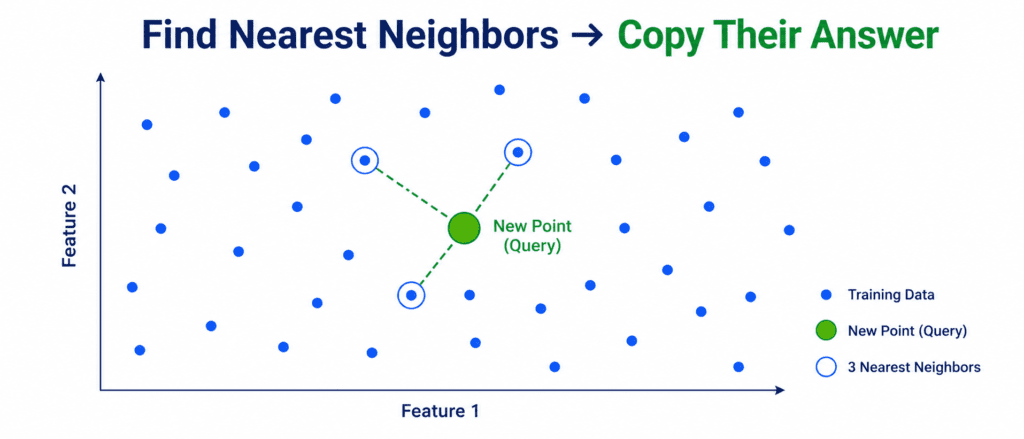
The Core Idea: The system tries to build a mathematical model (formula) from the training data. Once the model is built, the original data can be discarded. To make a prediction, you simply plug the new data into the formula.
How It Works Step by Step:
- You collect training data (inputs and outputs)
- You choose a type of model (linear line, polynomial curve, neural network)
- You train the model to find the best parameters for that model
- The model produces a mathematical formula
- You can now discard the original training data
- When a new data point arrives, you plug it into the formula
- The formula instantly outputs the prediction
Real-World Example:
Weather temperature prediction. After analyzing years of weather data, a model might discover the formula: “Tomorrow’s temperature = (Today’s temperature × 0.8) + (Yesterday’s temperature × 0.2) + Seasonal adjustment.” Once this formula is discovered, you do not need to keep the old weather data. Just apply the formula.
Simple Visual Example:
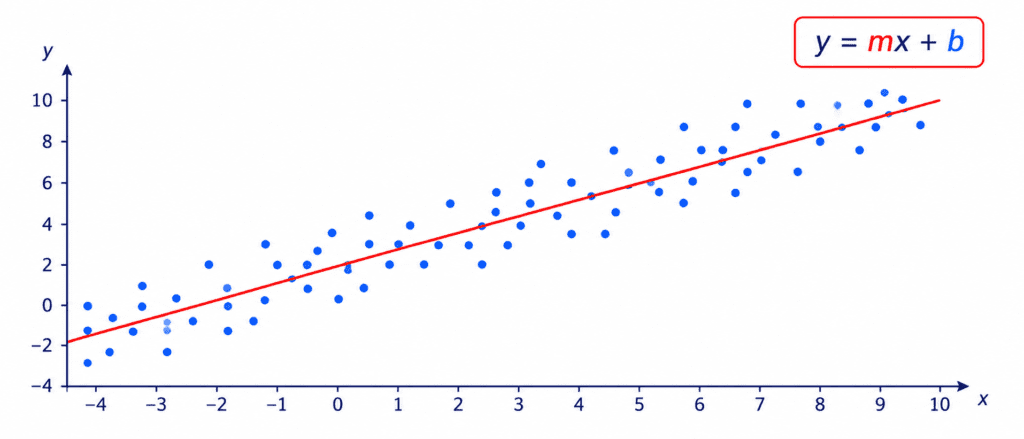
Imagine you plot house prices against house sizes. You see a pattern: as size increases, price increases. You decide to fit a straight line through these points. This line has a formula: Price = (Slope × Size) + Intercept. Once you know the slope and intercept, you can predict the price of any new house just by knowing its size. You never need to look at the original houses again.
The Training Process:
The model searches through the parameter space to find the combination that minimizes the error on the training data. This is called optimizing a cost function.
Pros and Cons:
| Pros | Cons |
|---|---|
| Very fast predictions (just a formula) | Requires training time |
| Small memory footprint (just parameters) | Model choice matters a lot |
| Easy to deploy anywhere | May underfit if model is too simple |
| Interpretable (for simple models like linear regression) | May overfit if model is too complex |
Simple Memory Trick: Model-based = The model extracts the rule (formula) and forgets the examples.
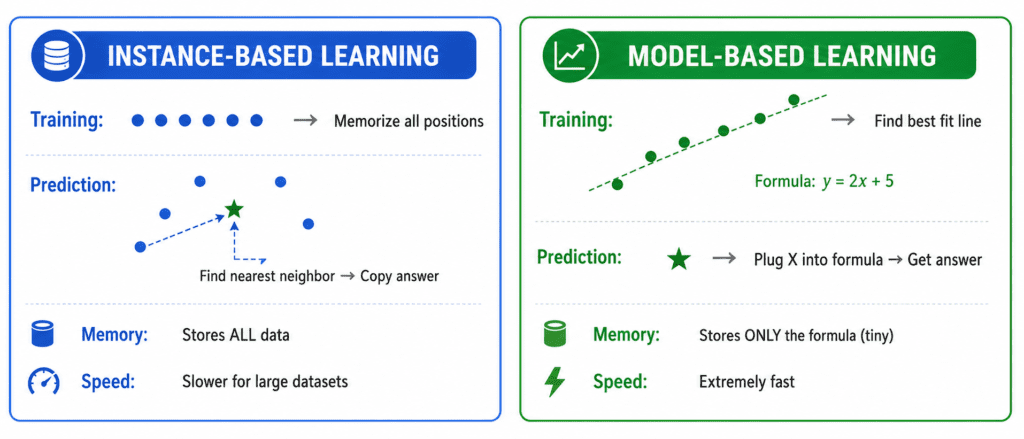
Visual Comparison: Instance vs Model-Based:
Complete Summary: All Three Classifications Together #
| Classification | Category | Key Idea | Best For |
|---|---|---|---|
| Supervision | Supervised | Learn from labeled examples | Spam filters, price prediction |
| Unsupervised | Find hidden patterns alone | Customer groups, fraud detection | |
| Semi-supervised | Small labels + big unlabeled data | Photo tagging, medical imaging | |
| Self-supervised | Data creates its own labels | ChatGPT, image restoration | |
| Reinforcement | Learn by trial and error | Game AI, robotics | |
| Learning Method | Batch | Train once, never update | Stable problems |
| Online | Continuous updates | Stock market, user behavior | |
| Prediction Method | Instance-based | Memorize and compare | Recommendation systems |
| Model-based | Find formula, use forever | Weather, price prediction |
Chapter Challenge #
Test your understanding with these real-world scenarios:
Question 1:
You are building a fraud detection system for a bank. Credit card fraud patterns change every week. New fraud techniques emerge constantly. Which learning method (Batch or Online) should you choose and why?
Question 2:
You have 10 million customer records but only 5,000 have been labeled with their customer segment (Gold, Silver, Bronze). Labeling the rest would cost $50,000. Which type of learning should you use?
Question 3:
Your self-driving car predicts steering angles using a mathematical formula derived from millions of driving hours. The original driving data has been discarded. Is this Instance-based or Model-based learning?
Question 4:
You want to build a model that plays chess. You do not have any labeled data of “good moves.” You only know whether the game was won or lost at the end. Which type of learning should you use?
Question 5:
You have a dataset of 1 million images. None of them have labels. You want the model to automatically group similar images together. Which type of learning is this?