
When you think like an analyst, you stop jumping to “let me code this” and start with a much more powerful tool: curiosity. It’s not magic — it’s a set of mental habits. Let’s walk through them like we’re shoulder to shoulder at your desk.

When you think like an analyst, you stop jumping to “let me code this” and start with a much more powerful tool: curiosity. It’s not magic — it’s a set of mental habits. Let’s walk through them like we’re shoulder to shoulder at your desk.
The Question-First Habit #
Most people see a dataset and immediately ask: “What can I find?” An analyst asks: “What problem are we trying to solve?”
Before opening any tool, you anchor yourself in a clear, simple question. Here’s a side‑by‑side look at how the mindset shifts:
| Without Analyst Thinking | With Analyst Thinking |
|---|---|
| “Here’s the sales data, let’s look for patterns.” | “Why did the VP say South region feels slow this month? Let’s check if sales dropped there specifically.” |
| “I’ll build a dashboard with every KPI.” | “I’ll build one table that compares South vs. other regions on the metric that matters most: daily average order value.” |
| “There’s a dip on Wednesday, maybe it’s a trend.” | “That dip could be a data pipeline issue. Let’s first verify if the rows are even complete for that day.” |
Notice how the analyst’s version is driven by a hypothesis, not a random walk. Start every project by writing down the one question you’re answering — on a sticky note, not just in your head.
Seeing the Business, Not Just the Rows #
Data doesn’t exist in a vacuum. An analyst translates every column back to a human decision. That means constantly asking:
- Who will use this answer?
- What action will they take if the number is up? Down? Flat?
- Is this metric a symptom or the root cause?
For example, if customer sign‑ups dropped 10% week‑over‑week, don’t just report it. Think: marketing might have paused a campaign, the sign‑up page could have a bug, or a national holiday could be in play. Your job is to connect the dots. You’re not a reporter of facts; you’re a translator of signals.
Getting Comfortable with “Probably” #
One of the biggest mindset shifts is learning to say “the data suggests…” instead of “the data proves…”. Analysis lives in probabilities. A great analyst is honest about uncertainty.
Let’s say you’re looking at two groups of customers. You could run a quick statistical check to see if their average spending is truly different. Here’s a tiny, non‑scary piece of code that shows this logic. It’s not about the math — it’s about the humility behind it.
import pandas as pd
import numpy as np

# Example: spend of two customer groups (A and B)
group_a = np.random.normal(50, 10, 100)
group_b = np.random.normal(53, 10, 100)

df = pd.DataFrame({'group': ['A']*100 + ['B']*100, 'spend': np.concatenate([group_a, group_b])})
avg = df.groupby('group')['spend'].mean()
print(avg)
Output:
group
A    49.73
B    53.19
ou see group B spends about $3.50 more on average. But would you bet next month’s budget on that? Maybe not yet. An analyst would test if that difference is consistent or just noise. The instinct to say “this might not be real, let me check” is gold.
Breaking Down a Vague Request Into a Sharp Analysis #
Stakeholders rarely come to you with perfect questions. They say things like, “We need to increase revenue.” Your job is to gently turn that into something you can actually measure.
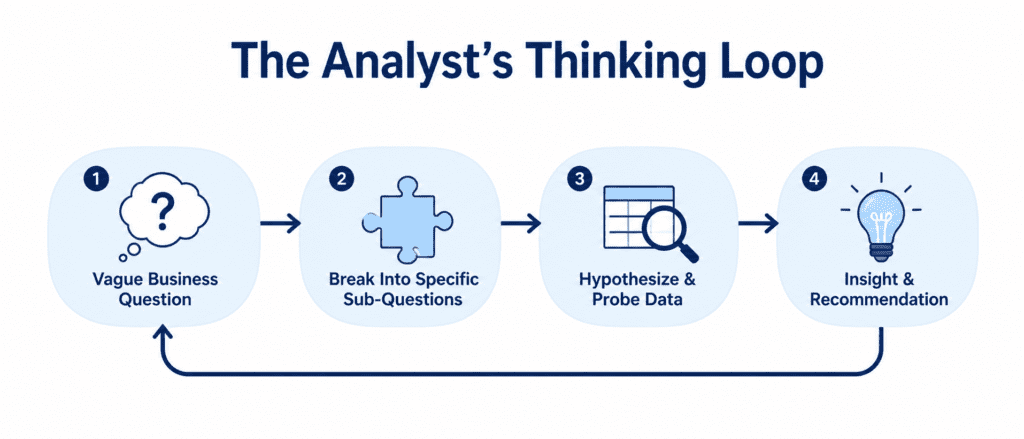
Here’s a simple mental funnel you can use every time:
- Narrow where? Which product line, region, or customer segment?
- Define the metric. Total revenue? Revenue per customer? Repeat purchase rate?
- Add a timeframe. Compared to when? Last quarter? Same month last year?
- Surface the lever. Is the goal to get more customers, raise prices, or increase order size?
Once you’ve broken it down, even a tiny piece of data exploration becomes laser‑focused. Suppose the team suspects North region’s revenue is weak. A focused glance at the data can take just one line of code:
# Quick check: average revenue per order by region
print(df.groupby('region')['revenue'].mean())
That’s it. No dashboard. No complex model. Just a direct answer to a specific, well‑defined sub‑question.
Building Your Data Intuition #
You can’t think like an analyst without spending time with real data. But you don’t need a fancy job to do it. Every time you see a dataset, play a game:
- Guess what a column’s relationship might be before you plot it.
- Notice an outlier and ask yourself: is this a mistake or a discovery?
- Ask “what would I do with this information if it were my business?”
This playful experimentation rewires your brain. Over time, you’ll develop a sense of what a “normal” monthly sales curve looks like, so that the one weird spike on a Tuesday jumps out at you like a sore thumb.
From Thinking to Doing: A Real‑World Loop #
Practice Challenges #
These are small thinking exercises — no heavy coding, just mindset shifts.
- Vague Request Makeover: A manager asks, “Can you look into our customer satisfaction?” Write down three specific, measurable sub‑questions you would answer instead. (Example: “Has our average support ticket rating changed in the last 3 months?”)
- Spot the Flaw: You see a dashboard showing that email open rates are higher on weekends. Before presenting this as a finding, list two possible non‑obvious reasons (like more promotional emails during the week, or a different audience segment) that could explain the pattern. Write a short sentence on how you’d quickly check one of them.
- Mini Exploration: Take any small public dataset (like
sns.load_dataset('tips')in Python) and write down three questions you’d want the data to answer. Then, using onlygroupby()andmean(), answer one of them. The goal is to practice question‑first thinking, not complex code.