
Evaluation Metrics for Regression #
Help you measure how accurate your machine learning model really is. You trained a model, and it gives predictions—but how good are they? Are they close to reality, far off, or sometimes wrong in a useful way? These numbers separate good models from bad ones.
The Setup #
Imagine you are predicting house prices.
| Actual Price | Your Prediction | Error (Actual – Prediction) |
|---|---|---|
| $500,000 | $480,000 | $20,000 (off by 4%) |
| $300,000 | $310,000 | -$10,000 (off by 3.3%) |
| $1,000,000 | $900,000 | $100,000 (off by 10%) |
How do you measure overall performance? One number that summarizes all errors.

The Four Main Metrics #
| Metric | What It Measures | Unit | Sensitive to Outliers? |
|---|---|---|---|
| MAE | Average absolute error | Same as target | No |
| MSE | Average squared error | Squared of target | Yes |
| RMSE | Square root of MSE | Same as target | Yes |
| R² | Proportion of variance explained | 0 to 1 (or negative) | No |
| MAPE | Average percentage error | Percentage | No |
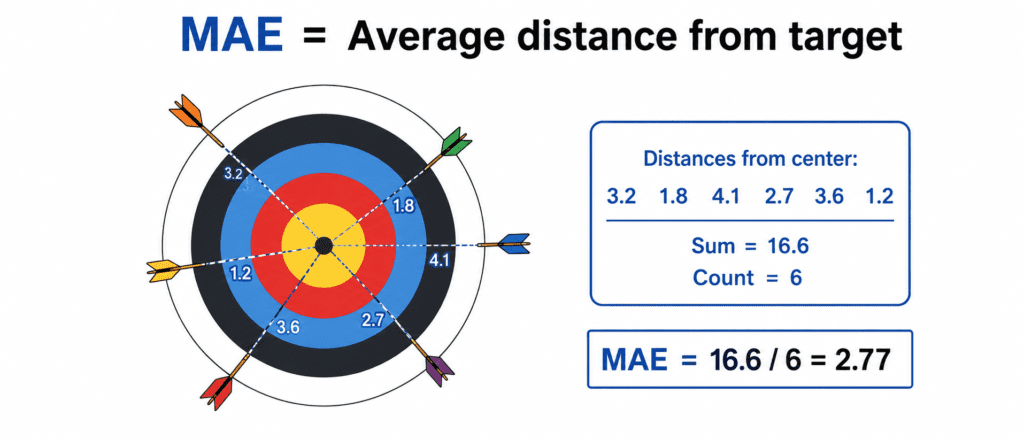
1. MAE (Mean Absolute Error) #
What it is: Average of absolute differences between actual and predicted.
The Formula:
MAE = (1/n) × Σ |actual - prediction|
Example:
| Actual | Prediction | Absolute Error |
|---|---|---|
| 500k | 480k | 20k |
| 300k | 310k | 10k |
| 1000k | 900k | 100k |
MAE = (20 + 10 + 100) / 3 = 43.3k
Interpretation: “On average, my predictions are off by $43,300.”
Pros:
- Easy to understand
- Not sensitive to outliers (a 1Merrorcountsthesameas10x100k errors)
Cons:
- Less mathematically convenient for optimization
When to use: When outliers are expected. When you want intuitive explanation.
2. MSE (Mean Squared Error) #
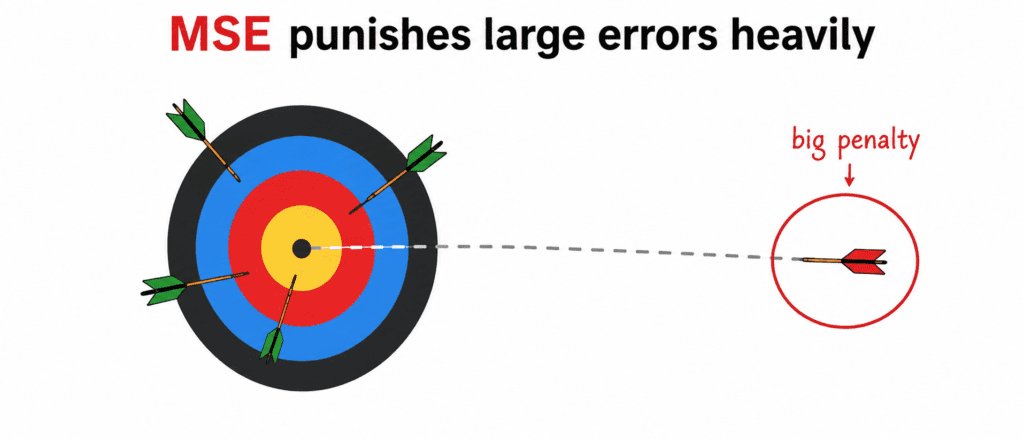
What it is: Average of squared differences between actual and predicted.
The Formula:
MSE = (1/n) × Σ (actual - prediction)²
Example:
| Actual | Prediction | Error | Squared Error |
|---|---|---|---|
| 500k | 480k | 20k | 400M |
| 300k | 310k | -10k | 100M |
| 1000k | 900k | 100k | 10,000M |
MSE = (400M + 100M + 10,000M) / 3 = 3,500M
Interpretation: Hard to interpret because units are squared ($²). Not intuitive.
Pros:
- Mathematically convenient (differentiable)
- Heavily penalizes large errors (good for some problems)
Cons:
- Units not interpretable
- Very sensitive to outliers
When to use: When large errors are unacceptable. When you need mathematical convenience for optimization.
3. RMSE (Root Mean Squared Error) #
What it is: Square root of MSE. Brings units back to original.
The Formula:
RMSE = √MSE
Example:
MSE = 3,500M
RMSE = √3,500M = 59.1k
Interpretation: “On average, my predictions are off by about $59,100.”
Pros:
- Same units as target (interpretable)
- Still penalizes large errors
Cons:
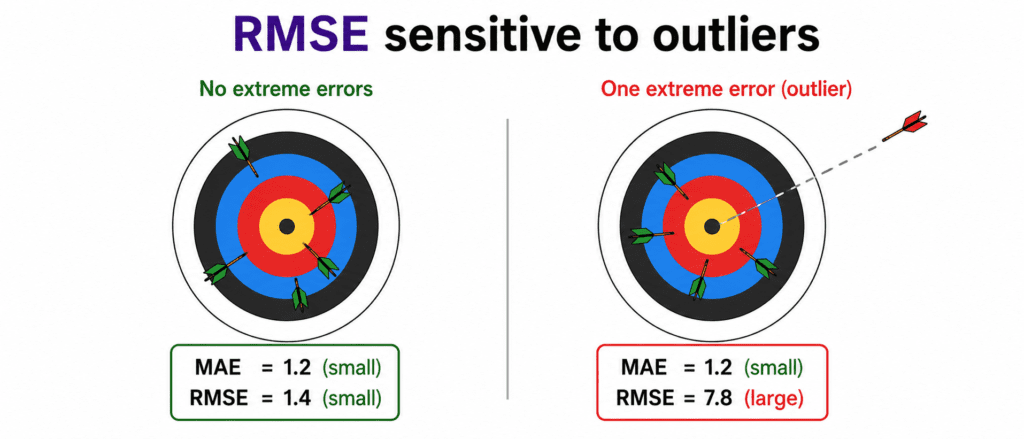
- Still sensitive to outliers
When to use: Most common default for regression. Balance of interpretability and sensitivity.
MAE vs RMSE:
| If Errors Are | MAE and RMSE are |
|---|---|
| All small and similar | Close to each other |
| Mostly small but some huge | RMSE > MAE (sometimes much larger) |
4. R² (R-Squared / Coefficient of Determination) #
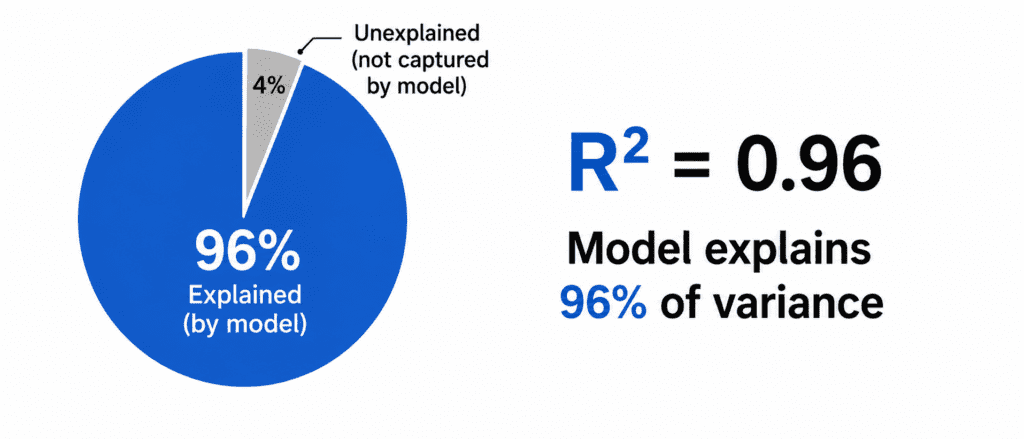
What it is: How much better your model is than simply predicting the mean.
The Formula:
R² = 1 - (Σ(actual - prediction)² / Σ(actual - mean)²)
Interpretation:
- R² = 1 → Perfect predictions (error = 0)
- R² = 0 → Model performs like always predicting average
- R² < 0 → Model performs WORSE than predicting average
Example:
| Actual | Mean (500k) | Your Prediction |
|---|---|---|
| 500k | 500k | 480k |
| 300k | 500k | 310k |
| 1000k | 500k | 900k |
Your errors: (20² + 10² + 100²) = 10,500
Mean baseline errors: (0² + 200² + 500²) = 290,000
R² = 1 – (10,500 / 290,000) = 0.96
Interpretation: “Your model explains 96% of the variance in house prices.”
Pros:
- Scale-free (always between 0 and 1 for good models)
- Easy to compare across different problems
Cons:
- Can be negative (confusing for beginners)
- Adding useless features always increases R²
When to use: Comparing models across different datasets. Explaining model quality to non-technical people.
5. MAPE (Mean Absolute Percentage Error) #
What it is: Average percentage error.
The Formula:
text
MAPE = (1/n) × Σ |(actual - prediction) / actual| × 100%
Example:
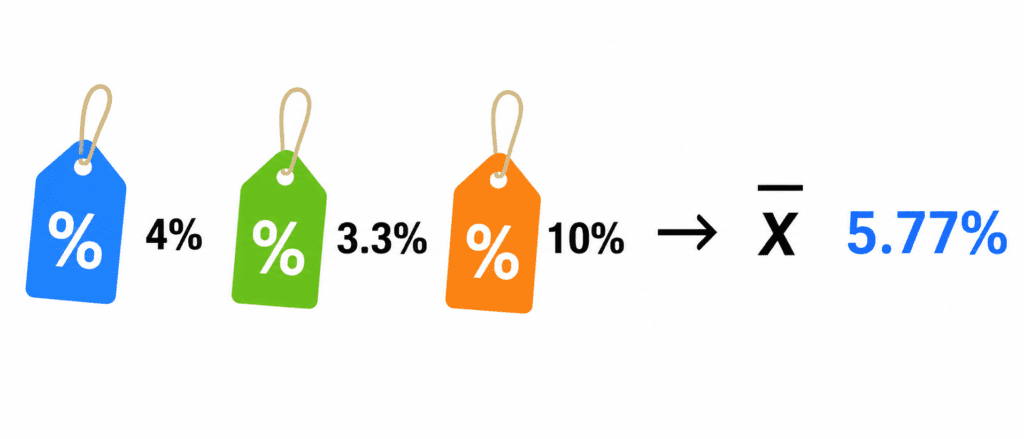
| Actual | Prediction | Percentage Error |
|---|---|---|
| 500k | 480k | 4% |
| 300k | 310k | 3.3% |
| 1000k | 900k | 10% |
MAPE = (4 + 3.3 + 10) / 3 = 5.77%
Interpretation: “On average, my predictions are off by 5.77%.”
Pros:
- Easy to explain (“off by about X%”)
- Scale-independent
Cons:
- Cannot use when actual values are zero or near zero
- Can be misleading if values are very small
When to use: When errors scale with value size. When explaining to business people.
Complete Code Example
import numpy as np
from sklearn.metrics import mean_absolute_error, mean_squared_error, r2_score

# Actual and predicted values
y_true = [500000, 300000, 1000000]
y_pred = [480000, 310000, 900000]

# Calculate metrics
mae = mean_absolute_error(y_true, y_pred)
mse = mean_squared_error(y_true, y_pred)
rmse = np.sqrt(mse)
r2 = r2_score(y_true, y_pred)

# Manual MAPE
mape = np.mean(np.abs((np.array(y_true) - np.array(y_pred)) / np.array(y_true))) * 100

print(f"MAE:  ${mae:,.0f}")
print(f"MSE:  ${mse:,.0f}²")
print(f"RMSE: ${rmse:,.0f}")
print(f"R²:   {r2:.3f}")
print(f"MAPE: {mape:.1f}%")
Output:
MAE:  $43,333
MSE:  $3,500,000,000²
RMSE: $59,161
R²:   0.964
MAPE: 5.8%
Important Note: Train vs Test #
Always evaluate on test set, not training set.
| If you evaluate on | You learn |
|---|---|
| Training set | How well model memorized (useless) |
| Test set | How well model generalizes (real performance) |
Rule: Never look at test metrics until the very end.
Quick Quiz #
Q1: Your RMSE is 50,000.YourMAEis30,000. What does this tell you?
A1: There are some large errors. RMSE > MAE indicates outliers (squared errors dominate).
Q2: Your R² is -0.5. What does this mean?
A2: Your model is worse than simply predicting the average. Something is very wrong.
Q3: You are predicting stock prices. A 10% error is fine. A 100% error is terrible. Which metric?
A3: RMSE or MSE. They penalize large errors more heavily.
Q4: Your actual values include zeros. Can you use MAPE?
A4: No. MAPE divides by actual value. Division by zero is impossible.
Key Takeaways (5 Lines) #
- MAE = Average absolute error. Easy to understand. Not sensitive to outliers.
- RMSE = Default choice. Same units as target. Penalizes large errors.
- R² = How much better than predicting average. 0 to 1 scale (usually).
- MAPE = Average percentage error. Great for business explanations.
- Always evaluate on test set. Never on training set.