
Evaluation Metrics for Classification #
Help you understand how good a classification model really is. You built a cancer detection model, and it says 99% accurate—sounds great. But what if only 1% of patients actually have cancer? Your model could predict “no cancer” for everyone and still be 99% accurate. Accuracy can lie. You need better metrics.
The Confusion Matrix (The Foundation) #
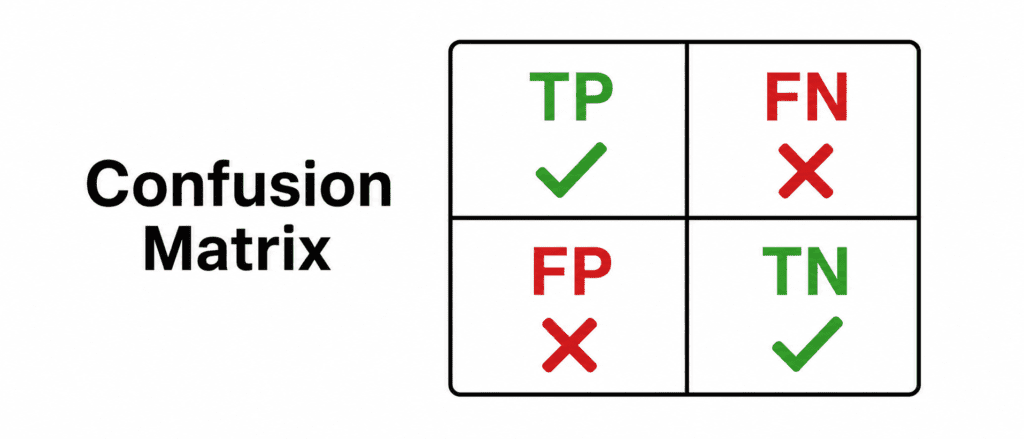
Before metrics, understand this 2×2 table.
| Predicted: YES | Predicted: NO | |
|---|---|---|
| Actual: YES | True Positive (TP) ✅ | False Negative (FN) ❌ |
| Actual: NO | False Positive (FP) ❌ | True Negative (TN) ✅ |
Simple meanings:
| Term | Meaning | Example (Cancer Detection) |
|---|---|---|
| True Positive | Correctly predicted YES | Correctly said “has cancer” |
| True Negative | Correctly predicted NO | Correctly said “no cancer” |
| False Positive | Wrongly predicted YES (Type I error) | Said “has cancer” but healthy |
| False Negative | Wrongly predicted NO (Type II error) | Said “no cancer” but has it |
The Four Main Metrics #
| Metric | What It Measures | Formula | Best For |
|---|---|---|---|
| Accuracy | Overall correctness | (TP+TN)/(Total) | Balanced classes |
| Precision | Trust positive predictions | TP/(TP+FP) | When false positives are costly |
| Recall | Catch all positives | TP/(TP+FN) | When false negatives are costly |
| F1 Score | Balance of precision and recall | 2×(P×R)/(P+R) | Imbalanced classes |
1. Accuracy (The Liar) #
What it is: Proportion of correct predictions (both YES and NO).
The Formula:
Accuracy = (TP + TN) / (TP + TN + FP + FN)
Example (Cancer Detection):
- 990 healthy, 10 sick
- Model predicts “healthy” for everyone
| Predicted Healthy | Predicted Sick | |
|---|---|---|
| Actually Healthy | 990 (TN) | 0 (FP) |
| Actually Sick | 10 (FN) | 0 (TP) |
Accuracy = (990 + 0) / 1000 = 99%
Problem: Model caught ZERO sick patients. But accuracy looks amazing.
When to use Accuracy:
- Classes are balanced (50% Yes, 50% No)
- False positives and false negatives have same cost
When NOT to use Accuracy:
- Imbalanced classes (fraud, disease, rare events)
- Different costs for different errors

2. Precision (When You Say YES, Are You Right?) #
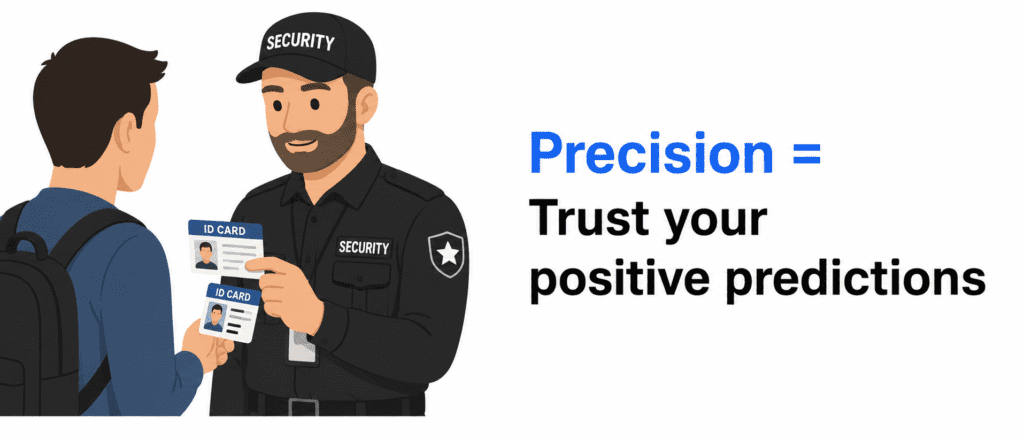
What it is: Of all the times you predicted YES, how many were actually YES?
The Formula:
Precision = TP / (TP + FP)
The Question: “When my model says something is positive, can I trust it?”
Example (Cancer Detection):
Model makes 100 positive predictions. 90 are correct. 10 are wrong.
Precision = 90 / 100 = 90%
Interpretation: “When my model says you have cancer, it is correct 90% of the time.”
When to care about Precision:
| Scenario | Why Precision Matters |
|---|---|
| Spam detection | Marking good email as spam angers users |
| Recommended videos | Showing bad recommendations loses trust |
| Hiring tool | Rejecting good candidates hurts company |
| Fraud alert | False alarms annoy customers |
High Precision = Few false positives.
3. Recall (Did You Catch All the YES?) #
What it is: Of all the actual YES cases, how many did you catch?
The Formula:
Recall = TP / (TP + FN)
The Question: “Did my model miss any real positives?”
Example (Cancer Detection):
There are 100 sick patients. Model catches 80. Misses 20.
Recall = 80 / 100 = 80%
Interpretation: “My model catches 80% of all cancer cases.”
When to care about Recall:
| Scenario | Why Recall Matters |
|---|---|
| Cancer detection | Missing cancer kills people |
| Airport security | Missing a weapon is disaster |
| Fraud detection | Missing fraud loses money |
| Self-driving car | Missing a pedestrian causes accident |
High Recall = Few false negatives.

4. F1 Score (The Balance Keeper) #
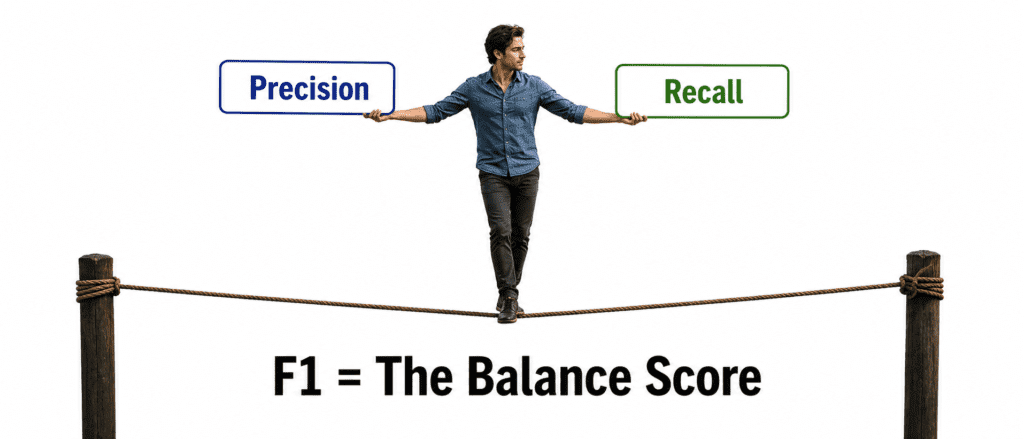
What it is: Harmonic mean of precision and recall. Balances both.
The Formula:
F1 = 2 × (Precision × Recall) / (Precision + Recall)
Why Harmonic Mean? Regular average lies. Harmonic mean punishes extreme differences.
Example:
| Model A | Precision | Recall | Regular Average | F1 Score |
|---|---|---|---|---|
| High Precision, Low Recall | 99% | 50% | 74.5% | 66% |
| Balanced | 80% | 80% | 80% | 80% |
Regular average says 74.5% for the unbalanced model. That is misleading. F1 correctly shows it is worse (66%).
Interpretation: “My model balances catching positives and being correct when it does.”
When to use F1 Score:
- Imbalanced datasets (always use F1, not accuracy)
- When you care about both precision and recall
- When you need one number to compare models
The Precision-Recall Trade-off #
You cannot have both high precision and high recall. Choose based on your problem.
| If You Increase | Precision Does | Recall Does |
|---|---|---|
| Threshold for positive | ↑ Increases | ↓ Decreases |
| Model complexity | ↓ Decreases | ↑ Increases |
Real Example: Cancer Detection
| Strategy | Precision | Recall | Result |
|---|---|---|---|
| Aggressive (call many sick) | Low (50%) | High (95%) | Many false alarms, but catch most cancer |
| Conservative (only sure cases) | High (99%) | Low (60%) | Few false alarms, but miss many cancer |
Which is better? Depends on cost.
- Missing cancer (low recall) = patient dies → High recall needed
- False alarm (low precision) = patient stressed but alive → Lower priority
The Trade-off Summary Table #
| Metric | What It Rewards | What It Ignores |
|---|---|---|
| Accuracy | Getting both right | Class imbalance |
| Precision | Being right when you say YES | Missing actual YES cases |
| Recall | Catching all YES cases | Being wrong sometimes |
| F1 | Balance of both | Neither extreme |
from sklearn.metrics import accuracy_score, precision_score, recall_score, f1_score, confusion_matrix

# Actual and predicted
y_true = [0, 0, 0, 0, 0, 0, 0, 0, 0, 0,  # 10 not spam (0)
          1, 1, 1, 1, 1, 1, 1, 1, 1, 1]   # 10 spam (1)

y_pred = [0, 0, 0, 0, 0, 0, 0, 0, 0, 0,  # 10 correct not spam
          1, 1, 1, 1, 1, 1, 0, 0, 0, 0]   # 6 correct spam, 4 missed

# Calculate metrics
accuracy = accuracy_score(y_true, y_pred)
precision = precision_score(y_true, y_pred)
recall = recall_score(y_true, y_pred)
f1 = f1_score(y_true, y_pred)
cm = confusion_matrix(y_true, y_pred)

print(f"Accuracy:  {accuracy:.2f}")
print(f"Precision: {precision:.2f}")
print(f"Recall:    {recall:.2f}")
print(f"F1 Score:  {f1:.2f}")
print(f"\nConfusion Matrix:")
print(f"TN: {cm[0,0]}, FP: {cm[0,1]}")
print(f"FN: {cm[1,0]}, TP: {cm[1,1]}")
Output:
Accuracy:  0.80
Precision: 1.00
Recall:    0.60
F1 Score:  0.75

Confusion Matrix:
TN: 10, FP: 0
FN: 4,  TP: 6
Quick Quiz #
Q1: Your model has 99% accuracy but 1% recall. What is happening?
A1: Severe class imbalance. Model predicts majority class only. Catches almost no positives.
Q2: You are building a fraud detection system. False alarms annoy customers. Missing fraud loses money. Which is more costly?
A2: Depends on business. Usually missing fraud (low recall) costs more. But both matter. Use F1.
Q3: Your precision is 50%, recall is 100%. What does this mean?
A3: You catch every positive (recall=100%). But half your positive predictions are wrong (precision=50%). You are over-predicting.
Q4: Precision = 90%, Recall = 90%. What is F1?
A4: F1 = 90% (same as both). When precision = recall, F1 equals that value.
Q5: Why not use accuracy for cancer detection?
A5: Cancer is rare (imbalanced). A model predicting “no cancer” for everyone gets high accuracy but kills patients.