You Already Use Artificial Intelligence Dozens of Times Every Day — You Just Don’t Notice
When your phone unlocks by recognizing your face, that’s AI. When Netflix suggests a show you end up watching for three hours, that’s AI. When you type a message and your keyboard predicts the next word, that’s AI. When Spotify builds a playlist that somehow knows exactly what you want to hear — AI again.
Artificial Intelligence is not a technology of the future. It is woven into the fabric of ordinary daily life right now, in 2026, more deeply than most people realize. And yet, for something so present and so consequential, it remains genuinely misunderstood by most people who use it every day.
Ask someone what AI is and you’ll get answers ranging from “robots that think” to “ChatGPT” to “the thing that’s going to take everyone’s jobs.” All of these capture something, and none of them are quite right.
This guide is the explanation I wish existed when I first started trying to understand AI — clear, honest, no jargon walls, no hype in either direction. By the end of it, you’ll know exactly what artificial intelligence is, how it actually works, the different types and what they’re each good for, where AI is already operating in your life, and where the technology is genuinely heading. You don’t need a computer science degree. You just need about 20 minutes.

So What Is Artificial Intelligence, Actually?
Let’s start with a definition that actually holds up.
Artificial Intelligence is the field of computer science focused on building systems that can perform tasks which, when done by humans, require intelligence.
That definition is deliberately broad — and it has to be, because AI is not one thing. It’s a family of technologies, approaches, and techniques all aimed at the same general goal: making computers capable of doing things that used to require human brains.
Notice what the definition does not say. It doesn’t say AI “thinks.” It doesn’t say AI “understands.” It doesn’t say AI is “conscious” or “alive.” These are loaded words that carry implications the technology doesn’t necessarily have. What AI does is perform tasks — and increasingly, it performs them remarkably well.
Here’s an analogy that I find genuinely useful:
Think of a very skilled parrot. A parrot can learn to say “good morning” when you walk into a room, respond to specific questions with trained phrases, and produce outputs that look, on the surface, like communication. But the parrot is not understanding language — it is pattern-matching sounds to responses it has been rewarded for producing.
AI is dramatically more sophisticated than a parrot. But the underlying principle — learning patterns from data and applying them to produce useful outputs — is not entirely different. What makes AI remarkable is not that it has invented a new kind of intelligence. It is that it does this pattern recognition at a scale, speed, and accuracy that genuinely produces useful, impressive, and sometimes surprising results.
KEY FACT: The term “Artificial Intelligence” was coined in 1956 by John McCarthy at the Dartmouth Conference — a summer workshop where a group of mathematicians and early computer scientists first formally proposed that “every aspect of learning or any other feature of intelligence can in principle be so precisely described that a machine can be made to simulate it.” Nearly 70 years later, that project is still ongoing — and in the last decade, it has accelerated dramatically.
The Three Big Types of AI You Need to Know
One of the most useful things to understand about AI is that it is not one uniform technology. There are meaningfully different types, and knowing the difference helps make sense of news, predictions, and the products you actually use.
Type 1: Narrow AI (What Exists Today)
Every AI system you have ever used or heard of — with no exceptions as of 2026 — is narrow AI. Also called weak AI (though the name is misleading — “narrow” is more accurate).
Narrow AI is an AI system that is extraordinarily good at one specific task, or a defined set of related tasks, and completely useless outside of that domain.
The chess-playing AI that beat world champions cannot play checkers. The AI that detects tumors in medical scans cannot answer a customer service email. The AI that recommends your next Netflix show cannot drive a car. Each of these systems is genuinely impressive within its domain and genuinely helpless outside it.
ChatGPT, Claude, and similar large language models feel like exceptions to this because they handle such a wide range of conversational tasks — writing, answering questions, coding, translation, analysis. But they are still narrow AI: they are specifically trained on language tasks and break down outside their training domain in ways that narrow the definition of “narrow” significantly.
Type 2: Artificial General Intelligence (Does Not Exist Yet)
Artificial General Intelligence (AGI) is an AI that can perform any intellectual task a human can — not just a defined set of tasks, but any task. Learning something new from minimal examples. Applying knowledge from one domain to solve problems in a completely different domain. Adapting to genuinely novel situations.
Humans do this naturally. You can learn to cook from a recipe, then use the same kind of spatial reasoning to rewire a lamp, then apply similar pattern recognition to learn a new card game. You transfer learning across domains constantly.
Current AI systems cannot do this. AGI does not yet exist. Whether and when it will exist is one of the most active and contested debates in all of science.
READ MORE: AGI Timeline: When Will Artificial General Intelligence Actually Get Here?!
Type 3: Superintelligence (Theoretical)
Artificial Superintelligence would be AI that surpasses human cognitive capability across all domains — not just matching humans, but exceeding the best human minds in every area simultaneously.
This is currently theoretical. It is taken seriously by many researchers not because it exists but because it is a plausible consequence of achieving AGI — if an AI can match human intelligence, it could potentially improve its own design, creating increasingly capable systems. Understanding this possibility matters for how we develop AI safely.
| Type | Capability | Exists Now? | Example |
|---|---|---|---|
| Narrow AI | One domain, very well | ✅ Yes | ChatGPT, facial recognition, AlphaFold |
| Artificial General Intelligence | Any domain humans can handle | ❌ Not yet | Theoretical |
| Superintelligence | Surpasses humans in all domains | ❌ Not yet | Theoretical |
How Does AI Actually Learn? The Simple Version
The most common question about AI — and the one with the most satisfying honest answer — is: how does it actually work?
The short version: AI learns by finding patterns in enormous amounts of data. The longer version is worth understanding because it changes how you think about what AI can and cannot do.
Machine Learning: Teaching by Example
Machine learning is the approach that powers most modern AI. Instead of writing explicit rules — “if the email contains the word ‘lottery,’ mark it as spam” — you show the AI thousands of examples labeled with the correct answer, and it figures out the rules itself.
Here’s a concrete example. Imagine you want to build an AI that can identify whether a photo contains a cat.
The old approach: write rules. “If there are triangular ear shapes, pointed pupils, and whisker lines…” The problem is that rules written by humans miss edge cases, require updating constantly, and struggle with the enormous variety of real-world images.
The machine learning approach: show the AI 10 million photos, half labeled “cat” and half labeled “not cat.” The AI analyzes all the images, finds patterns that consistently appear in the “cat” examples and not in the “not cat” examples, and builds an internal mathematical representation of what makes something a cat. Then it applies that representation to new images it has never seen before.
This approach works remarkably well. And it reveals something important about AI: it doesn’t think about what a cat is. It compresses statistical patterns from training data into mathematical weights and applies those weights to new inputs. That’s powerful. It’s also limited in ways that become important when you push the system.
PRO TIP: Understanding that AI learns from patterns in training data immediately explains many of its failure modes. If the training data is biased — for example, if a facial recognition system is trained mostly on light-skinned faces — the AI will perform worse on darker-skinned faces. Not because of malice. Because of the pattern in the data. This is why data quality and diversity in AI training is one of the most important topics in the field.
Deep Learning: Layers of Pattern Recognition
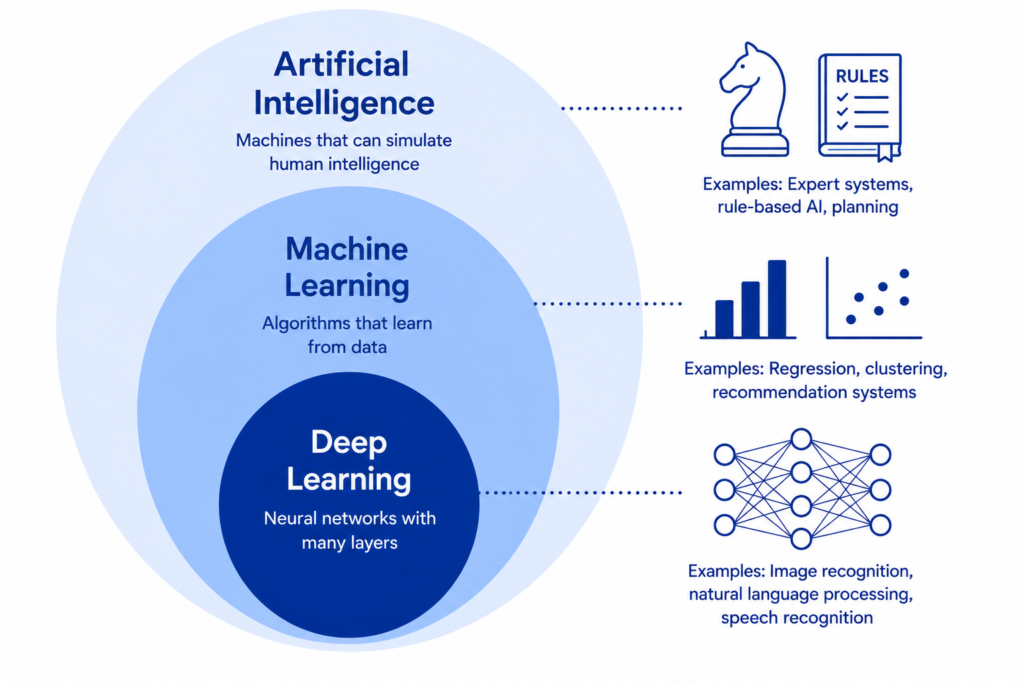
Deep learning is a specific type of machine learning that uses structures called neural networks — loosely inspired by how neurons in the brain connect and fire. The “deep” in deep learning refers to the many layers of these networks, each layer learning increasingly abstract patterns from the data.
In an image recognition neural network:
- Early layers learn simple patterns — edges, corners, gradients
- Middle layers combine these into shapes — curves, textures, geometric forms
- Later layers combine shapes into meaningful features — eyes, ears, fur
- Final layers use all these features to classify the image — “cat” or “not cat”
This layered pattern recognition is what allows deep learning to handle the extraordinary complexity of natural language, images, and sound — inputs that are far too complex and variable for hand-written rules to handle.
# A simple neural network for text classification
# This shows the STRUCTURE of how deep learning works
# Written for a beginner — every line explained

import torch
import torch.nn as nn

class SimpleTextClassifier(nn.Module):
    """
    A tiny neural network that classifies text as positive or negative.
    Real AI models have billions of parameters — this one has thousands.
    But the principle is the same.
    """

    def __init__(self, vocab_size, embed_dim=64, hidden_dim=128):
        super().__init__()

        # Layer 1: Embedding — converts each word to a number vector
        # The AI learns which words are similar by adjusting these numbers
        self.embedding = nn.Embedding(vocab_size, embed_dim)

        # Layer 2: Hidden layer — finds patterns BETWEEN word meanings
        # "I loved it" vs "I hated it" — the pattern is the relationship
        # between the sentiment word and its context
        self.hidden = nn.Linear(embed_dim, hidden_dim)

        # Activation function: adds non-linearity so the network
        # can learn complex patterns, not just straight-line relationships
        self.relu = nn.ReLU()

        # Layer 3: Output — collapses all patterns to a single prediction
        # Output: one number (positive) or another (negative)
        self.output = nn.Linear(hidden_dim, 2)

    def forward(self, word_indices):
        """
        This runs every time the network makes a prediction.
        Data flows FORWARD through the layers — hence 'forward pass'
        """
        # Step 1: Convert word indices to meaning vectors
        word_vectors = self.embedding(word_indices)

        # Average all word vectors to get a sentence-level representation
        sentence_vector = word_vectors.mean(dim=0)

        # Step 2: Find patterns in the sentence meaning
        hidden_output = self.relu(self.hidden(sentence_vector))

        # Step 3: Make the final prediction
        prediction = self.output(hidden_output)

        # Higher score at index 0 = negative sentiment
        # Higher score at index 1 = positive sentiment
        return prediction

# Training happens separately — the network adjusts its internal numbers
# (called 'weights') thousands of times based on feedback:
# "You said positive but it was actually negative — adjust accordingly"
# This process is called backpropagation, and it's how AI 'learns'
This code illustrates something important: AI learning is not magic. It is mathematics — specifically, the repeated adjustment of numbers based on feedback from examples. There is no understanding in the human sense. There is increasingly accurate pattern matching based on increasingly refined numerical weights.
The Branches of AI: A Map of the Field
AI is not a single subject. It’s more like a university department with many distinct research areas, each tackling a different aspect of the challenge. Here’s a practical map:
| Branch | What It Does | Real-World Example |
|---|---|---|
| Machine Learning | Learns patterns from data | Spam filters, recommendation systems |
| Deep Learning | Multi-layer neural pattern recognition | Image recognition, speech AI |
| Natural Language Processing (NLP) | Understands and generates human language | ChatGPT, translation apps, voice assistants |
| Computer Vision | Interprets images and video | Facial recognition, medical imaging AI |
| Robotics AI | Controls physical machines intelligently | Warehouse robots, surgical assistants |
| Reinforcement Learning | Learns through trial, error, and rewards | AlphaGo, game-playing AI, industrial optimization |
| Generative AI | Creates new content — text, images, audio | DALL-E, Midjourney, Suno, Claude |
| Expert Systems | Encodes domain expertise in rules | Medical diagnosis support, tax software |
AI in Your Daily Life: The Examples You Actually Use
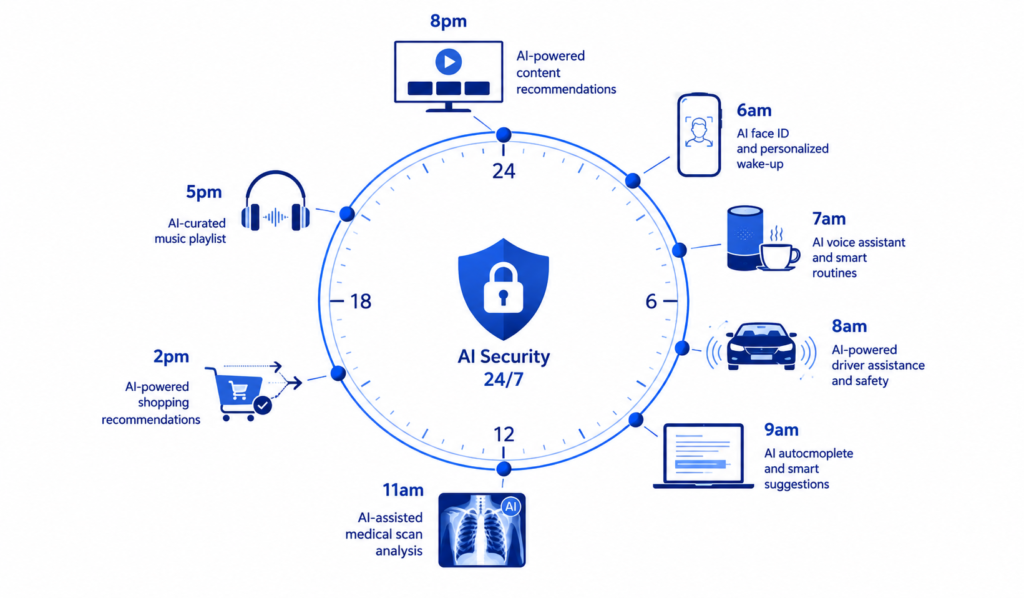
This is where the abstract becomes concrete. Let’s walk through a typical day and map every AI touchpoint — because most people dramatically underestimate how much AI they already interact with.
Morning:
- Your phone screen unlocks with facial recognition — computer vision AI trained on your face
- Your email app has sorted overnight messages, moved newsletters to promotions, and flagged a suspicious login attempt from a new device — behavioral AI
- Google Maps gives you a departure time that accounts for predicted traffic based on historical patterns and current conditions — predictive ML
During Work:
- Your autocomplete and grammar suggestions in Google Docs or Microsoft Word — language model AI
- Your video call automatically blurs the background and enhances your voice — computer vision + audio AI
- LinkedIn shows you job postings based on your profile, connections, and browsing behavior — recommendation AI
Shopping and Entertainment:
- Amazon predicts what you might want to buy next with startling accuracy — collaborative filtering AI
- Spotify’s Discover Weekly knows your music taste better than most friends — deep learning on listening patterns
- Netflix’s thumbnails change based on what images its AI predicts will make you more likely to click — personalization AI
Health and Safety:
- Your bank’s fraud detection system flagged and paused a suspicious transaction before you noticed — anomaly detection AI
- The hospital’s radiology department uses AI to review CT scans before the radiologist’s human review — medical imaging AI
- Your car’s automatic emergency braking system — real-time computer vision + decision AI
KEY FACT: According to McKinsey’s 2025 AI Report, the average person in a developed country interacts with an AI system more than 200 times per day — the vast majority of interactions being invisible background processes like content ranking, fraud detection, and traffic optimization rather than visible chatbot conversations.
The Big AI Moment: Why Everything Changed Around 2022
If you’ve noticed AI becoming a much bigger topic of conversation in the last three to four years, you’re right — something genuinely significant happened.
For most of AI’s history, progress was steady but narrow. Systems got better at specific tasks, but nothing captured general public attention because the improvements were incremental and domain-specific.
Then two things converged.
Large Language Models reached a threshold. The release of ChatGPT in November 2022 was not a technological leap so much as a usability leap — a point where language AI became good enough, general enough, and accessible enough for ordinary people without technical backgrounds to use and find genuinely valuable. Millions of people tried it in the first week. For many of them, it was the first time AI felt personal rather than abstract.
Generative AI exploded. In the same period, AI systems capable of generating images (Midjourney, DALL-E, Stable Diffusion), audio, video, and code became mainstream. These were not improvements to existing applications — they were entirely new categories of capability that had not previously existed for public use.
The reason these breakthroughs happened when they did comes down to three factors converging simultaneously:
- Scale: AI models became dramatically larger — from millions of parameters to hundreds of billions — and performance improved in ways that surprised even the researchers building them
- Data: The internet provided an unprecedented corpus of human-generated text, images, and code to train on
- Compute: Specialized AI chips (particularly NVIDIA’s GPUs) became fast enough and plentiful enough to train and run models of this scale
PRO TIP: Understanding why 2022 was a turning point helps you evaluate future AI news more accurately. The improvements that drove the 2022 moment were largely about scale and data — doing the same things much, much bigger. The next major threshold will likely require new architectural approaches or new training methods, not just more of the same. When you see AI news, asking “is this a scale improvement or a fundamental capability breakthrough?” helps separate genuine advances from incremental progress.
What AI Is Good At — And What It Genuinely Cannot Do
One of the most useful mental models for thinking about AI is understanding where it genuinely excels and where it genuinely struggles. Both sides of this are frequently misunderstood.
AI is genuinely excellent at:
- Processing and finding patterns in enormous amounts of data faster than any human
- Performing consistent, repetitive tasks without fatigue or errors from distraction
- Recognizing patterns in images, audio, and text that are too subtle for human perception
- Generating large volumes of content — text, images, code — that meets specified parameters
- Optimizing complex systems with many interdependent variables
- Making predictions based on historical data in domains where patterns are consistent
AI genuinely struggles with:
- Common sense reasoning — understanding things that humans know implicitly from living in a physical, social world. An AI can tell you the boiling point of water but might fail a simple question about what happens if you put a book in a bathtub if the question is phrased in an unusual way
- True novelty — performing well in situations completely outside its training distribution
- Causal reasoning — understanding why things happen, not just that they correlate in the data
- Physical world intuition — grasping how objects and spaces behave in ways that humans learn in early childhood
- Genuine creativity — AI can generate variations of existing patterns brilliantly but struggles with the kind of conceptual leaps that characterize human creative breakthroughs
- Knowing what it doesn’t know — AI systems often produce wrong answers with the same confidence as correct ones, a phenomenon called hallucination
WARNING: The most important thing to understand about AI limitations is not any specific failure — it’s the pattern of failures. AI systems are brittle in specific, often unpredictable ways. They can perform at expert level on a standard version of a problem and fail completely on a slight variation. This makes them powerful tools but unreliable autonomous agents for high-stakes decisions. Always keep a human in the loop for consequential choices.
AI and Jobs: The Honest Answer to the Question Everyone Is Asking
No beginner’s guide to AI in 2026 would be complete without addressing the question that makes many people anxious: what does AI mean for employment?
The honest answer requires separating two different things that often get conflated: automation of tasks and elimination of jobs.
Every previous major technology wave — the industrial revolution, electrification, computerization — automated large numbers of tasks that humans previously performed. Textile workers, elevator operators, bookkeepers, telephone switchboard operators. Some of these job categories disappeared. Many more new categories appeared that hadn’t previously existed.
AI follows this historical pattern, but with two important differences:
First, AI is automating cognitive tasks, not just physical or repetitive ones. Previous automation waves largely replaced manual labor. AI can replace substantial portions of knowledge work — writing, analysis, coding, customer service, legal research, medical imaging review. This expands the scope of automation significantly.
Second, the pace is faster. Previous transitions played out over decades, giving labor markets, educational systems, and individual careers time to adapt. AI’s transition is happening in years.
What this means practically:
- Jobs most at risk: Roles that consist primarily of routine information processing — data entry, basic customer service, standard document review, repetitive coding tasks
- Jobs most resilient: Roles requiring genuine human judgment, physical dexterity in uncontrolled environments, emotional intelligence, creativity, and real-world relationship management
- Jobs being created: AI development, AI oversight and auditing, AI training, prompt engineering, and entirely new categories that don’t yet exist
READ MORE: Top 10 AI Tools Every Beginner Must Know in 2026
The Ethical Questions Nobody Can Ignore
Understanding AI in 2026 requires understanding that it raises questions that are not purely technical. Some of the most important debates about AI are philosophical, ethical, and political.
Bias and fairness. AI systems trained on historical data inherit the biases in that data. A hiring AI trained on historical hiring decisions will replicate historical patterns of discrimination. A facial recognition system trained on unrepresentative data will perform unequally across different groups. These are not hypothetical concerns — they have been documented repeatedly in deployed systems.
Privacy. AI systems that power recommendation engines, targeted advertising, and personalization require data about individuals at a scale and granularity that was previously impossible to collect and process. What you watch, when you watch it, how long you pause, what you search after — all of it feeds AI systems whose outputs affect your life.
Transparency and explainability. When an AI system denies your loan application, rejects your resume, or flags your account for fraud, can it explain why? Many modern AI systems — particularly deep neural networks — are genuinely difficult to interpret even for their creators. This creates accountability gaps in high-stakes decisions.
Safety and alignment. As AI systems become more capable and more autonomous, ensuring they behave in ways aligned with human values and intentions becomes increasingly important and increasingly difficult. This is an active area of research and genuine concern among serious researchers.
None of these questions have clean answers. All of them deserve public engagement, because the outcomes depend on choices that societies, governments, and organizations are making now.
How to Start Learning AI — Without a CS Degree
If this article has made you curious about going deeper, here is a realistic path that doesn’t require a computer science background or a mathematics PhD.
Start with concepts, not code. Before touching any programming, understand the landscape. What are the main types of AI? What problems does each solve? What are the key limitations? Reading articles, watching YouTube explanations, and exploring AI tools yourself builds intuition that makes formal learning much faster.
Use AI tools actively and analytically. The best way to understand what current AI can and cannot do is to use it — and to push it deliberately. Ask ChatGPT or Claude a question, then ask a variation of it. Ask it to explain something, then ask if it’s confident. Probe the edges. You’ll develop a practical sense of AI behavior faster than any course can give you.
Learn Python basics. Python is the language of AI research and development. You don’t need to be a software engineer — you need enough familiarity to run existing code, modify it, and understand what you’re reading. Free resources like Python.org’s tutorial, freeCodeCamp, and Kaggle Learn are excellent starting points.
Explore machine learning fundamentals. Google’s Machine Learning Crash Course (free), fast.ai’s Practical Deep Learning course (free), and Andrew Ng’s courses on Coursera are the most widely recommended starting points by practitioners.
Follow real research, not just media coverage. AI media coverage is heavy on hype in both directions. Following researchers directly — on platforms like X/Twitter, through newsletters like The Batch from deeplearning.ai, or through Arxiv Sanity for research papers — gives you a cleaner signal.
PRO TIP: The single most important thing you can do to build genuine AI literacy is to ask “how does this actually work?” every time you encounter an AI system. Not accepting “it uses AI” as an answer. Pushing yourself to understand the specific mechanism — what data was it trained on, what is it optimizing for, what does it fail at. That habit of mind is what separates people who understand AI from people who just use it.
FAQ: What Is Artificial Intelligence?
Q1: Is AI the same as a robot?
No — and this is one of the most common misconceptions. A robot is a physical machine. AI is software — a set of algorithms and mathematical models running on computers. Most AI has no physical form at all. The AI in your Spotify recommendations or your bank’s fraud detection system exists entirely as software on servers. Some robots do use AI to control their behavior — like a robotic arm that uses computer vision to pick up objects of different shapes — but most AI is not robotic, and many robots are not AI-powered in the modern sense.
Q2: Does AI actually understand what it’s doing?
This is one of the most genuinely contested questions in the field — and the honest answer is “not in the way humans understand things.” Current AI systems process patterns in data and produce outputs that are statistically consistent with their training. Whether this constitutes “understanding” depends on how you define understanding, and philosophers of mind have been debating that definition for decades. What is clear is that AI systems can fail in ways that suggest a lack of genuine understanding — producing confidently wrong answers to slightly unusual versions of questions they handle correctly in standard form.
Q3: How is AI different from regular computer programs?
Traditional computer programs follow explicit rules written by programmers: “if X, then Y.” The programmer specifies every decision the program makes. AI systems — specifically machine learning systems — learn their own rules from data. The programmer defines the learning process and the objective, but the AI determines the specific rules that optimize that objective. This means AI can handle tasks too complex for humans to specify rules for — like recognizing faces in photos or understanding spoken language — but it also means AI behavior can be harder to predict and explain.
Q4: Is AI dangerous?
This depends enormously on which aspect you’re asking about. AI used for medical diagnosis, accessibility tools, and scientific research is primarily beneficial. AI used for surveillance, autonomous weapons, or manipulative misinformation campaigns carries serious risks. The more speculative concern about very advanced future AI — systems that might develop misaligned goals — is taken seriously by researchers but applies to systems that don’t yet exist. The honest answer is that AI is powerful, and powerful tools carry risks that are proportional to how they are developed, deployed, and governed.
Q5: What is the difference between AI and machine learning?
Artificial Intelligence is the broad field — the general goal of making computers perform intelligent tasks. Machine Learning is a specific approach within AI — the technique of having computers learn from data rather than following explicit programmed rules. All machine learning is AI. Not all AI is machine learning — there are other approaches, like rule-based expert systems, that are AI but not machine learning. In practice, when people say “AI” in 2026 they almost always mean machine learning, and specifically deep learning — because these are the approaches driving current AI capabilities.
Q6: Do I need to know math and coding to understand AI?
Not to understand AI conceptually — this article demonstrates that. To work in AI professionally — as a researcher, engineer, or data scientist — yes, mathematics (linear algebra, calculus, probability) and coding (primarily Python) are important. But AI literacy — understanding what AI is, how it works at a conceptual level, what it can and cannot do, and how to think critically about it — requires neither. In 2026, AI literacy is becoming as important as general computer literacy was in the 1990s. The ability to understand and reason about AI is increasingly a foundational skill for professional life, not a specialized technical one.
The Best Time to Understand AI Was Ten Years Ago. The Second Best Time Is Now.
Artificial intelligence is not something that will affect your life someday in the future. It is affecting your life right now — which job postings you see, which loan applications get approved, which medical conditions get caught early, which news you encounter, which products you’re offered. Understanding it is not optional if you want to navigate the world clearly.
The good news is that understanding AI at the level that matters for most people — knowing what it is, how it works, what it’s good at, and where it fails — is genuinely accessible. You don’t need to become a data scientist. You need to be curious and willing to look past the hype in both directions.
This article is a starting point. The field moves fast, the applications multiply, and the questions get deeper the more you explore. If something here sparked a question, follow it. If something surprised you, share this with someone who should know it. Drop your questions in the comments — there are no naive questions about AI, only questions nobody explained properly yet.
And when you’re ready to go deeper, start with our guide on How AI Is Changing Everyday Life — Examples You Already Use — because the best way to understand a technology is to see exactly where it shows up in the world you already live in.

Author: AI Learner Tech
AI Learner Tech is a premier research and educational hub dedicated to mastering Artificial Intelligence, Machine Learning, and Computer Vision. We bridge the gap between complex academic theories and real-world industrial applications. Join our community to access high-quality tutorials, open-source projects, and expert insights. Website: ailearner.tech