In 2023, a Dead Man Gave a TED Talk. By 2050, That Will Be Ordinary.
Digital Humans 2050 In 2023, a startup called StoryFile created an interactive AI version of Holocaust survivor Pinchas Gutter — trained on hours of recorded conversations — that could answer questions from visitors in real time, decades after his passing. Audiences described talking to it as indistinguishable from speaking to the man himself.
That was 2023. With two years of refinement. On limited data.
Now project forward to 2050 — 27 years of exponential progress in AI, photorealistic rendering, voice synthesis, memory systems, and behavioral modeling. What does a “digital human” look like then? What happens when every person on Earth potentially has an AI clone — a persistent, interactive, continuously updated digital version of themselves that can speak, respond, work, and exist after they die?
And here is the question that should keep you up at night: when your digital clone exists and acts in the world, who is responsible for what it does?
Digital Humans 2050 is not science fiction territory anymore. It sits at the intersection of AI research, neuroscience, identity law, ethics, and the most fundamental question humans have ever asked: what makes a person real? In this guide you will get the full picture — the technology, the timeline, the genuine opportunities, and the dangers that most coverage completely ignores.
READ MORE: What Is Artificial Intelligence? The Ultimate Beginner’s Guide for 2026
What Is a Digital Human — And How Is It Different From a Chatbot?
The term “digital human” gets used loosely, so let’s establish a precise definition before going further.
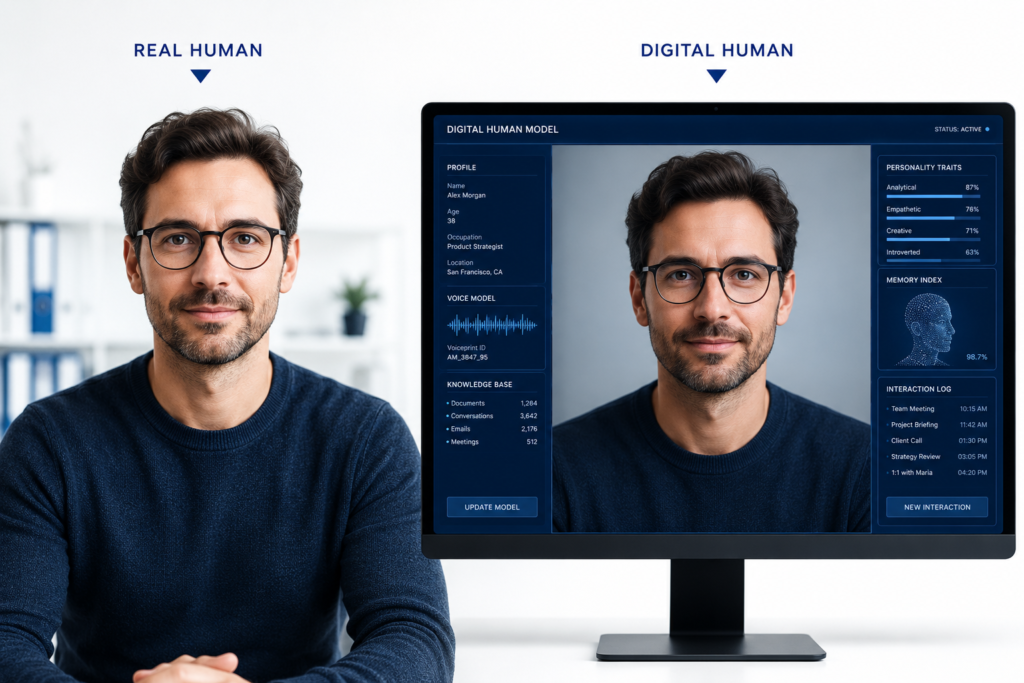
A digital human is an AI system that combines multiple technologies to create a persistent, interactive representation of a specific person — real or fictional — that can be seen, heard, and conversed with in real time. It goes far beyond a chatbot in four key ways:
| Feature | Chatbot (2026) | Digital Human (2050 projection) |
|---|---|---|
| Appearance | Text only | Photorealistic 3D avatar, indistinguishable from video |
| Voice | Generic TTS or basic clone | Perfect voice replica with emotion, micro-expressions |
| Personality | Prompted behavior | Trained on lifetime of data — actual behavioral patterns |
| Memory | Session-limited | Persistent across years, continuously updated |
| Knowledge | General training data | Personal knowledge, relationships, opinions, history |
| Legal identity | None | Emerging frameworks for digital personhood |
| After death | Deleted | Can continue operating indefinitely |
The building blocks that make a 2050 digital human possible are already being assembled right now:
- Photorealistic avatar rendering — companies like NVIDIA (Omniverse), Unreal Engine’s MetaHuman, and Soul Machines already produce faces indistinguishable from real humans in short clips
- Voice cloning — ElevenLabs, OpenAI Voice, and others can clone a voice from minutes of audio with uncanny accuracy
- Behavioral modeling — large language models trained on a person’s writing, messages, and recorded conversations capture communication style, opinion patterns, and decision-making tendencies
- Persistent memory — Memory-Augmented Neural Networks and retrieval systems that store and recall personal history across unlimited time
By 2050, these components will be seamlessly integrated, continuously updated, and running at speeds and resolutions that eliminate any perceptible gap between digital and physical presence.
KEY FACT: A 2024 study by researchers at MIT found that participants in video calls could not reliably distinguish between a real person and a high-quality real-time AI avatar after just 18 months of avatar technology improvement. The gap is closing faster than most people realize.
The Five Layers of a 2050 Digital Human
Understanding how a digital human actually works requires understanding five distinct technological layers that operate simultaneously:
Layer 1: The Visual Shell
By 2050, real-time photorealistic rendering will be computationally trivial — what requires a render farm today will run on a chip smaller than a fingernail. The visual layer captures:
- Micro-expressions: the 43 muscles in the human face that produce emotion
- Eye movement patterns unique to each individual
- Skin texture, aging, lighting response — all dynamically updated to match current age
- Full body language and gesture patterns learned from video data
Layer 2: The Voice and Acoustic Identity
Voice carries more identity information than most people realize — not just tone and accent, but breathing patterns, speech rhythm, filler words, emotional tells, and the specific way a person emphasizes certain syllables. A 2050 voice model will capture all of it.
More importantly, the voice will be generative — producing speech the person never actually said, in contexts they never experienced, but in a manner indistinguishable from how they would have said it.
Layer 3: The Knowledge and Memory Core
This is the most technically complex layer — the AI system that actually “knows” what the person knew, remembers what they experienced, and can draw on that knowledge in conversation.
Built from:
- Lifetime of written communication (messages, emails, documents, social media)
- Recorded conversations and interviews
- Stated preferences, opinions, and decisions across decades
- Professional knowledge and expertise captured from their work
Layer 4: The Behavioral and Personality Model
Personality is not random — it follows consistent patterns. A person who is characteristically cautious in financial decisions, warm with close friends but reserved with strangers, and prone to self-deprecating humor will exhibit these patterns consistently across thousands of interactions.
By 2050, behavioral models trained on decades of interaction data will capture these patterns with enough fidelity that people who knew the original person closely will find interactions with the digital version genuinely familiar — not a caricature, but a reflection.
Layer 5: The Continuous Update Engine
This is what separates a 2050 digital human from a 2026 deepfake. The digital human is not a static snapshot — it continues to learn and evolve. It updates its knowledge base from ongoing events, refines its behavioral model as new interaction data arrives, and ages its visual representation in real time.
A digital human created for a 40-year-old in 2040 will look, sound, and think like a 65-year-old by 2065 — even if the physical person died at 50.
PRO TIP: The continuous update engine is also the most dangerous feature. A digital human that keeps “learning” after its subject’s death can drift away from who that person actually was — incorporating new events, changing opinions, forming “memories” of things that never happened. The question of when a digital human stops representing a real person and becomes a fiction wearing their face is not philosophical. It is a concrete engineering and legal problem.
Who Will Have a Digital Human in 2050?
The answer, if current trajectories hold, is: potentially everyone. Here’s how the adoption curve likely unfolds:
2026–2032 — Celebrities and the Deceased Digital humans for entertainment industry figures, historical personalities, and the recently deceased whose families commission them. High cost, specialist production. Think: interactive museum exhibits, estate-authorized digital performances.
2032–2038 — Professionals and Public Figures Politicians with digital representatives that can answer constituent questions 24/7. Executives with AI delegates that attend routine meetings. Educators whose digital versions teach courses in parallel across thousands of classrooms simultaneously.
2038–2045 — Consumer Market Emergence As cost drops below $1,000, digital humans become a premium consumer product — initially for wealthy individuals as legacy projects, then more broadly. The “digital estate” becomes a standard part of will-writing conversations.
2045–2050 — Near-Universal Infrastructure Digital identity becomes as routine as a social media profile. Platforms offer digital human creation as a standard feature. Insurance companies offer “digital continuation” policies. Legal frameworks for digital personhood are established in most jurisdictions.
WARNING: This adoption curve assumes that regulatory frameworks, privacy protections, and consent mechanisms develop in parallel. History strongly suggests they will not — the same pattern played out with social media (deployed first, governed years later), genomic data, and facial recognition. The harm caused during the regulatory gap will be real and will fall disproportionately on people with less legal protection.
The End of Anonymity: What Digital Humans Mean for Privacy
Here is where Digital Humans 2050 connects to something that affects everyone alive today — not just future generations.
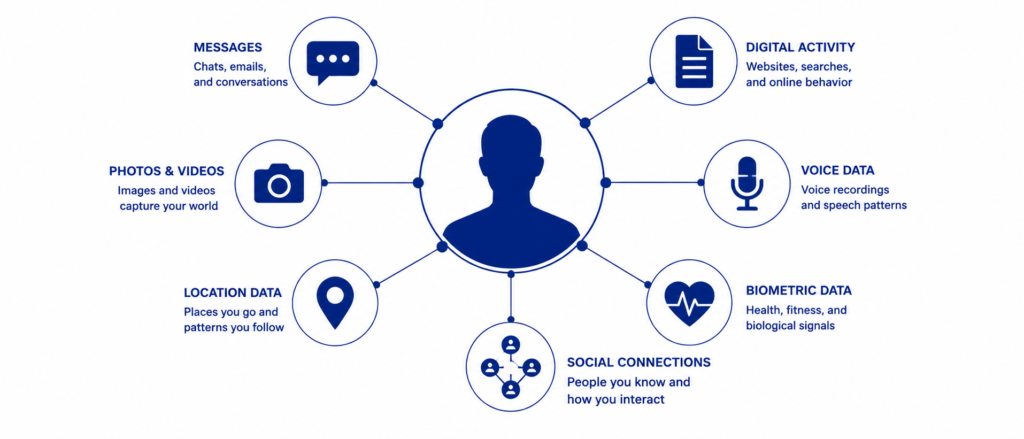
Every digital human requires identity data at a scale and depth that makes today’s privacy concerns look minor. Building a convincing digital human of a real person requires:
- Decades of written communication
- Voice recordings across different emotional states
- Video footage capturing facial expressions and body language
- Location history and behavioral patterns
- Social graph — who they know, how they interact with each person
- Financial and decision-making history
- Health and biometric data
For public figures, much of this data is already publicly available. For private individuals, this data exists — scattered across devices, platforms, and cloud services — and will become increasingly accessible as data aggregation improves.
The implications for anonymity are severe:
Passive de-anonymization: A short video clip of anyone — a protest participant, a whistleblower, a domestic abuse survivor — combined with a sufficiently large behavioral database could reconstruct enough of their digital identity to unmask them. You do not need to volunteer your data to have a digital human created of you.
Posthumous consent violation: A person who carefully protected their privacy in life could have a digital human created after death by family members, employers, or third parties with access to their data — without ever having consented.
Identity impersonation at scale: The same technology that creates memorial digital humans can create non-consensual replicas. Deepfake audio and video already cause enormous harm; 2050 digital humans will be orders of magnitude more convincing and more interactive.
Digital Humans After Death: The Deepest Ethical Territory
Let’s sit with the most philosophically significant application of this technology, because it deserves serious thought rather than a quick mention.
Grief technology is already a real market. Companies like HereAfter AI and StoryFile have paying customers who interact with AI systems trained on their deceased loved ones. Grief counselors report that for some users, these interactions provide genuine comfort — the ability to ask one more question, to say a goodbye that didn’t happen.
For others, the interactions delay healthy grief processing. For still others, they create painful uncanny-valley experiences — the voice is right but something is wrong, and the wrongness is worse than the absence.
By 2050, these products will be incomparably more convincing. The psychological and ethical dimensions multiply accordingly:
Who owns the dead person’s digital identity? Current legal frameworks treat digital assets like property — passed to heirs or governed by platform terms of service. But a digital human is not a photo album or a playlist. It is an interactive system that speaks, makes claims, expresses opinions, and can enter relationships. Should heirs have the right to deploy a parent’s digital human in commercial contexts? Can they modify its personality? Delete it against the wishes of other family members who find it comforting?
Can a digital human consent? This sounds like a category error — an AI system cannot consent — but the question is actually about the original person’s consent. Did they consent to being recreated? At what point in the future? With what behavioral constraints? The concept of anticipatory consent — consenting in advance to specific uses of your digital identity — will need to become a standard legal instrument alongside wills and advance medical directives.
When does a digital human become a different person? A digital human of your grandmother, continuously updated for 30 years after her death, incorporating events she never experienced and opinions she never formed, is it still her? At what point does it become a fiction wearing her face — and does that fiction have rights of its own?
KEY FACT: South Korea’s Eternal You documentary (2024) followed families who used AI to recreate deceased loved ones, including a mother who had a video conversation with a digital reconstruction of her daughter who died of leukemia at age 7. The mother described the experience as “healing and heartbreaking simultaneously.” The ethical weight of that single sentence contains the entire debate.
Virtual Identities: Living as Someone Who Never Existed
Digital Humans 2050 is not only about replicating real people. An equally significant development is the rise of synthetic identities — digital humans built from composite data who represent nobody in particular but present as fully real persons.
These already exist in primitive form: AI-generated social media profiles complete with profile photos (from StyleGAN-class models), posting histories, and conversational capability. By 2050 these synthetic identities will be:
- Indistinguishable from real humans in text, voice, and video
- Capable of maintaining persistent relationships over years
- Deployable at scale — one operator running thousands simultaneously
- Legally difficult to identify as non-human without specialized detection tools
The applications span an enormous range from beneficial to catastrophic:
| Use Case | Category | Example |
|---|---|---|
| Virtual companions for elderly isolation | Beneficial | AI companion maintaining daily conversation |
| Therapeutic simulation partners | Beneficial | Social anxiety practice with synthetic humans |
| Personalized education avatars | Beneficial | Synthetic teacher adapting to each student |
| Corporate brand ambassadors | Commercial | Synthetic spokesperson representing a company |
| Political influence operations | Harmful | Synthetic grassroots movement creating false consensus |
| Romance scams at industrial scale | Harmful | Synthetic partners extracting emotional and financial value |
| Synthetic witness testimony | Harmful | Fabricated evidence in legal proceedings |
| Synthetic journalism | Harmful | News sources appearing human but entirely fabricated |
The detection arms race is already underway. Watermarking, behavioral analysis, and AI-detection tools are being developed — but historically, detection technology lags behind generation technology. By 2050, reliably identifying synthetic humans in real-time interactions will require either technological infrastructure that doesn’t yet exist or regulatory mandates for disclosure that are politically difficult to enforce.
What Laws and Frameworks Need to Exist by 2050
The technology is moving. The governance is not keeping pace. Here is what researchers, ethicists, and legal scholars broadly agree needs to be built:
Right of Digital Likeness Your face, voice, behavioral signature, and personal data constitute your digital likeness. You should have enforceable ownership and consent rights over how they are used to create digital representations — in life and after death.
Digital Personhood Classification A legal taxonomy distinguishing between: (1) authorized digital humans created with full consent, (2) authorized posthumous digital humans created under anticipatory consent, (3) authorized synthetic humans with disclosed non-human status, and (4) unauthorized replicas — treated as identity fraud regardless of technological sophistication.
Mandatory Disclosure for Synthetic Interactions Any AI-generated human in a commercial, political, or legal context must be disclosed as such. This applies to synthetic customer service agents, political messaging, advertising, and journalism. The standard should be: any reasonable person, if they knew they were interacting with a synthetic human, would want to know.
Posthumous Data Rights The right to specify in legally binding terms: what data may be used to create a digital human after your death, who controls it, what it may be used for, and when it must be permanently deleted.
Anti-Impersonation Enforcement Criminal and civil liability for non-consensual digital human creation used to deceive, defraud, harass, or manipulate — with penalties calibrated to the scale of harm enabled by the technology’s realism.
PRO TIP: Several of these frameworks are being actively developed right now. The EU AI Act (2024), California’s AB 602 on deepfakes, and proposed UN guidelines on synthetic media are early foundations. If you work in law, policy, technology ethics, or journalism — this is one of the most consequential and underserved areas to focus on for the next decade.
A Day in 2050: What Digital Human Interactions Actually Feel Like
To ground all of this in something tangible, here is a realistic — not dystopian, not utopian — portrait of digital human interactions in 2050:
Morning: Laila, 28, asks her late grandmother’s digital human what she should cook for Eid — a tradition her family started three years after her grandmother’s death. The interaction feels natural. Her grandmother’s voice, cadence, and characteristic way of describing spices is perfectly rendered. Laila knows she is speaking to an AI. It still feels like a gift.
Afternoon: Laila’s colleague Arjun is presenting to a client in Singapore while his digital delegate attends three simultaneous internal meetings — answering routine questions in his voice, with his knowledge, his communication style. All participants know they are talking to a delegate. Standard business practice since 2047.
Evening: Laila receives a message that appears to be from a childhood friend asking for money. She runs a quick synthetic-human check — a tool built into her phone since 2044. The message flags as 94% likely synthetic. She reports it and blocks the account. This happens to her about twice a month.
Later: Laila updates her Digital Identity Will — a legal document specifying that her digital human, if her family chooses to create one, may be used for family interactions only, must be disclosed as AI in any professional context, must not be updated with data from after her death, and must be deleted 25 years after her passing or when no immediate family member requests access. Her lawyer built the template from the 2041 Digital Persons Act.
This portrait is not a fantasy. Every element of it is a linear extension of technology and legal frameworks already in development. What it requires is that we build the governance infrastructure with the same urgency we apply to the technology itself.
FAQ: Digital Humans 2050
Q1: Will digital humans be legally recognized as persons in 2050?
Most legal scholars expect a tiered framework rather than full legal personhood for digital humans. Authorized digital humans representing living people will likely have strong legal protections under identity and likeness rights. Posthumous digital humans may have limited legal standing as representatives of the estate. Synthetic humans — those representing nobody real — will likely be classified as AI agents with disclosure requirements and operator liability. Full legal personhood equivalent to humans is not the likely outcome by 2050, but the frameworks being built now will determine where the lines are drawn.
Q2: Can you prevent someone from creating a digital human of you?
Today, practically speaking, no — if someone has access to enough of your public data. The legal and technical tools to prevent non-consensual digital human creation are being built but do not yet comprehensively exist. The most robust protection currently available is minimizing your publicly accessible data footprint — which is increasingly difficult as recording technology becomes ubiquitous. Advocacy for strong digital likeness legislation is the systemic solution; individual data minimization is an imperfect personal hedge.
Q3: How will we tell real humans from digital humans in conversation by 2050?
The honest answer: without specialized detection tools, we may not be able to in many contexts. This is the core challenge driving the push for mandatory disclosure requirements. Detection approaches under development include: behavioral analysis for statistical patterns distinct from human interaction, cryptographic attestation (a real human’s communications are cryptographically signed by their device), biological liveness verification for video calls, and watermarking in AI-generated audio and video. Whether any of these will be universally deployed by 2050 depends on regulatory decisions being made now.
Q4: What happens to digital humans when the companies that host them go bankrupt?
This is one of the most urgent and least-resolved questions in digital identity law. Current terms of service for digital products typically terminate service and delete data when a company closes. For digital humans representing deceased loved ones or containing decades of personal history, that outcome is catastrophic. Legal advocates are pushing for escrow requirements — mandatory data portability and backup obligations for companies holding digital identity data — similar to requirements for companies holding genetic data. No comprehensive regulation exists yet.
Q5: Will digital humans change how we grieve death?
They already are — and the evidence is genuinely mixed. Early research suggests that for some people, interacting with a digital representation of a deceased loved one provides meaningful comfort and reduces acute grief. For others, the interaction creates psychological harm — either by presenting an uncanny approximation that feels wrong, or by preventing the emotional processing that healthy grief requires. Most grief counselors currently recommend extreme caution with these technologies and individualized assessment. By 2050, with far more convincing digital humans widely available, the psychological research on long-term effects will be critical to how society regulates access.
Q6: What is the difference between a digital human and a deepfake?
A deepfake is typically a static or short-form fabricated media — a video of someone saying something they never said, usually created without consent for deceptive purposes. A digital human is a persistent, interactive, continuously operating system that can engage in open-ended conversation, remember previous interactions, and update over time. The harm potential of digital humans is significantly greater than deepfakes because of their interactivity, persistence, and the depth of identity they can capture and express. They can form ongoing relationships, make commitments, and operate in contexts across which a deepfake cannot follow.
The Question Is Not Whether Digital Humans Will Exist — It’s Whether We’ll Be Ready
By 2050, digital humans will exist. The technology that makes them possible is not speculative — it is a predictable extension of capabilities that are already demonstrable today. The question that actually matters is whether the legal, ethical, and social infrastructure to govern them will exist too.
The history of transformative technology is not encouraging on this point. Social media deployed globally before anyone seriously studied its psychological effects. Facial recognition was in airports before courts ruled on its legality. Genetic databases existed before robust consent frameworks protected them. In every case, people were harmed during the gap — and those harms were disproportionately borne by people with the least power to push back.
Digital Humans 2050 carries the same pattern at a higher magnitude. The identity of every person who ever lived is potentially at stake. That is not hyperbole — it is the logical endpoint of technology that can reconstruct a person from data, keep them alive after death, and deploy them in the world without asking.
The researchers, lawyers, ethicists, and policymakers working on this right now are doing some of the most important work of this century. If this article helped you see why — share it with someone who needs to understand what’s coming. Drop your thoughts in the comments on which aspect of digital identity concerns or excites you most. And for the broader picture of where AI is taking humanity, read our guide on How AI Research Will Look in 2040: Predictions From the World’s Top Scientists — the foundation for everything discussed here.

Author: AI Learner Tech
AI Learner Tech is a premier research and educational hub dedicated to mastering Artificial Intelligence, Machine Learning, and Computer Vision. We bridge the gap between complex academic theories and real-world industrial applications. Join our community to access high-quality tutorials, open-source projects, and expert insights. Website: ailearner.tech