AI Reasoning Breakthroughs
Give a calculator a maths problem. It gives you the answer instantly.
Give a human the same problem. They pause. They write something down. They check a step. They go back and correct themselves. Then they give you the answer.
The calculator is faster. But the human handles problems the calculator cannot — because the human is actually thinking, not just computing.
For most of AI’s history, language models worked like calculators. Fast. Pattern-based. No pause to think. Ask a question, get an answer immediately — even if that answer was confidently wrong.
That is changing.
The most important shift in AI capability over the past two years is not a bigger model or more training data. It is something subtler: AI systems are learning to slow down. To work through problems step by step. To check their own reasoning before committing to an answer.
This shift — from fast pattern-matching to genuine step-by-step thinking — is what this article is about.
You will come away understanding:
- Why fast AI answers are often wrong, and why slowing down helps
- What chain-of-thought prompting is and why it works
- How OpenAI’s o1 model changed what people thought was possible
- The difference between reasoning and memorization in AI
- Where the hard limits still are — and why they matter
- What the next three years of AI reasoning research looks like
The Problem With Being Too Fast
Here is a question. Answer it quickly, without thinking:
A bat and a ball cost $1.10 together. The bat costs $1 more than the ball. How much does the ball cost?
Most people say 10 cents immediately.
The correct answer is 5 cents.
If the ball costs 10 cents and the bat costs $1 more, that means the bat costs $1.10 — and together they cost $1.20, not $1.10.
This is one of the most famous problems in cognitive psychology. It is called a cognitive reflection test — a problem designed to trigger a fast, intuitive answer that is wrong, so that only people who slow down and actually check get it right.
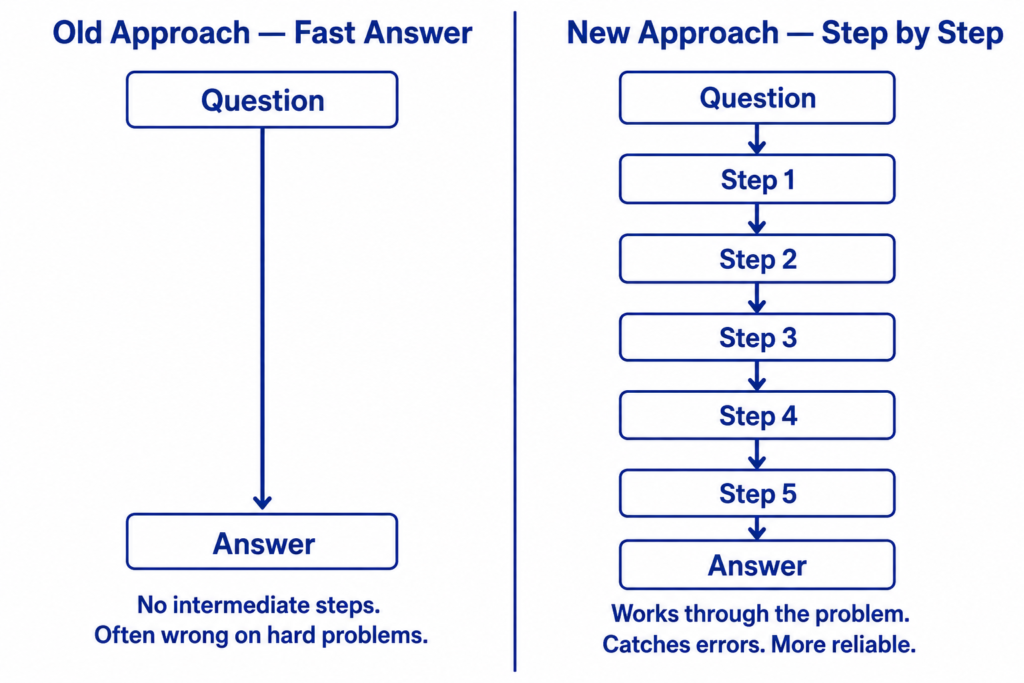
Early language models failed this test catastrophically. Not because they lacked knowledge. But because they were built to produce answers fast — without any mechanism for checking whether the fast answer made sense.
The same architecture that makes language models impressive at most tasks makes them unreliable at tasks that require genuine reasoning. They pattern-match their way to an answer. When the pattern leads somewhere wrong, there is nothing to catch it.
The issue was never intelligence. It was architecture. Language models were designed to generate the most probable next token — not to verify whether a chain of reasoning was logically sound before committing to it.
What Chain-of-Thought Prompting Revealed
In 2022, a team of researchers at Google Brain published a paper that quietly changed how the field thought about AI reasoning.
The paper was called Chain-of-Thought Prompting Elicits Reasoning in Large Language Models. The finding was striking.
They discovered that if you simply asked a language model to show its working — to write out each reasoning step before giving a final answer — its performance on hard reasoning problems improved dramatically. Not slightly. Dramatically.
The same model. The same weights. The same knowledge.
Two different prompting approaches. Very different results.

─────────────────────────────────────────────────────
Standard prompting:

Q: "Roger has 5 tennis balls. He buys 2 more cans
    of tennis balls. Each can has 3 balls. How many
    tennis balls does he have now?"

A: "11"   ✓ Correct — but this was a simple problem.
─────────────────────────────────────────────────────
Same approach on a harder multi-step problem:
A: Wrong answer — model jumped to conclusion

─────────────────────────────────────────────────────
Chain-of-thought prompting:

Q: Same question + "Let's think step by step."

A: "Roger starts with 5 balls.
    He buys 2 cans × 3 balls per can = 6 new balls.
    Total = 5 + 6 = 11 tennis balls."   ✓ Correct

On the same harder problem where standard prompting failed:
Chain-of-thought got it right.
─────────────────────────────────────────────────────
Why does writing steps out loud help?
Each intermediate step constrains what comes next.
When a model jumps from question to answer in one move, the probability distribution for that answer is very wide — many different answers are plausible and the model picks based on surface patterns.
When a model commits to step one first, then step two, then step three — each step narrows the space of reasonable next steps. Errors that would have been invisible in a one-shot answer become visible as inconsistencies between adjacent steps.
It is the same reason teachers tell students to show their working. Not to slow them down. Because the process of writing each step forces a kind of verification that skipping steps bypasses.
PRO TIP: You can use this yourself right now. When you ask any AI a complex question — a maths problem, a logical puzzle, a multi-step analysis — add “think through this step by step” to your prompt. The output will be longer. It will also be more accurate. The model is not getting smarter. It is being given permission to use its intelligence more carefully.
The Scaling Discovery That Changed Everything
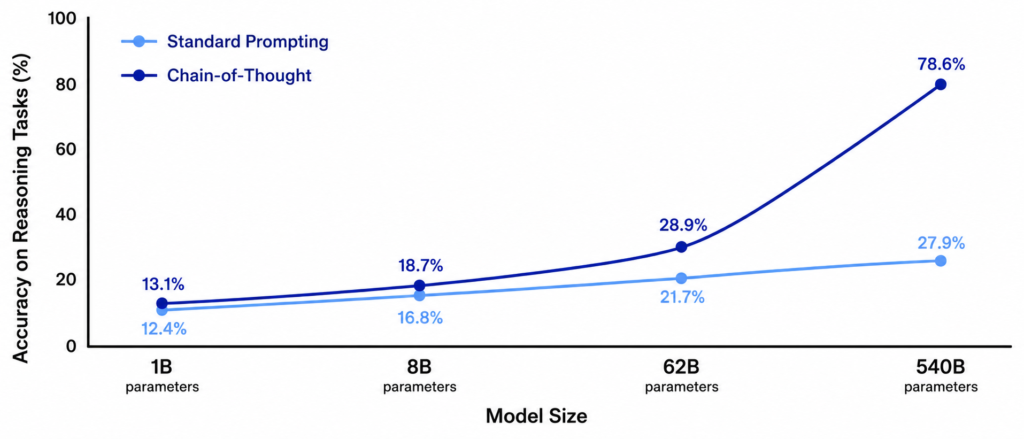
Chain-of-thought prompting worked — but it worked better on larger models.
On small models (under 10 billion parameters), asking for step-by-step reasoning produced marginal improvement or no improvement at all. On large models (100 billion parameters and above), the improvement was dramatic.
Chain-of-thought improvement by model size:
(performance on mathematical reasoning benchmarks)

Model size          Without CoT    With CoT    Improvement
──────────────────────────────────────────────────────────
~1B parameters        17%           17%          0%
~8B parameters        29%           30%          1%
~62B parameters       43%           51%          +8%
~540B parameters      54%           67%          +13%

Source: Wei et al., 2022 — Chain-of-Thought paper

The ability to reason through steps is itself an
emergent capability — it appears at scale, not gradually.
This told researchers something important.
The reasoning ability was always latent in large models. The model knew enough — it just needed a way to express that knowledge step by step rather than all at once. The prompt was not adding intelligence. It was unlocking a way of using intelligence that the standard generation format suppressed.
OpenAI o1: When Thinking Became a First-Class Feature
Chain-of-thought prompting showed that reasoning improves when AI works through steps.
But it was still the user’s job to prompt for it. The model did not choose to think carefully on its own. It only did so when asked.
OpenAI’s o1 model, released in September 2024, changed that.
o1 was trained specifically to reason before answering — not just when prompted, but as a default behavior. It thinks internally before producing any output. That internal thinking is not shown to the user by default, but it is happening.
What is actually different about o1:
The model was trained using a technique called reinforcement learning on reasoning chains. Rather than simply training on correct answers, it was trained to produce correct answers via correct reasoning — and rewarded specifically for the quality of the intermediate steps, not just the final output.
Standard model training:
  Input: question
  Target: correct answer
  → Model learns to produce correct-looking answers
  → Reasoning process is uncontrolled

o1-style training:
  Input: question
  Target: correct reasoning chain → correct answer
  → Model learns that good answers come from good reasoning
  → Reasoning process is explicitly rewarded

The difference in practice:

Problem: "A snail is at the bottom of a 30-foot well.
          Each day it climbs 3 feet. Each night it
          slides back 2 feet. How many days to escape?"

Standard model: "28 days" ✗ (common pattern-match error)

o1-style model internal reasoning:
  "Day 1: climbs to 3, slides to 1. Net: 1 foot per day.
   But wait — on the day it reaches 30 feet, it escapes
   before sliding back. So I need to find when the
   morning climb reaches 30.
   After 27 days the snail is at 27 feet.
   Day 28 morning: climbs from 27 to 30 — escapes.
   Answer: 28 days."  ✓
Where o1 genuinely outperformed previous models:
- International Mathematics Olympiad qualifying problems — o1 scored in the 89th percentile
- PhD-level science questions in physics, chemistry, and biology
- Complex multi-step coding challenges
- Legal reasoning problems requiring interpretation of conflicting rules
These are not tasks where knowing more information helps. They are tasks where the quality of the reasoning process determines the outcome. o1 improved on them because its reasoning process was better — not because it had more knowledge.
KEY FACT: On a competitive programming benchmark called Codeforces, GPT-4o scored at the 11th percentile — better than 11% of human contestants. o1 scored at the 89th percentile. Same company. Same general approach. The difference was almost entirely in the reasoning architecture.
What Reasoning Actually Means — And What It Does Not
This is the part most articles skip.
When we say AI is “learning to reason,” we need to be precise about what that means — because the word reasoning covers a lot of ground.
What AI reasoning is getting good at:
- Deductive reasoning — applying rules to reach conclusions
- “All mammals have lungs. A whale is a mammal. Therefore a whale has lungs.”
- AI handles this reliably on structured problems
- Mathematical reasoning — following calculation chains step by step
- Code reasoning — tracing through program logic to find bugs or predict output
- Analogical reasoning — recognizing structural similarities between different problems
What AI reasoning still struggles with:
- Causal reasoning — understanding why things happen, not just what correlates with what
- Counterfactual reasoning — “what would have happened if X were different?”
- Spatial reasoning — understanding physical arrangements and how they change
- Open-ended reasoning — problems with no clear correct answer or infinite solution space
A useful test for genuine vs apparent reasoning:

Genuine reasoning should be robust to surface changes.
If the underlying logic is the same, the answer should
be the same even if the words change.

Test — same logic, different surface:

Version A: "If it rains, the ground gets wet.
            It rained today. Is the ground wet?"
AI answer: Yes ✓

Version B: "If flurbs exist, zorks multiply.
            Flurbs exist. Do zorks multiply?"
AI answer: Yes ✓ — same logical structure, handled well

Version C (requires world knowledge + logic):
"If the government raises interest rates,
 inflation typically falls. The central bank
 raised rates. Has inflation definitely fallen?"
AI answer quality: Highly variable — because this
requires understanding that "typically" ≠ "always"
and that real-world causation is messier than
formal logic.
The honest picture: AI reasoning is genuinely improving at well-defined problems with clear logical structure. It remains unreliable on problems that require understanding causation, navigating ambiguity, or applying common sense to novel situations.
Process Reward Models: Rewarding Good Thinking, Not Just Right Answers
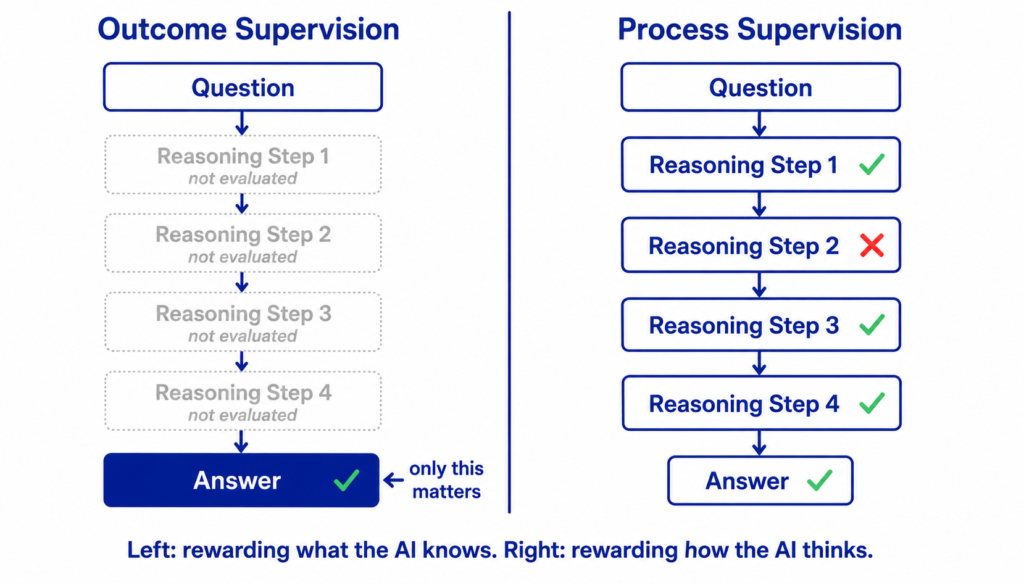
One of the most important technical developments in AI reasoning research is the shift from outcome supervision to process supervision.
Outcome supervision — the older approach: Reward the model if it gets the right answer. Penalize it if it gets the wrong answer. The reasoning in between is uncontrolled.
Process supervision — the newer approach: Reward the model for each correct reasoning step, regardless of whether the final answer is right. Penalize incorrect steps, even if they accidentally lead to a correct answer.
Why this matters — a concrete example:

Problem: "What is 15% of 240?"

Correct answer: 36

Response A (process wrong, answer right):
  "15% of 240... I'll estimate it's around 36."
  → Outcome supervision: reward given (right answer)
  → Process supervision: no reward (no valid reasoning)

Response B (process right, answer right):
  "15% means 15 per 100.
   So 15/100 × 240 = 0.15 × 240 = 36."
  → Outcome supervision: reward given
  → Process supervision: reward given

Response C (process right, answer wrong due to arithmetic):
  "15/100 × 240 = 0.15 × 240 = 35."  (arithmetic slip)
  → Outcome supervision: no reward (wrong answer)
  → Process supervision: partial reward (valid method,
    arithmetic error only — model learns the method
    is right even when execution slips)
Process reward models train the AI to value correct reasoning for its own sake — not as a means to an end. The result is models that are more reliable on novel problems because their reasoning process is sound, even when the specific facts of a new problem were never in their training data.
KEY FACT: OpenAI published research in 2023 showing that process reward models outperformed outcome reward models on the MATH benchmark — a dataset of competition-level maths problems — by a significant margin. The improvement was largest on the hardest problems in the dataset, where a correct reasoning process is most necessary.
Where AI Reasoning Is Heading Next
Test-time compute scaling
One of the most active research areas in 2025 and 2026 is scaling compute at inference time — giving the model more thinking time per problem rather than just making the model bigger during training.
The idea: let the model generate multiple candidate reasoning chains, evaluate them against each other, and select the best one before producing output. More thinking time equals better answers on hard problems.
Test-time compute scaling in practice:

Standard inference:
  Question → 1 reasoning chain → Answer
  Time: fast. Quality: average of one attempt.

Test-time scaled inference:
  Question → 32 candidate reasoning chains generated
           → Each chain evaluated for consistency
           → Best chain selected
           → Answer from best chain
  Time: ~32x slower. Quality: significantly higher.

This is how humans approach hard problems too —
we consider multiple approaches, discard the weak ones,
and commit to the most sound one.
Neuro-symbolic reasoning
Pure neural networks are not naturally suited to strict logical reasoning. Symbolic AI systems — rule-based, formal logic engines — are excellent at strict reasoning but cannot handle ambiguous real-world language.
Current research is combining both: a neural network handles natural language and uncertainty, a symbolic reasoning engine handles formal logic and verification. Early results are promising on mathematical proofs and formal verification tasks.
Self-correction and iterative refinement
Rather than producing one answer, future systems may produce an answer, critique it, revise it, critique the revision, and iterate — similar to how Constitutional AI works for safety, but applied to logical correctness.
Early versions of this exist in o1 and Claude 3.5. The challenge is knowing when to stop iterating — a model that revises endlessly is not useful. The research question is building reliable stopping criteria.
READ MORE: What Is Artificial Intelligence? The Ultimate Beginner’s Guide for 2026
READ MORE: How ChatGPT Actually Works: A Simple Explanation for Non-Tech People
READ MORE: AI Hallucinations: Why Language Models Lie and How Researchers Are Fixing It
Frequently Asked Questions
Is chain-of-thought prompting useful for everyday AI tasks?
Yes — but selectively. For creative writing, summarization, or casual questions, it adds length without much benefit. For anything involving multiple steps — calculations, comparisons, analysis, troubleshooting — it consistently improves output quality. A good rule: if a human would need to think carefully to answer well, ask the AI to think carefully too.
How does o1 compare to GPT-4o for everyday use?
For most everyday tasks — writing, summarizing, answering factual questions — GPT-4o is faster and the quality difference is minimal. o1 is meaningfully better on hard reasoning problems: complex maths, multi-step logic, PhD-level science, and intricate coding challenges. Using o1 for simple tasks is like using a calculator that takes ten seconds to add two numbers. Use the right tool for the task.
Can AI reasoning models solve problems that humans cannot?
On well-defined problems with clear rules — yes, in some cases. o1 has solved mathematical problems that stumped graduate students. However, these are problems where the rules are clear and the solution space is defined. AI reasoning models do not perform well on open-ended real-world problems where the rules are unclear, the goals are ambiguous, and the information is incomplete. Human reasoning in messy real-world situations remains significantly more capable.
Why do AI reasoning models sometimes show their working?
Models like o1 can be set to show their chain-of-thought reasoning in the output. This is useful because it lets you check where the reasoning went wrong if the answer is incorrect — rather than just seeing a wrong answer with no explanation. Some models show a summarized version of their reasoning rather than the full internal chain. The internal reasoning is typically more extensive than what gets shown.
Does better reasoning mean fewer hallucinations?
Partially. Better reasoning reduces hallucinations that come from faulty inference — cases where the model reached a wrong conclusion by making a logical error. It does not reduce hallucinations that come from gaps in training data — cases where the model simply does not know something and generates a plausible-sounding fabrication. Reasoning and knowledge are different things. Better reasoning helps one type of error. Better knowledge grounding addresses the other.
Is AI reasoning the same as human reasoning?
Not in any deep sense. AI systems produce outputs that look like step-by-step reasoning because they were trained to produce such outputs. Whether something like genuine logical thinking is happening internally — whether there is real understanding behind the steps — is an open philosophical and scientific question. What is measurable is that models producing step-by-step outputs make fewer errors on hard problems. What is happening computationally to produce that improvement is still an active research question.
Conclusion
The bat and ball problem is still hard for most people.
Not because the mathematics is difficult — it requires one equation with one variable. It is hard because our instinct gives us a fast, confident, wrong answer — and we trust that instinct without checking.
AI systems had the same problem. Fast, pattern-based, confident, and unreliable on anything that required actual verification of intermediate steps.
Chain-of-thought prompting was the first real evidence that slowing down helped. Process reward models showed that training for good reasoning — not just right answers — produced better results. o1 demonstrated that explicit reasoning training could push past what people thought language models were capable of.
The work is not finished. Causal reasoning, spatial reasoning, and handling genuine ambiguity remain hard problems. Test-time scaling and neuro-symbolic approaches are promising but not yet mature.
But the direction is clear. The next generation of AI systems will not just be bigger. They will be more careful — more willing to slow down, check their steps, and revise before committing. That shift matters more than most people realize, because the failure mode of overconfident fast answers is responsible for a large fraction of everything that goes wrong when people rely on AI.
Thinking carefully is underrated. In humans and in machines.
If this changed how you think about what AI is actually doing when it answers a question, share it with someone who still thinks AI is just a very fast search engine. Leave a question below — the more specific, the better.

Author: AI Learner Tech
AI Learner Tech is a premier research and educational hub dedicated to mastering Artificial Intelligence, Machine Learning, and Computer Vision. We bridge the gap between complex academic theories and real-world industrial applications. Join our community to access high-quality tutorials, open-source projects, and expert insights. Website: ailearner.tech