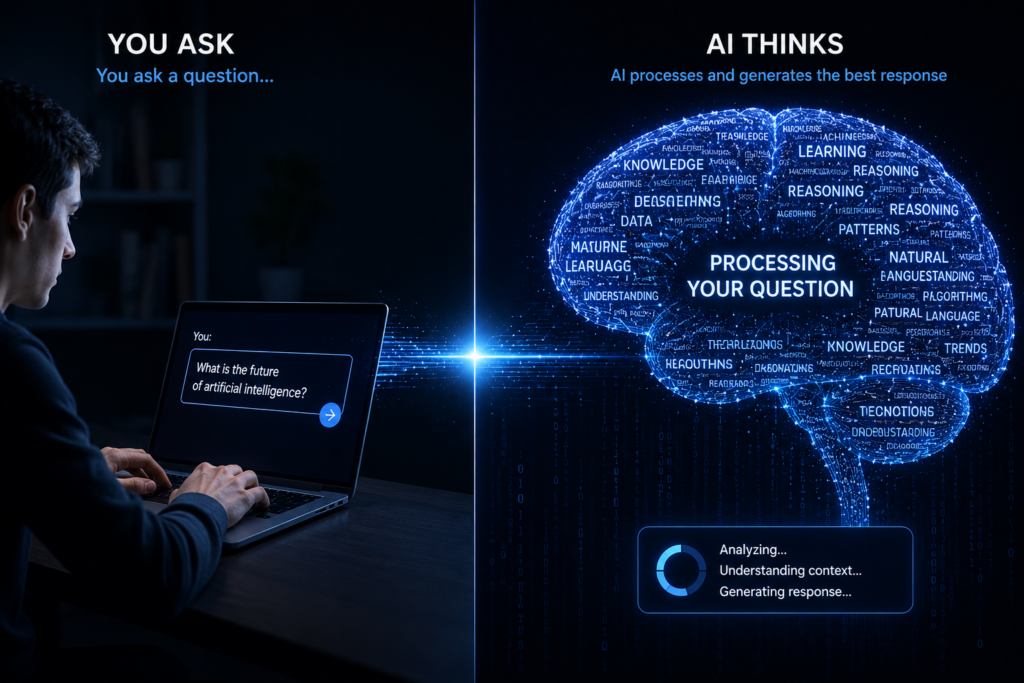
How ChatGPT Works is one of the most common questions people ask when they first use ChatGPT. There is a moment most people experience the first time they interact with it. You type a question, hit enter, and within seconds you get back a response that sounds like it was written by a well-read, thoughtful human being. And your first reaction is simple: how is it doing that?
It does not feel like a search engine. It does not feel like the autocomplete on your phone keyboard. It feels like something that genuinely understood what you wrote and responded with real intelligence.
But here is the truth: ChatGPT is not thinking. It is not conscious. It does not understand anything the way you and I do. What it does is something far more interesting — and once you understand the actual mechanism, you will never look at it the same way again.
This guide covers everything in plain English. No math. No jargon. No computer science background needed.
In this article you will learn:
- What kind of system ChatGPT actually is
- How it was trained and what it learned from
- What happens technically the moment you send it a message
- Why its responses sound so human
- Where it fails and why that matters
- How the different GPT versions compare
What Kind of Thing Is ChatGPT?
Before getting into how it works, it helps to understand what ChatGPT actually is — because most people have the wrong mental model of it.
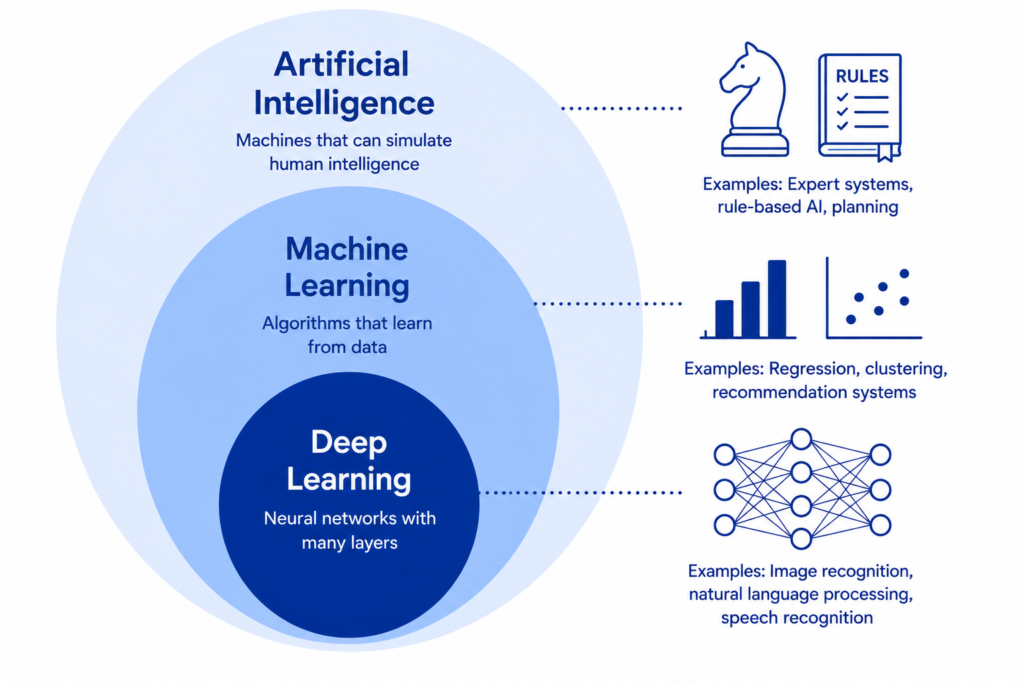
ChatGPT is a Large Language Model, or LLM. That name tells you almost everything you need to know:
- It is a model — a mathematical system trained to perform a specific task
- It works with language — text in, text out
- It is large — extraordinarily large, in ways that matter
The core task this model was built to do is surprisingly simple:
Predict what words should come next in a piece of text.
That is the foundation of everything. Answering questions, writing essays, explaining concepts, debugging code — all of it comes down to one repeated action: figuring out the most appropriate next word, then the word after that, and so on.
It sounds almost too simple to produce impressive results. But trained on enough data, with enough computing power, this single mechanism turns out to be extraordinarily capable.
Step 1 — How ChatGPT Learned: Reading a Huge Amount of Text
ChatGPT did not learn language the way humans do. You learned by growing up — hearing people speak, reading books, making mistakes, getting corrected, and living through experiences. ChatGPT learned by reading an almost unimaginable volume of written text.
What it was trained on:
- Books and novels across hundreds of genres
- Wikipedia articles in multiple languages
- News articles and journalism
- Academic and research papers
- Websites and blogs across the internet
- Online forums and discussions
- Code from public repositories like GitHub
The dataset is so large that if you read 24 hours a day, you would not finish it in multiple lifetimes.
How the training actually worked:
During this process, the model was not told what anything meant. Nobody wrote grammar rules. Nobody explained what a sentence is. Instead, it was given one task, repeated billions of times:
- Read a chunk of text
- Predict what word comes next
- Check if the prediction was right
- Adjust internal settings slightly based on the result
That single loop — done billions of times across billions of words using thousands of computers running for months — produced the system people use today.

Step 2 — What Are “Parameters” and Why Do They Matter?
You may have heard that ChatGPT has hundreds of billions of parameters. GPT-4 is estimated to have over one trillion. These numbers get mentioned constantly, but nobody explains what a parameter actually is.
The simple explanation:
Think of a parameter as a tiny adjustable dial inside the model. Imagine a sound mixing board with thousands of knobs — each one controlling some aspect of the audio output. Now imagine a mixing board with one trillion knobs, each controlling some tiny aspect of how the model interprets and generates language.
What happens to those dials during training:
- Every time the model makes a correct prediction, the relevant dials get nudged slightly in that direction
- Every time it makes a wrong prediction, those dials get nudged back
- After trillions of adjustments over months of training, the dials settle into positions that allow the model to generate coherent, accurate, contextually appropriate text
The important thing to understand:
Nobody manually programmed those settings. Nobody wrote rules saying “when someone asks about history, respond this way.” The settings emerged entirely from the training process — from the model learning, through repetition and correction, what patterns in language lead to what outcomes.
READ MORE: What Is Artificial Intelligence? The Ultimate Beginner’s Guide for 2026
Step 3 — What Happens the Moment You Send a Message
Now that the model exists, here is exactly what happens when you type something to ChatGPT.
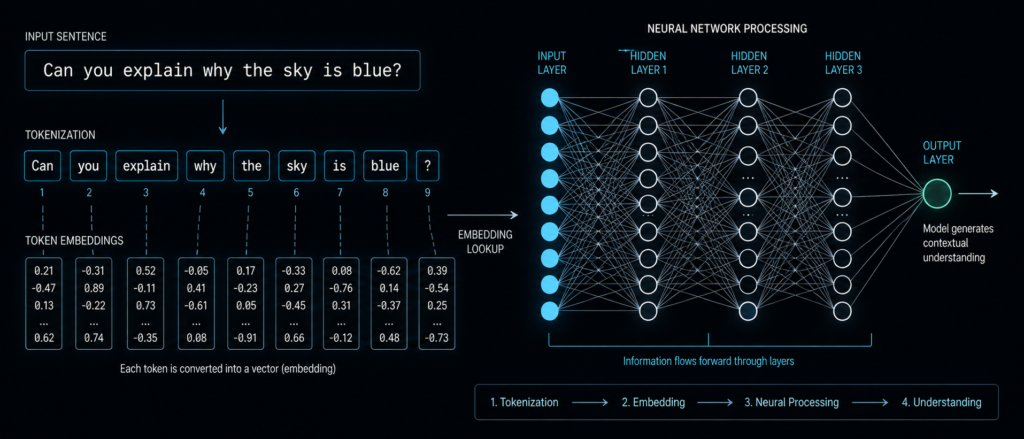
Say you type: “Can you explain why the sky is blue?”
Stage 1 — Tokenization
Your message gets broken into tokens. A token is not the same as a word — it is closer to a chunk of a word:
- Short, common words become a single token (“the”, “is”, “why”)
- Longer words get split (“explaining” becomes “explain” + “ing”)
- Rare or technical words may split into three or four pieces
Your question becomes a sequence of tokens. This is the format the model actually processes — not letters, not words, but tokens.
Stage 2 — Attention and Context
The model processes every token in relation to every other token. It figures out:
- That “sky” and “blue” are closely connected in this sentence
- That “explain” signals you want an educational response, not a yes/no answer
- That “why” means you are looking for a cause, not a physical description
- That the overall tone is curious and conversational
This relationship-mapping is handled by the Transformer architecture — the “T” in GPT. Its key mechanism is called “attention” — the model’s ability to decide which parts of your input are most relevant to each other when generating a response.
Stage 3 — Generating the Response
The model then generates its answer one token at a time:
- It predicts the first token of the response
- That token gets added to the context
- It predicts the next token, considering both your original message and everything generated so far
- This continues until the response is complete
The whole process — tokenization, attention, generation — takes a few seconds at most.
Why Does It Sound So Human?
This is the question that confuses most people. If ChatGPT is just predicting the next word, why does it sound like it is genuinely thinking?
Reason 1 — Good writing follows patterns
Language carries enormous amounts of logic and structure. When the model learned to predict language accurately, it incidentally learned:
- The patterns of good reasoning
- How clear explanations are structured
- What makes an argument logical
- How engaging writing flows
These patterns appear consistently in high-quality text. The model absorbed them so deeply that reproducing them looks like genuine thought — even though the underlying process is entirely statistical.
Reason 2 — Human feedback shaped the final product
After the initial training, the model went through a second phase called RLHF — Reinforcement Learning from Human Feedback:
- Human reviewers rated thousands of responses for quality, helpfulness, and accuracy
- The model was trained again using those ratings
- It learned to produce responses that humans judged as genuinely good
This fine-tuning step is what turns a raw text predictor into something that feels conversational, helpful, and thoughtful.
What ChatGPT Cannot Do — The Honest Limitations
Understanding where ChatGPT fails is just as useful as knowing what it is good at.
It has no memory between conversations
- Every new chat starts completely fresh
- It remembers nothing from previous sessions
- Within one conversation it tracks context well, but once the chat ends, it is gone
It can be confidently wrong
- Because it generates based on patterns rather than verified facts, it sometimes produces incorrect information with total confidence
- This is called hallucination — and it is the most important limitation to know about
- Never rely on ChatGPT for medical, legal, or safety-critical decisions without independent verification
Its knowledge has a cutoff date
- Training data ends at a specific point in time
- Anything that happened after that date is outside its knowledge
- Some versions have internet access through a separate tool, but the base model does not
It does not truly understand
- It processes patterns in language with great sophistication
- But it has no lived experience, no body, no emotions, and no consciousness
- It knows about hunger, cold, and grief because those things are described in text — not because it has experienced them
| What ChatGPT Does Well | Where ChatGPT Struggles |
|---|---|
| Writing, editing, summarizing text | Real-time or very recent information |
| Explaining complex topics in simple terms | Precise mathematical calculations |
| Brainstorming and generating ideas | Verifying facts independently |
| Writing and debugging code | Remembering previous conversations |
| Translating between languages | Knowing when it is wrong |
| Answering general knowledge questions | Genuine reasoning from first principles |
GPT-3, GPT-4, GPT-4o — What Do the Versions Mean?
If you have spent time with ChatGPT, you have seen these version names. Here is what they actually mean.
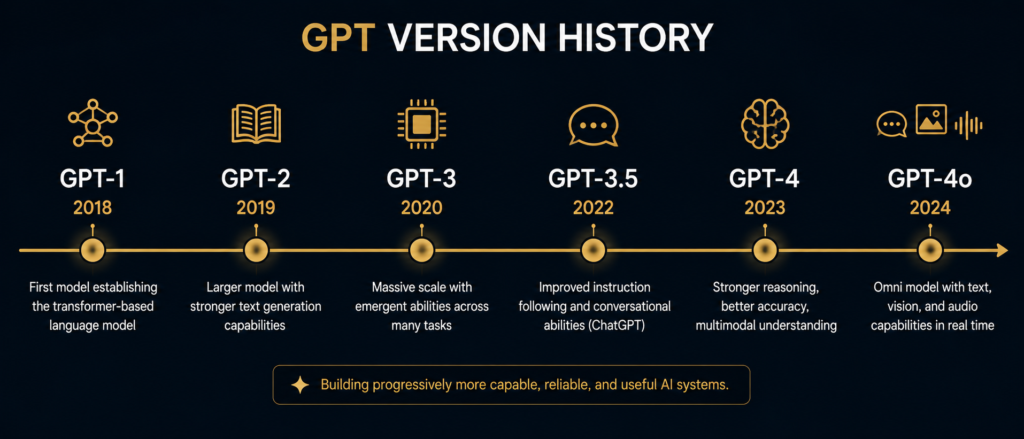
GPT stands for Generative Pre-trained Transformer. The number is the version. Each new version represents a new training run — usually with:
- More data
- More parameters
- Improved training techniques
- More and better human feedback
Version by version:
- GPT-3 (2020) — First version that genuinely shocked researchers. Could write, answer questions, and hold conversations at a quality nobody had seen before. Opened the door to everything that followed.
- GPT-4 (2023) — A significant step forward. Better reasoning, fewer factual errors, and for the first time the ability to process images alongside text.
- GPT-4o (2024) — Brought real-time voice, vision, and text together in a single faster model. Made the interaction feel considerably more natural and immediate.
Training a new GPT model is not a small update. It takes months of computation across thousands of specialized chips and costs tens to hundreds of millions of dollars. Each version release represents a serious investment.
ChatGPT vs Other AI Systems — How Do They Compare?
ChatGPT was the first to reach mainstream attention, but it is not the only system of its kind.
| System | Made By | Key Strength |
|---|---|---|
| ChatGPT (GPT-4o) | OpenAI | Most widely used, strong general capability |
| Gemini | Integrated with Google Search, multimodal | |
| Claude | Anthropic | Focus on safety, honesty, longer documents |
| Llama | Meta | Open source, can run on your own hardware |
| Copilot | Microsoft | Built into Windows and Office products |
Each system has different strengths. None of them is best at everything. For most everyday tasks, the differences are smaller than the marketing suggests.
Why This Matters for You
You do not need to understand transformer mathematics to use ChatGPT well. But knowing the basic mechanics changes how you interact with it:
- You will know to verify important claims rather than accepting them as fact
- You will give it more context because you understand that context drives better predictions
- You will not be surprised when it is confidently wrong because you understand why that happens
- You will use it as a tool rather than treating it as an authority
That shift in understanding — from “magical thing that knows everything” to “very sophisticated pattern-matching system” — makes you a considerably better user of the technology.
Frequently Asked Questions
Does ChatGPT actually understand what I am saying?
Not in the way humans understand things. ChatGPT identifies statistical relationships between words and phrases — recognizing patterns that correlate with meaning — but it has no genuine comprehension. It has never experienced the world, it has no beliefs or intentions, and it does not know what words mean the way someone who has lived and felt things knows what words mean. The outputs look like understanding. The mechanism underneath is entirely different.
Why does ChatGPT give wrong answers so confidently?
Because it generates responses based on patterns, not on a fact-checking process. If a certain type of incorrect statement appeared in training data — or if the pattern of the language matches something that looks like a confident, authoritative answer — the model may produce it without any internal alarm going off. This is why critical reading of ChatGPT responses, especially on factual matters, is always the right approach.
Can ChatGPT learn from our conversations?
Within a single conversation, yes — it builds on context as the chat develops. Across separate conversations, the base model does not permanently learn or change. Your chats do not update ChatGPT’s underlying knowledge. Some versions offer a memory feature that stores specific facts between sessions, but that is a separate layer added on top of the model — not the model itself updating in real time.
How is ChatGPT different from a Google search?
Google retrieves existing web pages already written by humans. ChatGPT generates new text in real time based on what it learned during training. Google gives you a list of sources to explore. ChatGPT gives you a synthesized response directly. Neither is strictly better — they are different tools for different jobs. Google is better for finding specific, current, verifiable information. ChatGPT is better for explanation, drafting, summarizing, and tasks where you need something generated rather than retrieved.
With care. OpenAI uses conversation data in ways that depend on your account settings and the region you are in. For anything genuinely sensitive — confidential business information, private medical details, legal situations — it is worth reviewing the privacy settings and considering whether sharing that information with any third-party platform is appropriate in the first place.
Will ChatGPT replace search engines?
It is changing them rather than replacing them. Google has already integrated generative AI into search results. The line between search and AI assistant is blurring. The more likely outcome is a single experience that combines retrieval of real information with generative synthesis — giving you answers that are both accurate and clearly explained, rather than a list of links to sort through yourself.
Conclusion
At its foundation, ChatGPT is a next-word prediction system trained on an almost incomprehensible volume of human-written text. That description sounds modest. The results it produces are not.
Understanding how it works does not make it less impressive. It makes the achievement more interesting — that a system built entirely on pattern recognition and statistical relationships in language can produce responses that are coherent, contextually appropriate, and genuinely useful across such a wide range of tasks.
Use it. Experiment with it. But understand what it is and what it is not. A tool you understand is a tool you use well — and right now, that understanding is something most people simply do not have.
If this article helped you finally make sense of something that felt confusing before, share it with someone still puzzled by what ChatGPT actually does. And if there is something this article did not answer, leave it in the comments below.

Author: AI Learner Tech
AI Learner Tech is a premier research and educational hub dedicated to mastering Artificial Intelligence, Machine Learning, and Computer Vision. We bridge the gap between complex academic theories and real-world industrial applications. Join our community to access high-quality tutorials, open-source projects, and expert insights. Website: ailearner.tech