The Smartest AI in the World Has the Memory of a Goldfish — Here’s the Fix
Memory-Augmented Neural Networks are designed to solve one of AI’s biggest weaknesses: memory.
Imagine hiring the world’s most brilliant employee — someone who can solve complex math, write perfect code, and debate philosophy — but every morning they wake up with zero memory of the day before. Every conversation starts from scratch. Every lesson learned is instantly forgotten.
That’s not a hypothetical. That’s exactly how most AI systems work today.
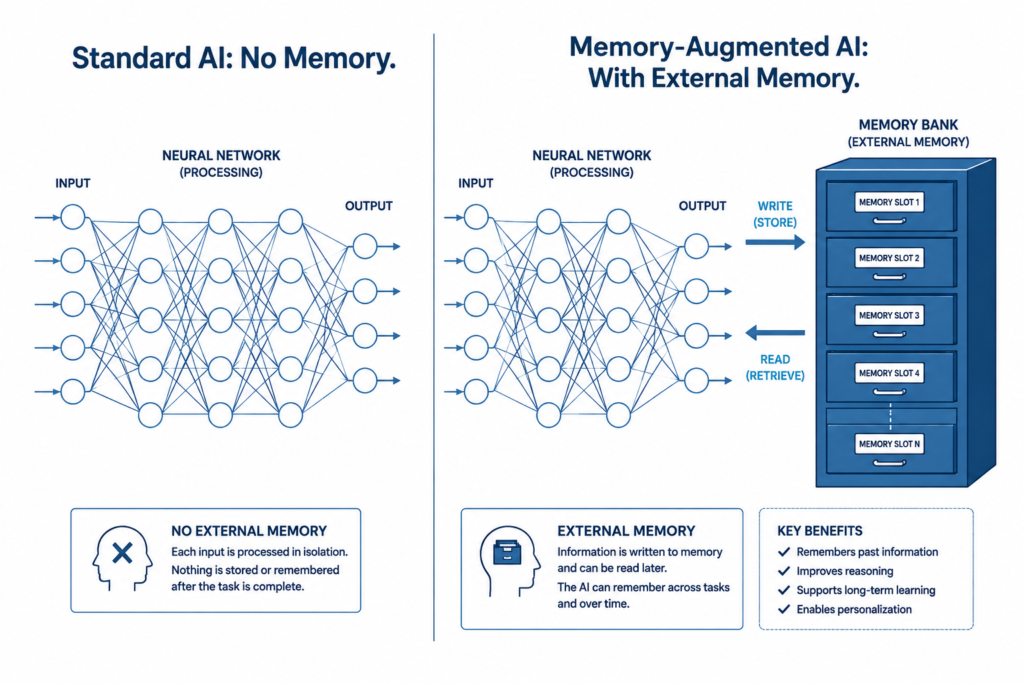
Standard neural networks — the engines behind ChatGPT, image recognition software, and voice assistants — process information and produce outputs, but they don’t remember across tasks the way humans do. Each input is treated in isolation. There’s no filing cabinet, no long-term storage, no ability to say “oh, I’ve seen something like this before.”
Memory-Augmented Neural Networks (MANNs) are the research field dedicated to fixing this fundamental limitation. They attach an external memory system to a neural network, giving AI something far closer to how human memory actually functions.
In this guide, you’ll learn exactly what MANNs are, how they work from the inside, why they matter for the future of AI, and where this research is heading in 2026 and beyond — all explained in plain language with real examples, diagrams, and code.
READ MORE: What Is Artificial Intelligence? The Ultimate Beginner’s Guide for 2026
What Is a Neural Network — And Why Can’t It Remember?
Before understanding Memory-Augmented Neural Networks, you need a clear picture of what a regular neural network is and where its memory limitation comes from.
A neural network is a system of mathematical operations loosely inspired by how brain neurons fire and connect. It takes in data — say, a sentence — processes it through multiple layers of calculations, and produces an output — say, a translation or a classification.
Here’s the critical thing: a trained neural network stores knowledge in its weights — billions of small numerical values adjusted during training. Those weights encode general patterns learned from data. But they’re frozen after training. They can’t be updated on the fly while the model is running.
This creates two distinct types of “memory” problems:
- Within-context memory — Standard transformers (the architecture behind most LLMs) can only “remember” what’s inside their current context window. Feed them a 100,000-token window and they work fine. Go beyond it, and earlier information is simply gone.
- Cross-task memory — Once a conversation ends or a task is completed, the model retains nothing. It cannot accumulate experience the way a human professional does over a career.
KEY FACT: A human doctor builds memory over 30 years of practice — pattern-matching thousands of cases, remembering unusual presentations, updating intuitions. A standard AI model resets entirely between sessions. Memory-Augmented Neural Networks are the first serious architectural attempt to close that gap.
What Are Memory-Augmented Neural Networks (MANNs)?
A Memory-Augmented Neural Network is a neural network that has been given access to an external, addressable memory structure — a separate “storage unit” that the network can read from and write to during operation, not just during training.
Think of it this way:
- A standard neural network is like a person who has studied hard and holds all knowledge in their head — but can’t take notes during a conversation.
- A MANN is like that same person given a notepad. During a task, they can jot things down, refer back to earlier notes, and update their notes as new information arrives.
The key innovation is that this memory is differentiable — meaning the process of reading and writing to memory can be trained using standard deep learning techniques (backpropagation). The network learns what to store, when to store it, and how to retrieve it — all through experience.
The three core components of any MANN are:
- The Controller — the main neural network that processes input and decides what to do
- The Memory Matrix — an external storage structure, essentially a table of stored information vectors
- Read/Write Heads — mechanisms that allow the controller to access specific locations in memory
PRO TIP: The “memory matrix” in a MANN is not like RAM in your computer where you access specific addresses directly. It uses content-based addressing — meaning the network retrieves memories based on similarity to what it’s looking for, not based on a fixed location. It’s much more like how human memory works: you remember things that feel relevant, not things at a specific brain coordinate.
The Architecture: How Does a MANN Actually Work?
Let’s go one level deeper into the mechanics. Understanding the architecture is what separates someone who’s heard of MANNs from someone who actually understands them.
The Neural Turing Machine (NTM)
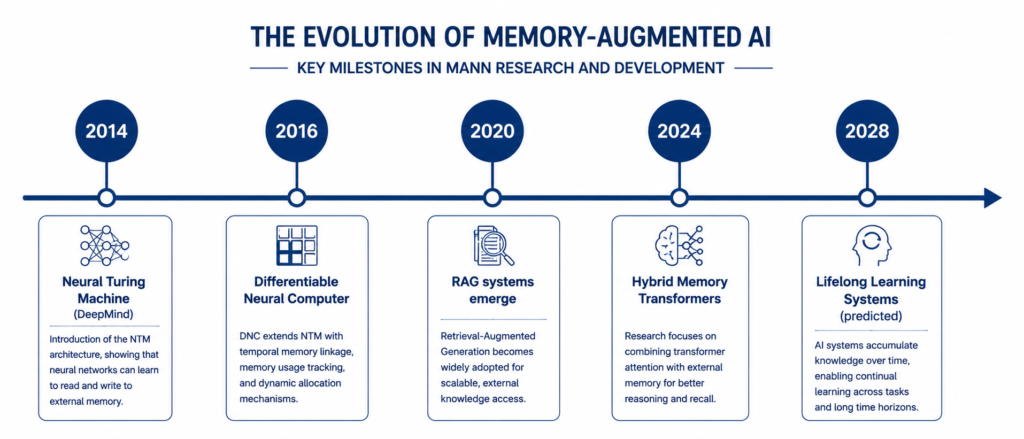
The landmark paper that launched modern MANN research was published by Alex Graves, Greg Wayne, and Ivo Danihelka at DeepMind in 2014. They introduced the Neural Turing Machine (NTM) — an architecture inspired by the theoretical Turing Machine (a mathematical model of computation) but implemented as a trainable neural network.
The NTM consists of:
- A controller network (typically an LSTM or feedforward network) that processes inputs and produces outputs
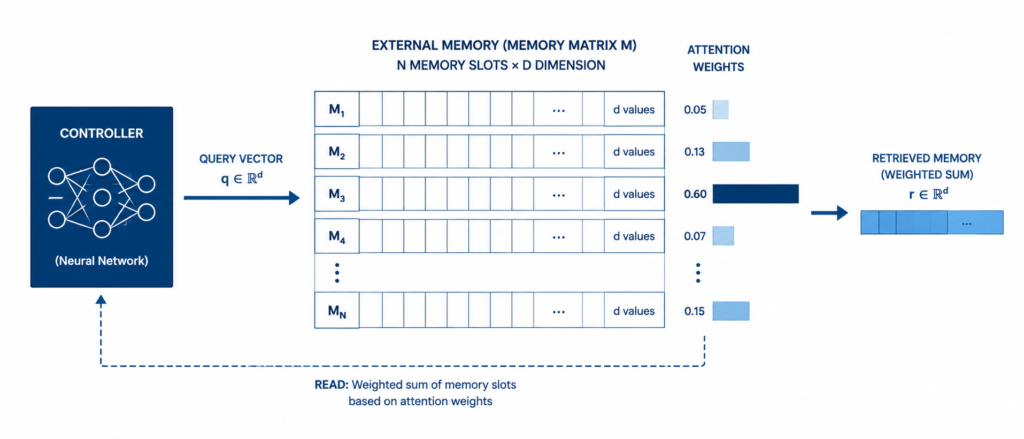
- A memory matrix M of size N × W — think of it as N rows (memory slots) each holding a W-dimensional vector
- Read heads that output a weighted average of all memory rows, where the weights reflect relevance
- Write heads that add to or erase from memory slots based on learned attention weights
Here’s a simplified code representation of the read operation:
import numpy as np

def read_from_memory(memory_matrix, key_vector, beta):
    """
    Read from external memory using content-based addressing.

    memory_matrix : shape (N, W) — N memory slots, each W-dimensional
    key_vector    : shape (W,)   — what we're 'searching for' in memory
    beta          : float        — sharpness of focus (higher = more focused)

    Returns a single vector blending all memory slots by relevance.
    """

    # Step 1: Compute cosine similarity between the key and every memory slot
    # Cosine similarity measures how 'similar' two vectors are (range: -1 to 1)
    dot_products = memory_matrix @ key_vector          # shape: (N,)
    memory_norms = np.linalg.norm(memory_matrix, axis=1)  # length of each slot
    key_norm     = np.linalg.norm(key_vector)

    cosine_similarity = dot_products / (memory_norms * key_norm + 1e-8)

    # Step 2: Apply sharpening via beta — this is the 'focus' control
    # Higher beta makes the network more selective (retrieves fewer slots)
    sharpened = np.exp(beta * cosine_similarity)

    # Step 3: Normalize to get attention weights that sum to 1 (softmax)
    attention_weights = sharpened / sharpened.sum()    # shape: (N,)

    # Step 4: Return weighted sum of all memory slots
    # This is the 'retrieved memory' — a blend weighted by relevance
    retrieved = attention_weights @ memory_matrix      # shape: (W,)
    return retrieved, attention_weights
What this code does in plain English: the network looks at every slot in its memory, scores each one by how similar it is to what it’s currently looking for, and then returns a weighted blend — pulling heavily from the most relevant slots and mostly ignoring the rest.
This is strikingly similar to how human memory retrieval works. You don’t scan memories alphabetically — you retrieve based on relevance and association.
The Differentiable Neural Computer (DNC)
In 2016, DeepMind followed up the NTM with the Differentiable Neural Computer (DNC) — a more powerful architecture that added several key improvements:
- Temporal memory linkage — the DNC tracks the order in which memory slots were written, allowing it to retrieve sequences in order
- Memory usage tracking — it keeps track of which slots are currently “occupied” to avoid overwriting important information
- Dynamic allocation — it can intelligently decide where to store new information based on usage patterns
The DNC was demonstrated solving tasks that standard neural networks simply couldn’t: navigating graph structures, answering questions requiring multi-step reasoning over stored facts, and solving small-scale planning problems.
Types of Memory in MANN Research
Not all memory is the same — and MANN research has developed distinct types of memory systems, each suited to different problems.
| Memory Type | What It Stores | How It’s Accessed | Real-World Analogy |
|---|---|---|---|
| External Memory Matrix | Explicit information vectors | Content-based attention | Notepad you can search by topic |
| Episodic Memory | Sequences of past experiences | Temporal indexing | Personal diary with timeline |
| Working Memory | Current task context | Direct read/write | Whiteboard during problem-solving |
| Semantic Memory | General facts and concepts | Similarity retrieval | Encyclopedia you can query |
| Procedural Memory | Learned sequences of actions | Pattern-triggered recall | Muscle memory for a skill |
Most MANN architectures today focus on external memory and episodic memory because these are the most tractable to implement and the most useful for practical tasks like question answering, few-shot learning, and multi-step reasoning.
Why MANNs Matter: The Problems They Actually Solve
This is where theory connects to real-world impact. MANNs are not just an academic curiosity — they address concrete limitations that prevent today’s AI from doing things we genuinely need.
Few-Shot Learning
Standard deep learning models need thousands or millions of examples to learn a new concept. A MANN can store a few examples in its external memory during inference and use them immediately to classify new inputs — much like how a human can learn to recognize a new bird species from just two or three pictures.
Long-Horizon Reasoning
Tasks that require remembering information from many steps ago — like reading a long document and answering questions about the beginning while processing the end — are naturally handled by an external memory that persists across all those steps.
Continual Learning
One of the biggest unsolved problems in AI is catastrophic forgetting — when a model learns new information, it overwrites old information, destroying previously learned skills. External memory systems naturally separate new knowledge from old, reducing this problem significantly.
Personalization
A MANN-based system could maintain a persistent memory of individual users across sessions — preferences, past interactions, learned context — without needing to retrain the underlying model. This has obvious applications in healthcare, education, and personal assistants.
WARNING: Persistent memory also raises serious privacy concerns. A system that remembers everything about every user interaction is, by definition, a system holding potentially sensitive personal data indefinitely. Researchers working on MANN applications must take privacy-by-design seriously — not as an afterthought.
MANNs vs. Other Memory Approaches: How Do They Compare?
Memory-Augmented Neural Networks are not the only approach researchers have taken to give AI better memory. Here’s how they compare to the main alternatives:
| Approach | How Memory Works | Strengths | Weaknesses |
|---|---|---|---|
| MANN (NTM/DNC) | External differentiable memory matrix | Flexible, trainable, generalizable | Computationally expensive, complex to train |
| Transformer Context Window | All context held in attention layers | Simple, works well short-term | Limited by context length, no true persistence |
| Retrieval-Augmented Generation (RAG) | Searches external document database | Scalable, easy to update | Not end-to-end trained, retrieval errors cascade |
| Long Short-Term Memory (LSTM) | Hidden state carries memory through time | Good for sequences | Hidden state too small for complex long-term storage |
| Vector Databases | Store embeddings, retrieve by similarity | Fast at scale | Static, not learned dynamically during inference |
The honest picture: today’s most deployed AI systems (like large language models) use Retrieval-Augmented Generation (RAG) for memory, not pure MANNs. RAG is simpler to implement at scale. But MANNs represent a more principled, end-to-end trainable approach that many researchers believe is closer to how biological memory actually works — and therefore more likely to scale to genuinely human-like memory capabilities.
Real-World Applications of Memory-Augmented Neural Networks
Where are MANNs actually being used or seriously researched right now?
Medical Diagnosis Support
Researchers have applied MANN architectures to rare disease diagnosis — a problem where any single doctor has seen very few examples. A MANN can store cases in its external memory during inference, allowing it to recognize patterns across a small set of examples far more effectively than standard models.
Robotic Task Planning
For a robot to complete a multi-step physical task — “fetch the red mug from the shelf, bring it to the kitchen, fill it with water” — it needs to remember what it has done and what remains. MANN architectures are being explored as planning modules in robotic systems precisely because they handle this sequential memory naturally.
Personalized Education
A tutoring AI that remembers every concept a student has struggled with, adapts its explanations based on past sessions, and tracks knowledge gaps over weeks or months would be dramatically more effective than a system that resets after each session. MANNs are a natural architectural fit for this use case.
Code Generation and Debugging
Modern AI coding assistants like GitHub Copilot work primarily within a single context window. A MANN-augmented coding assistant could remember architecture decisions made earlier in a project, track known bugs, and maintain a mental model of a large codebase across multiple sessions.
# Conceptual example: how a MANN-augmented coding assistant
# might store and retrieve project-specific memory

class MANNCodingAssistant:
    def __init__(self, memory_slots=1000, vector_dim=512):
        self.memory = ExternalMemory(slots=memory_slots, dim=vector_dim)
        self.controller = NeuralController(input_dim=vector_dim)

    def remember_decision(self, decision_text, context_vector):
        """Store an architectural decision in external memory."""
        # Encode the decision into a dense vector representation
        decision_vector = self.controller.encode(decision_text)

        # Write to the least-used memory slot (dynamic allocation)
        slot_index = self.memory.find_free_slot()
        self.memory.write(slot_index, decision_vector, context_vector)
        print(f"Stored decision at memory slot {slot_index}")

    def recall_relevant(self, current_query):
        """Retrieve the most relevant past decisions for the current task."""
        query_vector = self.controller.encode(current_query)

        # Retrieve top-k most similar stored decisions
        retrieved, weights = self.memory.read(query_vector, top_k=5)
        return retrieved  # Returns relevant context to inform current output
PRO TIP: If you’re a developer following AI research, watch the intersection of MANNs and in-context learning closely. The question of whether memory should live inside the model (as learned weights), in the context window (as recent text), or in an external structure (as in MANNs) is one of the most active and consequential debates in AI architecture right now.
READ MORE: AI Reasoning Breakthroughs: How Machines Are Learning to Think Step by Step
Current Limitations and Open Research Challenges
MANNs are powerful in theory and promising in research settings, but they come with real challenges that have prevented wide deployment so far.
- Scaling difficulty — Training a network that learns to read and write to memory efficiently at the scale of modern LLMs (billions of parameters) remains an unsolved engineering challenge
- Training instability — The attention mechanisms that control memory access can be hard to train stably, especially on long sequences
- Memory capacity vs. retrieval precision — Larger memory matrices hold more information but can produce noisier retrievals; finding the right balance is non-trivial
- Evaluation benchmarks — The field lacks standardized, universally accepted benchmarks for measuring memory capability, making it hard to compare architectures fairly
- Integration with transformers — Combining external memory with modern transformer architectures cleanly and efficiently is an active area of research without a clear consensus solution yet
KEY FACT: At NeurIPS 2024, several papers explored hybrid architectures combining transformer attention with external memory modules. The consensus in the research community is that pure MANNs and pure transformers will likely converge into unified architectures by the late 2020s — taking the best of both approaches.
The Future: Where MANN Research Is Heading in 2026 and Beyond
The trajectory of this research field points toward several exciting directions:
Lifelong Learning Systems — AI models that accumulate knowledge over years of deployment, much like a human professional, without requiring full retraining. MANNs are a core architectural component of most proposals for achieving this.
Hybrid Memory Architectures — Combining the flexibility of external memory with the power of large pre-trained transformers. Researchers at Google DeepMind, Meta AI, and several academic labs are actively working on this.
Neurobiologically-Inspired Memory — Taking cues from how the hippocampus and neocortex interact in human memory consolidation — storing experiences in fast short-term memory and gradually moving important ones to slower long-term storage. Computational neuroscience and AI research are converging here.
Memory for Agentic AI — As AI systems increasingly operate as autonomous agents — planning, executing multi-step tasks, working across long time horizons — persistent memory becomes not optional but essential.
FAQ: Memory-Augmented Neural Networks
Q1: What is the simplest way to explain a Memory-Augmented Neural Network?
It’s a neural network with a separate “notepad” it can read from and write to while working. Standard neural networks hold all knowledge baked into their parameters from training and can’t update during use. A MANN can dynamically store and retrieve specific pieces of information during inference — making it far better at tasks that require remembering details across many steps.
Q2: How is a MANN different from just giving an AI a larger context window?
A larger context window keeps more text in the AI’s “short-term attention” — but it’s still bounded, still temporary, and still processed all at once with quadratic computational cost. A MANN’s external memory is separate from the computation, can be much larger, can persist across sessions, and is accessed selectively rather than all at once. The two approaches are complementary, not equivalent.
Q3: Are MANNs used in ChatGPT or Claude?
Not in the classical MANN sense. Current large language models like GPT-4, Claude, or Gemini use context windows and, increasingly, Retrieval-Augmented Generation (RAG) for memory. True MANN architectures — with differentiable external memory that the model trains to read and write — are still primarily in the research phase, though elements of the approach are influencing how next-generation architectures are being designed.
Q4: What programming frameworks are used to implement MANNs?
PyTorch is the dominant framework for MANN research, primarily because its dynamic computation graphs make it easier to implement the variable-length memory access patterns MANNs require. TensorFlow and JAX are also used. Most published MANN implementations include custom memory modules built on top of standard deep learning layers.
Q5: What is the Neural Turing Machine and why is it important?
The Neural Turing Machine (NTM), proposed by DeepMind in 2014, was the first major architecture to combine a neural network controller with a differentiable external memory. It proved that a neural network could learn to use memory in a general, task-agnostic way — solving algorithmic tasks like sorting and copying that pure neural networks failed at. It launched the entire modern MANN research field and remains the foundational reference for the architecture.
Q6: Can MANNs solve the catastrophic forgetting problem in AI?
Partially — and this is one of the most active research questions. External memory in MANNs does reduce catastrophic forgetting because new information can be stored in fresh memory slots rather than overwriting existing weights. However, the controller network itself (still a standard neural network) remains susceptible to forgetting. Truly solving catastrophic forgetting likely requires combining external memory with other techniques like elastic weight consolidation or modular network architectures.
The AI That Finally Remembers Is Almost Here
Memory has always been the missing piece. We’ve built AI systems that can reason, generate, translate, and create — but systems that genuinely remember the way humans do have remained elusive. Memory-Augmented Neural Networks represent the most technically principled approach to closing that gap.
From the Neural Turing Machine’s first demonstration in 2014 to today’s hybrid memory-transformer research, this field has steadily built the tools that will eventually give AI systems something resembling genuine long-term memory — not just a bigger context window, but a true architecture for accumulating and retrieving experience over time.
If you found this breakdown useful, share it with someone learning about AI — this is exactly the kind of architectural knowledge that separates surface-level AI literacy from genuine understanding. Drop a comment below with your questions or thoughts on where AI memory research is heading. And if you want to go deeper on how these models actually learn, check out our guide on Reinforcement Learning From Human Feedback (RLHF): How AI Learns From Us — another foundational piece of the modern AI puzzle.

Author: AI Learner Tech
AI Learner Tech is a premier research and educational hub dedicated to mastering Artificial Intelligence, Machine Learning, and Computer Vision. We bridge the gap between complex academic theories and real-world industrial applications. Join our community to access high-quality tutorials, open-source projects, and expert insights. Website: ailearner.tech