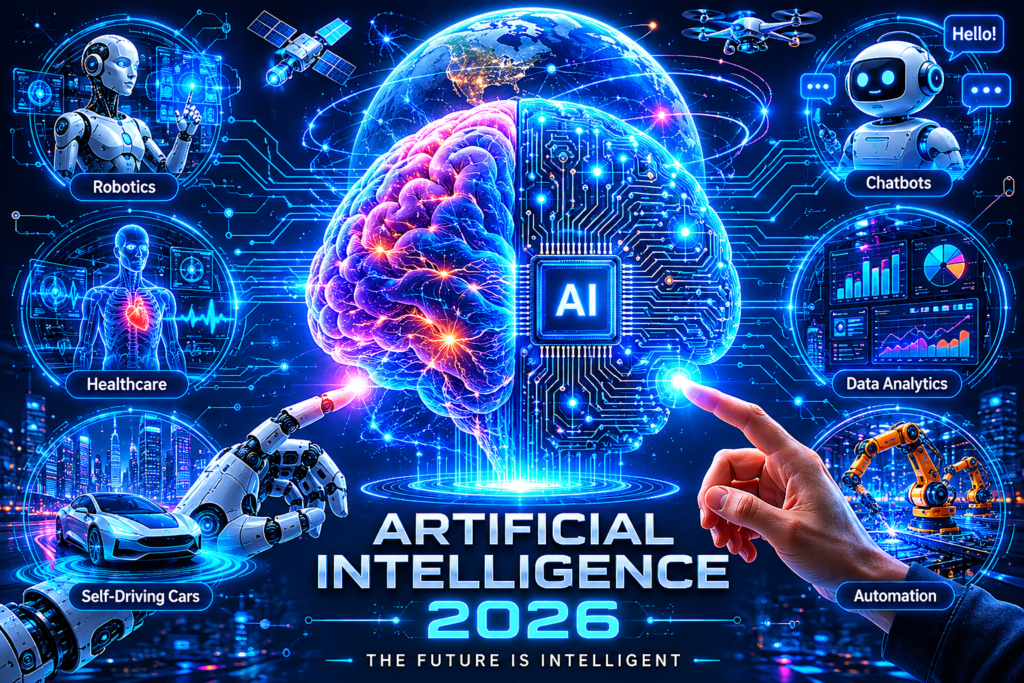
Did you know that by 2026, over 77% of the devices you use daily already have some form of Artificial Intelligence built inside them? From the moment your phone unlocks using your face, to Netflix recommending your next binge-worthy show, to Google finishing your sentence before you even type it — AI is already running your life. And most people have absolutely no idea.
But here is the scary part: the people who understand AI will have an enormous advantage over those who don’t — in jobs, in business, and in life. The next decade belongs to people who learn to work with AI, not against it.
In this complete beginner’s guide, you will learn:
- What Artificial Intelligence actually is (in plain English, no jargon)
- How AI works step by step
- The different types of AI and what makes each one unique
- Real-world examples of AI you already use every day
- The future of AI from 2026 all the way to 2050
- How to start learning AI even if you have zero technical background
Let’s begin.
What Is Artificial Intelligence? The Simple Definition
Artificial Intelligence, or AI, is the ability of a computer or machine to perform tasks that normally require human intelligence.
Think about what humans are good at:
- Understanding language
- Recognizing faces and objects
- Making decisions
- Learning from mistakes
- Solving complex problems
AI teaches machines to do all of these things — and in many cases, do them faster and more accurately than any human ever could.
📌 KEY FACT: The term “Artificial Intelligence” was first coined in 1956 by computer scientist John McCarthy at a conference at Dartmouth College. It took almost 70 years — but AI has finally arrived in full force.
Here is the simplest way to think about it:
If a machine can observe, learn, reason, and act — it is using Artificial Intelligence.
That’s it. No magic. No science fiction. Just very, very smart software.
How Does AI Actually Work? Step by Step
Most people assume AI is some mysterious black box. It is not. At its core, AI follows a surprisingly logical process.
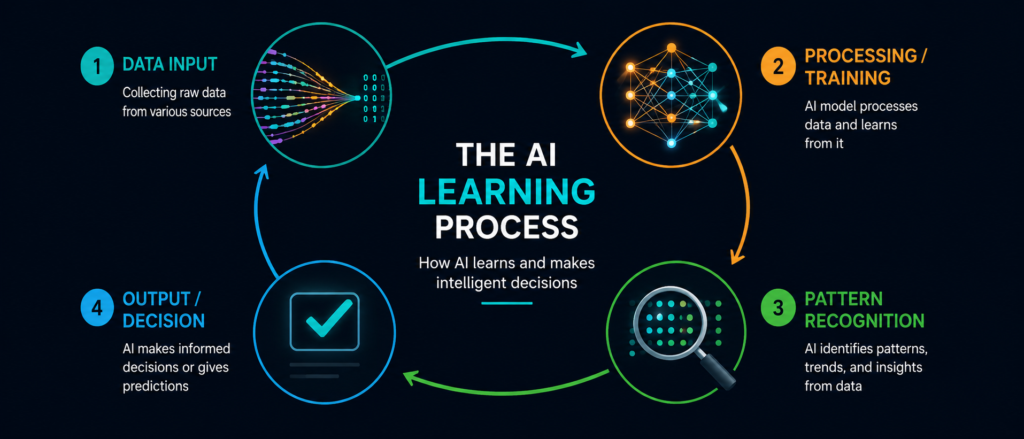
Step 1 — Feed It Data
AI learns from data — just like humans learn from experience. You show an AI system thousands (sometimes millions) of examples. Want to teach AI to recognize cats? Show it 1 million cat photos. Want it to understand English? Feed it billions of sentences.
Step 2 — Train the Model
The AI uses something called a model — a mathematical system that finds patterns in the data. During training, the model keeps adjusting itself, making better and better guesses until it gets very accurate.
Step 3 — Test and Evaluate
After training, you test the AI on new data it has never seen before. This tells you if it truly learned the pattern — or just memorized the examples.
Step 4 — Deploy and Improve
Once the AI performs well, it gets deployed into a real product. It keeps learning from new data over time, getting smarter with every interaction.
💡 PRO TIP: This entire process — feeding data, training, testing, and improving — is called the Machine Learning Pipeline. Learning this pipeline is the first step to becoming an AI engineer.
The 4 Types of Artificial Intelligence Explained
Not all AI is the same. Scientists classify AI into four major types based on capability:
| Type | Name | Can It Learn? | Can It Feel? | Example |
|---|---|---|---|---|
| Type 1 | Reactive Machines | ❌ No | ❌ No | IBM Deep Blue (Chess AI) |
| Type 2 | Limited Memory AI | ✅ Yes | ❌ No | Self-driving cars, ChatGPT |
| Type 3 | Theory of Mind AI | 🔄 In Progress | 🔄 In Progress | Research phase only |
| Type 4 | Self-Aware AI | ❌ Not Yet | ❌ Not Yet | Science fiction (for now) |
Let’s break each one down:
🔵 Type 1 — Reactive Machines
These are the simplest AI systems. They react to specific inputs with specific outputs. They have no memory, no learning ability. The famous IBM chess computer “Deep Blue” that defeated world champion Garry Kasparov in 1997 was a reactive machine — brilliant at chess, useless at anything else.
🟢 Type 2 — Limited Memory AI (Where We Are Today)
This is the AI powering our world right now. These systems learn from past data and use that memory to make better decisions. Your email spam filter, Google Maps traffic prediction, ChatGPT, and Tesla’s Autopilot — all Type 2 AI.
🟡 Type 3 — Theory of Mind AI (Coming Soon)
This future AI will understand human emotions, beliefs, and intentions. It will be able to have a genuine conversation, understand context, and respond like a human being. We are getting closer — but not there yet.
🔴 Type 4 — Self-Aware AI (The Future)
You do not need to be a tech expert to experience AI. Here are 7 ways AI is already in your daily life — right now:
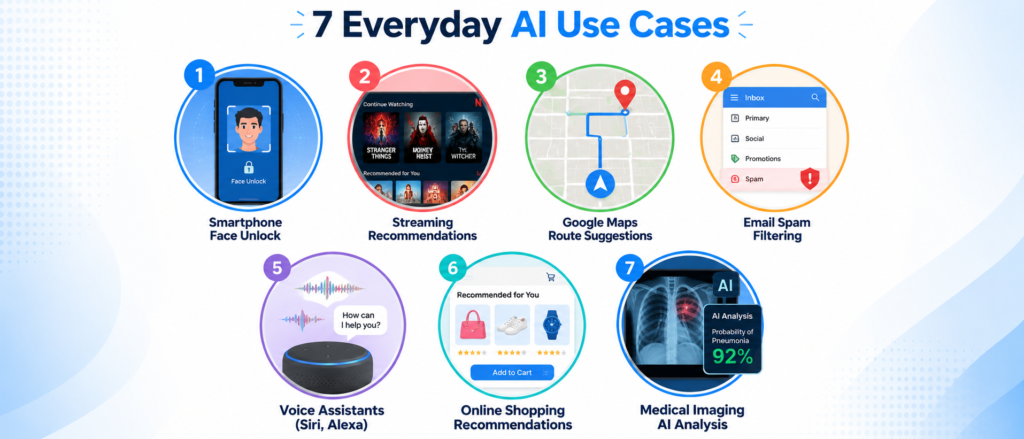
1. 🔓 Face Unlock on Your Smartphone
Your phone scans your face using a computer vision AI that maps over 30,000 invisible dots on your face. It compares this to a stored model and unlocks in milliseconds. This same technology is used in airport security worldwide.
2. 📺 Netflix & YouTube Recommendations
Every video Netflix suggests is chosen by an AI that has analyzed your watch history, pause points, rewatch behavior, and time of day. Netflix claims its recommendation AI saves the company over $1 billion per year in customer retention.
3. 🗺️ Google Maps Traffic Prediction
When Google Maps says your route will take 23 minutes, it is using AI to process real-time GPS data from millions of phones, historical traffic patterns, road incidents, and weather — all in under a second.
4. 📧 Email Spam Filters
Your Gmail spam folder exists because of AI. A Natural Language Processing (NLP) model reads every incoming email and decides whether it is spam or legitimate — blocking billions of harmful emails every single day.
5. 🛍️ Amazon Product Recommendations
“Customers who bought this also bought…” — that is AI. Amazon’s recommendation engine is responsible for 35% of all its total revenue. One AI system generating billions of dollars.
6. 🏥 Medical Diagnosis AI
AI systems like Google’s DeepMind can now detect eye diseases, breast cancer, and lung tumors from medical scans — sometimes more accurately than trained doctors. This is saving lives right now.
7. 💬 AI Chatbots (ChatGPT, Claude, Gemini)
You are likely already using these. These Large Language Models are trained on vast amounts of text and can write, code, explain, translate, and reason — changing how we work and learn forever.
⚠️ WARNING: Not all “AI-powered” products are genuinely intelligent. Many companies put the “AI” label on basic software to appear more advanced. Always look for real capabilities, not just marketing buzzwords.
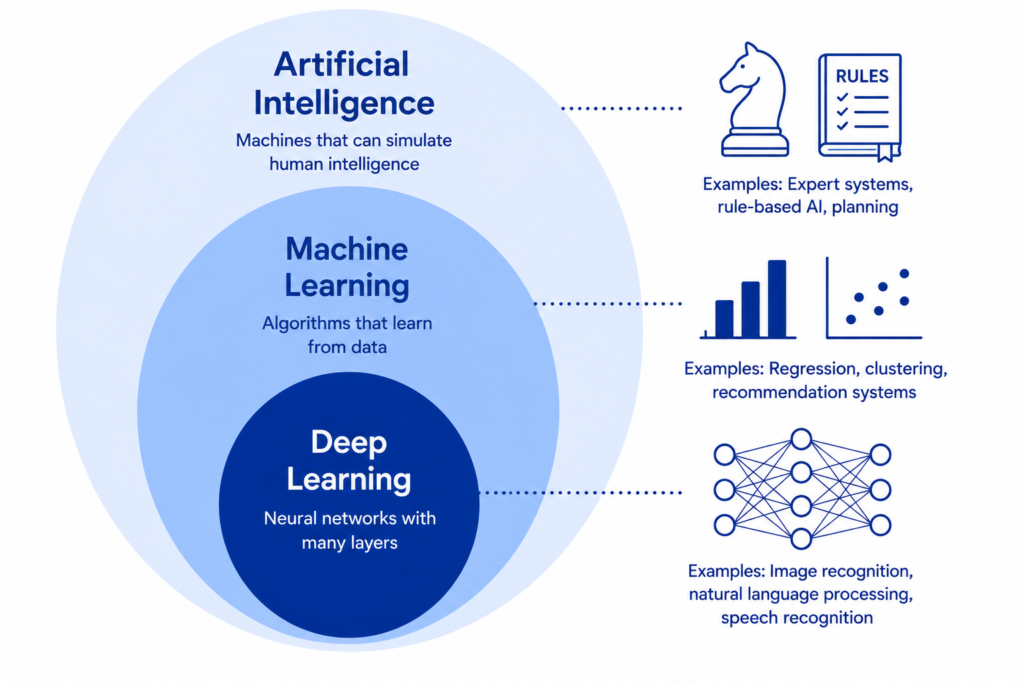
AI vs Machine Learning vs Deep Learning — What Is the Difference?
This is the most common confusion among beginners. Here is a clear explanation:
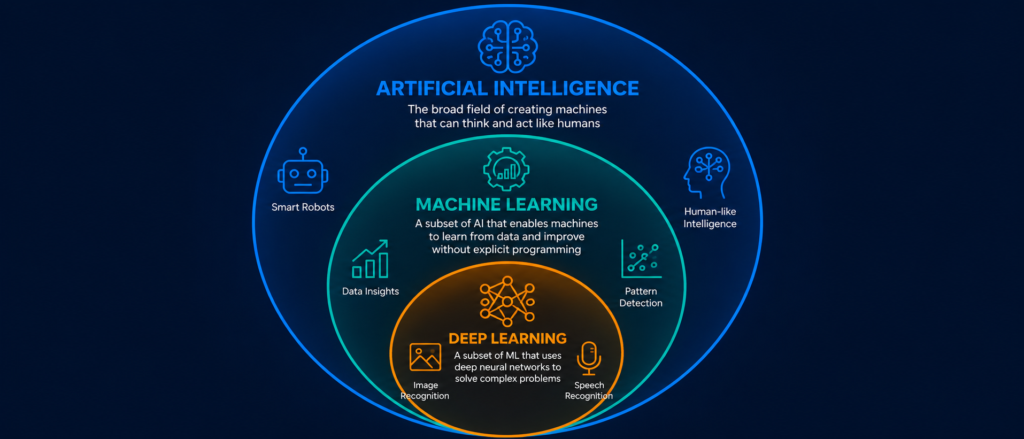
Think of it like three nested circles:
| Term | What It Means | Example |
|---|---|---|
| Artificial Intelligence | The broad field — any machine showing intelligence | Chess programs, voice assistants |
| Machine Learning | A subset of AI — machines that learn from data | Email spam filter, recommendation engines |
| Deep Learning | A subset of ML — using neural networks with many layers | Image recognition, ChatGPT, self-driving cars |
The simplest way to remember:
All Deep Learning is Machine Learning. All Machine Learning is AI. But not all AI is Machine Learning.
The 5 Biggest AI Breakthroughs of the Last 5 Years
| Year | Breakthrough | Why It Mattered |
|---|---|---|
| 2020 | GPT-3 Released | First AI that could write like a human at scale |
| 2021 | AlphaFold Solves Protein Folding | Solved a 50-year biology problem in months |
| 2022 | ChatGPT Launch | 100 million users in 2 months — fastest ever |
| 2023 | GPT-4 Multimodal | AI could now see, read, and understand images |
| 2024–2025 | Agentic AI Systems | AI that can take actions, not just answer questions |
📌 KEY FACT: ChatGPT reached 100 million users in just 2 months — making it the fastest-growing application in human history. For comparison, Instagram took 2.5 years to reach the same milestone.
The Future of AI: 2026 to 2050
Where is all of this heading? Here is a realistic timeline of what experts predict:
🗓️ 2026–2030: The Age of AI Assistants
- Every smartphone has a personal AI assistant smarter than today’s ChatGPT
- AI co-pilots in medicine, law, and education become standard
- Most repetitive office jobs begin automating
🗓️ 2030–2040: The Age of Autonomous AI
- Self-driving vehicles become mainstream globally
- AI makes scientific discoveries independently
- Brain-computer interfaces begin entering consumer markets
🗓️ 2040–2050: The Age of General Intelligence
- AGI (Artificial General Intelligence) may be achieved
- AI handles most cognitive tasks better than humans
- New economy forms around human-AI collaboration
💡 PRO TIP: You do not need to fear AI replacing you. You need to fear someone who knows AI replacing you. The best career move in 2026 is learning to work with AI tools, not avoiding them.
How to Start Learning AI in 2026 — Complete Beginner Path
You do not need a computer science degree. Here is a realistic learning path:
📅 Month 1–2: Build the Foundation
- Learn Python basics (free: Python.org, freeCodeCamp)
- Understand what data is and how to work with it
- Complete Google’s free “AI Essentials” course
📅 Month 3–4: Machine Learning Basics
- Learn Scikit-learn (Python library for ML)
- Build your first classification model
- Understand how training and testing works
📅 Month 5–6: Deep Learning & AI Tools
- Learn TensorFlow or PyTorch basics
- Experiment with pre-built AI APIs (OpenAI, Google AI)
- Build a small project — a chatbot, image classifier, or data predictor
📅 Month 7–12: Specialize & Build Portfolio
- Choose a focus: Computer Vision, NLP, Data Science, or AI Research
- Complete 3–5 real projects
- Share on GitHub and LinkedIn
| Resource | Cost | Level | Best For |
|---|---|---|---|
| fast.ai | Free | Beginner | Deep Learning |
| Coursera (Andrew Ng) | Paid/Free Audit | Beginner | ML Foundations |
| Kaggle | Free | All Levels | Practice Projects |
| Google AI | Free | Beginner | AI Literacy |
| Hugging Face | Free | Intermediate | NLP & Models |
READ MORE: What Is Artificial Intelligence? Updated Ultimate Beginner’s Guide for 2026
Frequently Asked Questions (FAQ)
❓ Is Artificial Intelligence dangerous?
AI itself is a tool — like electricity or the internet. The danger comes from how it is used. Poorly designed AI can have biases, make wrong medical decisions, or be weaponized for misinformation. This is why AI safety and ethics is one of the most important research fields today. Responsible development and regulation are key.
❓ Can AI replace human jobs completely?
AI will automate many tasks — but replacing entire jobs is far more complex. Most experts believe AI will transform jobs rather than simply eliminate them. New roles will emerge that did not exist before. The workers most at risk are those who refuse to adapt and learn new skills.
❓ Do I need to know coding to work with AI?
Not necessarily. Many AI tools today are no-code or low-code. However, knowing Python gives you a massive advantage — it opens up the ability to build, customize, and understand AI at a deeper level. Even basic Python knowledge sets you far ahead of the average person.
❓ What is the difference between AI and a robot?
A robot is a physical machine that can move and interact with the physical world. AI is software — a program that thinks and learns. Some robots use AI to make decisions (like Boston Dynamics’ robots), but most AI exists purely in software with no physical body (like ChatGPT).
❓ How long does it take to learn AI from scratch?
With consistent daily effort (1–2 hours per day), most beginners can build solid foundational AI skills in 6 to 12 months. Getting to a professional, job-ready level typically takes 12 to 24 months of focused learning and project building.
❓ What programming language is best for AI?
Python is the undisputed king of AI and machine learning. Over 90% of AI projects, research papers, and industry tools use Python. If you learn one language for AI — make it Python.
❓ Is AI only for big companies and experts?
Absolutely not. In 2026, anyone with a laptop and an internet connection can access state-of-the-art AI tools — for free or at very low cost. Google, OpenAI, Meta, and Hugging Face all offer free AI models and tools that were worth billions of dollars just a few years ago.
Conclusion
Artificial Intelligence is no longer the future — it is the present. From the phone in your pocket to the hospital that may save your life, AI is already embedded into the fabric of modern civilization. And it is only accelerating.
The question is not whether AI will change your world. It already has. The question is whether you will be a passive observer — or an active participant who understands, uses, and shapes this technology.
You do not need to become an AI scientist. But understanding the basics — what AI is, how it works, and where it is going — gives you a powerful advantage in any career, any business, and any field.
Start today. Even reading this article puts you ahead of the majority.
📣 Found this guide helpful? Share it with someone who still thinks AI is just science fiction. And drop a comment below — what aspect of AI are you most curious or excited about? We read every single one.

Author: AI Learner Tech
AI Learner Tech is a premier research and educational hub dedicated to mastering Artificial Intelligence, Machine Learning, and Computer Vision. We bridge the gap between complex academic theories and real-world industrial applications. Join our community to access high-quality tutorials, open-source projects, and expert insights. Website: ailearner.tech