A Computer That Calculates Every Possible Answer at the Same Time — No, Really
Classical computers — the ones in your phone, your laptop, the servers running ChatGPT — work by processing one calculation at a time, very fast. Even when they feel instant, they’re executing steps sequentially, flipping millions of tiny switches called transistors between 0 and 1.
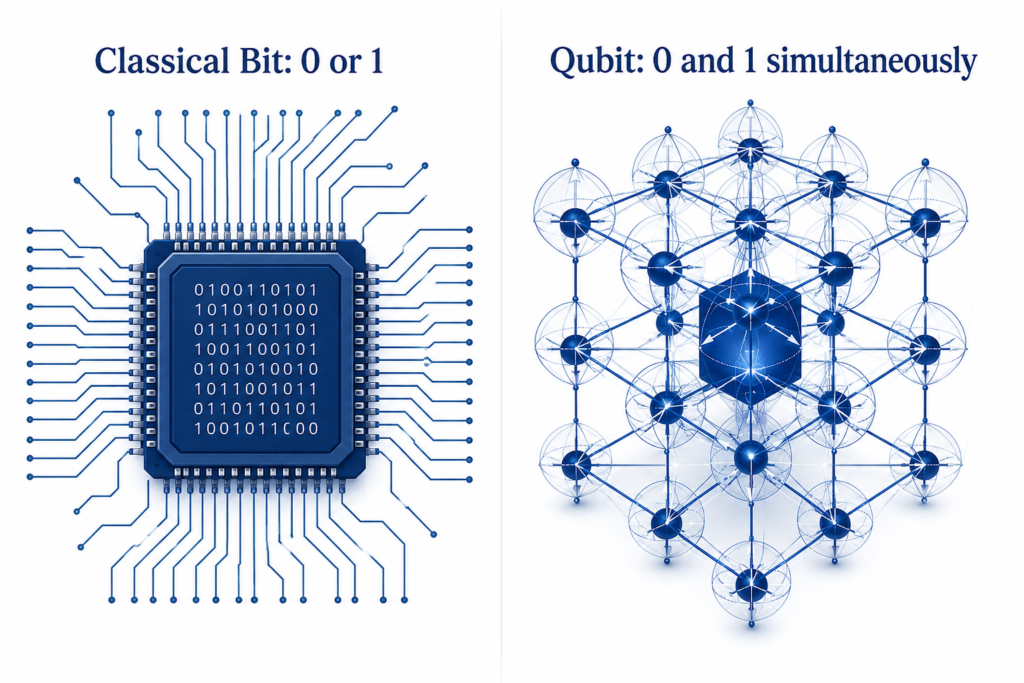
Quantum AI quantum computers do something so different it breaks your intuition. Instead of a bit being either 0 or 1, a qubit — the quantum equivalent — can be both 0 and 1 at the same time. This property, called superposition, means a quantum computer with 300 qubits can represent more simultaneous states than there are atoms in the observable universe.
Now combine that with machine learning — the technology already reshaping medicine, science, and everyday life — and you get Quantum AI: one of the most genuinely exciting and genuinely overhyped frontiers in all of modern technology.
The honest reality? Quantum AI is not going to replace your GPU cluster next year. But within a decade, specific quantum machine learning techniques could crack problems that classical AI will never solve — drug molecule simulation, cryptography-proof optimization, and training AI on datasets so complex that today’s computers would need millions of years.
In this guide, you’ll learn exactly what quantum computing is, how it interacts with machine learning, what Quantum AI can realistically do that classical AI cannot, and why the hype and the genuine breakthroughs are both real — just in different proportions.
READ MORE: What Is Artificial Intelligence? The Ultimate Beginner’s Guide for 2026
Classical Computing vs. Quantum Computing: The Real Difference
Before combining quantum computing with machine learning, you need a solid mental model of what makes quantum computers fundamentally different from classical ones. This section covers three concepts — superposition, entanglement, and interference — that underpin everything in Quantum AI.
Superposition: Being in Two States at Once
A classical bit is a light switch — it’s either on (1) or off (0). A qubit is more like a spinning coin — while it spins, it’s neither heads nor tails. It exists in a probabilistic blend of both states simultaneously. Only when you “observe” it (measure it) does it collapse to a definite 0 or 1.
This means a quantum computer with N qubits can represent 2^N states simultaneously:
| Qubits | Simultaneous States | Classical Equivalent |
|---|---|---|
| 10 | 1,024 | Standard pocket calculator |
| 50 | ~1 quadrillion | Supercomputer needed |
| 100 | ~1 nonillion | No classical computer can match |
| 300 | More than atoms in universe | Physically impossible classically |
Entanglement: Qubits That Are Linked Across Space
When two qubits become entangled, measuring one instantly determines the state of the other — regardless of distance. Einstein famously called this “spooky action at a distance” and hated it. But it’s experimentally confirmed and it gives quantum computers a way to coordinate massive parallel computations in a way classical systems cannot replicate.
Interference: Amplifying Right Answers, Canceling Wrong Ones
Quantum algorithms are designed to use wave-like interference to make correct answer paths reinforce each other and incorrect paths cancel out. This is the mechanism by which quantum computers don’t just process all possibilities simultaneously — they actually guide the computation toward the right answer.
KEY FACT: The combination of superposition, entanglement, and interference is what gives quantum computers their theoretical advantage — not just raw speed. It’s a fundamentally different computational model, not just a faster classical computer.
What Is Quantum Machine Learning (QML)?
Quantum Machine Learning (QML) is the field that sits at the intersection of quantum computing and machine learning. It asks a deceptively simple question: can quantum computers make machine learning faster, more powerful, or capable of things classical ML simply cannot do?
Researchers are exploring this intersection from two directions:
Direction 1: Quantum-Enhanced Classical ML Using quantum algorithms to speed up specific steps within classical machine learning pipelines — matrix operations, optimization, sampling — while keeping the overall framework classical.
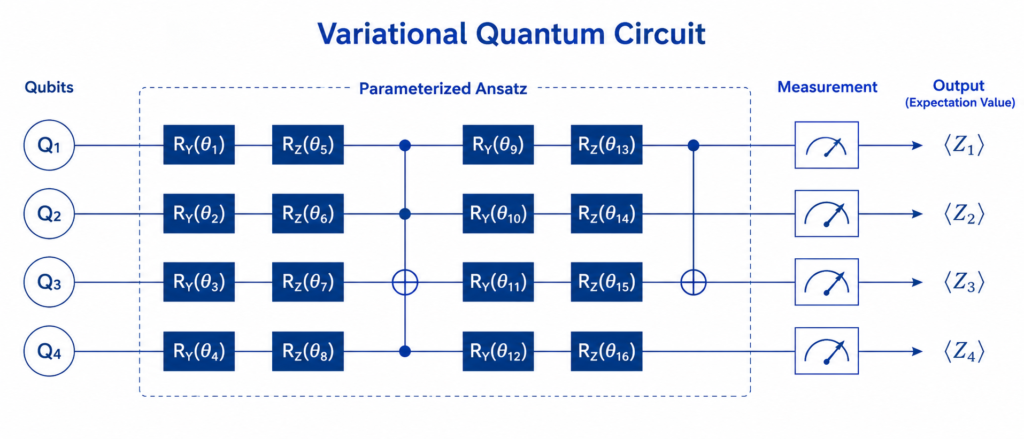
Direction 2: Genuinely Quantum ML Models Building machine learning models that run natively on quantum hardware — Quantum Neural Networks (QNNs) and Variational Quantum Circuits (VQCs) — which have no direct classical equivalent.
The honest assessment of where each stands:
| Approach | Maturity Level | Realistic Timeline | Key Bottleneck |
|---|---|---|---|
| Quantum speedup for optimization | Early research | 5–10 years for useful scale | Error correction, qubit count |
| Quantum speedup for sampling | Demonstrated in theory | 5–10 years | Fault-tolerant hardware |
| Quantum Neural Networks | Proof of concept | 10–15 years for advantage | Barren plateau problem |
| Quantum data encoding | Active research | 3–5 years for specific domains | Loading classical data efficiently |
| Quantum chemistry ML | Most mature | 3–7 years for drug discovery | Domain-specific, not general |
The Three Quantum Advantages That Actually Matter for AI
Not every ML problem benefits from quantum computing. The genuine advantages cluster around three specific areas:
Advantage 1: Exponential Speedup for Linear Algebra
Many of the most computationally expensive operations in machine learning — matrix multiplication, solving systems of linear equations, principal component analysis — have quantum counterparts that are theoretically exponentially faster.
The HHL algorithm (Harrow-Hassidim-Lloyd, 2009) demonstrated that quantum computers could solve certain systems of linear equations exponentially faster than classical computers. Since linear algebra is the backbone of neural network training, this has obvious implications.
PRO TIP: The HHL speedup has important caveats — it assumes the data is already in quantum form (a major practical challenge) and the speedup applies to a specific class of problems. Don’t interpret “exponentially faster linear algebra” as “training GPT-6 in seconds.” The conditions required are strict. But for specific scientific computing applications, this is a real and significant advantage.
Advantage 2: Quantum Sampling for Generative Models
Generative AI models — like the diffusion models behind image generators — require sampling from complex probability distributions. This is computationally expensive classically. Quantum computers can sample from certain distributions in ways that have no efficient classical equivalent.
This could enable generative models of extraordinary complexity — modeling the full probability distribution of protein folding configurations, for example, or generating candidate drug molecules with properties specified at the quantum chemistry level.
Advantage 3: Native Quantum Data Processing
Here’s an advantage that doesn’t get enough attention: some data is already quantum in nature. The behavior of molecules, chemical reactions, and materials properties is governed by quantum mechanics. Simulating these systems on classical computers requires exponential approximations. Quantum computers can model quantum systems directly.
This means Quantum AI’s earliest and most certain wins will be in quantum chemistry and materials science — using quantum machine learning to predict molecular properties, discover new materials, and design drugs at a level of accuracy that classical AI cannot reach
# Conceptual example: Variational Quantum Circuit (VQC)
# This shows the structure of a quantum neural network layer
# using PennyLane — a real quantum ML library

import pennylane as qml
import numpy as np

# Define a quantum device with 4 qubits
# In a real system, this would run on quantum hardware
dev = qml.device("default.qubit", wires=4)

@qml.qnode(dev)
def quantum_circuit(inputs, weights):
    """
    A single layer of a Variational Quantum Circuit (VQC).
    This is the quantum equivalent of a neural network layer.

    inputs  : classical data encoded into qubit rotation angles
    weights : trainable parameters (like weights in a neural network)
    """

    # Step 1: Encode classical input data into qubits
    # Each input value rotates a qubit by that angle on the Y-axis
    # This is called 'angle encoding' — one way to load data into qubits
    for i, x in enumerate(inputs):
        qml.RY(x, wires=i)          # Rotate qubit i by angle x

    # Step 2: Apply trainable rotation gates (the 'learnable' part)
    # These are optimized during training, just like neural net weights
    for i in range(4):
        qml.RY(weights[i, 0], wires=i)   # Trainable Y-rotation
        qml.RZ(weights[i, 1], wires=i)   # Trainable Z-rotation

    # Step 3: Entangle qubits using CNOT gates
    # This creates correlations between qubits — the quantum advantage
    # Each CNOT links two qubits so they affect each other's state
    qml.CNOT(wires=[0, 1])
    qml.CNOT(wires=[1, 2])
    qml.CNOT(wires=[2, 3])
    qml.CNOT(wires=[3, 0])  # Circular entanglement

    # Step 4: Measure the expected value of qubit 0
    # This collapses quantum state to a classical output value
    return qml.expval(qml.PauliZ(0))

# Initialize random weights — shape (4 qubits, 2 rotation axes)
weights = np.random.uniform(0, 2 * np.pi, (4, 2))
sample_input = np.array([0.5, 1.2, 0.8, 0.3])  # Classical data point

output = quantum_circuit(sample_input, weights)
print(f"Quantum circuit output: {output:.4f}")
# This single output value is then used in a loss function
# and optimized using gradient descent — just like classical ML
What this code shows: a quantum circuit works in layers just like a neural network. Data goes in, gets processed through quantum gates, and a measurement comes out. The difference is that intermediate steps exploit quantum superposition and entanglement — processing many possible states simultaneously before collapsing to a final answer.
The Biggest Challenges Holding Quantum AI Back
The potential is real. The timeline is long. Here’s precisely why:
Challenge 1: Quantum Noise and Decoherence
Qubits are extraordinarily fragile. Any interaction with the environment — heat, vibration, electromagnetic interference — causes decoherence: the qubit loses its quantum properties and becomes classical. Current quantum computers need to operate at temperatures near absolute zero (around 15 millikelvin — colder than outer space) to maintain qubit coherence for even microseconds.
This means quantum computations must complete before decoherence destroys the calculation. For the complex, long-running operations that machine learning requires, this is a profound constraint.
Challenge 2: Error Rates
Current quantum hardware has error rates of roughly 0.1–1% per gate operation. That sounds small, but a machine learning training run might require millions or billions of gate operations. Errors compound catastrophically.
Quantum error correction can fix this — but it requires using 1,000 or more physical qubits to represent a single reliable logical qubit. Today’s largest quantum computers have a few thousand physical qubits total. Useful fault-tolerant quantum computing likely requires millions of physical qubits.
KEY FACT: Google’s 2023 quantum error correction paper demonstrated that increasing qubit count reduced error rates — proving the principle works. But they need roughly 1,000 physical qubits per logical qubit. Going from their current ~1,000 physical qubits to the millions needed for practical quantum ML is an engineering challenge comparable to going from the first transistor to a modern CPU.
Challenge 3: The Data Loading Problem
Here’s an often-overlooked bottleneck: loading classical data into a quantum computer is slow. To process classical data on a quantum computer, you must first encode it as quantum states — a process that can erase the theoretical speedup entirely.
For Quantum AI to outperform classical AI on real-world ML tasks, either the data must be naturally quantum (as in chemistry applications) or researchers must find efficient encoding schemes that don’t become the new bottleneck.
Challenge 4: The Barren Plateau Problem
Quantum Neural Networks face a training challenge unique to quantum systems. As these networks get larger, their gradient landscapes become increasingly flat — a phenomenon called the barren plateau. With near-zero gradients, standard optimization algorithms cannot learn.
# Conceptual illustration of the barren plateau problem
# As quantum circuit depth increases, gradients vanish

import numpy as np
import matplotlib.pyplot as plt

def estimate_gradient_variance(n_qubits, n_layers, n_samples=1000):
    """
    The barren plateau theorem predicts that gradient variance
    decreases EXPONENTIALLY with the number of qubits.

    This means: deeper quantum networks become untrainable
    because there's no signal to follow during optimization.
    """
    # Theoretical prediction: variance scales as 1/2^n_qubits
    # This is the 'barren plateau' — gradients become exponentially small
    theoretical_variance = 1.0 / (2 ** n_qubits)

    return theoretical_variance

# Show how gradient variance collapses as network scales
qubit_counts = range(2, 20)
variances = [estimate_gradient_variance(n, n_layers=n)
             for n in qubit_counts]

# At 20 qubits, gradient variance is ~1/1,000,000
# The optimizer cannot find any direction to improve
# This is why large quantum neural networks are currently untrainable
for n, v in zip(qubit_counts, variances):
    print(f"{n:2d} qubits → gradient variance: {v:.2e}")
This is not a solved problem. Active research explores strategies like local cost functions, layerwise training, and problem-specific circuit designs — but no general solution exists yet.
Where Quantum AI Will Win First: Real Applications
Given the constraints, where will Quantum AI deliver genuine advantages first?
Drug Discovery and Molecular Simulation
This is the strongest near-term case. Classical computers simulate molecular behavior using approximations because exact quantum mechanical calculations are intractable. Quantum computers model quantum systems natively — no approximations needed.
What this unlocks: predicting exactly how a drug molecule will bind to a protein target, simulating the quantum effects that govern chemical reactions, designing entirely new molecular structures with specified properties.
Companies like Roche, Pfizer, and Google are actively investing in quantum chemistry ML. The expected timeline for practical quantum advantage in drug discovery is 5–10 years.
Materials Science and Battery Technology
Designing new materials — superconductors, solar cell materials, battery electrolytes — requires understanding quantum mechanical properties at the atomic level. Quantum ML could predict material properties from first principles, dramatically accelerating the discovery of:
- Higher-density battery materials for electric vehicles
- Room-temperature superconductors (one of physics’ great unsolved problems)
- More efficient solar cell compounds
Financial Portfolio Optimization
Certain optimization problems in finance — finding the optimal portfolio allocation across thousands of assets under complex constraints — map naturally onto quantum optimization algorithms. Early demonstrations have been made, though quantum advantage at commercially relevant scale remains years away.
Cryptography and Cybersecurity AI
Shor’s algorithm — a quantum algorithm that can factor large numbers exponentially faster than classical methods — will eventually break RSA encryption, the foundation of most internet security. This isn’t Quantum AI per se, but it creates urgent demand for quantum-resistant encryption, and AI systems that can test and verify quantum-safe cryptographic protocols.
WARNING: “Harvest now, decrypt later” is an active security threat. Nation-state actors are collecting encrypted communications today, planning to decrypt them once sufficiently powerful quantum computers exist. Organizations handling sensitive long-term data — governments, healthcare systems, financial institutions — should already be planning their transition to quantum-resistant encryption. This is a present concern, not a future one.
The Quantum AI Landscape in 2026: Who Is Building What
The field is moving fast. Here’s where the major players stand:
| Organization | Quantum Platform | ML Focus | Key Milestone |
|---|---|---|---|
| Google Quantum AI | Sycamore processor | Quantum error correction, QML research | 2023 error correction breakthrough |
| IBM Quantum | IBM Eagle/Condor | Hybrid quantum-classical ML | 1,000+ qubit processors deployed |
| Microsoft Azure Quantum | Topological qubits | Fault-tolerant computing | Topological qubit demonstration 2023 |
| IonQ | Trapped ion qubits | Quantum NLP, chemistry | Higher fidelity, lower qubit count |
| Rigetti Computing | Superconducting qubits | Hybrid quantum-classical | Quantum cloud access |
| PsiQuantum | Photonic qubits | Fault-tolerant at scale | Silicon photonic fab approach |
| D-Wave | Quantum annealing | Optimization problems | Commercially deployed, specialized |
Two important notes on this table: D-Wave’s quantum annealing approach is the most commercially deployed but is purpose-built for optimization problems — not general quantum computing. And Microsoft’s topological qubit approach, if it works at scale, could be the most fault-tolerant architecture — but it’s the furthest from demonstrating practical advantage.
PRO TIP: When evaluating quantum computing company claims, always distinguish between physical qubits (raw hardware) and logical qubits (error-corrected, reliable qubits). A press release about “1,000 qubit processor” means very little without knowing the error rate and whether those are logical or physical qubits. Logical qubit count is the number that actually matters for useful computation.
Hybrid Quantum-Classical AI: The Realistic Near-Term Path
Given the limitations of current quantum hardware, the most practical near-term approach is hybrid quantum-classical computing — systems where quantum processors handle specific subtasks that benefit from quantum properties, while classical computers handle everything else.
The architecture looks like this:
Classical computer handles:
- Data preprocessing and loading
- High-level algorithm orchestration
- Post-processing of quantum measurements
- Everything quantum hardware cannot yet do reliably
Quantum processor handles:
- Specific optimization subroutines
- Quantum chemistry calculations
- Sampling from complex distributions
- Linear algebra operations on small problem instances
This is not a compromise — it’s the right engineering approach. The quantum processor doesn’t need to run an entire ML training job to provide value. If it accelerates a single critical bottleneck by 1,000x, the overall system wins.
The Variational Quantum Eigensolver (VQE) and Quantum Approximate Optimization Algorithm (QAOA) are the two most mature hybrid algorithms in active use today — both designed to run partially on quantum hardware and partially classical.
Quantum AI Timeline: What to Expect and When
Based on current hardware trajectories and algorithmic progress, here is a realistic assessment:
2026–2030 — The NISQ Era Continues NISQ = Noisy Intermediate-Scale Quantum
- 1,000–10,000 physical qubit systems
- Hybrid quantum-classical algorithms demonstrate advantage on narrow problems
- First practical quantum advantage in molecular simulation for drug discovery
- Quantum ML remains mostly research; no general advantage over classical AI yet
2030–2035 — Early Fault-Tolerant Era
- First fault-tolerant logical qubits at useful scale
- Quantum speedup demonstrated for specific optimization problems at commercial scale
- Quantum chemistry ML becomes a standard tool in pharmaceutical research
- Quantum ML training still limited; inference applications emerge
2035–2040 — Practical Quantum AI
- Millions of physical qubits, thousands of logical qubits
- Genuine quantum advantage for specific ML tasks beyond chemistry
- Hybrid architectures become standard in high-performance AI computing
- Quantum-classical co-processors become available via cloud APIs
2040+ — Full Fault-Tolerant Quantum Computing
- Broad quantum advantage across multiple ML domains
- Quantum AI becomes a standard tool in scientific research
- Classical AI and Quantum AI coexist, each dominant in its natural problem space
KEY FACT: IBM’s public quantum roadmap targets 100,000 qubit systems by 2033. Google has stated they expect fault-tolerant quantum computing “within a decade” from 2023. These are aspirational targets from organizations with strong incentives to be optimistic — but the directional trajectory is broadly accepted across the research community.
READ MORE: How AI Research Will Look in 2040: Predictions From the World’s Top Scientists
FAQ: Quantum AI Questions Answered
Q1: Will quantum computers replace classical computers for AI?
No — at least not in any foreseeable timeframe, and probably never for most AI tasks. Quantum computers will be specialized accelerators that outperform classical systems on specific problem types — much like GPUs accelerate classical ML without replacing CPUs. The relationship will be complementary: quantum hardware handles problems with natural quantum structure (chemistry, optimization, sampling), while classical hardware handles everything else. The idea of a quantum computer replacing your laptop or the servers running large language models is not realistic.
Q2: Is Quantum AI just hype?
Both yes and no, and the distinction matters. The hype: claims that quantum computing will revolutionize all of AI imminently, or that current quantum ML experiments demonstrate practical advantage — these are overstated. The reality: quantum computers genuinely have theoretical advantages for specific problems, those problems include important applications in drug discovery and materials science, and the engineering progress is real and accelerating. The technology is real; the timeline is longer than many press releases suggest.
Q3: What programming languages and tools are used for Quantum ML?
The main libraries are PennyLane (by Xanadu, most popular for quantum ML), Qiskit (IBM’s quantum computing framework), Cirq (Google’s quantum computing library), and TensorFlow Quantum (Google’s integration of Qiskit with TensorFlow). All use Python as the primary language. Most quantum ML experiments today run on quantum simulators running on classical hardware — actual quantum hardware is accessed via cloud APIs from IBM, Google, IonQ, and others.
Q4: What is quantum supremacy and has it been achieved?
Quantum supremacy (now often called “quantum advantage”) refers to a quantum computer performing a specific task faster than any classical computer could. Google claimed this in 2019 with their Sycamore processor performing a specific sampling task in 200 seconds that they claimed would take the best classical supercomputer 10,000 years. IBM disputed the classical baseline estimate. The specific task had no practical application — it was a benchmark designed to demonstrate the principle. Practical quantum advantage for real-world problems has not yet been demonstrated as of 2026.
Q5: How does quantum computing affect AI safety and security?
The most immediate security impact is Shor’s algorithm’s ability to break RSA and elliptic curve cryptography — the backbone of internet security. When sufficiently powerful quantum computers exist, all currently encrypted data becomes vulnerable. This is driving urgent standardization of post-quantum cryptography (PQC) — encryption algorithms resistant to quantum attacks. The US NIST finalized its first post-quantum cryptographic standards in 2024. Organizations should be actively planning migration to quantum-resistant encryption now.
Q6: What background do I need to understand or work in Quantum AI?
A genuine understanding of Quantum AI requires three pillars: quantum mechanics fundamentals (superposition, entanglement, measurement), classical machine learning (linear algebra, calculus, optimization, neural networks), and quantum computing concepts (quantum gates, circuits, algorithms). You don’t need a physics PhD — but you do need to be comfortable with linear algebra and complex numbers, since quantum states are represented as complex vectors. MIT OpenCourseWare, IBM’s Qiskit Textbook (free online), and PennyLane’s tutorials are excellent starting points.
The Most Important Technology You’ve Never Heard Explained Honestly
Quantum AI occupies a strange space in public consciousness — simultaneously overhyped in press releases and underappreciated in terms of its genuine long-term significance. The truth is somewhere more interesting than either extreme.
We are in the early chapters of a technology that will, eventually, give us computational tools for problems that are genuinely unsolvable today. The path from here to there runs through 10–15 years of hard engineering, algorithmic breakthroughs, and honest reckoning with the gap between theoretical promise and practical hardware.
The people who will shape that path are starting to learn about this field right now. If this article sparked your curiosity about where computing and AI intersect at their deepest level, that’s the right reaction.
Share this with someone who thinks quantum computing is either magic or fiction — it’s neither, and understanding the real picture is genuinely important. Drop your questions in the comments, and check out our deep-dive on to understand the classical AI foundations that quantum systems will eventually augment.

Author: AI Learner Tech
AI Learner Tech is a premier research and educational hub dedicated to mastering Artificial Intelligence, Machine Learning, and Computer Vision. We bridge the gap between complex academic theories and real-world industrial applications. Join our community to access high-quality tutorials, open-source projects, and expert insights. Website: ailearner.tech