Neuromorphic Computing Building Computer Chips Guide
Your brain runs on roughly 20 watts of power.
That is less than the bulb inside your refrigerator.
Yet it processes more information, learns more efficiently, and handles more complexity than the most powerful AI supercomputer on the planet — which consumes megawatts of electricity and fills an entire building.
That gap is not a small engineering problem. It is one of the most fundamental puzzles in computer science. And neuromorphic computing is the field trying to close it.
Neuromorphic chips are processors designed not around the logic of traditional computers, but around the biology of the human brain. They do not run programs in sequential steps. They fire, connect, adapt, and learn — the same way neurons do.
In this article you will understand:
- Why traditional chips cannot keep up with the brain’s efficiency
- How neuromorphic hardware actually works at the physical level
- The key chips being built today and what makes each one different
- Where this technology is being applied right now
- What the timeline looks like from 2026 to 2050
Why Traditional Computer Chips Are the Wrong Tool for AI
To understand why neuromorphic computing matters, you first need to understand what is broken about the chips running AI today.
Every conventional processor — whether it is the CPU in your laptop or the GPU training a neural network in a data center — is built on the Von Neumann architecture. This design, which dates to the 1940s, separates memory and processing into two distinct units:
Traditional Von Neumann Architecture:

[Memory Unit] ←——— data bus ———→ [Processing Unit]
     ↑                                    ↑
  Stores data                      Executes instructions
  and instructions                 one step at a time

Problem: Data must travel back and forth constantly.
         This bottleneck is called the "memory wall."
Here is why this matters for AI:
Every time a GPU calculates a weight update in a neural network, it has to:
- Fetch the number from memory
- Send it across the data bus to the processor
- Perform the calculation
- Send the result back to memory
This round trip happens billions of times per second. That constant data movement is what burns most of the energy in AI training — not the actual math.
The brain works completely differently:
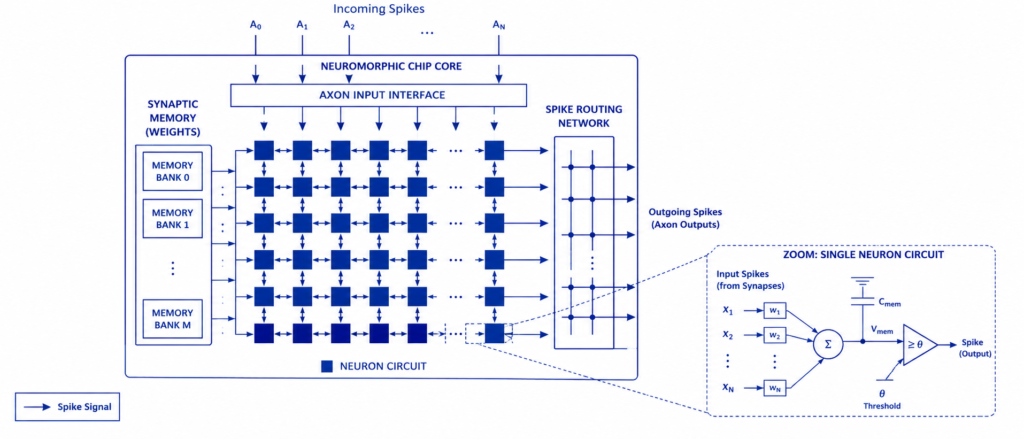
- Memory and processing are not separated
- Each synapse both stores information and participates in computation
- There is no data bus, no bottleneck
- Processing happens everywhere simultaneously, at the point where data lives
This is the architectural gap neuromorphic computing is trying to bridge.
KEY FACT: Training GPT-3 consumed approximately 1,287 MWh of electricity — enough to power an average American home for over 120 years. A human brain doing equivalent reasoning would use the energy of a dim light bulb running for a few hours.
How the Brain Actually Computes: Spikes, Not Numbers
This is where most explanations go wrong — they assume AI and the brain work the same way. They do not.
How a standard artificial neural network works:
Standard Neural Network — every single time step:

Neuron A  ——— 0.7842 ———→
Neuron C  ——— 0.2341 ———→  Neuron B (always receiving)
Neuron D  ——— 0.9103 ———→

Every neuron sends a precise decimal number to every
connected neuron on every forward pass.
Constant, expensive, never stops.
How a biological neuron actually works:
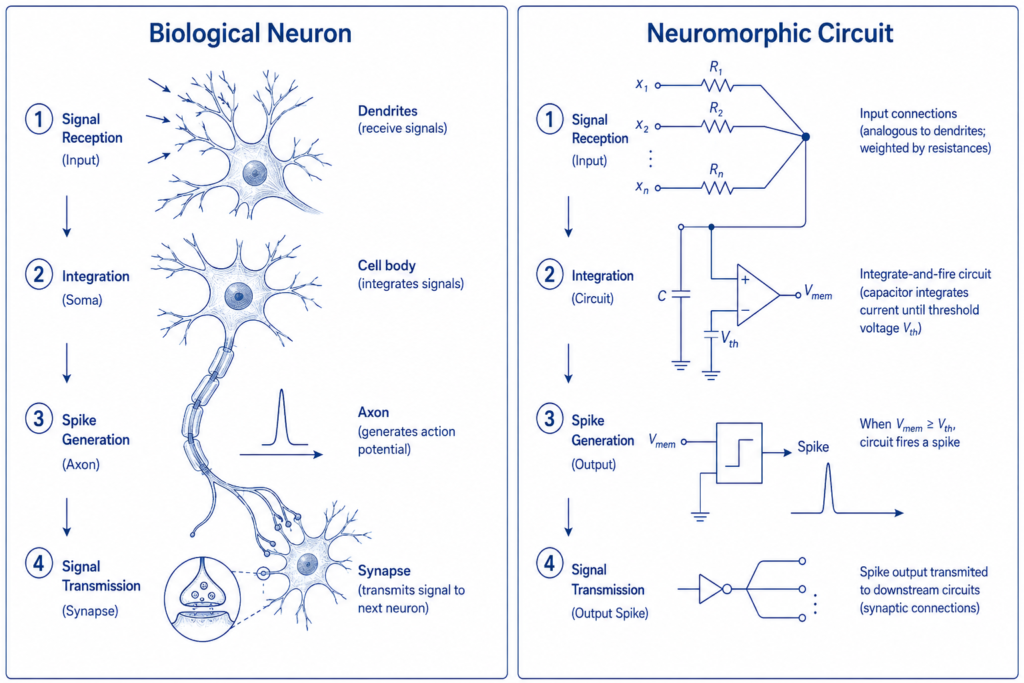
A real neuron sits completely silent — consuming almost zero energy — until its inputs slowly accumulate past a threshold. Only then does it fire a single binary spike — a brief electrical pulse — and immediately return to rest.
Biological Neuron Behavior:

Voltage
  |
  |          ___spike___
  |         /           \
threshold --|----         \——  (returns to rest, silent again)
  |        /
  |_______/  (slowly charging from inputs)
  |
  +————————————————————→ Time

Key insight:
  Silent most of the time  →  near-zero energy
  Fires only when needed   →  sparse, efficient
  Spike timing = data      →  rich information in patterns
Think of it like this: a conventional neural network is like every person in a stadium screaming numbers at each other continuously. A spiking neural network is like people only tapping their neighbor on the shoulder when something important happens.
This spike-based computation is called a Spiking Neural Network (SNN). It is not just a software idea — it needs different hardware to run efficiently.
WARNING: Running spiking neural networks on a conventional GPU is actually slower and more power-hungry than standard neural networks. GPUs are built for dense matrix multiplication — the opposite of what sparse spike-based computing needs. This is exactly why new hardware is necessary.
The Integrate-and-Fire Model: The Physics Inside a Neuromorphic Core
The fundamental computing unit inside every neuromorphic chip is called an integrate-and-fire neuron.
Think of it as a leaky bucket:
- Water drips in slowly from multiple sources (incoming signals)
- The bucket has a small hole — it slowly leaks if nothing significant arrives (the neuron forgets old inputs)
- When the bucket fills past a line on the side (threshold), it tips over (fires a spike) and instantly empties (resets)
In circuit terms, this is modeled as a leaky capacitor:
Leaky Integrate-and-Fire (LIF) Neuron Circuit:

Input spikes ——→ [Synaptic weights] ——→ [Capacitor C]
                                              |
                                         Voltage V(t)
                                              |
                                    V(t) > threshold?
                                         /        \
                                       YES         NO
                                        |           |
                                   Fire spike    Stay quiet
                                   Reset V to 0  Leak slowly

The membrane potential equation:

  τ × dV/dt = −V(t) + R × I(t)

Where:
  τ  = time constant — how fast the neuron forgets
  V  = current membrane voltage
  R  = membrane resistance
  I  = incoming current from synaptic inputs
What makes this remarkable in silicon:
- Each circuit consumes power only when it fires
- Millions of these circuits operate simultaneously and independently
- There is no global clock synchronizing them
- Each neuron makes its own local decision based purely on its own inputs
This is as different from a conventional processor as a beehive is from a factory. A factory has a central manager, a production schedule, and workers following instructions in sequence. A beehive has thousands of agents each following simple local rules — and the result is a remarkably efficient, adaptive system.
The Major Neuromorphic Chips Being Built Today
Intel Loihi 2
Intel’s Loihi 2 is currently the most advanced neuromorphic research chip available outside of university labs.
Key specs at a glance:
| Specification | Loihi 1 (2017) | Loihi 2 (2021) |
|---|---|---|
| Neurons | 128,000 | 1,000,000 |
| Synapses | 130 million | 120 million |
| Process node | 14nm | Intel 4 (7nm) |
| Power (active) | ~1W | ~1W |
| On-chip learning | Basic | Fast, programmable |
| Programming | NxSDK | Lava (open source) |
What makes it significant:
- On-chip learning — synaptic weights update locally without sending data to an external processor
- This is how the brain learns: at the synapse, based on local activity, without a central supervisor
- A robot using Loihi 2 can adapt its touch sensitivity in real time, without cloud connectivity
IBM TrueNorth
IBM’s TrueNorth took a completely different approach — instead of prioritizing learning, it focused on extreme energy efficiency for inference (running already-trained models).
Standout numbers:
- 4,096 neurosynaptic cores
- 1 million neurons, 256 million synapses
- Power consumption: 70 milliwatts at full operation
- That is roughly the power of a small LED indicator light running an entire AI system
BrainScaleS-2 (Heidelberg University)
BrainScaleS-2 does something unusual — it runs up to 1,000 times faster than biological real-time.
- A biological neuron integrates inputs over milliseconds
- BrainScaleS-2 simulates that same process in microseconds
- This lets researchers simulate years of neural adaptation and learning in minutes
Why this matters: It is not built for energy efficiency — it is built for neuroscience research. Studying how Alzheimer’s disease affects neural circuits over 20 years becomes a 7-hour experiment.
SpiNNaker 2 (University of Manchester)
SpiNNaker 2 is designed for massive scale — simulating very large networks.
- Up to 1 billion neurons in full configuration
- Uses a network of small ARM processors communicating through spike messages
- Primary use: simulating the scale of animal and eventually human brain regions
Quick comparison of all four:
| System | Neurons | Strength | Primary Use |
|---|---|---|---|
| Intel Loihi 2 | 1 million | On-chip learning | AI research, robotics |
| IBM TrueNorth | 1 million | Ultra-low power | Edge inference |
| BrainScaleS-2 | 512 per chip | 1000x real-time speed | Neuroscience research |
| SpiNNaker 2 | Up to 1 billion | Massive scale | Brain simulation |
The Efficiency Gap: Why These Numbers Should Shock You
Energy cost of a single synaptic operation:

Human brain synapse:      ~10 femtojoules   (10 × 10⁻¹⁵ J)
Intel Loihi 2 synapse:    ~23 picojoules    (23 × 10⁻¹² J)
GPU (training operation): ~1  nanojoule     (1  × 10⁻⁹  J)

Comparison (brain = 1×):
  Brain:      1×           ████
  Loihi 2:    2,300×       ████████████████████
  GPU:        100,000×     ████████████████████████████████████████

Loihi 2 is already 40× more efficient than a GPU
for equivalent sparse spike-based operations.
The gap to the brain is still large — but it is closing fast.
Why this matters at scale:
- AI data centers currently consume 1 to 2% of global electricity
- Projections suggest this could reach 10% by 2030 if current trends continue
- Neuromorphic hardware offers a path where AI inference drops by orders of magnitude in energy cost
KEY FACT: If the energy efficiency of neuromorphic chips at the Loihi 2 level were applied to the workloads currently running on GPUs in data centers, the projected 10% global electricity figure by 2030 would drop to under 1% — without any reduction in AI capability.
Where Neuromorphic Computing Is Being Used Right Now
Edge AI and IoT Devices
The problem: A conventional AI chip running object detection on a security camera might consume 5 to 15 watts continuously — even when nothing is happening in the frame.
The neuromorphic solution:
- The chip sits silent when nothing moves
- Fires sparsely only when motion or an object of interest appears
- Same detection capability at milliwatts instead of watts
- For a battery-powered sensor, that is the difference between hours and years of operation
Robotic Sensory Processing
Robots need to handle continuous, real-time sensory data — touch, balance, vision — with very low latency.
Current research applications:
- Intel Loihi 2 has been used in robots that learn to navigate terrain through touch
- The chip updates its touch-sensitivity model in real time as the robot encounters new surfaces
- No cloud connection needed, no retraining cycle — adaptation happens at the synapse level
Adaptive Signal Processing
Applications running today:
- Hearing aids that filter background noise dynamically
- Cochlear implants that adapt to new acoustic environments
- Radar systems that track moving targets with less computational overhead
- Industrial sensors that detect anomalies without continuous data streaming to a server
PRO TIP: If you want to experiment with neuromorphic computing today, Intel’s Lava framework is fully open source and runs on standard hardware. You can build and simulate spiking neural networks in Python without access to physical neuromorphic chips. It is the best way to build intuition before the hardware becomes widely available.
python
# Simple spiking neuron simulation using Lava framework
import lava.proc.lif.process as lif
import lava.proc.io.source as io_source

# Create a Leaky Integrate-and-Fire neuron
neuron = lif.LIF(
    shape=(1,),           # Single neuron
    vth=10,               # Voltage threshold — fires when voltage hits 10
    dv=0.1,               # Voltage decay per timestep (the "leak")
    du=0.5,               # Current decay
    bias_mant=3,          # Constant input bias — slowly charges the neuron
)

# The neuron will integrate the bias input over time
# When membrane voltage reaches vth=10, it fires a spike and resets
# This is the same leaky-bucket behavior described earlier — in real code
Challenges That Still Need to Be Solved
These are not minor issues — they are why neuromorphic computing is still in research labs rather than in every data center:
Challenge 1 — Training SNNs is genuinely hard
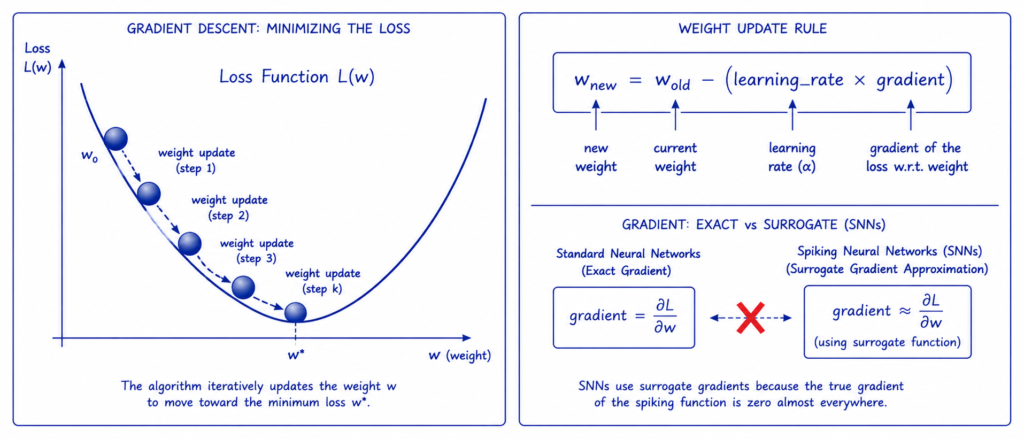
- Backpropagation does not work on spiking neurons — spikes are binary, they have no gradient
- Researchers use approximations called surrogate gradients, but accuracy on complex tasks still lags behind conventional networks
- Matching a standard ResNet’s image classification accuracy on a neuromorphic chip remains an open problem
Challenge 2 — Converting existing AI models loses accuracy
- You cannot take GPT-4 and run it on Loihi 2
- Converting conventional networks to spiking format introduces significant accuracy loss
- Building neuromorphic-native AI requires rethinking model design from scratch
Challenge 3 — Software ecosystem is immature
- The GPU ecosystem has 15+ years of tooling, tutorials, debuggers, and trained engineers behind it
- Neuromorphic tooling is years behind
- This single factor slows adoption more than any hardware limitation
Challenge 4 — No standardization exists
- Every major chip uses a different architecture, programming model, and learning rules
- There is no neuromorphic equivalent of CUDA — the unified programming layer that drove the GPU revolution
- Until this exists, every application has to be rebuilt for each chip
WARNING: Anyone claiming neuromorphic computing will replace GPUs within the next five years is overstating where the field actually is. The hardware is progressing faster than the software ecosystem. Real mainstream adoption is a 2030s story, not a 2020s story — and that is fine. The trajectory is clear even if the timeline is not.
The Road Ahead: 2026 to 2050
Neuromorphic Computing Timeline:

2026 ——— Research chips in specialized labs
          First commercial edge applications in IoT and robotics
          Intel Lava and PyNN frameworks maturing

2028 ——— First consumer neuromorphic chips in hearing aids
          and autonomous vehicle perception systems
          SNN training tools reach practical usability

2032 ——— Hybrid chips: neuromorphic cores + GPU/CPU on same die
          First large-scale data center deployment for inference
          Energy cost of AI inference drops 60% from 2026 levels

2038 ——— Neuromorphic chips standard in all edge AI devices
          Brain-computer interfaces using neuromorphic processing
          Energy cost of AI inference drops 90% from 2026 levels

2045 ——— Wafer-scale systems approaching human brain synapse counts
          Real-time full brain region simulation becomes feasible

2050 ——— Neuromorphic hardware potentially enabling AGI-class
          systems that are energetically sustainable at scale
The key insight about this timeline:
Hardware is progressing faster than software. That is the typical pattern in computing — hardware unlocks possibilities that software takes years to fully realize. The GPU existed before deep learning needed it. The same dynamic is playing out here.
READ MORE: Sparse Mixture-of-Experts Models: The Architecture Powering Next-Generation AI
Frequently Asked Questions
Is neuromorphic computing the same as quantum computing?
No — completely different approaches. Quantum computing uses quantum mechanical phenomena like superposition to perform certain calculations exponentially faster. Neuromorphic computing mimics the architecture of biological neural networks to achieve radically better energy efficiency for AI workloads. They solve different problems and will likely be used together in future systems rather than competing.
Can neuromorphic chips run ChatGPT or large language models?
Not directly with current technology. LLMs are trained using backpropagation on GPU clusters and cannot be directly converted to spiking format without significant accuracy loss. Building an LLM-class model natively on neuromorphic hardware has not been achieved yet. This is an active research problem — the answer in 2032 may be different.
Why has neuromorphic computing not gone mainstream already?
Three main reasons: SNN training accuracy still lags behind conventional networks on complex tasks, the software ecosystem is years behind the GPU world, and there is no standardization across chips. The economics only favor neuromorphic hardware for specific workloads today. Mainstream adoption follows once these gaps close.
What skills do you need to work in this field?
- Strong foundation in neuroscience basics alongside computer architecture
- Python proficiency and familiarity with PyTorch or TensorFlow
- Intel Lava framework for neuromorphic-specific programming
- Most people entering this field come from computational neuroscience, electrical engineering, or physics — not pure software
How close are neuromorphic chips to matching the human brain?
In raw neuron count: Loihi 2 simulates 1 million neurons. The human brain has 86 billion neurons and 100 trillion synaptic connections. We are several orders of magnitude away in scale. In energy efficiency for specific tasks, we are already partially there. Matching the brain’s full capability — including continuous learning, generalization, and multi-sensory integration — is likely decades away.
Will neuromorphic computing replace GPUs?
Almost certainly not entirely. GPUs are excellent at dense matrix multiplication — what training large AI models requires. Neuromorphic chips are excellent at sparse, event-driven inference — running trained models efficiently in real-world devices. The likely future is a heterogeneous computing landscape where both chip types handle the tasks they are best suited for, often working together in the same system.
Conclusion
The human brain is not just an inspiration for AI — it is an engineering benchmark that current technology has not come close to matching.
20 watts. 86 billion neurons. Continuous learning. Zero reboots.
It is the most energy-efficient intelligence system ever observed, and we built it through millions of years of evolution without understanding what we were building.
Neuromorphic computing is the serious, hardware-level attempt to understand what makes the brain so efficient and replicate those principles in silicon. The chips exist today. The research is running in labs right now. The trajectory is clear even where the exact timeline is not.
As AI grows larger and more power-hungry, the pressure to find more efficient architectures will only increase. Neuromorphic hardware is one of the most credible answers to that pressure — and the decade ahead will determine whether it delivers on that promise.
If this article gave you a clearer picture of where AI hardware is heading, share it with someone who thinks AI is only about software. And leave a question in the comments — we cover neuromorphic research updates regularly on AI Learner Tech.

Author: AI Learner Tech
AI Learner Tech is a premier research and educational hub dedicated to mastering Artificial Intelligence, Machine Learning, and Computer Vision. We bridge the gap between complex academic theories and real-world industrial applications. Join our community to access high-quality tutorials, open-source projects, and expert insights. Website: ailearner.tech