Multimodal AI Explained
What if an AI could look at an X-ray, listen to your voice, read a document, and give you a diagnosis — all at the same time? That is not science fiction. That is Multimodal AI, and it is happening right now.
For decades, computers could only process one type of data at a time. A chatbot only understood text. An image tool only understood pictures. But today, AI systems can see images, hear audio, read text, and watch videos — all together — just like a human brain does.
In this guide, you will learn exactly what Multimodal AI means, how it works, which real models are using it, where it is being applied across industries, and what the future looks like. Whether you are a student, developer, or curious tech enthusiast — this article will give you a clear, complete picture with no confusion.
📌 KEY FACT: The human brain is naturally multimodal. When you watch a movie, you process visuals, sound, dialogue, and emotions all at once. Multimodal AI is engineered to do exactly the same thing.
What Is Multimodal AI? The Simple Definition
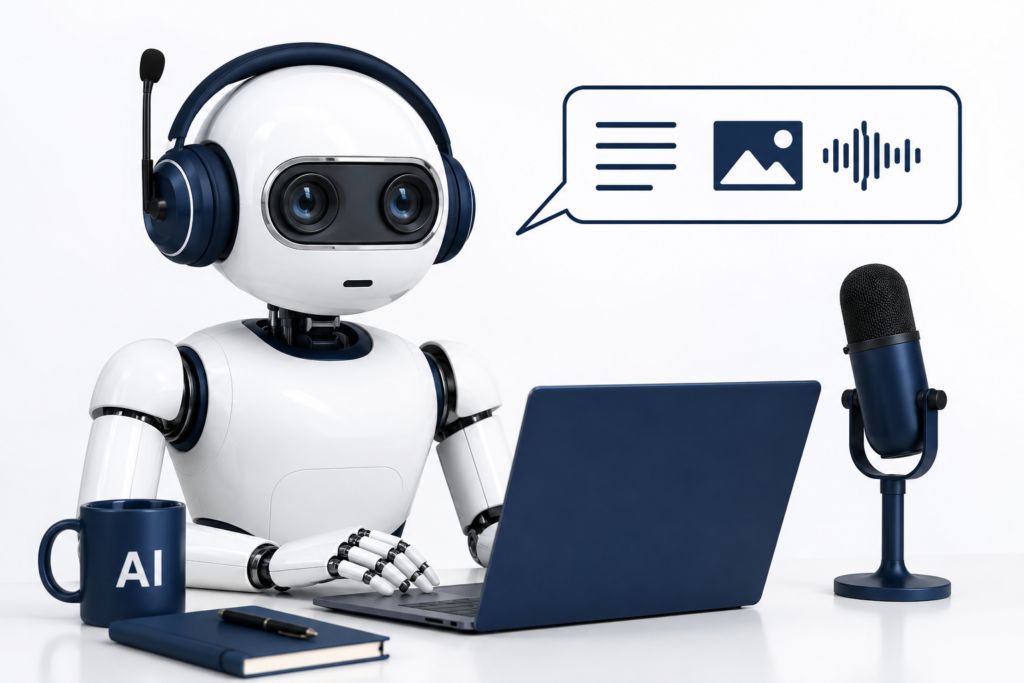
The word multimodal comes from “multi” (many) and “modal” (type or mode). So Multimodal AI simply means an artificial intelligence system that can process and understand multiple types of data at the same time.
Traditional AI systems were unimodal — they worked with only one data type. A speech recognition system only understood audio. An image classifier only understood pictures. A chatbot only understood text.
Multimodal AI breaks these barriers. It can take in text, images, audio, video, and other inputs — process them together — and produce a smart, meaningful response.
Unimodal vs Multimodal AI — Quick Comparison
| Feature | Unimodal AI | Multimodal AI |
|---|---|---|
| Data Types Handled | One only (text OR image OR audio) | Many at the same time |
| Real-world Usefulness | Limited, narrow tasks | Broad, complex tasks |
| Example | Spam filter (text only) | GPT-4o (text + image + audio) |
| Human-like Understanding | No | Much closer to yes |
| Flexibility | Rigid, task-specific | Flexible, general-purpose |
How Does Multimodal AI Actually Work?
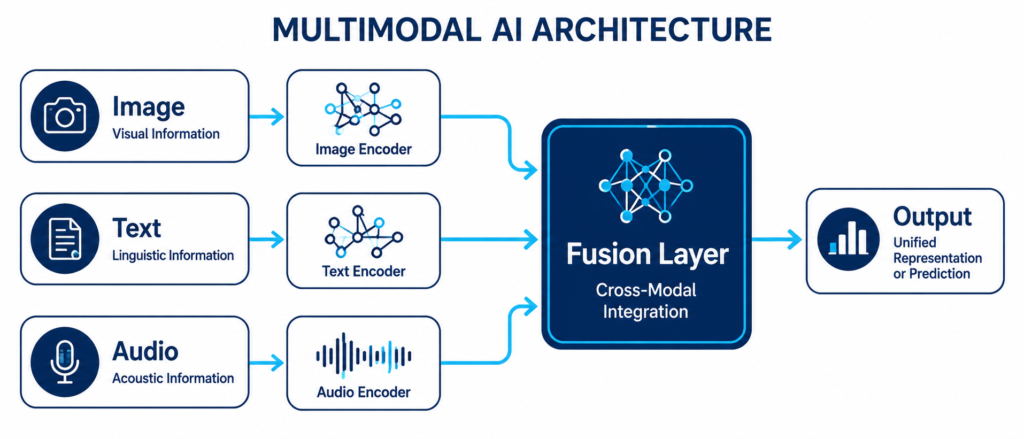
The magic is in its architecture — the technical blueprint of how the system is built. Let us break it down step by step.
Step 1 — Different Encoders for Different Data Types
Each type of data first goes through a specialized encoder. Think of an encoder as a translator — it converts raw data into a common language that the AI can understand.
- 📷 Image Encoder: Converts pixels into numerical patterns using Vision Transformers (ViT)
- 📝 Text Encoder: Converts words into numerical embeddings using transformer models like BERT or GPT
- 🎙️ Audio Encoder: Converts sound waves into features using models like Whisper
- 🎬 Video Encoder: Breaks video into frames, processes each frame, then links them with time-aware models
Step 2 — Fusion: Bringing It All Together
After encoding, all data streams are combined inside a fusion layer. This is where the real intelligence happens. The AI learns relationships between different inputs — for example, that the sound of barking matches the image of a dog.
| Fusion Type | When It Happens | Advantage |
|---|---|---|
| Early Fusion | Before processing (raw data combined) | Captures low-level patterns |
| Late Fusion | After encoding (features combined) | Each modality processed deeply |
| Cross-Attention Fusion | During processing (modern approach) | Best performance, used in GPT-4o |
Step 3 — Output
Finally, the model produces a response. In Multimodal AI, the output can also be multi-type. GPT-4o can look at your image and respond with both text and spoken audio. DALL-E takes text and produces an image.
💡 PRO TIP: Think of Multimodal AI like the human brain — different regions handle vision, sound, and language separately, but they all connect and work together. Cross-attention fusion is exactly that “connection” inside AI.
Real-World Multimodal AI Models You Already Know
Multimodal AI is not a future concept — it is running right now inside products millions of people use daily.
| Model / Product | Company | Modalities Supported | Key Capability |
|---|---|---|---|
| GPT-4o | OpenAI | Text, Image, Audio, Video | Real-time voice + vision conversation |
| Gemini 1.5 Pro | Google DeepMind | Text, Image, Audio, Video, Code | 1M token context with video understanding |
| Claude 3.5 Sonnet | Anthropic | Text, Image, Document | Visual document and chart analysis |
| LLaVA | Open Source | Text + Image | Open-source visual question answering |
| DALL-E 3 | OpenAI | Text → Image | High-quality text-to-image generation |
| Sora | OpenAI | Text → Video | Text-to-video generation (minutes long) |
| Whisper + GPT-4 | OpenAI | Audio + Text | Speech-to-text + intelligent reply |
📌 KEY FACT: Google’s Gemini 1.5 Pro can process an entire 1-hour video — analyzing both visual and audio content — and answer detailed questions about specific moments in the footage.
Multimodal AI Across Industries — Real Applications Right Now
Multimodal AI is actively transforming real industries today. Here is where it is making the biggest impact:
🏥 Healthcare
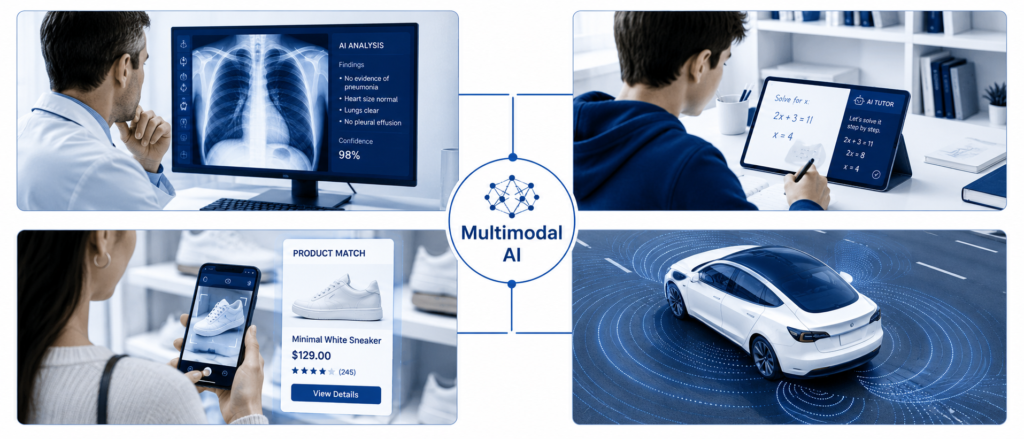
- AI reads X-rays and MRI scans and explains findings in plain language
- Combines patient voice recordings with written symptoms for better diagnosis
- Detects early signs of diabetic retinopathy from eye photographs
🎓 Education
- AI tutors look at a student’s handwritten math problem, hear their explanation, and correct it in real time
- AI grades handwritten essays by combining image reading and text analysis
- Language apps teach vocabulary using audio and images together in context
🛒 E-Commerce
- Take a photo of a shoe you like — Multimodal AI finds the most similar product in the catalog
- Google Lens is a live example of this working at massive scale every day
🚗 Autonomous Vehicles
- Self-driving cars simultaneously process camera video, LIDAR sensor data, GPS, and radar signals
- All of this happens in real time to make safe driving decisions
🎬 Entertainment and Media
- Automatic subtitles that sync audio with video frames precisely
- AI video editors that understand voice commands and apply visual edits
- Content moderation that checks images AND text captions together
A Simple Python Code Example — Multimodal AI in Action
Here is how you send both an image and a text question to GPT-4o using Python:
python
# Install first: pip install openai

import openai

# Set up your OpenAI client
client = openai.OpenAI(api_key="your-api-key-here")

# Send a multimodal message: text question + image URL
response = client.chat.completions.create(
    model="gpt-4o",           # GPT-4o supports text + images
    messages=[
        {
            "role": "user",
            "content": [
                # Text part of the message
                {
                    "type": "text",
                    "text": "What objects do you see in this image?"
                },
                # Image part of the message
                {
                    "type": "image_url",
                    "image_url": {
                        "url": "https://yourimage.com/sample.jpg"
                    }
                }
            ]
        }
    ],
    max_tokens=300    # Limit response length
)

# Print the AI's response
print(response.choices[0].message.content)
⚠️ WARNING: Never hardcode your real API key in your code. Use environment variables (os.environ) to keep your credentials secure.
Challenges and Limitations of Multimodal AI
Multimodal AI is powerful but not perfect. Knowing the limitations helps you use these systems responsibly.
| Challenge | Why It Matters | Current Status |
|---|---|---|
| Hallucinations | AI can “see” things in images that are not there | Ongoing research problem |
| Compute Cost | Processing multiple data types is expensive | Improving with better hardware |
| Data Bias | Training data bias affects visual and audio understanding | Active fairness research |
| Privacy | Processing photos and voice raises serious data concerns | Regulation still catching up |
| Temporal Reasoning | Understanding sequence and time in video is hard | Partially solved by newer models |
💡 PRO TIP: When using Multimodal AI for medical, legal, or financial decisions, always verify the output with a qualified human expert. These systems are powerful assistants — not replacements for professional judgment.
The Future of Multimodal AI — What Is Coming Next?
We are still in the early chapters of this story. Here is what the next five years will bring:
- 🤖 Embodied AI: Robots that see, hear, and physically interact with the world using Multimodal AI as their brain
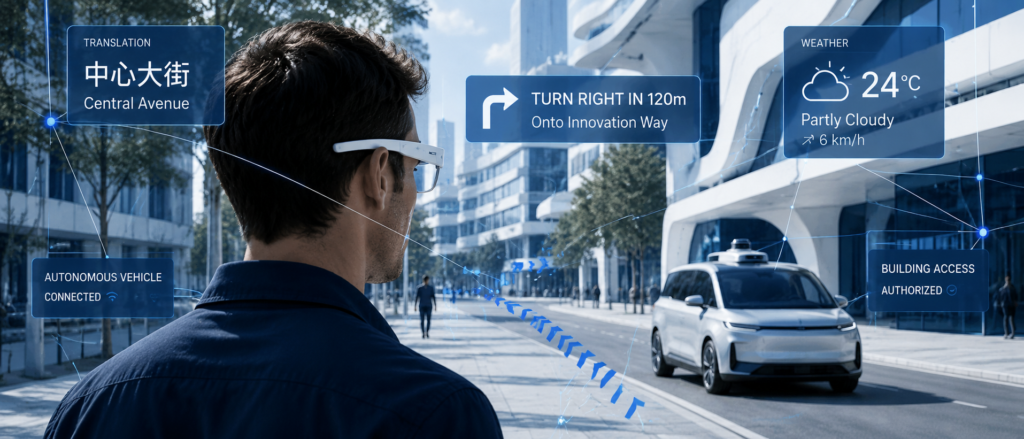
- 👓 Wearable AI: Smart glasses that constantly process your visual and audio environment to assist you in real time — Meta Ray-Ban AI glasses are an early example
- 🌐 Universal Translators: See a sign in Japanese — your glasses read it in English aloud, instantly
- 🎨 Creative Co-pilots: Describe ideas by voice and sketch — AI produces complete visual designs in seconds
- ⚕️ Personalized Medicine: AI monitors your voice, face, and body language to detect early signs of health conditions
- 🏠 Smart Home AI: Home systems that understand your voice, gestures, and facial expressions together
📌 KEY FACT: The global Multimodal AI market was valued at $1.34 billion in 2023 and is projected to grow at a 35.8% annual rate through 2030 — one of the fastest-growing segments in all of technology.
Frequently Asked Questions About Multimodal AI
Q1: What is the difference between Multimodal AI and Generative AI?
Generative AI refers to AI that can create new content — text, images, audio, video. Multimodal AI refers to AI that can process multiple types of data simultaneously. These two often overlap. GPT-4o is both generative AND multimodal. However, not all generative AI is multimodal — a text-only model like early GPT-3 is generative but not multimodal.
Q2: Is Multimodal AI safe to use with personal photos or audio?
It depends on the platform. When you upload an image or voice recording to a cloud-based AI service, that data is sent to their servers and may be used for model improvement depending on their privacy policy. Always read the privacy settings before sharing sensitive content. For highly private use cases, look for on-device AI solutions that process data locally.
Q3: Which is the best Multimodal AI model available in 2025?
As of 2025, GPT-4o (OpenAI) and Gemini 1.5 Pro (Google DeepMind) are the two leading general-purpose multimodal models. GPT-4o is praised for real-time voice and vision. Gemini 1.5 Pro stands out for its enormous 1-million-token context window and excellent video understanding. The best model depends on your specific use case.
Q4: Can I build a Multimodal AI app without a PhD?
Absolutely yes. Thanks to APIs from OpenAI, Google, and Anthropic, you can build powerful multimodal applications with basic Python knowledge. The code example in this article is a perfect starting point. You do not need to train models from scratch — you simply call the API with your text and image inputs.
Q5: What is a Vision Transformer and why does it matter?
A Vision Transformer (ViT) applies the same transformer mechanism used in language models to image data. It divides an image into small patches, converts each patch into a number sequence, and processes them like words in a sentence. This makes it easy to combine vision and language models into one unified Multimodal AI system. ViT is the backbone of image understanding in GPT-4o and Gemini.
Q6: Does Multimodal AI understand video the same way as images?
Not quite. Video is harder because it adds a time dimension. For images, AI understands one moment. For video, it must understand a sequence of moments and how they relate over time. Models like Gemini 1.5 Pro handle this by sampling frames at regular intervals and processing them alongside the audio track.
Conclusion
Multimodal AI is one of the most significant shifts in the history of computing. For the first time, machines can perceive the world the way humans do — through multiple senses working together. From reading X-rays and tutoring students to powering self-driving cars and creative tools, this technology is already reshaping every major industry.
We are moving from AI that reads text to AI that sees, hears, and understands full context. The models available today — GPT-4o, Gemini 1.5, Claude — are just the beginning. The next decade will bring AI embedded in our glasses, homes, healthcare, and creative workflows in ways we are only starting to imagine.
The best time to understand this technology is right now. Start with what you learned in this guide, try the code example, and keep following AI Learner Tech for the latest.

Author: AI Learner Tech
AI Learner Tech is a premier research and educational hub dedicated to mastering Artificial Intelligence, Machine Learning, and Computer Vision. We bridge the gap between complex academic theories and real-world industrial applications. Join our community to access high-quality tutorials, open-source projects, and expert insights. Website: ailearner.tech