Search “free AI course” right now and you will get 847 million results.
Most of them are a waste of your time.
Not because the instructors are bad. Because most courses are designed to make you feel like you are learning rather than actually build the skills to do something with AI. You watch 40 hours of video. You complete the quizzes. You get a certificate. You open a code editor and stare at a blank screen with no idea what to build or how to start.
That is the gap this article closes.
Every course on this list was selected based on one criterion: does it produce people who can actually do things with AI after completing it? Not people who can describe AI concepts at a dinner party. People who can build, analyse, train, and deploy.
The list is organised by where you are starting from — not by popularity or marketing budget.
What this guide covers:
- Why most AI courses fail and what good ones do differently
- The best starting point for someone with zero background
- The single best course for learning machine learning properly
- The fastest path from beginner to building real projects
- Research-level resources for people going deep
- A realistic week-by-week schedule for different goals
- The honest answer on whether certificates matter
Why Most AI Courses Fail You
Before the list — the pattern worth understanding.
Most online AI courses are built around a specific incentive: completion rates look good in marketing, and completion rates go up when courses are easy. When the quizzes are straightforward. When the code is pre-written and you just run it. When the concepts are explained but never tested through building.
The result is a course you can finish in a weekend that leaves you knowing what a neural network is but unable to build one from any starting point.
The courses that actually work share three qualities:
They make you struggle. The problems are hard enough that you have to think. The code does not run on the first try. You have to debug, search, and figure things out. That difficulty is not poor course design — it is the learning.
They make you build. Not fill in blanks in a pre-written notebook. Build something from a problem statement, deciding yourself what approach to use, what libraries to import, and what to do when it does not work.
They connect concepts to practice immediately. The moment you learn a concept, you use it on a real dataset or a real problem. Not two weeks later after seven more concept videos.
Every course on this list does at least two of those three. Most do all three.
Level 1 — Starting From Zero
Google’s AI Essentials
Platform: Coursera Cost: Free to audit (certificate costs money — not necessary) Time: 5 hours Requires: Nothing — genuinely no background needed
This is the correct starting point for anyone who wants to understand AI before learning to build with it.
It covers what AI is, how it is used across industries, what machine learning means in plain terms, and how to use AI tools effectively. No code. No maths. Just clear conceptual grounding.
Who it is for: Managers, executives, career changers, or anyone who works near AI and wants to understand what the people around them are building.
What it does not do: Teach you to build anything. That is not its purpose.
Honest limitation: The production is polished to the point of being slightly sanitised. It will not challenge you. It will orient you, which is all it needs to do at this stage.
Elements of AI
Platform: elementsofai.com (University of Helsinki) Cost: Completely free Time: 6 weeks at 5 hours per week Requires: No coding — some logical thinking
Built by the University of Helsinki and Reaktor, this is the best non-technical AI course available anywhere.
It covers AI history, how machine learning works conceptually, what neural networks are, what AI can and cannot do, and the societal implications — all without requiring you to write a single line of code.
The exercises are actual problems that require thinking, not multiple-choice quizzes you can guess your way through.
Over one million people have completed it. It has been adopted by governments and universities as a foundational AI literacy programme.
Why it stands out: It takes you seriously as an intelligent adult without requiring a technical background. The writing is clear, the examples are real, and the interactive exercises actually test whether you understood the concept.
Honest limitation: It will not give you any practical technical skills. It is literacy, not capability.
Which Level 1 course to choose:

You want to understand AI for your job
and have no interest in building things:
→ Elements of AI

You specifically want to use AI tools
more effectively in your current work:
→ Google AI Essentials

You want both:
→ Do Elements of AI first (more depth),
  then Google AI Essentials for the tools focus
  Total time: under 40 hours combined
Level 2 — Python and First Steps in ML
Python for Everybody (Dr. Chuck)
Platform: Coursera / py4e.com Cost: Free (py4e.com has everything free with no signup) Time: 8 months at 2-3 hours per week — or 6 weeks intensive Requires: Nothing
If you do not know Python, learn Python before touching ML. This is the course.
Dr. Charles Severance (Dr. Chuck) at the University of Michigan has taught more people Python than almost anyone alive. His teaching style is genuinely warm, his explanations are patient, and the course builds from absolute first principles without ever being condescending.
By the end you can: read and write Python programmes, work with files and data, use web APIs, and handle the kind of data manipulation that ML projects require constantly.
Why it stands out: Most Python courses either move too fast for beginners or waste time on things ML practitioners never use. This one gets the balance right and builds to the specific skills you need next.
Honest limitation: It does not cover NumPy or Pandas — the libraries you actually use in data science. You will need to supplement with a short NumPy/Pandas tutorial (Kaggle’s free micro-course on both is excellent and takes about 4 hours combined).
Kaggle’s Free Micro-Courses
Platform: kaggle.com/learn Cost: Completely free Time: 4-8 hours per course Requires: Basic Python (for ML courses)
Kaggle’s micro-courses are among the most underrated free resources in AI education.
Each one is focused, practical, and immediately applicable. The relevant ones for someone building towards ML:
- Python (4 hours) — good refresher if you know basics
- Pandas (4 hours) — essential for data manipulation
- Data Visualisation (4 hours) — matplotlib and seaborn
- Intro to Machine Learning (3 hours) — first real ML models
- Intermediate Machine Learning (4 hours) — cross-validation, pipelines, feature engineering
Each micro-course runs in Kaggle’s free cloud notebooks — no installation, no setup, just open and code.
Why it stands out: The exercises are on real datasets. You are not working with cleaned toy data — you are working with the kind of messy, incomplete data that real projects use, and you have to deal with it.
Honest limitation: Each course is short enough that it introduces concepts without fully developing them. Use them as structured practice alongside a deeper course, not as standalone education.
Level 3 — The Core Machine Learning Education
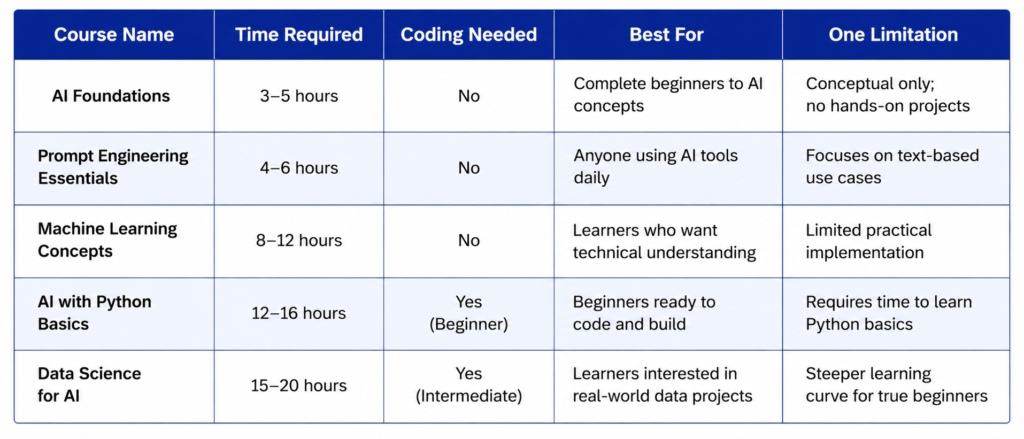
Machine Learning Specialization — Andrew Ng (Coursera)
Platform: Coursera Cost: Free to audit — every lecture, every assignment Time: 3 months at 10 hours per week Requires: Basic Python, high school maths
If you only take one machine learning course in your life, it should be this one.
Andrew Ng co-founded Google Brain, co-founded Coursera, and has taught machine learning longer and more effectively than almost anyone in the field. This specialization — an updated version of his legendary Stanford course — covers supervised learning, unsupervised learning, and reinforcement learning from the ground up.
What makes it exceptional is not just the content. It is the teaching philosophy. Ng has a rare gift for making mathematical concepts feel intuitive before making them rigorous. By the time you see the equation, you already understand why it should look that way.
What you will be able to do after completing it:
- Build and train classification and regression models
- Understand what is happening inside the models, not just run them
- Evaluate whether your model is actually good or just overfitted
- Apply clustering and dimensionality reduction to real datasets
- Understand the basics of how neural networks learn
Honest limitation: The coding exercises use a slightly older library setup that does not perfectly match what you will use in real projects. Supplement with scikit-learn practice on your own after each section.
Why Andrew Ng's course specifically:

The field has no shortage of ML courses.
What makes this one different:

Intuition first:
  Before showing you the gradient descent formula,
  Ng shows you a graph of a loss surface and asks:
  "If you were standing here, which direction would
   you walk to reach the bottom fastest?"
  You already understand the concept.
  The formula just makes it precise.

Error analysis:
  Most courses teach you to build models.
  This course teaches you to diagnose why they are wrong
  and what to do about it — the skill that separates
  practitioners from tutorial-completers.

Real decision-making:
  "Should I get more data or tune my model?"
  "Is this underfitting or overfitting?"
  These practical decisions are explicitly taught.
  Most courses skip them.
fast.ai — Practical Deep Learning for Coders
Platform: fast.ai Cost: Completely free Time: 7 weeks of lessons — plan for 3-6 months to do it properly Requires: Some Python, ideally some ML basics
Fast.ai takes the opposite approach to most deep learning courses.
Traditional courses teach theory first and practice later. Fast.ai puts you building state-of-the-art models in lesson one — a working image classifier in about ten lines of code — and then spends the rest of the course explaining why it works.
This top-down approach feels disorienting at first. You are using things before fully understanding them. But it mirrors how expert practitioners actually learn new tools, and it means you experience success early — which keeps motivation alive through the harder material that follows.
By the end you will have built image classifiers, text classifiers, recommendation systems, and tabular data models using PyTorch and the fast.ai library.
Why it stands out: The instructors — Jeremy Howard and Rachel Thomas — are among the most respected educators in the field. Howard was President of Kaggle and built models that topped global competitions. The course material reflects how people who actually win competitions think about problems.
Honest limitation: The top-down approach genuinely confuses some learners. If you need to understand something fully before moving on, this course will frustrate you until you adjust your learning style. Some people find they need to do Andrew Ng’s course first to get the foundations, then do fast.ai to see how those foundations are applied at scale.
Andrew Ng vs fast.ai — which to do first:

You prefer understanding before building:
→ Andrew Ng first, fast.ai second

You prefer building before understanding:
→ fast.ai first, Andrew Ng second for foundations

You only have time for one right now:
→ Andrew Ng — more complete foundational coverage

You are targeting Kaggle competitions specifically:
→ fast.ai — more aligned with competition-style thinking
Level 4 — Deep Learning and Specialization
Deep Learning Specialization — Andrew Ng (Coursera)
Platform: Coursera Cost: Free to audit Time: 3-4 months at 10 hours per week Requires: Machine Learning Specialization or equivalent
The natural next step after the ML Specialization.
This five-course series covers neural network foundations, improving deep neural networks, structuring ML projects, convolutional neural networks (CNNs) for vision, and sequence models (RNNs, LSTMs, Transformers) for text and audio.
By the end you can build and train neural networks from scratch — not using high-level APIs that hide the details, but understanding what is happening at each layer.
What you will understand after completing it:
Deep Learning Specialization outcomes:

Course 1 — Neural Networks and Deep Learning:
  Build a neural network from scratch in NumPy
  Understand forward and backward propagation
  Know what activation functions are and why they matter

Course 2 — Improving Deep Neural Networks:
  Regularization techniques (dropout, L2)
  Batch normalization
  Optimisation algorithms beyond gradient descent

Course 3 — Structuring ML Projects:
  How to prioritize what to work on
  Error analysis in practice
  Transfer learning strategy

Course 4 — Convolutional Neural Networks:
  Image recognition from scratch
  Object detection architectures
  Face recognition systems

Course 5 — Sequence Models:
  RNNs, LSTMs, GRUs
  Attention mechanisms
  Introduction to Transformers — the foundation of all LLMs
Andrej Karpathy — Neural Networks: Zero to Hero
Platform: YouTube (free) Cost: Completely free Time: 8 videos, approximately 20 hours of content Requires: Solid Python, calculus basics, some ML background
This is the most technically demanding resource on this list — and for the right person, the most valuable.
Karpathy — former Director of AI at Tesla and a founding member of OpenAI — built this series to show exactly how modern neural networks and language models work, from first principles, in Python, with no magic.
In the first video he builds backpropagation from scratch — not using PyTorch’s autograd, but implementing the derivative calculations manually to show exactly what is happening. By the final video he has built a GPT-style language model from scratch.
If you work through all eight videos and actually reproduce the code yourself rather than just watching, you will understand modern AI at a depth that most people who work with these systems do not have.
Honest limitation: This is not beginner content despite the “zero” in the title. The zero refers to starting from first principles, not starting from zero knowledge. You need solid Python and at least a conceptual understanding of neural networks before this series is accessible.
KEY FACT: Andrej Karpathy’s “Let’s build GPT from scratch” video — the final video in this series — has been watched over 5 million times and is cited by working AI engineers at major labs as one of the most useful technical resources publicly available. That is not hyperbole from a course marketing page — it is the consistent report of practitioners who have worked through it.
The Research Level — Beyond Courses
If your goal is research — contributing to the field, publishing papers, working at an AI lab — courses are not enough. Here is where to go beyond them.
Papers With Code (paperswithcode.com)
Every major AI paper, linked to its implementation code, with benchmark results across datasets. This is how researchers discover what has been tried, what works, and where the open problems are.
Start by reading the papers that introduced the systems you already use — the original Transformer paper (“Attention Is All You Need”), the GPT-3 paper, the BERT paper. You will not understand everything. Read them anyway. Read them again in three months. The rate at which comprehension improves is itself a measure of how much you have learned.
Hugging Face Course
Platform: huggingface.co/learn Cost: Free Time: 5 weeks
The Hugging Face Course covers using the Hugging Face ecosystem — transformers, datasets, tokenizers — to build and fine-tune real NLP models. It is the practical bridge between understanding how language models work and building things with them.
By the end you can fine-tune a pre-trained model on a custom dataset, evaluate it, and deploy it as a live API. That is a complete real-world skill that gets used in industry every day.
CS229 — Stanford Machine Learning (Full University Course)
Platform: YouTube / cs229.stanford.edu Cost: Free Time: A full semester — plan 4-6 months serious
The full Stanford graduate course that Andrew Ng taught for years, available as lecture recordings and problem sets. Significantly more mathematical than his Coursera version — requires calculus, linear algebra, and probability at a comfortable level.
This is for people who want to understand the theory rigorously — not just use the tools but know why they work and be able to read the research literature that extends them.
A Realistic Schedule for Different Goals
Goal: Understand AI for professional context
      (no coding, career awareness)

Week 1-6:   Elements of AI
Week 7-8:   Google AI Essentials
Total time: ~50 hours
Outcome:    Can discuss AI intelligently, use AI tools
            effectively, contribute to AI-related decisions

─────────────────────────────────────────────────────────

Goal: Become a data analyst using ML
      (some coding, practical focus)

Month 1:    Python for Everybody
Month 2:    Kaggle Pandas + Visualisation micro-courses
Month 3-4:  Andrew Ng ML Specialization (Courses 1-2)
Month 5-6:  Build 3 projects on Kaggle datasets
Total time: ~6 months at 10 hours/week
Outcome:    Can analyse data, build models, explain results

─────────────────────────────────────────────────────────

Goal: Become an ML engineer
      (full technical path)

Month 1:    Python for Everybody
Month 2:    Kaggle micro-courses
Month 3-5:  Andrew Ng ML Specialization
Month 5-7:  fast.ai Practical Deep Learning
Month 7-10: Andrew Ng Deep Learning Specialization
Month 10-12: Hugging Face Course + personal projects
Total time: ~12 months at 10 hours/week
Outcome:    Job-ready for junior ML engineer roles

─────────────────────────────────────────────────────────

Goal: Research-oriented deep understanding

Add after ML engineer path:
  Karpathy Zero to Hero series
  Stanford CS229 lecture series
  Papers With Code — read 2 papers per week
  Contribute to open source ML projects on GitHub
Timeline:   Additional 6-12 months
Outcome:    Can read and contribute to research literature
Do Certificates Actually Matter?
Honest answer: less than most people think, more than cynics claim.
When certificates help:
- Passing automated resume screening systems at large companies that scan for specific credentials
- Signalling to employers that you completed a structured course rather than just claiming to know ML
- Motivation — having a credential to work toward keeps some people on track
When certificates do not help:
- If you have a portfolio of real projects, certificates add almost nothing
- Senior roles in AI care about what you have built and how you think, not what courses you completed
- Certificates from any platform are not recognized the way university degrees are — they signal effort, not credential
The practical implication:
Do the course for the learning. If the certificate is free, take it. If the certificate costs money but the course can be audited free, audit it — the learning is the same, the certificate is mostly decoration.
The one exception: the deeplearning.ai certificates from Andrew Ng’s courses are specifically recognised at a significant number of companies that use them as a filter. If you are applying to companies that use LinkedIn’s “verified skills” filtering — getting the official certificate is worth the cost.
PRO TIP: The most valuable thing you can do alongside any course is build one real project per month — not a tutorial project where you follow along, but something you decided to build yourself on a dataset you found yourself for a question you cared about yourself. After twelve months, that portfolio of twelve projects is more persuasive evidence of capability than any combination of certificates.
READ MORE: How to Start Learning AI From Zero — A Complete 2026 Roadmap
Frequently Asked Questions
How long does it realistically take to go from zero to job-ready in ML?
With consistent effort of around 10 hours per week — which is roughly 1.5 hours on weekdays and 2-3 hours on weekends — most people reach a junior-level job-ready standard in 12 to 18 months. Going faster is possible if you have more time available. Going slower is common and fine — the material does not expire. The main risk is losing momentum over a long timeline, which is why building projects as you go is important. Visible progress on a portfolio maintains motivation better than abstract study goals.
Is Andrew Ng’s course still relevant in 2026 given how fast AI moves?
Yes — because it teaches fundamentals that do not change. Gradient descent, regularization, train/test splits, bias-variance tradeoff — these concepts underpin every ML system built in 2026 and will underpin systems built in 2036. The specific libraries and frameworks change. The mathematical foundations do not. The practical judgment skills Ng teaches — error analysis, when to get more data, how to diagnose model problems — are equally relevant regardless of what year you are reading this.
Should I learn TensorFlow or PyTorch?
PyTorch. As of 2026, PyTorch dominates both academic research and industry deployment. The majority of new papers use PyTorch. The majority of open-source models are released in PyTorch. fast.ai is built on PyTorch. Karpathy uses PyTorch. Andrew Ng’s newer courses use PyTorch. Learning TensorFlow is not wasted — there are still significant production TensorFlow deployments — but if you are starting fresh, PyTorch is where the momentum is.
What if I cannot do the maths?
Most practical ML work requires comfort with basic linear algebra (vectors, matrices, dot products), basic calculus (derivatives, what a gradient is), and basic statistics (mean, variance, probability distributions). None of this requires a mathematics degree. Khan Academy covers all of it for free. The specific maths you need for ML is a narrow, learnable subset — not the full breadth of university mathematics. Andrew Ng’s Specialization includes optional mathematics refreshers that are worth watching even if you are not anxious about maths.
Can I learn AI entirely on my phone or tablet?
For video content and reading — yes. For actually writing and running code — not effectively. You need a computer to do serious learning in this field. If you do not have access to a powerful computer for running models, use Google Colab — a free browser-based Python environment with free GPU access that runs entirely online. It handles everything short of training very large models. The barrier is internet access and a laptop, not expensive hardware.
Is a computer science degree necessary to work in AI?
No — but it helps with certain things. A degree provides structured exposure to algorithms, data structures, systems programming, and mathematics at depth. It also helps with credentialing at companies that use degrees as a filter. But many working ML engineers and data scientists entered through non-traditional paths — physics, statistics, other engineering disciplines, and self-teaching. What matters in hiring is what you can demonstrate, not how you learned it. A strong portfolio of real projects gets more interviews than a relevant degree with no portfolio.
Conclusion
847 million search results. Probably fewer than 50 courses worth your time.
The gap between an AI course that makes you feel like you are learning and one that actually builds real capability is enormous — and the first type is more common because it is easier to build and easier to market.
The courses in this guide are harder. You will get stuck. You will write code that does not work and spend hours figuring out why. You will read explanations multiple times before they click. That difficulty is not a flaw in the courses — it is the mechanism of real learning.
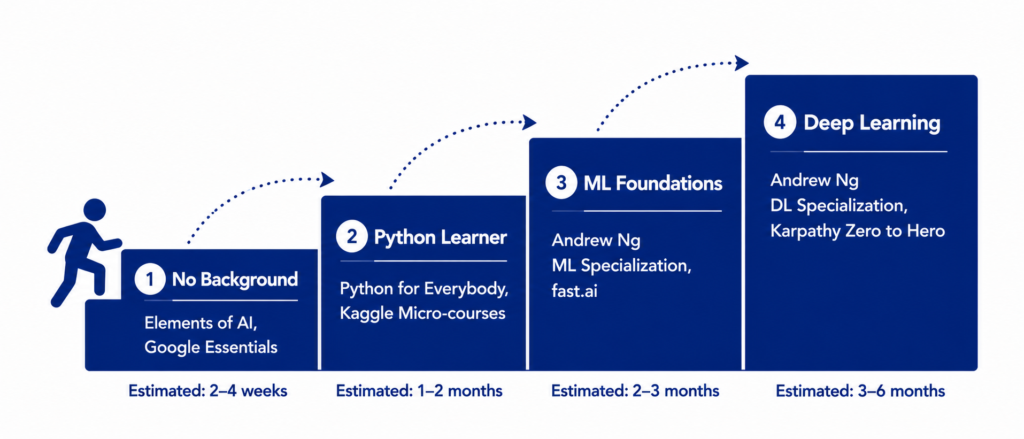
The path is not complicated. Elements of AI for orientation. Python for Everybody for the language. Andrew Ng’s ML Specialization for the foundations. fast.ai or Andrew Ng’s DL Specialization for deep learning. Your own projects running alongside everything.
Twelve months from now, the person who starts with Elements of AI today and works through this list consistently will have real, demonstrable AI skills — not certificate images and a vague sense of having watched a lot of videos.
The courses are free. The time is the investment.
If this guide helped you cut through the noise and find a path that actually fits where you are starting from, share it with someone who has been searching for “best AI course” for three months without actually starting one. Leave a comment below — if you are unsure which course to start with given your specific background, ask. Specific situations get specific answers.
Author: AI Learner Tech
AI Learner Tech is a premier research and educational hub dedicated to mastering Artificial Intelligence, Machine Learning, and Computer Vision. We bridge the gap between complex academic theories and real-world industrial applications. Join our community to access high-quality tutorials, open-source projects, and expert insights. Website: ailearner.tech