The Person Who Hired Me Knew Less About AI Than You Do Right Now
Three years ago I sat across from a hiring manager at a tech company who told me she was building an “AI team.” She asked me to explain what a neural network was. Halfway through my explanation she stopped me and said: “I don’t need to understand the details. I just need to know who to hire.”
She hired me. Six months later she asked me to teach her everything I’d explained in that interview — because she’d realized that managing AI projects without understanding AI was making her dependent on people she couldn’t evaluate.
That story contains the whole argument for this roadmap: you don’t need to become a researcher to benefit from learning AI, but the gap between “uses AI tools” and “understands what’s happening” is now one of the most consequential professional gaps in any field.
The good news is that the path from zero to genuinely useful AI knowledge is clearer in 2026 than it has ever been. The resources are better, more accessible, and increasingly free. The tools let you see results immediately. And the market for people who actually understand what they’re doing — not just people who can prompt ChatGPT — has never been larger.
This roadmap is honest about what the journey actually looks like. There are parts that take real work. There are things that will frustrate you. There are also parts that will genuinely surprise you with how accessible they are. I’ll tell you which is which, what order to do things in, and how long each stage actually takes for someone starting from scratch.
READ MORE: What Is Artificial Intelligence? Updated Ultimate Beginner’s Guide for 2026
Before the Roadmap: Two Honest Things You Need to Hear
Most learning guides skip the part where they tell you what this actually costs you — in time, in frustration, and in prerequisites. This one won’t.
Honest Thing One: This takes longer than most guides admit.
You will see claims like “learn AI in 30 days” and “become an AI engineer in 8 weeks.” These are marketing copy. Building genuinely useful, employable AI skills from zero — the kind where you can build real things, debug real problems, and make real decisions — takes six to twelve months of consistent effort. Not because AI is impossibly hard, but because it combines multiple skills (programming, mathematics, problem-solving, domain knowledge) that each take time to develop.
What you can learn in 30 days: enough to understand what AI is, run existing code, and use AI tools intelligently. That is genuinely valuable and worth doing. It is not the same as being able to build AI systems.
Honest Thing Two: Mathematics is unavoidable, but it’s less scary than you think.
You will need linear algebra, basic calculus, and probability. If those words make you want to close this tab — stay. The specific mathematical depth required to use AI effectively is much lower than a computer science degree requires. You need intuition more than proof-writing. You need to know what a matrix is and what multiplication means for it. You need to understand what a derivative tells you. You need to understand probability as “how likely is this.” That level is genuinely reachable for anyone who made it through high school math, even if it was years ago.
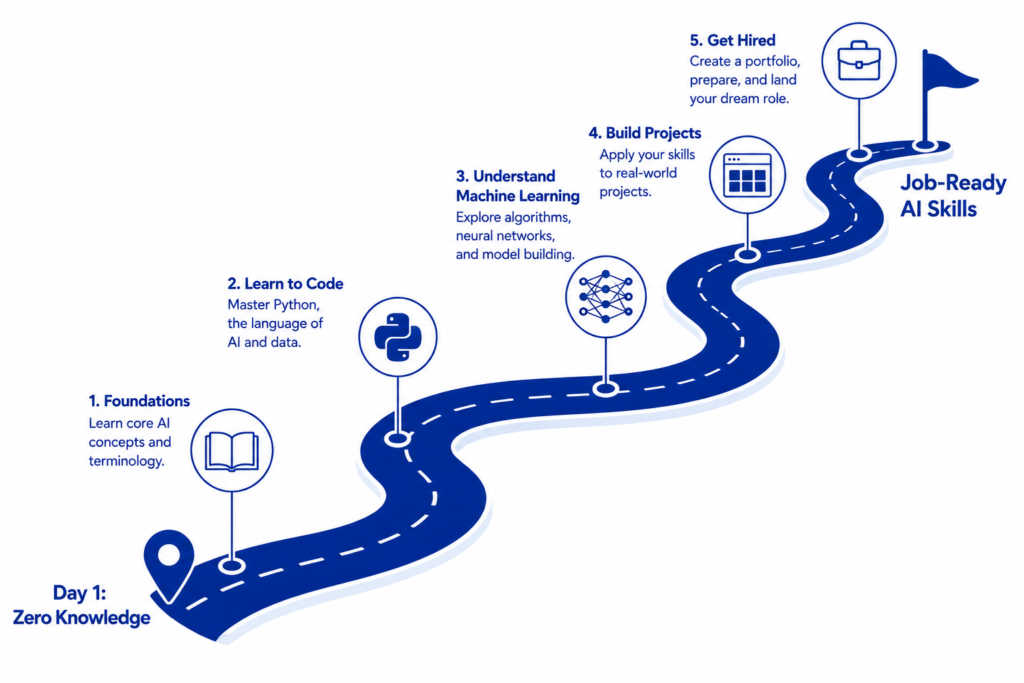
The Four Stages of This Roadmap
The journey from zero to job-ready AI skills has four distinct stages, each building on the last. Skipping stages — the most common mistake — causes people to get stuck, confused, and give up. Going in order is slower in the short term and dramatically faster overall.
Stage 1: Build Your Foundation (Weeks 1–6) Understand what AI actually is. Get comfortable with Python. Build the mathematical intuition you need.
Stage 2: Learn Machine Learning (Weeks 7–16) Understand how machines learn from data. Build your first real models. Work with actual datasets.
Stage 3: Learn Deep Learning and Modern AI (Weeks 17–28) Neural networks, transformers, LLMs, computer vision, natural language processing. The technology behind the products people actually use.
Stage 4: Specialize, Build, and Get Hired (Weeks 29 onward) Pick a direction. Build projects. Put together a portfolio. Enter the job market or apply skills in your existing field.
KEY FACT: According to the World Economic Forum’s 2025 Future of Jobs Report, AI and machine learning specialist roles are projected to be among the top five fastest-growing jobs through 2030, with demand growing at nearly 40% per year. The shortage of people who genuinely understand AI — not just talk about it — is severe enough that organizations are hiring people mid-learning and training them on the job.
Stage 1: Building Your Foundation (Weeks 1–6)
Week 1–2: Understand the Landscape Before Writing a Line of Code
The single most common mistake people make when starting to learn AI is jumping directly into code without building conceptual understanding. They copy-paste code from tutorials, get results they don’t understand, and have no framework for debugging when things go wrong — which they always do.
Spend your first two weeks reading and watching, not coding. Your goal is to be able to answer these questions confidently before touching any programming:
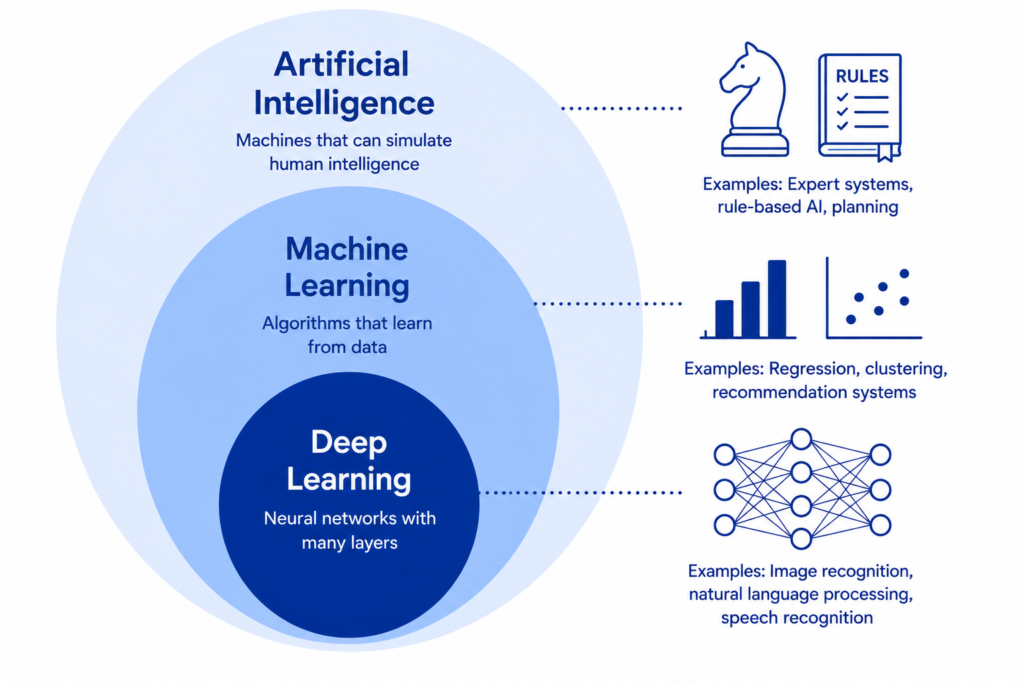
- What is the difference between AI, machine learning, and deep learning?
- What is supervised vs unsupervised vs reinforcement learning?
- What is a neural network, conceptually?
- What problems is AI good at? What problems is it bad at?
- What is a training dataset, and why does its quality matter?
- What does “overfitting” mean in plain language?
Recommended resources for this phase:
- 3Blue1Brown’s Neural Networks series on YouTube — the best visual explanation of how neural networks work that exists anywhere, completely free, requires no prior knowledge
- AI Learner Tech conceptual guides — start with the foundational articles on AI basics and work through the beginner-friendly explanations
- Seeing Theory (seeing-theory.brown.edu) — interactive visualizations of probability and statistics concepts, genuinely enjoyable
PRO TIP: Keep a vocabulary journal during these two weeks. Every time you encounter a term you don’t fully understand — overfitting, gradient descent, hyperparameter, epoch — write it down with a plain-language definition in your own words. This practice builds the conceptual scaffolding that makes everything that follows much faster to absorb.
READ MORE: AI vs Machine Learning vs Deep Learning: What’s the Real Difference?
Week 3–4: Python — The Language of AI
Python is the non-negotiable foundation. Nearly all AI research is done in Python. Nearly all AI tools and libraries are Python-first. You can learn AI concepts in theory without Python, but you cannot build anything or follow any practical tutorial without it.
The good news: you do not need to become a software engineer. You need to become comfortable enough with Python to read code you didn’t write, modify it, and write simple scripts yourself.
What to focus on for AI purposes:
- Variables, data types (strings, integers, lists, dictionaries)
- Loops and conditionals
- Functions — defining them, calling them, understanding arguments and return values
- Working with files — reading CSVs, loading data
- Understanding error messages — this skill is underrated and critical
What you do NOT need at this stage:
- Object-oriented programming (classes) — you’ll encounter it but don’t need to master it upfront
- Web development (Flask, Django) — different skill set, not AI-specific
- Complex data structures — comes later, naturally, when needed
# The Python skills you actually need for AI — demonstrated
# This level of comfort is your Week 4 target

import csv  # Read data files

# 1. Variables and basic data types
model_name = "linear_regression"  # string
accuracy = 0.87                    # float (decimal number)
n_samples = 1500                   # integer
features = ["age", "income", "education"]  # list

# 2. Working with lists — fundamental for data
scores = [0.92, 0.87, 0.91, 0.88, 0.95]
average_score = sum(scores) / len(scores)  # 0.906
best_score = max(scores)                   # 0.95

# 3. Dictionaries — storing structured information
model_results = {
    "accuracy": 0.87,
    "precision": 0.84,
    "recall": 0.91,
    "f1_score": 0.87
}
print(f"Model accuracy: {model_results['accuracy']:.0%}")

# 4. Loops — processing many items
for metric, value in model_results.items():
    print(f"  {metric}: {value:.3f}")

# 5. Functions — reusable blocks of logic
def evaluate_model(predictions, true_labels):
    """
    Count how many predictions matched the true labels.
    Returns accuracy as a percentage between 0 and 1.
    """
    correct = 0
    for pred, true in zip(predictions, true_labels):
        if pred == true:
            correct += 1
    return correct / len(true_labels)

# Example usage
my_predictions = [1, 0, 1, 1, 0, 1]
actual_labels  = [1, 0, 1, 0, 0, 1]
accuracy = evaluate_model(my_predictions, actual_labels)
print(f"My model accuracy: {accuracy:.0%}")  # 83%

# 6. Reading data from a CSV file
# Most real AI projects start by loading data like this
with open("dataset.csv", "r") as file:
    reader = csv.DictReader(file)
    data = [row for row in reader]

print(f"Loaded {len(data)} records")
print(f"First record: {data[0]}")
Resources:
- Python.org official tutorial — free, comprehensive, well-written
- freeCodeCamp Python Course on YouTube (full course, free, 4 hours) — best for visual learners
- Kaggle Learn: Python — free, browser-based, no installation required, certificates
Realistic timeline: 2 weeks of 1–2 hours daily gets you to functional comfort with Python for data work.
Week 5–6: The Mathematics You Actually Need
Do not skip this stage. People who skip it hit a wall at week 12 and don’t know why — because everything they’re copying from tutorials is working but nothing makes sense and nothing is debuggable.
You need three mathematical areas:
Linear Algebra — The Language of Data Data in machine learning is stored as matrices (tables of numbers) and vectors (single rows or columns of numbers). Operations on these — addition, multiplication, transformation — are the basic operations of every ML algorithm.
You need to understand: what a matrix is, what matrix multiplication means geometrically (transformation of space), what a vector is, what the dot product of two vectors represents (similarity/projection).
You do not need to: prove theorems, derive algorithms from scratch, or remember every matrix decomposition.
Calculus — The Engine of Learning Machine learning systems learn by adjusting their parameters to minimize error. The tool for finding which direction to adjust is the derivative — specifically, the gradient (the multi-variable version of a derivative). You need to understand what a derivative means geometrically (slope of a curve) and what gradient descent is conceptually (walking downhill to find the lowest point).
You do not need to: manually compute derivatives during your work. Libraries do this automatically. You need the intuition, not the computation.
Probability and Statistics — The Language of Uncertainty AI deals with uncertainty constantly — probability that a prediction is correct, distribution of training data, likelihood of different outcomes. You need to understand: what probability means, what a probability distribution is, what mean and variance tell you, what the difference between correlation and causation is.
You do not need to: derive probability theorems or work through Bayesian inference by hand (though understanding it conceptually helps later).
| Math Area | Key Concepts | Best Free Resource |
|---|---|---|
| Linear Algebra | Matrices, vectors, dot product, matrix multiply | 3Blue1Brown “Essence of Linear Algebra” (YouTube) |
| Calculus | Derivatives, chain rule intuition, gradient descent | 3Blue1Brown “Essence of Calculus” (YouTube) |
| Probability | Distributions, conditional probability, Bayes basics | Khan Academy Statistics (free) |
| Statistics | Mean, variance, correlation vs causation, hypothesis testing | StatQuest with Josh Starmer (YouTube) |
PRO TIP: 3Blue1Brown’s linear algebra and calculus series are genuinely the best introductions to these topics that exist anywhere — not just for AI learners but for anyone. The visual approach makes abstract concepts concrete in a way that textbooks almost never achieve. Watch them at 1.25x speed, pause to think, and watch confusing sections twice. 10–12 hours total for both series.
Stage 2: Learning Machine Learning (Weeks 7–16)
The Core Course You Should Take
After Stage 1, you are ready for structured machine learning study. There is one course that the global AI community consistently recommends above all others for this stage:
Andrew Ng’s Machine Learning Specialization on Coursera
This is not marketing. Andrew Ng co-founded Google Brain and Coursera, was the founding lead of Baidu AI, and is one of the most respected AI educators in the world. His ML course has been taken by over 5 million people. It is available for free to audit (you pay only if you want the certificate).
The course covers:
- Supervised learning in depth — linear regression, logistic regression, neural network basics
- Advanced ML — decision trees, ensemble methods, overfitting and regularization
- Unsupervised learning — clustering, anomaly detection, recommendation systems
- Best practices — how to actually improve a model when it’s not working
What makes this course particularly good for beginners:
Ng explains concepts from first principles, builds mathematical intuition rather than just showing formulas, and uses simple examples before complex ones. Every concept is introduced in a way that makes you feel like it makes sense, rather than the experience most technical courses produce — where you follow the steps without understanding why.
Realistic time commitment: 4–6 weeks at 8–10 hours per week.
Working With Real Data: The Kaggle Practice Layer
Courses give you knowledge. Practice on real data gives you skill. These are different things. The best free platform for AI practice with real data is Kaggle.
Kaggle (kaggle.com) provides:
- Free datasets across every domain imaginable
- “Competitions” where you build models to solve real problems and compare results
- Notebooks — browser-based coding environments where you can run Python without installing anything
- “Learn” section with short, practical skill modules
Your Stage 2 Kaggle plan:
Start with the Titanic survival prediction competition — the canonical beginner project that nearly every ML practitioner has worked on. The goal is binary classification (did this passenger survive?) using structured data (age, ticket class, gender, etc.). It teaches data cleaning, feature engineering, model selection, and submission workflow.
After Titanic, try one more beginner competition of your choosing. The choice matters less than the habit of working with real data that isn’t pre-cleaned and pre-formatted like course examples.
# A beginner ML project — the structure every project follows
# Using the classic Iris dataset (flower classification)

import pandas as pd
import numpy as np
from sklearn.model_selection import train_test_split
from sklearn.preprocessing import StandardScaler
from sklearn.ensemble import RandomForestClassifier
from sklearn.metrics import accuracy_score, classification_report

# ── STEP 1: LOAD YOUR DATA ──────────────────────────────────
# In real projects, this is usually a CSV from Kaggle or your company
from sklearn.datasets import load_iris
iris = load_iris()

# Convert to a DataFrame so we can see and manipulate it clearly
df = pd.DataFrame(iris.data, columns=iris.feature_names)
df['species'] = iris.target  # 0=setosa, 1=versicolor, 2=virginica

print("Dataset shape:", df.shape)      # (150, 5) — 150 rows, 5 columns
print("\nFirst 5 rows:")
print(df.head())

# ── STEP 2: SPLIT INTO FEATURES (X) AND TARGET (y) ─────────
# X = what the model sees (inputs)
# y = what the model should predict (output)
X = df.drop('species', axis=1)   # All columns except target
y = df['species']                  # Just the target column

# ── STEP 3: SPLIT INTO TRAINING AND TEST SETS ───────────────
# Train set: model learns from this
# Test set:  we hide this and use it to evaluate real performance
# Never train and test on the same data — gives false accuracy!
X_train, X_test, y_train, y_test = train_test_split(
    X, y,
    test_size=0.2,      # 20% held out for testing
    random_state=42     # Same split every run (reproducibility)
)

print(f"\nTraining samples: {len(X_train)}")  # 120
print(f"Test samples: {len(X_test)}")          # 30

# ── STEP 4: SCALE FEATURES ──────────────────────────────────
# Many ML algorithms work better when features are on similar scales
# StandardScaler transforms each feature to have mean=0, std=1
scaler = StandardScaler()
X_train_scaled = scaler.fit_transform(X_train)  # Learn scale from training data
X_test_scaled = scaler.transform(X_test)         # Apply same scale to test data
# Note: ONLY fit scaler on training data, never on test data

# ── STEP 5: TRAIN THE MODEL ─────────────────────────────────
# Random Forest: an ensemble of decision trees — robust, beginner-friendly
model = RandomForestClassifier(
    n_estimators=100,   # 100 trees in the forest
    random_state=42
)
model.fit(X_train_scaled, y_train)  # This is where learning happens
print("\nModel trained!")

# ── STEP 6: EVALUATE ON TEST DATA ───────────────────────────
y_pred = model.predict(X_test_scaled)
accuracy = accuracy_score(y_test, y_pred)
print(f"\nTest Accuracy: {accuracy:.1%}")  # Typically ~97%

# Detailed breakdown by class
print("\nDetailed results:")
print(classification_report(y_test, y_pred,
                            target_names=iris.target_names))

# ── STEP 7: USE THE MODEL TO PREDICT NEW DATA ────────────────
new_flower = [[5.1, 3.5, 1.4, 0.2]]  # Measurements for one new flower
new_flower_scaled = scaler.transform(new_flower)
prediction = model.predict(new_flower_scaled)
print(f"\nNew flower prediction: {iris.target_names[prediction[0]]}")
This six-step pattern — load, split, scale, train, evaluate, predict — is the skeleton of virtually every supervised learning project. Learning it deeply on simple datasets makes complex datasets manageable.
Stage 3: Deep Learning and Modern AI (Weeks 17–28)
The Shift in Mindset
Classical machine learning is intuitive in a certain way — you can often look at a decision tree and understand why it made a prediction. Deep learning is powerful in a different way — the patterns it learns are distributed across millions of numbers that no human can interpret directly. This shift requires a different way of thinking about building and debugging models.
The recommended deep learning course for this stage:
fast.ai’s Practical Deep Learning for Coders (course.fast.ai) — completely free, requires no payment, no signup beyond creating an account.
What makes fast.ai different from every other deep learning course: it teaches top-down. You start with a working model that produces real results, then you go deeper into how it works. Most courses teach bottom-up — months of theory before you see anything impressive. fast.ai gets you building real image classifiers in the first lesson, then explains how they work.
This approach is not universally preferred — some people find it disorienting to use something before fully understanding it. But for most learners, seeing impressive results early provides the motivation to push through the harder conceptual material that follows.
After fast.ai, the targeted supplements:
For understanding transformers (the architecture behind ChatGPT, Claude, and all modern LLMs): Andrej Karpathy’s “Let’s build GPT from scratch” on YouTube — 2 hours of Karpathy (former Tesla AI director, former OpenAI researcher) building a small GPT model from scratch in live coding. Watching it multiple times is standard. It is the best existing explanation of transformer mechanics by anyone.
For understanding computer vision: Stanford’s CS231n lecture notes are freely available and considered the canonical reference for CNNs.
For understanding LLMs and prompt engineering: DeepLearning.AI’s short courses (deeplearning.ai/short-courses) — most are free or very low cost, 1–2 hours each, taught by the researchers who built the technologies being explained.
The Critical Habit of This Stage: Read Papers
By Stage 3, you are ready to read actual research papers — and you should start doing so. Not every paper. Not daily. But regularly.
Papers are where ideas exist before they become courses and tutorials. The researchers who built the tools you’re using wrote papers explaining them. Reading those papers, even imperfectly, builds a level of understanding that no course alone provides.
The papers every AI learner should read at this stage:
- “Attention Is All You Need” (Vaswani et al., 2017) — the transformer paper
- “Deep Residual Learning for Image Recognition” (He et al., 2015) — foundational CNNs
- “BERT: Pre-training of Deep Bidirectional Transformers” (Devlin et al., 2018)
- “Language Models are Few-Shot Learners” (GPT-3 paper, Brown et al., 2020)
You will not understand everything. Read what you can, look up what you can’t, and keep a list of concepts to revisit. The goal is not full comprehension immediately — it is building familiarity with research writing and the ideas it contains.
PRO TIP: Papers on arxiv.org are free. Semantic Scholar provides free access to virtually all AI research papers with related paper recommendations. Explainers on Papers With Code (paperswithcode.com) walk through important papers with practical context. None of this costs money.
Stage 4: Specialize, Build, and Get Hired (Week 29 Onward)
Pick a Direction — Generalism Has Limits
By Week 28, you have broad AI knowledge. That is valuable. But the job market and real project work both reward specialization. You need to pick a direction:
Natural Language Processing (NLP) Working with text — building chatbots, summarization systems, sentiment analysis tools, search systems, question-answering. The domain of LLMs. Highest demand in 2026, closely tied to the generative AI wave.
Computer Vision Working with images and video — object detection, medical imaging, autonomous vehicles, video analysis. Extremely well-established field with deep tooling and research base.
Machine Learning Engineering (MLOps) The engineering discipline of deploying ML models in production — not building the models but making them run reliably at scale, monitoring them, updating them. Extremely high demand because this skill is rare.
Data Science Using ML and statistical analysis to extract insights from business data. Broader than pure AI but overlapping significantly. Highest volume of job openings.
AI Research Building new algorithms, new architectures, advancing the state of the field. Requires graduate education in most cases. Not the typical destination for self-learners, but some do make it.
| Specialization | 2026 Job Demand | Avg Salary Range (USD) | Entry Point Difficulty |
|---|---|---|---|
| NLP / LLM Engineering | Very High ↑ | $120K–$200K | Medium |
| Computer Vision | High | $110K–$180K | Medium |
| ML Engineering / MLOps | Very High ↑ | $130K–$210K | Medium-High |
| Data Science | Very High | $95K–$160K | Low-Medium |
| AI Safety Research | Growing rapidly | $130K–$250K | High |
| AI Research | Moderate | $150K–$300K | Very High |
Build a Portfolio — This Is Non-Negotiable
No AI hiring manager in 2026 is impressed by certificates alone. What gets you interviews is demonstrated ability to build real things. Your portfolio needs three to five projects, each one meaningfully more complex than the last.
Project 1 — Structured Data Classification (Skill: classical ML) Pick a real dataset from Kaggle (not Iris or Titanic — those are overrepresented). Build a clean solution: proper train/test split, feature engineering, model selection with cross-validation, final evaluation. Write a clear README explaining your approach and results. Put it on GitHub.
Project 2 — Computer Vision or NLP (Skill: deep learning) Build an image classifier using transfer learning (using a pre-trained model as your base — EfficientNet, ResNet) fine-tuned on a specific problem you care about. Or build a text classification or sentiment analysis system. Use Hugging Face’s transformers library — the standard tool for NLP in 2026.
Project 3 — End-to-End Application (Skill: deployment) Build something a non-technical person can actually use. Take one of your earlier models and put it behind a simple web interface using Gradio or Streamlit — both make this possible in under 50 lines of Python. Deploy it for free on Hugging Face Spaces. Now you have a live demo anyone can try.
Project 4 (Optional but powerful) — Domain-Specific Problem Apply AI to a problem in your existing professional domain. A nurse who builds a medication side effect classifier. A lawyer who builds a contract clause extraction tool. A teacher who builds a student essay feedback system. This project is almost always more impressive to employers than a generic benchmark project, because it demonstrates judgment about where AI is actually useful.
WARNING: Do not build portfolio projects from the exact same tutorials everyone else follows. Hiring managers have seen hundreds of MNIST digit classifiers and Titanic survival predictors. Pick interesting problems. Use real data. Document what didn’t work as well as what did. The projects that get callbacks are the ones where it’s obvious the person actually thought, not just followed instructions.
The Resources That Actually Work in 2026
A curated list — not exhaustive, not padded, just the things that consistently produce results:
Free Foundations:
- 3Blue1Brown YouTube (mathematics visual intuition)
- freeCodeCamp Python Course (YouTube, free)
- Kaggle Learn (Python, ML, pandas, SQL — all free)
- StatQuest with Josh Starmer (statistics and ML intuition)
Free Core Courses:
- Andrew Ng ML Specialization (Coursera — audit for free)
- fast.ai Practical Deep Learning (completely free)
- Andrej Karpathy’s YouTube channel (building AI from scratch)
- DeepLearning.AI Short Courses (many free, 1–2 hrs each)
Free Practice Platforms:
- Kaggle (datasets, competitions, free GPU notebooks)
- Hugging Face (models, datasets, free hosting for demos)
- Google Colab (free GPU computing for running notebooks)
- LeetCode (coding practice — important for interviews)
Paid Options Worth Considering:
- Coursera Plus subscription ($59/month) — access all Ng courses and certificates
- fast.ai’s book “Deep Learning for Coders” ($60) — companion to the free course
- Udemy courses during sales ($15–20) — good supplementary content for specific topics
Communities to Join:
- Reddit: r/MachineLearning, r/learnmachinelearning
- Discord: fast.ai community, Hugging Face Discord
- Twitter/X: follow @karpathy, @ylecun, @AndrewYNg, @GaryMarcus for research pulse
- LinkedIn: engage with AI content to build network while learning
The Weekly Schedule That Actually Works
The biggest reason people fail to complete AI learning paths: inconsistency. Life interrupts. Motivation cycles. Complexity spikes. Here is a sustainable weekly structure based on what consistently works for self-learners:
For someone with a full-time job:
- Monday/Wednesday/Friday evenings: 90 minutes of structured course content — watching, coding along, taking notes
- Saturday morning: 2–3 hours of project work or Kaggle practice — hands-on building
- Sunday: 30–60 minutes light — reading an article, watching a conceptual video, reviewing notes
Total: approximately 7–8 hours per week. At this pace, the full roadmap takes 12–14 months. Doubling the hours roughly halves the timeline.
The rules that make this sustainable:
Never skip more than one planned session without immediately rescheduling it. The compounding effect of consistent learning is broken by extended gaps faster than you expect.
Keep a learning log — even just a text file where you write two sentences after each session: what you covered and what confused you. Review it weekly. Progress becomes visible, which maintains motivation.
Build something small every month, regardless of how early you are in the journey. It doesn’t need to be impressive. It needs to be real — code that runs, produces output, and does something. The habit of building is more important than the quality of what gets built early.
PRO TIP: The biggest predictor of completing an AI learning path is not intelligence, prior background, or available time — it is having a specific reason that’s personal and concrete. “I want to get a better job” is less powerful than “I want to build an AI tool that helps my mother manage her diabetes data.” The more specific and personal the goal, the more resilient the motivation when learning gets hard — and it will get hard.
What the Job Market Actually Looks Like in 2026
If you’re learning AI with career goals, here is an honest picture of the market:
Entry-level data science positions — requiring Python, SQL, classical ML, and a portfolio of projects — are available in volume. Competition is real but manageable for candidates with solid portfolios. Starting salaries range from $85K–$120K in the US, lower internationally.
ML engineering and MLOps roles are in high demand with insufficient supply. Companies building AI products need people who can deploy and maintain ML systems, not just build models. This specialization commands a premium.
NLP and LLM engineering is the fastest-growing segment in 2026, driven by every company building generative AI features into their products. Prompt engineering is the entry point; LLM fine-tuning and evaluation are the next level; building AI applications on top of foundation models is the core skill.
AI safety and alignment is growing significantly in funding but small in absolute headcount. Anthropic, DeepMind, OpenAI, and a growing number of academic institutions are hiring for safety research. This path typically requires graduate-level background or exceptional self-demonstrated capability.
The role that surprises people: AI product management. Companies need people who understand AI well enough to make decisions about AI products — what to build, what not to build, what to promise users and what not to. This is a management/strategy role, not a technical one, but requires genuine technical understanding. Former engineers and strong AI generalists both enter this path.
FAQ: Learning AI From Zero
Q1: Do I need a degree in computer science or mathematics to learn AI?
No — but you need some of the underlying skills those degrees develop, specifically programming and mathematical foundations. The difference is you can build those skills in months through focused self-study rather than years through a degree program. Many successful AI practitioners are self-taught or came from adjacent fields like physics, statistics, economics, or engineering. What matters to employers is demonstrated ability — projects, GitHub, understanding of concepts — not the paper credential. That said, if your goal is AI research at a top lab, a graduate degree is still the standard path.
Q2: How much does it cost to learn AI if I want to spend as little as possible?
The core learning path can be completed for essentially zero cost. Andrew Ng’s Coursera course can be audited free. fast.ai is entirely free. 3Blue1Brown, StatQuest, and Andrej Karpathy’s content are free on YouTube. Kaggle provides free GPU compute for practice. Google Colab provides free GPU access for training models. The main costs are your time and a laptop capable of running Python — any computer made in the last 8 years is sufficient for learning.
Q3: What if I tried to learn programming before and couldn’t do it?
Most people who “couldn’t learn programming” ran into one of three problems: they tried to learn general software engineering (much harder than the Python-for-data-science you need), they used resources not designed for their learning style, or they didn’t have a concrete reason to keep going when it got frustrating. Python for AI work is genuinely more accessible than web development or systems programming. The concepts you need are fewer, the feedback is faster, and the results are more immediately satisfying.
Q4: Should I learn Python or R for AI?
Python, without meaningful hesitation. R is excellent for statistical analysis and is used in academia and some data science contexts. But the AI ecosystem — frameworks like TensorFlow and PyTorch, libraries like Hugging Face, tools like LangChain — is Python-first and Python-dominant. Anything built for AI is in Python. If you already know R, it’s useful background, but your primary investment should be Python.
Q5: How do I know when I’m ready to apply for jobs?
You are ready when you have three things: a solid understanding of ML fundamentals (you can explain what regularization is, why we split data, what overfitting means, how gradient descent works), practical Python ability (you can write and debug working ML code without copying from tutorials), and a portfolio of three or more real projects publicly available on GitHub. You don’t need to know everything. Entry-level positions expect to train. What they need evidence of is capability and genuine interest, not complete expertise.
Q6: Is it too late to enter the AI field?
This is the question I get most often, and the honest answer is: the concern is understandable and the worry is wrong. The AI field is expanding faster than it is filling up. The shortage of people who genuinely understand AI — not people who can put “AI” on a resume, but people who can build things, make decisions, and explain what they’re doing — is severe and growing. The person who starts learning seriously today and reaches job-ready skill in 12 months is not late. They are arriving as the market is peaking.
The Map Is In Your Hands — What You Do With It Is Yours
Every person who is good at AI right now was once exactly where you are. They didn’t have special talent that you’re missing. They had a map and the willingness to follow it consistently, even when a specific section was confusing, even when progress felt slow, even when they questioned whether it was worth it.
Here is what I know from watching people go through this journey: the confusion you’ll feel at week 4 does not mean you’re bad at this. The frustration at week 10 when something isn’t working does not mean you made a mistake starting. The moment at week 18 when something suddenly clicks — when the architecture makes sense, when you can debug your own errors, when you build something you’re proud of — that moment is available to you too.
The roadmap is clear. The resources have never been better. The market has never been more open to people who put in the work.
Start today. Share this guide with someone who’s been meaning to start. Leave a comment with which stage you’re at — or with the first step you’re committing to taking this week. And when you’re ready to go deeper on the concepts you’ll encounter along the way, our guide on gives you the conceptual clarity that makes everything else faster to learn.
Author: AI Learner Tech
AI Learner Tech is a premier research and educational hub dedicated to mastering Artificial Intelligence, Machine Learning, and Computer Vision. We bridge the gap between complex academic theories and real-world industrial applications. Join our community to access high-quality tutorials, open-source projects, and expert insights. Website: ailearner.tech