
Handling Imbalanced Datasets in Machine Learning #
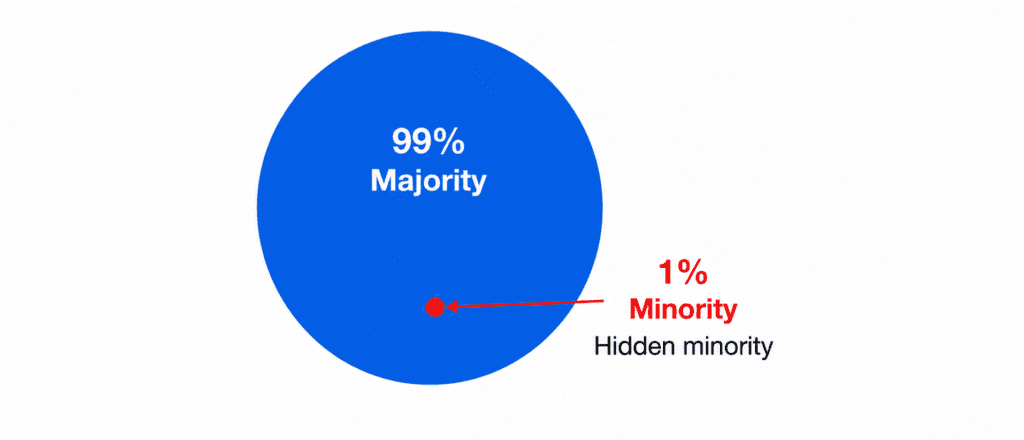
Is one of the most common problems in classification tasks. You build a fraud detection model. It says 99% accurate. You celebrate. Then you realize: only 1% of transactions are fraud. Your model just predicted “Not Fraud” for everything. It learned nothing. This is the hidden trap of imbalanced datasets.
What is an Imbalanced Dataset? #
Simply put: one class has way more examples than the other.
Real life examples:
- Fraud detection: 99% normal, 1% fraud
- Disease detection: 98% healthy, 2% sick
- Rare event prediction: 99.9% no event, 0.1% event
The problem: Your model becomes lazy. It learns to predict the majority class every time. Accuracy looks great. But the model is useless.
Why Accuracy Lies to You #
Imagine 1000 transactions. 990 normal. 10 fraud.
A dumb model that always says “normal” gets 99% accuracy. But it catches ZERO fraud.
Better metrics for imbalanced data:
- Precision: Of the ones you called fraud, how many were actually fraud?
- Recall: Of all actual fraud, how many did you catch?
- F1 Score: Balance between precision and recall
These tell the real story. Not accuracy.
Three Ways to Fix Imbalanced Data #
| Method | One Line Explanation |
|---|---|
| class_weight | Tell model “pay more attention to rare class” |
| Undersampling | Throw away some majority examples |
| SMOTE | Create fake minority examples |
Method 1: class_weight (Easiest) #
You just add one line of code. The model automatically cares more about the minority class.
How it thinks: Missing a fraud is 100x worse than wrongly flagging a normal transaction.
model = RandomForestClassifier(class_weight='balanced')
model.fit(X, y)
When to use: Almost always. Start here. It is the easiest and often works well.
Downside: Does not create new data. Only changes how model learns.
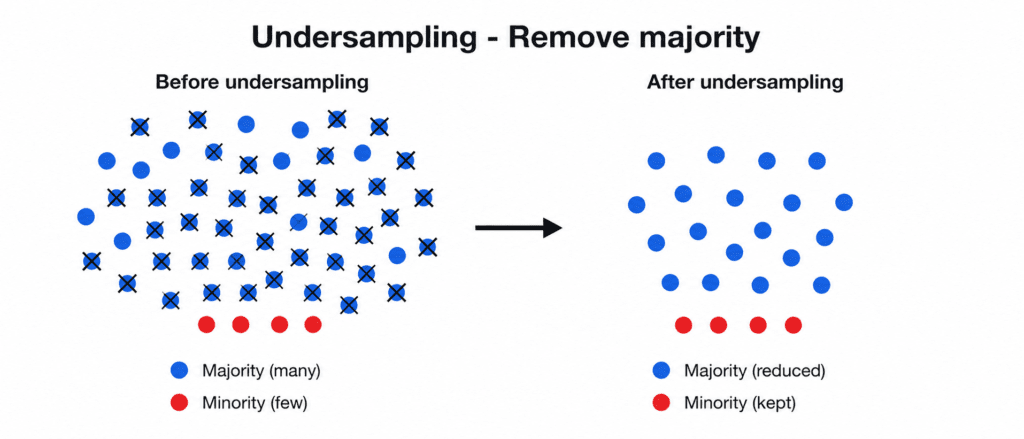
Method 2: Undersampling (Delete Data) #
You randomly delete majority examples until both classes are equal.
Example: 990 normal, 10 fraud → Delete 980 normal → Keep 10 normal, 10 fraud
from sklearn.utils import resample

# Keep all fraud, take same number of normal randomly
normal_under = resample(normal, n_samples=len(fraud), random_state=42)
balanced = pd.concat([normal_under, fraud])
When to use: When you have millions of examples. Deleting some is fine.
Downside: You lose data. Model sees less variety.
Method 3: SMOTE (Create Fake Data) #
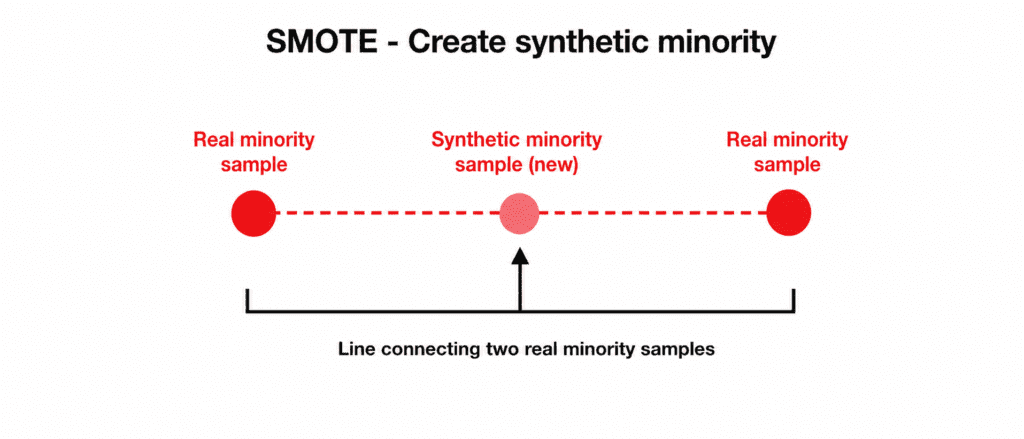
You create brand new synthetic minority examples.
How it works: Take two real fraud examples. Draw a line between them. Pick a random point on that line. That is your new fake fraud example.
Example: 10 fraud → Create 980 fake fraud → Now 990 fraud, 990 normal
from imblearn.over_sampling import SMOTE

smote = SMOTE(random_state=42)
X_balanced, y_balanced = smote.fit_resample(X, y)
When to use: Small dataset. Cannot afford to lose data.
Downside: Can create unrealistic examples if not careful.
Which One Should You Choose? #
| Your Situation | Best Method |
|---|---|
| You want quick and easy | class_weight |
| You have millions of data | Undersampling |
| You have very little data | SMOTE |
| You are using XGBoost | class_weight (built-in) |
| You are using Neural Network | SMOTE + class_weight |
Simple rule: Start with class_weight. If that fails, try SMOTE. Use undersampling only for huge datasets.
Complete Picture
Problem: Detect fraud. 10,000 transactions. 100 fraud (1%).
Step 1: Train model with no balancing.
- Result: 99% accuracy. Catches 5% of fraud. ❌ Fails.
Step 2: Add class_weight=’balanced’
- Result: Catches 60% of fraud. ✅ Much better.
Step 3: Try SMOTE
- Result: Catches 75% of fraud. ✅ Even better.
Step 4: Combine SMOTE + class_weight
- Result: Catches 78% of fraud. ✅ Best.
Important Note #
Balancing data does not guarantee success. If fraud looks exactly like normal transactions, no method will work. You need good features first.
Quick Quiz #
Q1: Your model has 98% accuracy but catches only 10% of fraud. What is wrong?
A1: Imbalanced dataset. Accuracy is lying. Check precision and recall instead.
Q2: You have 1 million normal and 1000 fraud. Which method is fastest?
A2: Undersampling. Delete 999,000 normal. Keep 1000 each.
Q3: You have 500 normal and 500 fraud. Is your dataset balanced?
A3: Yes. Perfect balance 1:1. No need for these methods.
Q4: Which method creates brand new fake data?
A4: SMOTE. It creates synthetic minority examples.