Everyone Uses These Three Terms Interchangeably — Almost Everyone Is Wrong
Open any tech article. Watch any news segment about technology. Sit through any corporate presentation about “digital transformation.” You will hear the words artificial intelligence, machine learning, and deep learning used as though they mean the same thing — swapped in and out based on whichever sounds most impressive in the sentence.
They are not the same thing.
One of them is the broadest possible category. One is a specific approach within that category. One is a specific technique within that approach. Getting them confused is a bit like using the words “vehicle,” “car,” and “Tesla” interchangeably — technically they can all refer to the same object in certain situations, but they carry very different information and conflating them makes you sound less informed, not more.
The reason this confusion matters beyond pedantry: these terms describe fundamentally different technologies with different capabilities, different limitations, and different applications. When a company says they “use AI” in their product, you cannot evaluate that claim without knowing whether they mean a simple rule-based system, a statistical model, or a deep neural network. The answers are wildly different.
This guide will give you a clear, memorable mental model of all three — how they relate to each other, what makes each one distinct, and how to recognize which one you’re actually looking at in the real world. No mathematics required. No prior technical knowledge assumed.
READ MORE: What Is Artificial Intelligence? Updated Ultimate Beginner’s Guide for 2026
The Relationship You Need to Picture First
Before any definitions, burn this image into your memory because everything else flows from it:
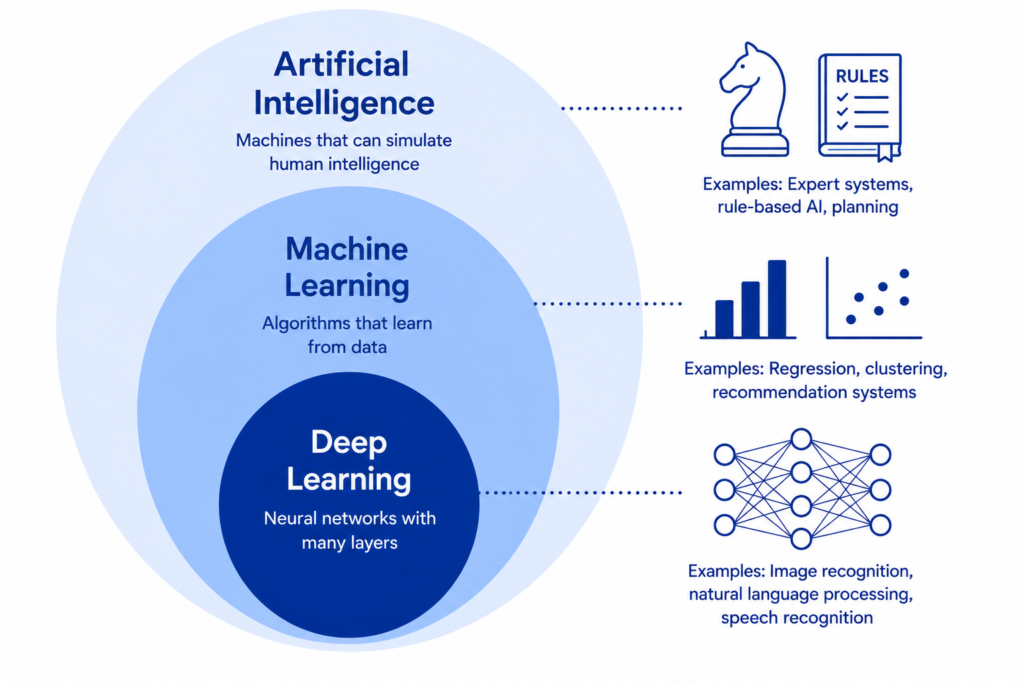
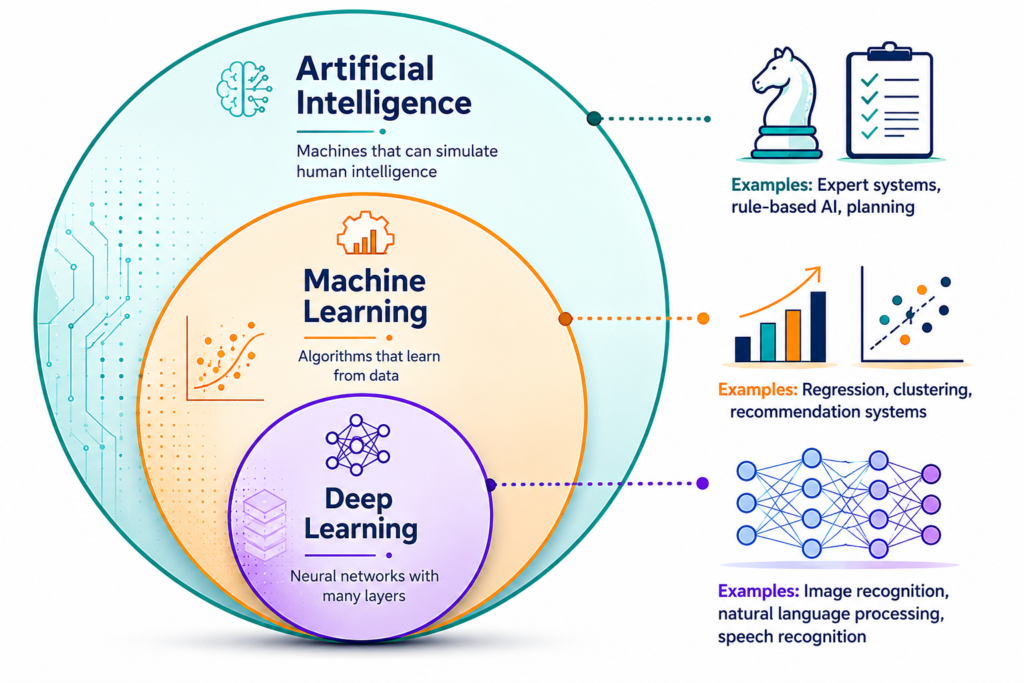
Deep Learning is inside Machine Learning. Machine Learning is inside Artificial Intelligence.
They are nested, not separate. Deep Learning is a type of Machine Learning. Machine Learning is a type of AI. Every deep learning system is a machine learning system is an AI system. But not every AI system is machine learning, and not every machine learning system is deep learning.
The analogy I find most useful: think of them like locations.
- AI is the continent — enormous, diverse, containing many different countries and climates
- Machine Learning is a specific large country on that continent — with its own distinct culture and approach
- Deep Learning is a major city within that country — denser, more powerful, more specialized, the place where most of the exciting action currently happens
You can be in the AI continent without being in the Machine Learning country. You can be in the Machine Learning country without being in the Deep Learning city. But if you’re in the Deep Learning city, you are necessarily in the Machine Learning country and on the AI continent.
With that spatial relationship clear, let’s visit each one.
Artificial Intelligence: The Whole Continent
Artificial Intelligence is the broadest term. It refers to any technique that enables computers to perform tasks that would normally require human intelligence.
Notice how broad that is. It does not specify how the computer does the task. It does not require that the computer learned anything. It simply requires that the task, when done by a human, would be considered intelligent.
This means AI includes:
Rule-based systems — Programs that follow explicit if-then rules written by humans. The first chess programs were AI: they evaluated positions using rules that human chess experts programmed in. No learning. No data. Just rules. Still AI.
Search algorithms — Programs that explore possible moves or solutions systematically. Early AI game-playing systems searched through possible game states. Still AI.
Expert systems — Programs that encode the knowledge of human experts as logical rules. Medical diagnosis systems from the 1980s that asked symptom questions and produced diagnoses were AI. Still AI.
Machine learning — Programs that learn their own rules from data. This is the modern dominant approach. Also AI.
Deep learning — A specific type of machine learning using layered neural networks. This is what powers most of today’s impressive AI products. Also AI, also machine learning.
KEY FACT: The term “Artificial Intelligence” was coined at the Dartmouth Conference in 1956. At that time, rule-based systems and search algorithms were considered the primary approaches. Machine learning as we know it today barely existed. Deep learning was decades away. The term is 70 years old. The approaches it covers have changed dramatically — which is exactly why “we use AI” tells you very little about what a company actually does.
The important thing to understand about the AI category: most of what was exciting AI research in 1980 or 1990 is not what anyone is excited about in 2026. The field has evolved. When modern people say “AI,” they almost always mean machine learning — and often specifically deep learning. But the formal definition of AI is far broader.
Machine Learning: The Country Where Rules Teach Themselves
Machine Learning is a specific approach to building AI systems in which the system learns patterns from data rather than following explicitly programmed rules.
This is the conceptual shift that changed everything. Let’s make it concrete.
The Traditional AI Approach (Rule-Based)
Imagine you want to build a spam filter. In the traditional AI approach, a programmer would sit down and write rules:
- If the email contains “FREE MONEY” → spam
- If the sender is unknown AND the email contains “click here” → probably spam
- If the email has more than 5 exclamation marks → suspicious
- And so on…
This works, but it breaks. Spammers learn the rules and work around them. The rules need constant updating. Novel spam patterns that nobody anticipated slip through. The programmer has to think of every case in advance.
The Machine Learning Approach
The machine learning alternative: instead of writing rules, show the system thousands of emails already labeled as spam or not spam, and let it figure out the rules itself.
The ML system analyzes those examples, finds statistical patterns that distinguish spam from not-spam — patterns too subtle and numerous for any human to articulate — and builds its own internal rules for classification. Then it applies those rules to new emails it has never seen.
The rules are learned from data, not programmed by humans. That’s the core of machine learning.
PRO TIP: Machine learning’s great strength — learning rules from data — is also its most important limitation. The system can only learn patterns that exist in the data it was given. If the training data is biased, incomplete, or unrepresentative, the learned rules will be biased, incomplete, or unrepresentative in exactly the same ways. “Garbage in, garbage out” is the oldest principle in computing, and machine learning does not escape it.
The Three Main Types of Machine Learning
Machine learning itself divides into three broad approaches based on how the system learns:
Supervised Learning — The most common type. The training data is labeled: each example comes with the correct answer. 10,000 photos labeled “cat” or “not cat.” The system learns to predict the label for new unlabeled examples.
Real examples: spam filters, image classifiers, fraud detection, credit scoring, medical image diagnosis.
Unsupervised Learning — The training data has no labels. The system finds structure in the data on its own — grouping similar things together, finding unusual outliers, compressing data into meaningful representations.
Real examples: customer segmentation (“group our customers by behavior without telling me how many groups”), anomaly detection in network traffic, topic modeling in documents.
Reinforcement Learning — The system learns by taking actions in an environment and receiving rewards or penalties. No labeled data. Instead, the feedback comes from the consequences of actions.
Real examples: game-playing AI (AlphaGo learned by playing millions of games against itself), robotics control, optimizing energy usage in data centers, certain recommendation system training.
| ML Type | How It Learns | What’s Needed | Real Example |
|---|---|---|---|
| Supervised | From labeled examples | Large labeled dataset | Image recognition, spam filter |
| Unsupervised | From structure in unlabeled data | Large unlabeled dataset | Customer segmentation, anomaly detection |
| Reinforcement | From rewards and penalties | Environment to interact with | Game AI, robotics, recommendation systems |
Deep Learning: The City Where Everything Happens Now
Deep Learning is a specific type of machine learning that uses artificial neural networks with many layers — the “deep” refers to the depth of these layers — to learn patterns of extraordinary complexity.
To understand why deep learning matters, you first need to understand what came before it — and why it wasn’t enough.
Classical Machine Learning Has a Hidden Cost
Traditional (non-deep) machine learning works well, but it has a significant limitation: it usually requires humans to decide which features of the data to focus on. This is called feature engineering.
Consider the cat-recognition problem again. A classical ML system doesn’t directly process raw pixel data well. A human engineer needs to decide: “let’s extract these features from the image — edge sharpness at these coordinates, color histogram, texture patterns” — and give those pre-processed features to the ML system.
Feature engineering requires domain expertise. For images, you need experts who understand computer vision. For medical data, you need experts who understand what patterns in the data are medically significant. You need to know what to look for before you can teach the machine to look for it.
For simple problems, this is fine. For complex ones — recognizing objects in photos, understanding speech, reading handwriting — it becomes the bottleneck.
Deep Learning Learns Its Own Features
Deep learning networks solve this by learning what features to look for, automatically, from raw data — at multiple levels of abstraction simultaneously.
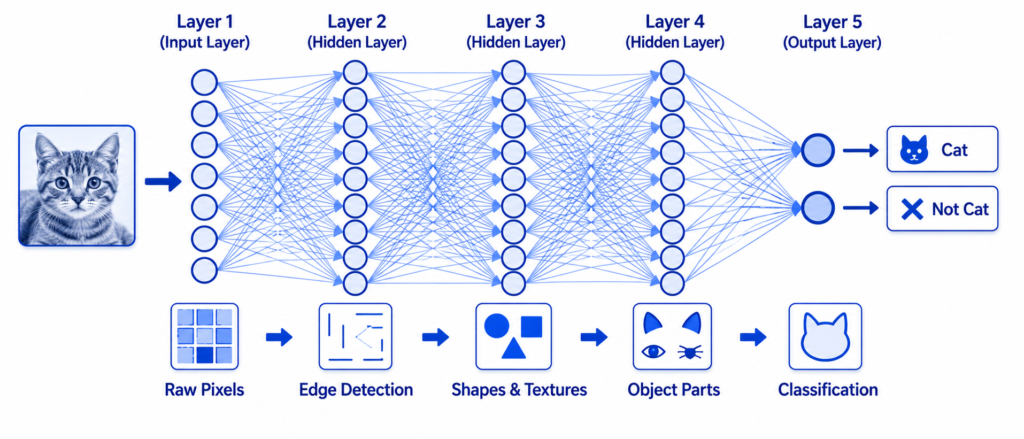
A deep neural network for image recognition doesn’t need a human to define “edges” and “textures” as inputs. It learns to detect edges in early layers, combine edges into shapes in middle layers, combine shapes into objects in later layers, and combine objects into scene understanding in final layers — all without anyone telling it to do this.
This happens through layers of interconnected artificial neurons, each layer transforming the representation produced by the layer before it.
How a Deep Neural Network Processes an Image (Conceptually):

RAW INPUT: 224×224 pixel image — 150,528 numbers, just pixel brightness values

LAYER 1 — Edge Detection
→ Neurons learn to respond to: horizontal edges, vertical edges, diagonal edges
→ The network wasn't told to look for edges — it discovered that edges matter

LAYER 2 — Simple Shapes
→ Neurons combine edge detectors: corners, curves, circles, rectangles
→ Still no human instruction — the network found this level of abstraction useful

LAYER 3 — Textures and Patterns
→ Combinations of shapes become: fur texture, smooth surface, grid pattern

LAYER 4 — Object Parts
→ Textures combine into: eye shape, ear shape, nose, whisker pattern

LAYER 5 — Object Recognition
→ Parts combine into: "this is the pattern of features that consistently appears
                       in training images labeled 'cat'"

OUTPUT: "Cat — 96.3% confidence"

Every single feature at every single level was discovered automatically.
No human defined what an "edge detector" or "fur texture" should be.
The network found that these representations were useful for the task.
This ability to learn useful representations automatically from raw data — without human feature engineering — is what makes deep learning so powerful for complex problems like language, vision, and audio.
The Feature That Makes Deep Learning “Deep”
The word “deep” refers specifically to the number of layers in the network. Early neural networks had one or two layers. Modern deep learning networks have dozens, hundreds, or even thousands of layers.
Why does depth matter? Because each layer learns a more abstract representation of the data than the layer before it. More layers means the network can learn more abstract, complex patterns — patterns that couldn’t be captured in a shallower network.
GPT-4, the model underlying recent versions of ChatGPT, has 96 transformer layers. The model that reads your text, understands your question, and generates a response does this through 96 sequential stages of pattern transformation, each one building on the last.
KEY FACT: The term “deep learning” only became widely used after 2006, when Geoffrey Hinton, Yann LeCun, and Yoshua Bengio (who would later share the Turing Award for this work, and Hinton would win the Nobel Prize in Physics in 2024) demonstrated that training deep networks was possible with enough data and computing power. Before their work, it was believed that networks with many layers were too difficult to train reliably. Their contributions unlocked the era of deep learning that has produced virtually every major AI capability since.
A Side-by-Side Comparison You Can Actually Use
Let’s put all three into a direct comparison with concrete examples, so the differences become tangible rather than abstract.
The Task: Identify whether a photo contains a dog
| Traditional AI | Machine Learning | Deep Learning | |
|---|---|---|---|
| Approach | Human writes rules: “if four legs + fur + snout shape → dog” | Human extracts features (ear shape, fur texture), ML learns which features predict “dog” | Network learns to detect edges → shapes → fur → ears → dog. No human feature design |
| What humans provide | All the rules | Feature definitions + labeled examples | Only labeled examples (photo + “dog/not dog”) |
| Performance on standard photos | Poor — rules miss variation | Good on similar photos | Excellent across huge variation |
| Performance on unusual angles/lighting | Fails — rules don’t generalize | Moderate — depends on training variety | Good — learns robust representations |
| Data needed | Very little (just rule writing time) | Thousands of labeled examples | Millions of labeled examples |
| Compute needed | Very low | Low to moderate | High — GPUs essential |
The Task: Detect fraud in financial transactions
A traditional AI system would use explicit rules written by fraud analysts: “flag any transaction over $10,000 in a foreign country.” Simple, auditable, but catches only the fraud patterns humans anticipated.
A machine learning system learns from thousands of past fraud cases, finding statistical patterns across hundreds of variables — time of day, merchant category, previous purchase history, device fingerprint, location change speed — weighting each one based on how predictive it was in training data.
A deep learning system does this but can additionally learn complex nonlinear interactions between these variables — patterns like “this combination of six variables together is suspicious, even though no individual variable is” — that classical ML might miss.
In practice, fraud detection often uses classical ML and deep learning together, depending on the specific fraud type being detected.
Real Products: Which Type of AI Powers What
Let’s ground this in things you actually use.
GPS Navigation (Google Maps, Waze) Primarily classical ML and optimization algorithms. Route-finding is a graph search problem. Traffic prediction uses ML models trained on historical traffic patterns. The ETA predictions use gradient boosting — a classical ML technique, not deep learning.
Face Unlock on Your Phone Deep learning — specifically convolutional neural networks (CNNs) trained on millions of face images. The complexity of recognizing faces across lighting, angles, aging, and glasses requires the hierarchical feature learning that only deep learning provides.
Spam Filter in Gmail A combination — rules for obvious spam, classical ML for known patterns, and increasingly deep learning for sophisticated phishing emails that evolve to avoid simpler detection.
Siri, Alexa, Google Assistant (Voice Recognition) Deep learning — recurrent neural networks and transformer models that convert audio waveforms to text. Understanding natural speech across accents, background noise, and conversational patterns requires the deep feature learning that only neural networks can do.
Netflix Recommendations Primarily collaborative filtering — a classical ML technique that finds users similar to you and recommends what they liked. Netflix also uses deep learning for thumbnail image selection and content features extraction, but the core recommendation engine is classical ML.
ChatGPT, Claude, Gemini Deep learning — specifically transformer neural networks with hundreds of billions of parameters, trained on enormous text datasets. Nothing in classical AI or classical ML comes close to producing conversational language capability at this level.
Your Credit Score Primarily classical ML — typically logistic regression or gradient boosted trees, both non-deep learning approaches. Financial industry often prefers these because they’re more interpretable (you can explain why the score went up or down) than deep learning’s black-box predictions.
Medical Image Diagnosis (Cancer Detection) Deep learning — convolutional neural networks trained on millions of labeled medical images. The ability to detect subtle visual patterns across radiology scans requires the same kind of hierarchical feature detection that makes deep learning excellent at general image recognition.
Why Classical ML Isn’t Dead — And When to Use It
Deep learning gets most of the headlines. That can create the impression that classical machine learning is obsolete. It isn’t — and understanding when classical ML outperforms deep learning is practically important.
Classical ML wins when:
Data is limited. Deep learning typically needs enormous amounts of training data — hundreds of thousands to millions of examples. Classical ML algorithms like random forests or support vector machines can work with thousands or even hundreds of examples. If you’re building a model for a rare medical condition with 500 documented cases, classical ML is likely your best option.
Interpretability matters. Deep neural networks are famously difficult to interpret — you can know what they predict but not exactly why. Classical ML models like decision trees and logistic regression produce human-readable rules. When a bank needs to explain why it denied a loan, or a doctor needs to understand why a model flagged a patient, interpretable models matter.
Compute resources are limited. Training and running deep learning models requires significant hardware — particularly GPUs. Classical ML runs on standard CPUs. For edge applications (running on a phone, a sensor, or embedded hardware), classical ML is often more practical.
The problem is well-structured. If your input data consists of clean, structured records — customer age, purchase frequency, account balance — classical ML often performs as well as or better than deep learning. Deep learning’s advantage is most pronounced for unstructured data: images, audio, text.
PRO TIP: In professional data science, the first question is not “should I use deep learning?” It is “what does the problem actually need?” Many real-world business problems — predicting customer churn, forecasting inventory, detecting manufacturing defects in structured sensor data — are solved most effectively and most reliably with classical ML. Reaching for deep learning by default often adds complexity without adding accuracy.
The Evolution: How We Got Here
Understanding the timeline helps these concepts feel less abstract — they emerged in response to real limitations at each stage.
1950s–1980s: Rule-Based AI Early AI was primarily rule-based. Researchers believed that if you could write enough precise rules, you could replicate human intelligence. This produced some impressive specialized systems — chess programs, medical diagnosis systems — but hit a wall. The real world has too many edge cases. Rules written by humans never covered everything.
1980s–2000s: Classical Machine Learning Rises Researchers shifted strategy: instead of writing rules, build systems that learn rules from data. Statistical methods, decision trees, support vector machines, and other classical ML approaches produced real improvements across many domains. But they required significant human expertise to prepare data and engineer features.
2012: The Deep Learning Breakthrough A deep learning model called AlexNet entered the ImageNet competition — a prestigious image recognition challenge — and outperformed all classical ML approaches by a margin that shocked the field. It reduced the error rate by nearly half compared to the previous best. The era of deep learning began.
2017: The Transformer Architecture Google researchers published “Attention Is All You Need” — the paper introducing the transformer architecture. This fundamentally changed how neural networks process sequential data (text, speech) by replacing earlier approaches with the attention mechanism. Every major language AI since — GPT, BERT, Claude, Gemini — is built on this foundation.
2022–2026: The Foundation Model Era Enormous transformer models trained on massive datasets produced unexpected capabilities — language understanding, code generation, image creation, scientific reasoning — at scales that surprised even their creators. This is where we are now.
The Terminology Trap: How to Spot Misuse
Now that you understand the actual distinctions, here’s a practical guide to recognizing when these terms are being used loosely — which happens constantly in media and marketing.
“Our product uses AI” This tells you almost nothing. A thermostat that turns on when temperature drops below a threshold technically “uses AI” by the broadest historical definition. When you hear this, ask: is it rule-based, does it learn from data, and what kind of data?
“We use machine learning to personalize your experience” More specific, but still broad. Ask: what type of ML? What does it learn from? What is it predicting? Many “personalization” systems are fairly simple collaborative filtering, not sophisticated ML.
“Powered by deep learning” This is specific enough to mean something — deep learning requires neural networks with multiple layers. But it can still be deployed in trivial or misleading ways. Deep learning applied to a tiny dataset with limited training is not impressive regardless of the label.
“Our AI understands natural language” Almost certainly means large language models — transformer-based deep learning. This is where the term carries the most weight in 2026.
WARNING: The word “AI” in marketing is essentially unregulated. Any company can claim their product “uses AI” regardless of what the technology actually is. Before being impressed or concerned by an AI claim, ask what the system actually does, what it learned from, and what it cannot do. The terminology map in this article gives you the framework to ask those questions precisely.
FAQ: AI vs Machine Learning vs Deep Learning
Q1: Is deep learning always better than machine learning?
No — and this is one of the most important things to understand. Deep learning requires large amounts of data, significant computing resources, and produces models that are difficult to interpret. For many real-world problems with limited data, clean structured inputs, or interpretability requirements, classical machine learning methods like gradient boosting, random forests, or logistic regression perform better and are easier to deploy and maintain. Deep learning dominates on complex unstructured data — images, audio, text — but for tabular business data, classical ML is often the better choice.
Q2: Can machine learning work without data?
No — this is definitional. Machine learning is learning from data. A system with no data to learn from is not machine learning, regardless of what it’s called. Rule-based systems can function without training data because the rules are written by humans. ML systems fundamentally require examples to learn from. The more complex the task and the more accurate the required output, the more data is generally needed.
Q3: What is a neural network and how does it relate to these three terms?
A neural network is a specific type of machine learning model loosely inspired by how biological neurons connect and communicate in brains. Neural networks can be shallow (one or two layers) or deep (many layers). When people talk about “deep learning,” they are talking about deep neural networks. So: neural networks are a subset of machine learning, and deep learning refers specifically to deep (many-layered) neural networks. All deep learning uses neural networks; not all neural networks are “deep learning” (though in 2026, most neural networks of practical interest are deep).
Q4: Why do people confuse these three terms so often?
Primarily because the terms became popular in different eras and are used inconsistently by media. “AI” became a pop culture term decades ago and was reused to describe new capabilities as they emerged. “Machine learning” became a term of art in academic and professional circles. “Deep learning” emerged as the specific technique that suddenly started producing impressive results. In casual conversation, all three often refer to the same technology — whatever is currently producing the most impressive AI results — even though they formally refer to different levels of specificity. The confusion is widespread enough that even technically sophisticated articles frequently conflate them.
Q5: Is ChatGPT machine learning or deep learning?
Both — because deep learning is a type of machine learning. ChatGPT is built on deep learning specifically: it uses a transformer neural network with many layers, trained on enormous text datasets. When people ask “is it ML or DL,” the answer is “yes to both, but specifically deep learning within the category of machine learning within the broader category of AI.”
Q6: What is the best way to start learning machine learning and deep learning?
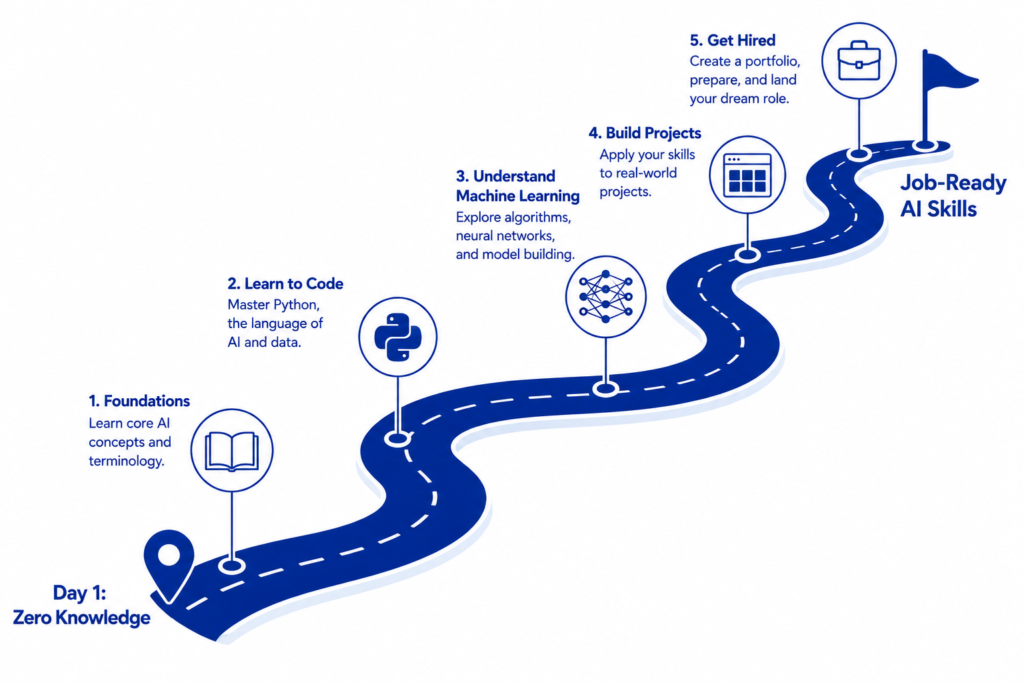
The most effective practical path for beginners: start with Python basics (you need to be comfortable with the syntax before any ML framework makes sense), then work through a structured ML course (Andrew Ng’s Machine Learning Specialization on Coursera is the most widely recommended starting point), then progress to deep learning specifically (fast.ai’s Practical Deep Learning course teaches it from the application down rather than the math up, which many people find more accessible). The key habit throughout: run actual code, not just read about it. Every concept in ML becomes clearer when you see it working on real data.
Three Terms. One Clear Picture. Completely Different Things.
Let’s bring it back to the nested circles we started with.
Artificial Intelligence is the whole project — any computer system performing tasks that require intelligence. It includes everything from a thermostat with a temperature rule to GPT-4. The term is so broad it tells you almost nothing specific about what a system actually does.
Machine Learning is a particular approach within AI — letting systems learn from data rather than following human-written rules. It’s the approach that has dominated AI research and practice since the 1990s and that powers the majority of practical AI applications today.
Deep Learning is a specific powerful technique within machine learning — multi-layered neural networks that learn hierarchical representations automatically from raw data. It’s the approach behind virtually every impressive AI capability of the last decade: computer vision, speech recognition, language models, protein folding, image generation.
Every time you use ChatGPT, you’re in the innermost circle — deep learning, inside machine learning, inside AI. Every time your bank flags a suspicious transaction, you’re probably in the middle circle — machine learning, inside AI, but not necessarily deep learning. Every time a rule-based system routes your customer service call, you’re in the outer circle — AI, but neither ML nor deep learning.
Knowing which circle you’re in changes what questions you should ask, what limitations you should expect, and what claims are worth taking seriously.

Author: AI Learner Tech
AI Learner Tech is a premier research and educational hub dedicated to mastering Artificial Intelligence, Machine Learning, and Computer Vision. We bridge the gap between complex academic theories and real-world industrial applications. Join our community to access high-quality tutorials, open-source projects, and expert insights. Website: ailearner.tech