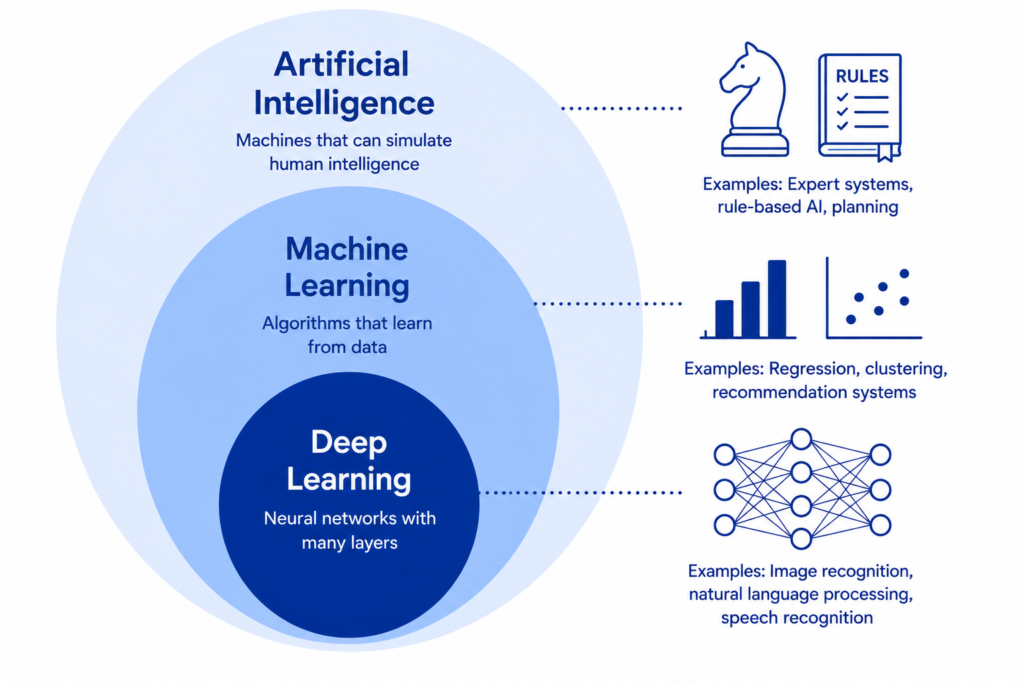
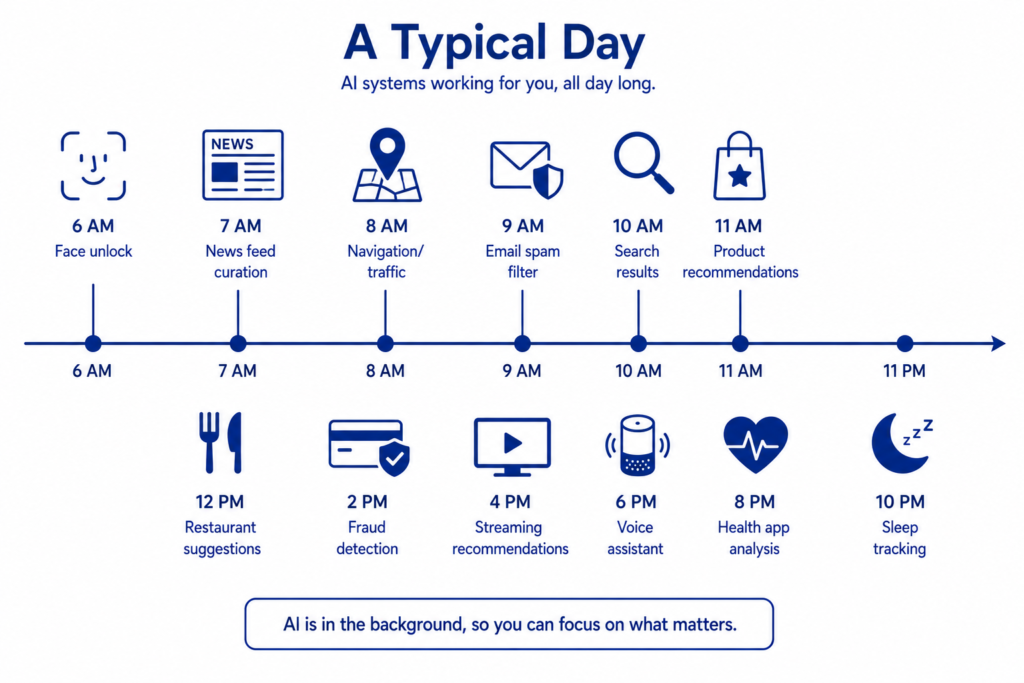
Yesterday, before you read a single article about AI, you used it at least a dozen times.
You probably did not notice most of them.
The route your maps app suggested. The email your spam filter quietly moved. The product sitting at the top of your search results. The song that came on after the one you chose. The moment your phone unlocked without a password. The price you were shown for a flight that someone else saw differently.
AI was there for all of it — invisible, fast, and making small decisions that shaped your day before you had made any conscious decisions yourself.
This is not the AI of science fiction. No robots. No sentient machines. Just software, running quietly in the background of services you already use, learning from patterns in data, and making predictions that influence what you do next.
This article makes the invisible visible.
For twelve areas of everyday life, it explains exactly what AI is doing, how it works in plain terms, and what that means for you — both the benefits and the parts worth thinking carefully about.
1. The News You See — Curated Before You Arrive
Open any news app, social media feed, or content platform and you are looking at a personalised selection assembled by an AI system in the fraction of a second before the page loaded.
You did not choose that selection. The algorithm did — based on what you have clicked before, how long you spent reading each story, what time of day it is, what other people with similar reading patterns engaged with, and dozens of other signals you never consciously provided.
What it is actually doing:
How a news feed algorithm works:

Your signals (collected over time):
  Articles clicked:        →  infers topic interests
  Time spent reading:      →  infers depth of interest
  Articles skipped:        →  infers what you find irrelevant
  Sharing behaviour:       →  infers what you find important
  Time of day patterns:    →  infers context (commute, leisure)
  Device used:             →  infers attention level available

System's goal: maximise engagement
  — keep you scrolling longer

What this produces:
  Content that confirms what you already believe
  is more engaging than content that challenges it.
  Emotionally activating content (outrage, anxiety)
  keeps attention longer than calm, nuanced content.
  The algorithm optimises for your time on the platform
  — not for your being well-informed.
The benefit: You see content relevant to your interests rather than wading through everything.
The cost: The algorithm has no interest in whether you are well-informed. It has an interest in keeping you engaged. These are not the same thing.
KEY FACT: A 2021 internal Facebook study, revealed in the Frances Haugen documents, found that the platform’s own researchers concluded the recommendation algorithm amplified divisive and emotionally activating content — not because of a deliberate design decision, but because that content performed better on engagement metrics. The algorithm was optimising for what it was told to optimise for. What it was told to optimise for was the problem.
What you can do: Actively search for content rather than passively consuming what is surfaced. Follow sources you disagree with occasionally. Notice when you are reading because a story made you angry — that feeling is exactly what the algorithm learned to produce.
When you ask Google Maps or Waze for directions, you are not getting a pre-planned route from a database. You are getting a prediction — generated in real time from a continuous stream of data — about which route will get you there fastest given current conditions.
The inputs feeding into that prediction:
- Live GPS speed data from every phone currently using the app on every road in your city
- Historical traffic patterns for this specific road, this specific time, this specific day of the week
- Reported incidents — accidents, roadworks, police, hazards — from users and official feeds
- Traffic signal timing data from city infrastructure partnerships
- Weather conditions and their historically observed effect on traffic speeds
- Events — concerts, sports fixtures, markets — and their typically observed traffic impact
All of this synthesises into a journey time estimate and route recommendation that updates continuously as you drive.
What makes it genuinely impressive:
The system is not just reacting to current conditions. It is predicting what conditions will be when you reach each segment of your route — taking into account that a traffic jam now might have cleared by the time you reach it, or that a clear road now might be congested in twenty minutes based on patterns it has seen before.
The navigation AI makes thousands of micro-predictions to produce the one number you see: 23 minutes. If it is wrong, the map updates in real time. If you deviate from the suggested route, it recalculates without judgment. It is one of the most mature and genuinely useful AI applications in everyday life — and one that most people have completely stopped thinking about as technology.
3. Healthcare — Decisions That Affect Your Life
This is where AI moves from convenient to consequential.
AI is now embedded in medical systems in ways that influence diagnoses, treatment recommendations, and healthcare access decisions that directly affect your health outcomes.
Where it is already working:
Medical imaging analysis: AI systems trained on hundreds of thousands of labeled scans can detect certain conditions — diabetic retinopathy, breast cancer in mammograms, pneumonia in chest X-rays — with accuracy comparable to specialist physicians. In some studies, the AI catches cases that specialists missed.
In the UK’s National Health Service, AI tools for diabetic eye disease screening have been deployed at scale — making specialist-level screening accessible in locations without enough ophthalmologists to meet demand.
Early warning systems: In hospitals, AI models continuously monitor patient vital signs and flag patients at risk of deterioration — sepsis, respiratory failure, cardiac events — hours before the clinical signs become obvious. Research shows early warning AI reduces mortality in patients who would otherwise deteriorate without intervention.
Drug discovery: DeepMind’s AlphaFold solved the protein folding problem — predicting the 3D structure of proteins from their amino acid sequence — which had been unsolved for fifty years. This is not a small productivity improvement. It opened new approaches to drug discovery that are currently producing experimental treatments for diseases that had no tractable drug targets before.
AlphaFold in context:

Protein structure determines function.
Understanding structure → understanding disease mechanism
→ designing drugs that target it.

Before AlphaFold:
  Determining one protein structure:
  Method: X-ray crystallography or cryo-electron microscopy
  Time: months to years per protein
  Cost: hundreds of thousands of dollars
  Total structures in database by 2020: ~170,000

After AlphaFold:
  Predicting one protein structure:
  Time: seconds
  Cost: near zero compute cost per structure
  AlphaFold database by 2022: 200 million+ structures
  Coverage: essentially every protein known to science

This is not an incremental improvement.
It changed what is possible in drug discovery.
The legitimate concern:
AI in healthcare also raises real questions. Algorithms used to allocate healthcare resources — which patients get follow-up calls, which are flagged for intervention — have been shown to embed racial and socioeconomic biases present in the historical data they trained on. A system trained on data where Black patients historically received less care may learn to recommend less care for Black patients, not because of explicit racism but because past patterns persist.
This is not an argument against AI in healthcare. It is an argument for rigorous auditing of healthcare AI before deployment at scale.
4. What You Buy — The Invisible Sales System
Every major online retailer uses AI across multiple stages of your shopping experience.
You may be looking at a different product, a different price, and a different offer than someone sitting next to you searching for the same thing.
Product recommendations: Amazon’s recommendation system — “customers who bought this also bought” — is responsible for an estimated 35% of the company’s total revenue. It is not a simple “people who bought X also bought Y” lookup. It is a collaborative filtering system that models your behaviour against millions of similar users, weights recency, incorporates seasonal patterns, and updates in real time.
Dynamic pricing: AI systems adjust prices continuously based on demand signals, competitor pricing, your browsing history, your inferred price sensitivity, inventory levels, and the time until you need the product. A flight ticket you looked at on Monday may cost more when you return on Tuesday — because the system inferred from your behaviour that you are closer to buying.
How dynamic pricing sees you:

Signals the system reads:
  You searched the same flight three times:
  → infers high purchase intent
  → price may increase (demand signal)

  You are searching from a premium device (Mac, iPhone):
  → infers higher income bracket
  → some retailers show higher prices (documented practice)

  Your account history shows you book last-minute:
  → price may be higher (you are less price-sensitive
    when you need to book urgently)

What you can do about it:
  Search in private/incognito mode (clears session signals)
  Use a VPN to mask your location
  Clear cookies before returning to a price
  Compare prices across devices
  Search midweek — flights are historically cheaper
  Tuesday through Thursday
Fraud detection: The same moment you buy something online, an AI model evaluates the transaction for fraud signals — comparing it to your purchase history, the merchant’s risk profile, the device you are using, your location, and the time of day. Most legitimate transactions are approved in milliseconds. Unusual ones trigger holds or additional verification. This system blocks significant fraud that would otherwise reach you as disputed charges and account headaches.
5. Entertainment — The System That Knows What You Want Next
Streaming platforms have invested billions in recommendation AI — and it shows in the numbers.
Netflix claims that 80% of content watched on its platform is discovered through its recommendation system rather than search. Spotify’s Discover Weekly playlist — algorithmically assembled every Monday specifically for each of its 600 million users — has become one of the platform’s most popular features.
What makes modern recommendation systems sophisticated:
They do not just track what you play. They track how you engage with it.
Spotify's listening signals (documented):

What you play:                obvious preference signal
What you skip:                stronger negative signal than not playing
Where you skip:               skipping at 15 seconds vs 2 minutes = different signals
What you replay:              strong positive signal
What you add to playlists:    intent signal
When you listen:              context signal (commute music ≠ gym music)
What other users with
similar taste listen to:      collaborative signal
Audio features of liked songs: tempo, key, energy, danceability
  → system learns your preferred acoustic properties,
    not just artist names

The system assembles Discover Weekly not from "you liked
artist X so here is artist Y who is similar" — but from
a model of your listening behaviour that predicts which
specific tracks you have not heard will match your inferred
taste profile most closely.
The flip side: Recommendation systems create filter bubbles. If you only hear music like what you already like, your taste does not expand. If Netflix only shows you content matching your past viewing, you miss things you would have loved that do not fit the pattern.
The best streaming services now deliberately inject variety — recommending things slightly outside your pattern to avoid the taste stagnation that pure optimisation creates.
6. Education — Personalised at Scale
AI is changing education in two ways — one already deployed at scale, one still emerging.
Already deployed: AI tutoring and adaptive learning
Platforms like Khan Academy, Duolingo, and Coursera use AI to adapt content difficulty, pacing, and practice problems to each individual student in real time.
Duolingo’s AI does not give every user the same lesson sequence. It tracks which concepts each learner struggles with, models their forgetting curve (how quickly they lose a new skill without practice), and schedules review sessions at the optimal moment — right before the forgetting curve predicts they will lose the material.
The result is that two people “doing the same Duolingo course” are actually doing very different courses — customised to their individual strengths, weaknesses, and learning pace.
Emerging: AI as a study partner
Students using AI assistants to explain concepts, check their reasoning, work through practice problems, and get feedback on their writing represents a shift in how learning happens outside the classroom.
The concerns are real — plagiarism, bypassing the struggle that is necessary for genuine learning, developing dependence on AI explanation rather than building independent understanding. These are legitimate pedagogical challenges that education systems are actively working through.
The opportunity is also real — a student in a rural area with a poor school can now access the equivalent of a knowledgeable personal tutor at any hour for any subject. That access was previously available only to families who could afford private tutoring.
KEY FACT: Duolingo’s AI-driven spaced repetition system was designed around research by Herman Ebbinghaus on the forgetting curve — the predictable pattern by which humans lose new memories over time without reinforcement. The AI schedules each review session to happen just before the predicted forgetting point — making review feel harder in the short term (because you are almost forgetting) but producing significantly stronger long-term retention than reviewing at random intervals.
7. Finance — Quiet Decisions About Your Money
AI makes decisions about your financial life that you often never see.
Credit scoring: Traditional credit scores are based on a narrow set of data — payment history, credit utilisation, length of credit history. AI-based credit models incorporate far more signals — transaction patterns, spending behaviour, income stability patterns — to produce assessments that are argued to be both more accurate and more accessible to people with thin traditional credit files.
The concern: more data means more opportunity for proxy discrimination. A model that accurately predicts creditworthiness using patterns in spending data may be using signals that correlate with race or postcode even without explicitly including those factors.
Fraud prevention: Every card transaction you make passes through an AI risk model before it is approved. The system you never see is also the system that has prevented fraudulent purchases from reaching your statement — working at a scale that human review could never match.
Trading: An estimated 70-80% of trading volume on major stock exchanges in 2026 is executed by algorithmic trading systems, many of which use machine learning. These systems react to market signals in microseconds — far faster than any human trader. The result is markets that are more liquid in normal conditions and occasionally subject to “flash crashes” when multiple AI systems react to the same signal simultaneously in ways their designers did not anticipate.
8. Your Home — The Ambient Intelligence Layer
Smart home devices have made AI environmental.
A thermostat like Google Nest does not just execute your temperature settings. It learns your schedule — when you wake, when you leave, when you return — and begins adjusting temperature in advance of your patterns rather than reacting to them. It also learns which temperature adjustments you accept and which you manually override, using that feedback to refine its predictions.
Voice assistants — Alexa, Google Home, Siri — process natural language requests using AI that has come a remarkably long way from the keyword-matching systems of ten years ago. Current voice assistants understand context, resolve ambiguous references, and handle multi-part requests that would have failed completely in 2015.
How far voice assistant NLP has come:

2015 capability:
  "Set a timer for 5 minutes" → Works
  "Set a timer for the pasta" → Fails (no keyword match)
  "Make it 10 minutes instead" → Fails (no reference resolution)

2026 capability:
  "Set a timer for the pasta" → Works (context from recipe app)
  "Make it 10 minutes instead" → Works (resolves "it" = the timer)
  "Also remind me to stir it every few minutes" → Works
  (understands "it" = the pasta, not the timer;
   creates recurring reminder within the cooking window)

The improvement comes from language models trained on
enormous amounts of conversational data — not from better
keyword matching, but from genuine language understanding.
9. Travel — From Booking to Boarding
AI is embedded throughout the travel experience — most of it invisible until it breaks down.
Pricing: Airline and hotel pricing algorithms update continuously. The price you see for a flight on Monday at 9 AM may be different from what you see at 11 AM — because demand signals, competitor prices, and booking pace have all changed.
Security screening: Facial recognition systems at airports compare your face to your passport photo and boarding pass. CT scanner AI flags suspicious items in baggage for human review. Behaviour detection systems (controversial, with documented accuracy problems on certain demographics) flag individuals for additional screening.
Customer service: The “customer service chat” on most major airline and hotel websites is an AI system — not a human. Modern conversational AI handles flight changes, refund requests, and seating adjustments without human involvement for the majority of standard requests. Escalation to a human agent happens when the AI cannot confidently handle the request.
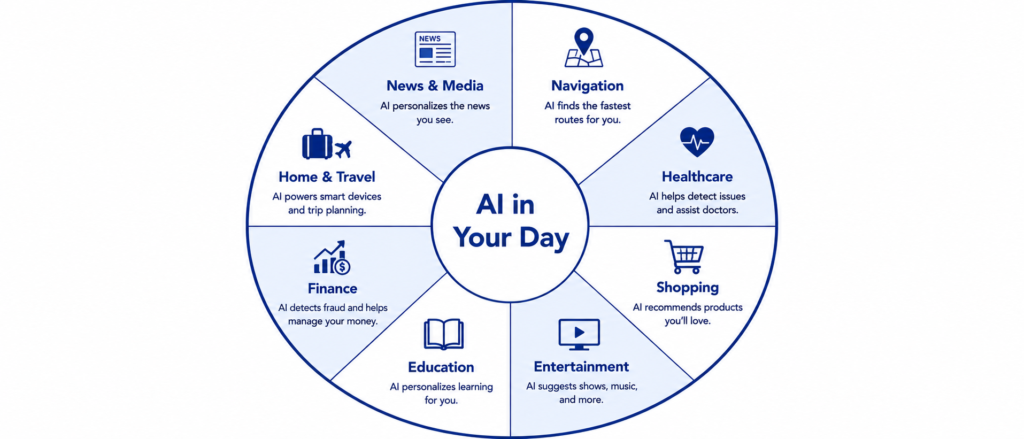
10. Mental Health — A Sensitive Frontier
This is where AI in daily life becomes most consequential and most contested.
What currently exists:
- Apps like Woebot and Wysa provide AI-based cognitive behavioural therapy (CBT) techniques through conversational interfaces — accessible at any time, with no wait time, and at low cost compared to human therapy
- AI systems that analyse speech patterns, writing, and social media activity to screen for depression or anxiety risk
- Crisis detection systems on social media platforms that flag users showing signs of distress for human review
The genuine benefit:
Mental health care has an enormous access problem globally. There are not enough therapists. Wait times for care are months in many healthcare systems. Cost is prohibitive for many people. AI-based mental health tools — when designed responsibly — can reach people who would otherwise have no support.
The legitimate concern:
Mental health AI is being deployed without the same evidence standards applied to other medical interventions. The effectiveness of AI therapy apps varies significantly. There is a risk that accessible but ineffective AI tools become a substitute for genuine care rather than a bridge to it.
WARNING: No AI mental health tool currently available is a substitute for professional mental health care in serious conditions — clinical depression, anxiety disorders, trauma, or crisis situations. These tools may be useful as supplements, for mild stress management, or as a first point of contact before accessing professional care. They are not equipped to manage complex or severe mental health conditions. If you are struggling seriously, please seek professional support.
11. Language and Communication
AI translation has become genuinely useful in a way it was not five years ago.
Google Translate and DeepL now produce translations that are, for most language pairs and most content types, readable and accurate enough for practical use. Neural machine translation — the AI approach that replaced phrase-based statistical translation around 2016 — learns to translate meaning and context, not just words.
The practical effect: a small business owner in any country can communicate with suppliers or customers in languages they do not speak, with sufficient accuracy for most business purposes. A traveler can navigate a foreign city’s menus, signs, and public transport systems without knowing the local language. A researcher can access academic papers published in languages they do not read.
Real-time translation — hearing speech in one language and seeing subtitles or hearing an AI voice in your own language simultaneously — is now functional and deployed in applications including Google Meet and Microsoft Teams.
Where it still struggles: Idioms, cultural references, highly technical domain-specific language, and languages with limited training data (less-spoken languages remain significantly under-served). Literary translation — capturing the tone, rhythm, and subtlety of well-crafted writing — remains beyond current AI capability.
12. The Job Market — Invisible Gatekeeping
AI is involved in hiring decisions at a scale most people do not know about.
An estimated 75% of large companies in the US use Applicant Tracking Systems (ATS) — software that parses, screens, and ranks resumes before a human sees them. Many of these systems use ML models trained on historical hiring data.
What this means practically:
How ATS systems affect your resume:

Keyword matching:
  Job description mentions "project management"
  Your resume says "managing projects" — may not match
  → Use the exact phrasing from job descriptions

Format parsing:
  Unusual resume formats, tables, columns, headers
  → AI may parse incorrectly, losing content
  → Simple single-column formats parse most reliably

Ranking models:
  Trained on resumes of successful hires at that company
  → Encodes historical hiring patterns
  → May disadvantage candidates from different backgrounds
    if historical hires were not diverse

What helps:
  Mirror the exact language from the job description
  Use standard resume formatting
  Include all required skills explicitly, even if obvious
  Apply for roles where you meet most listed requirements
  (models trained on historical hires may score down
   applications that deviate significantly)
The concern researchers have documented:
When AI hiring systems train on historical hiring data, they learn who was hired in the past — not who would have been a good hire. Amazon famously scrapped an internally developed AI hiring tool after discovering it had learned to downrank resumes containing the word “women’s” — because the historical data it trained on reflected a male-dominated hiring history.
Historical patterns in data become embedded predictions about the future. Auditing these systems for bias before deployment is essential and still inconsistently practised.
READ MORE: What Is Artificial Intelligence? The Ultimate Beginner’s Guide for 2026
Frequently Asked Questions
Is AI in everyday life making decisions about me without my knowledge?
Yes — regularly. Credit scoring, hiring screening, content curation, price determination, and fraud detection all involve AI systems making or significantly influencing decisions about your life. In most jurisdictions, you have limited visibility into these decisions and limited ability to contest them. GDPR in the EU provides some rights around automated decision-making — including the right to request a human review of consequential automated decisions. Other regions have fewer protections.
Can I opt out of AI systems in my daily life?
Partially. You can opt out of certain data collection practices, use privacy-focused alternatives for some services, and limit the signals you provide to recommendation systems. You cannot fully opt out of AI in banking, healthcare infrastructure, or hiring systems — these operate on data held by institutions you interact with necessarily. The realistic goal is informed engagement — understanding which systems affect you, what data they use, and what choices you have within them.
Are AI recommendations actually good for me?
It depends on the goal. Recommendation systems optimise for their stated objective — typically engagement or purchase conversion. If your goal aligns with that objective, they are helpful. If you want to discover things genuinely new, challenge your existing views, or make deliberate choices rather than algorithmically suggested ones, the recommendation system’s goal diverges from yours. The best approach is conscious use — following recommendations when they serve you, actively seeking outside them when they do not.
Is healthcare AI safe?
AI medical tools cleared for clinical use go through regulatory review — FDA in the US, CE marking in the EU, UKCA in the UK. Regulatory standards for medical AI have evolved significantly in recent years and continue to develop. The main risks are: bias in systems trained on non-representative data, overreliance by clinicians who trust AI flags without independent judgment, and the deployment of AI tools in clinical settings without adequate validation. These are real risks that active research and regulation are working to address — not reasons to avoid AI in healthcare, but reasons to want rigorous oversight of it.
Do streaming platforms deliberately make recommendations addictive?
The honest answer is: the systems optimise for engagement, and engagement and addiction exist on a continuum. Streaming platforms have faced criticism for autoplay features and recommendation systems that minimise natural stopping points. Some platforms have introduced features — usage reminders, episode skip timers — in response to these concerns. The underlying recommendation algorithms still optimise for watch time, which rewards content that keeps you watching whether or not that is in your interest. Being aware of this dynamic is the first step to using streaming services deliberately rather than reactively.
Will AI in everyday life keep expanding?
Yes, significantly. Current AI deployment in everyday life is substantial but early. Autonomous vehicles, AI-powered personal health monitoring, AI-assisted education at scale, and ambient AI assistants that understand context across your digital life are all on credible development trajectories. The pace of deployment into everyday life has been fast and shows no sign of slowing. The most useful response to this is not anxiety about where it leads but informed engagement with how it works — which is exactly what this article was for.
Conclusion
Yesterday you used AI at least a dozen times without thinking about it.
That is, depending on your perspective, either remarkable or alarming — or both.
Remarkable because the technology works well enough that its presence is invisible. Navigation that predicts your route before you leave. Recommendations that know what you want to watch before you search. Security systems that stop fraud before it reaches you. Medical tools that catch diseases before symptoms appear.
Alarming because invisible systems making consequential decisions — about what information you see, what credit you receive, whether your resume makes it past the first filter — deserve more scrutiny than invisible things typically receive.
The goal is not to become suspicious of every service you use. It is to move from passive user to informed participant. To understand which systems are working on your behalf and which are working on behalf of the platform. To notice when an algorithm is shaping your attention in ways you would not choose consciously. To know which decisions about your life are being made by systems you can contest, and which ones you cannot.
AI in everyday life is neither the utopian tool that solves everything nor the dystopian threat that controls everything. It is a set of specific systems, with specific objectives, producing specific outcomes — some genuinely beneficial, some worth questioning, and all worth understanding.
You are already living with it. You might as well know what it is actually doing.
If this article helped you see your own day differently, share it with someone who thinks AI only matters to people in tech. Leave a question in the comments — specific examples from your own experience are always the most interesting place to start.

Author: AI Learner Tech
AI Learner Tech is a premier research and educational hub dedicated to mastering Artificial Intelligence, Machine Learning, and Computer Vision. We bridge the gap between complex academic theories and real-world industrial applications. Join our community to access high-quality tutorials, open-source projects, and expert insights. Website: ailearner.tech