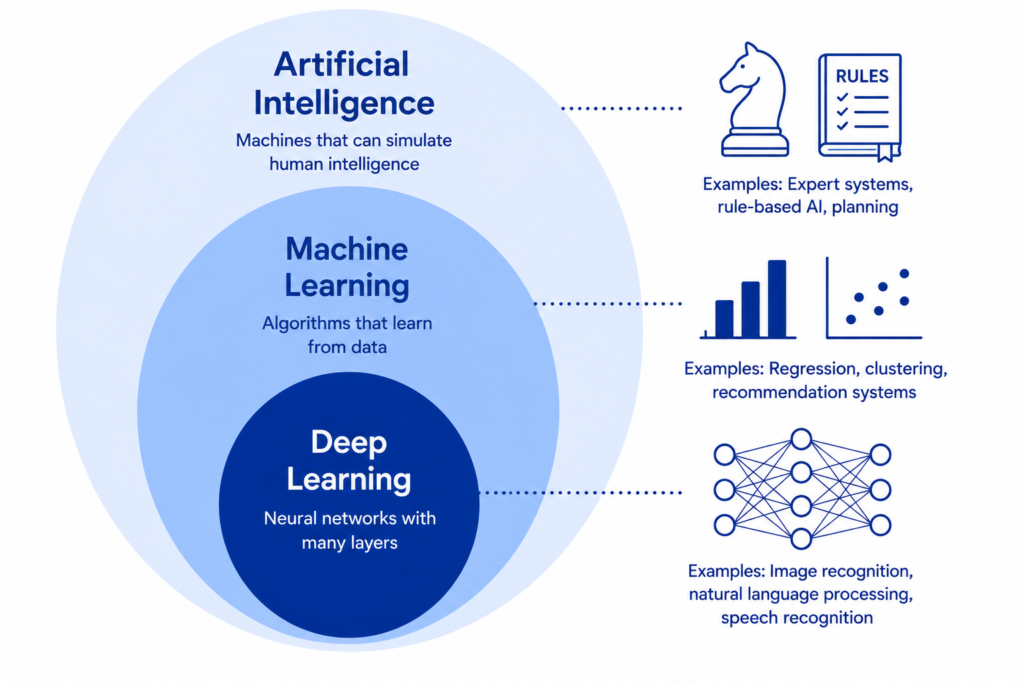
How to Start Learning AI From Zero is one of the most common questions beginners ask in 2026. Most people who want to learn AI never actually start. Not because they are not motivated — they are. They watch the tutorials, bookmark the courses, and tell themselves they will begin on Monday. But Monday comes and they still do not know whether to start with Python, or mathematics, or a specific course, or just start using ChatGPT and figure it out from there.
The problem is not laziness. It is the absence of a clear, honest roadmap that tells you exactly what to learn, in what order, and why.
This guide solves that problem. It lays out a complete, step-by-step learning path for someone starting from absolute zero in 2026 — no prior coding experience required, no mathematics degree needed, no expensive bootcamp necessary.
By the end of this article you will know:
- What skills you actually need and in what order to build them
- How long each stage realistically takes with consistent effort
- Which free and paid resources are worth your time
- What mistakes to avoid that slow most beginners down by months
- What a realistic first job or project looks like at the end of this path

The Honest Truth About Learning AI in 2026
Before the roadmap, there are three things worth saying plainly — because most guides skip them.
It takes longer than social media suggests. Posts claiming you can learn AI in 7 days or become job-ready in 30 days are misleading. A realistic timeline from zero to employable is 12 to 18 months of consistent effort. That is not discouraging — it is honest. Knowing the real timeline helps you plan properly instead of feeling like a failure when day 30 arrives and you are not yet an AI engineer.
Mathematics matters, but not as much as most people fear. You do not need a mathematics degree. You do need to be comfortable with a specific, narrow set of concepts — linear algebra, basic calculus, and statistics. These can be learned alongside programming, not before it. Starting with math before writing a single line of code is one of the most common reasons beginners quit early.
Consistency beats intensity every time. One hour every day for a year will take you further than ten-hour weekend marathons with nothing in between. The skills compound slowly and then suddenly — but only if the practice is regular.
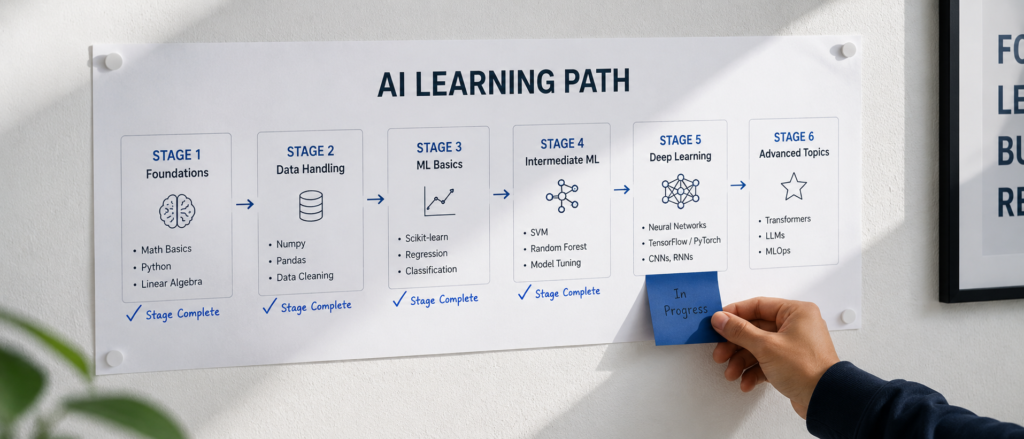
The Complete AI Learning Roadmap: 6 Stages
Stage 1 — Python Fundamentals (Weeks 1 to 6)
Python is the language of AI. Every major framework, every research paper implementation, every job posting in machine learning lists Python as a requirement. Learning it first is non-negotiable.
The good news is that Python is genuinely beginner-friendly. Its syntax reads close to plain English, the community is enormous, and there are more free learning resources for Python than for any other programming language.
What to learn in Stage 1:
- Variables, data types, and basic operations
- Conditional statements and loops
- Functions and how to write reusable code
- Lists, dictionaries, and how to work with collections of data
- Reading and writing files
- Basic error handling
What to avoid: Do not try to learn every Python feature before moving on. Object-oriented programming, advanced decorators, and complex design patterns are not needed at this stage. Learn enough to write small programs that work, then move forward.
Recommended resources:
| Resource | Cost | Format | Time to Complete |
|---|---|---|---|
| Python.org Official Tutorial | Free | Text | 2 to 3 weeks |
| freeCodeCamp Python Course | Free | Video | 3 to 4 weeks |
| Automate the Boring Stuff with Python | Free online | Book + exercises | 4 weeks |
| CS50P by Harvard (edX) | Free to audit | Video + projects | 6 weeks |
PRO TIP: Do not just watch tutorials. After every new concept, close the video and write the code from memory. Getting stuck and solving that confusion yourself is where the actual learning happens — not during passive watching.
End of Stage 1 milestone: You should be able to write a Python script that reads a CSV file, performs basic calculations on the data, and prints a formatted result. If you can do that without looking anything up, you are ready for Stage 2.
Stage 2 — Data Handling and Analysis (Weeks 7 to 12)
AI runs on data. Before you can build models, you need to know how to find, clean, explore, and understand data. This stage introduces the two most important Python libraries in all of data science.
What to learn in Stage 2:
- NumPy — working with numerical arrays and matrix operations
- Pandas — loading datasets, cleaning messy data, filtering and grouping
- Matplotlib and Seaborn — visualizing data with charts and graphs
- Exploratory Data Analysis (EDA) — understanding a dataset before modeling it
- Handling missing values, duplicates, and inconsistent formatting
A practical exercise for this stage:
Download any free dataset from Kaggle — a platform that hosts thousands of real-world datasets. Pick something simple like housing prices, movie ratings, or sales data. Load it into Pandas, clean it up, answer five questions about it using code, and visualize the answers. Do this with three different datasets before moving to Stage 3.
KEY FACT: Data scientists and ML engineers spend an estimated 60 to 80 percent of their working time on data cleaning and preparation — not on building models. Mastering this stage is not a detour from AI. It is central to it.
READ MORE: What Is Artificial Intelligence? The Ultimate Beginner’s Guide for 2026
Stage 3 — Mathematics for Machine Learning (Weeks 10 to 16)
This stage runs parallel with Stage 2, not after it. You do not need to finish all mathematics before touching ML — you need just enough foundation to understand what is happening inside the algorithms.
The three areas that actually matter:
Linear Algebra:
- Vectors and matrices — what they are and how to multiply them
- Why this matters: neural networks are fundamentally matrix multiplication operations
Calculus:
- What a derivative is — the rate at which something changes
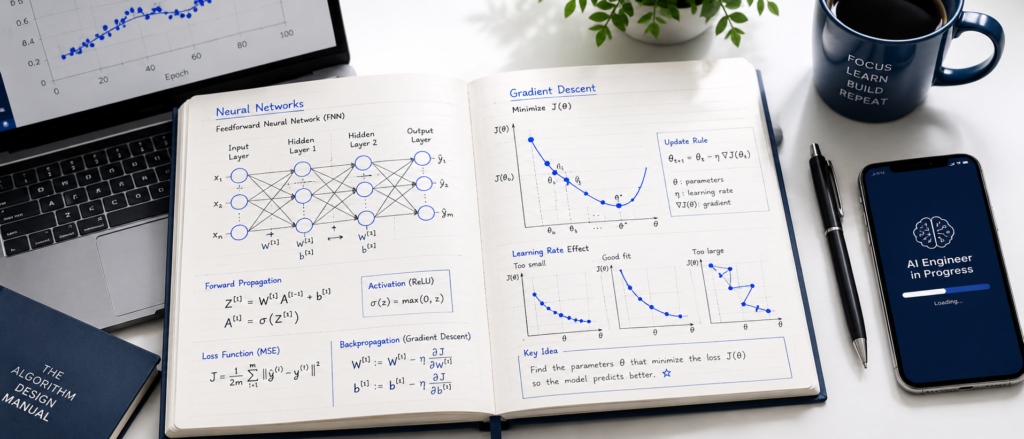
- The concept of gradient descent — how models improve through training
- Why this matters: every training algorithm in ML uses derivatives to update model parameters
Statistics and Probability:
- Mean, median, variance, and standard deviation
- Probability distributions — especially normal distribution
- Correlation vs causation
- Why this matters: evaluating whether a model is actually good requires statistical thinking
Recommended resources:
| Resource | Cost | What It Covers |
|---|---|---|
| Khan Academy — Linear Algebra | Free | Full linear algebra course |
| Khan Academy — Statistics | Free | Probability and statistics |
| 3Blue1Brown — Essence of Calculus | Free (YouTube) | Visual calculus intuition |
| Mathematics for Machine Learning (Coursera) | Free to audit | All three areas combined |
PRO TIP: Watch 3Blue1Brown’s “Essence of Linear Algebra” series on YouTube before anything else in this stage. It builds visual intuition for concepts that most textbooks explain in ways that feel abstract and disconnected. Sixteen videos, each under fifteen minutes — it is the best mathematical investment a beginner can make.
Stage 4 — Machine Learning Fundamentals (Weeks 13 to 22)
This is where the pieces start connecting. With Python solid, data skills in place, and basic mathematics understood, you are ready to build actual machine learning models.
What to learn in Stage 4:
Supervised Learning — the most practical starting point:
- Linear Regression — predicting numerical values
- Logistic Regression — classifying data into categories
- Decision Trees and Random Forests — intuitive, powerful, widely used
- Support Vector Machines — understanding the concept even if you use libraries
Model Evaluation — understanding if your model is actually good:
- Train/test splits and cross-validation
- Accuracy, precision, recall, and F1 score
- Overfitting and underfitting — what they mean and how to fix them
- Confusion matrices
Unsupervised Learning — finding patterns without labels:
- K-Means Clustering
- Principal Component Analysis (PCA) for dimensionality reduction
The tool for all of this: Scikit-learn. It is the standard Python library for classical machine learning and is what every tutorial, course, and professional uses for these algorithms.
A basic machine learning workflow in Scikit-learn looks like this:
# Import required libraries
import pandas as pd
from sklearn.model_selection import train_test_split
from sklearn.ensemble import RandomForestClassifier
from sklearn.metrics import accuracy_score

# Load your dataset
df = pd.read_csv('your_dataset.csv')

# Separate features (X) from the target variable (y)
X = df.drop('target_column', axis=1)
y = df['target_column']

# Split data — 80% for training, 20% for testing
X_train, X_test, y_train, y_test = train_test_split(
    X, y, test_size=0.2, random_state=42
)

# Create the model and train it
model = RandomForestClassifier(n_estimators=100, random_state=42)
model.fit(X_train, y_train)

# Make predictions on the test set
predictions = model.predict(X_test)

# Evaluate how well the model performed
accuracy = accuracy_score(y_test, predictions)
print(f"Model Accuracy: {accuracy:.2f}")
This is the foundation. Almost every ML project you will ever build starts with a version of this structure.
Recommended course for Stage 4: Andrew Ng’s Machine Learning Specialization on Coursera is the single best structured course for this stage. It is free to audit, covers every concept above with strong intuition-building, and has been taken by over five million people worldwide.
End of Stage 4 milestone: Build a complete ML project — load a real dataset, clean it, train at least two different models, compare their performance, and write a short explanation of your findings. Post it on GitHub. That single project is already more than most people who claim to “know machine learning” have actually done.
READ MORE: Top 10 AI Tools Every Beginner Must Know in 2026
Stage 5 — Deep Learning and Neural Networks (Weeks 20 to 32)
Deep learning is the branch of machine learning behind the most impressive AI applications — image recognition, language models, speech synthesis, and generative AI. It builds directly on everything from Stage 4.
What to learn in Stage 5:
- How neural networks work — layers, neurons, weights, and activation functions
- Forward pass and backpropagation — how networks learn
- Convolutional Neural Networks (CNNs) — the architecture behind image recognition
- Recurrent Neural Networks (RNNs) and LSTMs — processing sequential data
- The Transformer architecture — the foundation of ChatGPT, Gemini, and Claude
- Transfer learning — using pre-trained models instead of training from scratch
The tool for this stage: Either TensorFlow with Keras or PyTorch. In 2026, PyTorch has become the dominant choice in both research and industry. Learning PyTorch is the better long-term investment.
Recommended resources:
| Resource | Cost | Best For |
|---|---|---|
| fast.ai Practical Deep Learning | Free | Hands-on, project-first approach |
| Deep Learning Specialization — Coursera (Andrew Ng) | Free to audit | Theory + implementation balance |
| PyTorch Official Tutorials | Free | Learning PyTorch directly |
| Andrej Karpathy — Neural Networks: Zero to Hero | Free (YouTube) | Building neural nets from scratch |
KEY FACT: Andrej Karpathy — former Director of AI at Tesla and founding member of OpenAI — published a free YouTube series called “Neural Networks: Zero to Hero” that builds a GPT-style language model from absolute scratch in Python. It is considered by many working ML engineers to be the best deep learning resource ever made publicly available.
Stage 6 — Specialization and Portfolio Building (Weeks 28 to 52)
The final stage is where you pick a direction and build real things that demonstrate your skills to the world.
The four main specialization paths in AI:
Natural Language Processing (NLP) Working with text — sentiment analysis, summarization, translation, chatbots, search. High demand from every industry that handles written communication.
Computer Vision Working with images and video — object detection, facial recognition, medical imaging, autonomous vehicles. Strong demand in manufacturing, healthcare, and security.
Data Science and Analytics Using ML to extract insights from business data — forecasting, customer segmentation, anomaly detection. The most accessible path for people without a deep engineering background.
MLOps and AI Engineering Deploying, monitoring, and maintaining AI systems in production. Growing rapidly as companies move from AI experiments to AI products at scale.
What your portfolio should include by the end:
- Three to five complete projects hosted on GitHub with clean documentation
- At least one project using real data from a source outside of Kaggle tutorials
- A brief write-up for each project explaining the problem, your approach, and your results
- A simple personal website or LinkedIn profile that links everything together
PRO TIP: The quality of your documentation matters as much as the quality of your code. A well-explained average project is more impressive to an employer than an excellent project with no explanation. Write your README files as if you are explaining your work to someone intelligent who has never seen it before.
READ MORE: How AI Is Changing Everyday Life — Examples You Already Use
The Full Roadmap at a Glance
| Stage | Focus | Duration | Key Tools |
|---|---|---|---|
| 1 | Python Fundamentals | Weeks 1–6 | Python, VS Code |
| 2 | Data Handling | Weeks 7–12 | Pandas, NumPy, Matplotlib |
| 3 | Mathematics for ML | Weeks 10–16 | Khan Academy, 3Blue1Brown |
| 4 | Machine Learning | Weeks 13–22 | Scikit-learn, Kaggle |
| 5 | Deep Learning | Weeks 20–32 | PyTorch, fast.ai |
| 6 | Specialization + Portfolio | Weeks 28–52 | GitHub, chosen domain tools |
Note that stages overlap intentionally. You do not finish one completely before starting the next — some concepts are better understood when you are already applying adjacent skills.
Common Mistakes That Slow Beginners Down
Mistake 1 — Tutorial paralysis Watching courses but never building anything independently. After every major concept, close the tutorial and build something small from scratch. Getting stuck is not a sign of failure — it is the actual learning process.
Mistake 2 — Starting with the wrong thing Jumping into neural networks before understanding Python properly, or trying to understand transformers before knowing what a matrix is. The sequence in this roadmap exists for a reason — skipping stages creates gaps that become painful problems later.
Mistake 3 — Collecting certificates instead of building projects Certificates from online platforms have some value. A GitHub profile with real, working, well-documented projects has considerably more. Employers look at what you have built, not what certificates you collected.
Mistake 4 — Waiting until you feel ready There is no point in this roadmap where you will feel fully ready to build a project or apply for an opportunity. The discomfort of attempting something slightly beyond your current level is exactly how learning works. Start before you feel ready.
Mistake 5 — Learning alone Join communities — the fast.ai forums, Kaggle discussion boards, AI-focused Discord servers, and LinkedIn groups. Other learners at a similar stage are one of the most valuable resources available to you. So are working professionals who occasionally answer beginner questions in these spaces.
Realistic Timeline Summary
If you put in one hour per day on weekdays and two to three hours on weekends — which is roughly ten hours per week — here is an honest projection:
- Month 3: Comfortable with Python, can analyze datasets with Pandas
- Month 6: First machine learning models working, first Kaggle submission done
- Month 9: Neural network basics understood, first deep learning project complete
- Month 12: Specialization chosen, two to three portfolio projects on GitHub
- Month 18: Job-ready for entry-level ML or data science roles
These timelines assume consistent effort. They also assume you are building things, not just watching content. Passive learning is not learning — it is entertainment with an educational theme.
Frequently Asked Questions
Do I need a degree to get a job in AI?
A degree helps, especially for research roles at large companies and for getting past automated resume screening. But it is not the only path. In 2026, a strong portfolio of real projects, demonstrable Python and ML skills, and evidence of self-directed learning can get you interviews at many companies — particularly startups, mid-size tech companies, and in markets where AI talent is scarce. The degree matters less as your portfolio grows stronger.
What if I have no mathematics background at all?
Start with Khan Academy’s pre-calculus and statistics courses before Stage 3. They are free, well-structured, and designed for people returning to mathematics after a long gap. The mathematics required for ML is specific and limited — you are not studying for a mathematics degree, you are learning a targeted subset of concepts. Most people with no mathematics background can reach sufficient understanding within three to four months of focused study.
Is Python really necessary, or can I use another language?
Python is not the only language used in AI, but it is overwhelmingly the most common one. R is used in certain statistics-heavy research contexts. Julia is used in some scientific computing environments. But if your goal is employment, practical projects, or following the vast majority of tutorials and courses available — Python is the correct choice. There is no realistic alternative in 2026.
How do I stay motivated over a 12 to 18 month learning period?
Set project-based goals rather than knowledge-based ones. Instead of “learn machine learning,” set the goal “build a model that predicts apartment prices in my city using real data.” Project goals are concrete and give you something to work toward. Also track your progress — a simple notebook or spreadsheet logging what you built each week makes the accumulation visible, which is motivating in a way that vague progress is not.
What is the difference between a data scientist and a machine learning engineer?
A data scientist typically focuses on analyzing data, building models to answer business questions, and communicating findings to non-technical stakeholders. A machine learning engineer focuses more on building, deploying, and maintaining ML systems in production — the engineering infrastructure around models rather than the models themselves. In practice, roles overlap significantly at smaller companies. Both paths start with the same foundational skills in this roadmap.
Should I learn TensorFlow or PyTorch?
PyTorch. As of 2026, PyTorch has become the dominant framework in both academic research and industry production. The majority of new papers, tutorials, and open-source projects use PyTorch. TensorFlow is still used in certain production environments, particularly in Google’s ecosystem, but for learning purposes PyTorch is the better investment of your time.
Conclusion
Learning AI from zero is a real, achievable goal. It does not require a computer science degree, a mathematics background, or an expensive bootcamp. It requires a clear sequence, consistent daily effort, and the discipline to build real things rather than just consume content.
The six-stage roadmap in this guide gives you that sequence. Python first, then data, then just enough mathematics to understand what is happening, then classical machine learning, then deep learning, then specialization and building. Follow the sequence, do the projects, and the skills will come.
One year from now, you could be someone with a genuine, demonstrable set of AI skills that most people in your field simply do not have. That gap is worth the effort.
Start today. Not Monday. Today.
If this roadmap helped you get clarity on where to begin, share it with someone else who has been putting off learning AI. And if you have a question this article did not answer, leave it in the comments — we read all of them.
Author: AI Learner Tech
AI Learner Tech is a premier research and educational hub dedicated to mastering Artificial Intelligence, Machine Learning, and Computer Vision. We bridge the gap between complex academic theories and real-world industrial applications. Join our community to access high-quality tutorials, open-source projects, and expert insights. Website: ailearner.tech