AI Hallucinations: Why ChatGPT Makes Mistakes
Your SEO title doesn’t contain a number.
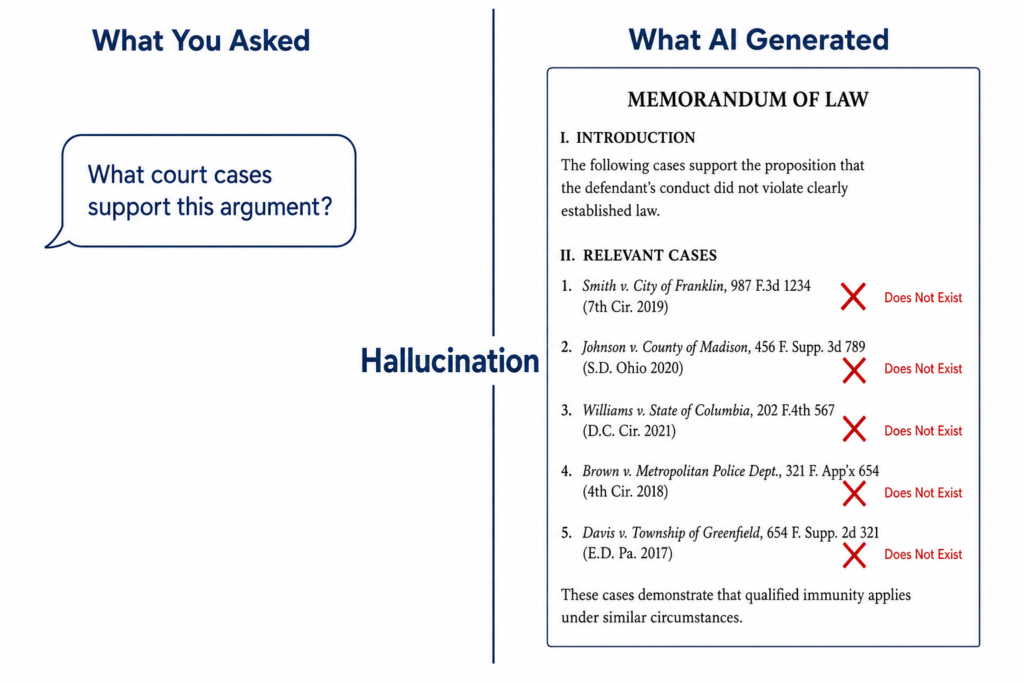
In 2023, a New York lawyer named Steven Schwartz submitted a legal brief to a federal court citing six precedent cases to support his argument.
Every single case was fake.
He had asked ChatGPT to find supporting cases. ChatGPT invented them — complete with case names, court names, judges, dates, and detailed legal reasoning. None of them existed anywhere in legal history. When the judge asked for the actual documents, Schwartz could not produce them. He faced sanctions and public humiliation.
ChatGPT did not know it was lying. It was not trying to deceive anyone. It simply generated text that looked like what real legal citations look like — because that is all it knows how to do.
This is an AI hallucination. And it is not a rare glitch or a bug that will be patched in the next update. It is a fundamental consequence of how language models work — one that researchers are working hard to understand and reduce, but have not yet solved.
This article covers:
- What hallucinations actually are at a technical level
- Why they happen — the mathematical reason, not just the intuition
- The different types of hallucinations and how to distinguish them
- Real-world examples that show the full range of severity
- Every major technique researchers are using to fix them
- How to protect yourself from hallucinations right now
- Where the research stands in 2026 and what remains unsolved
What Is an AI Hallucination, Exactly?
The word hallucination comes from psychology — it means perceiving something that is not there. In AI, the meaning is slightly different but related.
An AI hallucination is when a language model generates information that is:
- Factually incorrect
- Presented with complete confidence
- Internally coherent and plausible-sounding
- Not flagged as uncertain by the model itself
That last point is what makes hallucinations dangerous. The model does not say “I am not sure about this.” It states fabricated information in exactly the same tone and style as accurate information. There is no signal to the reader that something is wrong.
Think of it like a very confident person who has read an enormous amount but misremembers details constantly — and never once says “I might be wrong about this.” The confidence is the problem, not just the error.
Hallucination vs other AI errors:
It is important to distinguish hallucinations from other types of mistakes AI models make:
| Error Type | What It Is | Example |
|---|---|---|
| Hallucination | Confident false information | Citing a case that never existed |
| Knowledge gap | Correctly says it does not know | “I don’t have information after my cutoff date” |
| Reasoning error | Wrong conclusion from correct facts | Miscalculating a math problem |
| Misunderstanding | Answers a different question than asked | Explaining how vaccines work when asked about vaccine mandates |
Hallucinations are specifically the confident false information case. The others are problems too — but they are different problems with different causes and different fixes.
Part 1 — Why Hallucinations Happen: The Technical Reason
Most explanations stop at “the model predicts the next word and sometimes gets it wrong.” That is true but not useful. Here is the actual mechanism.
Language Models Are Probability Machines, Not Fact Databases
A language model does not store facts the way a database stores records. There is no table somewhere inside GPT-4 where the entry for “Abraham Lincoln” links to “born February 12, 1809.”
Instead, what the model stores — distributed across billions of parameters — are statistical associations between patterns of text.
What a language model actually learns:

Not: Abraham Lincoln → { born: 1809, died: 1865, role: President }

But: patterns like:
  "Abraham Lincoln was born in..." → frequently followed by "1809"
  "Abraham Lincoln was the ... president" → frequently followed by "16th"
  "Abraham Lincoln was assassinated in..." → frequently followed by "1865"

The model learned these patterns from millions of documents.
It has no way to verify whether they are true —
it only knows they appeared together frequently.
When you ask a language model a question, it does not look up the answer. It generates tokens that are statistically likely to follow the question — based on patterns learned during training.
Most of the time, the statistically likely continuation is also the factually correct one. But not always.
The Probability Distribution Problem
At every single token generation step, the model produces a probability distribution over its entire vocabulary — typically 50,000 to 100,000 tokens. It then samples from that distribution to pick the next token.
Simplified example — generating the birth year of a fictional person:

Model generates probabilities for next token after
"Dr. James Whitfield was born in ":

  "1" → 0.89  (year probably starts with 1)
  "2" → 0.08
  "other" → 0.03

Then for the next digit after "1":
  "9" → 0.71
  "8" → 0.21
  "7" → 0.06
  "other" → 0.02

Then after "19":
  "4" → 0.31
  "5" → 0.28
  "6" → 0.22
  "3" → 0.12
  "other" → 0.07

Final output: "1945" — generated purely from statistical
patterns, not from any stored fact about Dr. Whitfield.

If Dr. Whitfield is a real but obscure person whose birth year
appeared rarely or inconsistently in training data,
the model generates a plausible-sounding year with
no mechanism to flag that it is guessing.
KEY FACT: A language model has no internal “confidence flag” that distinguishes between things it learned reliably from thousands of consistent sources versus things it is pattern-matching from sparse, inconsistent, or absent training data. Both come out sounding equally certain.
Why Obscure Facts Are Especially Dangerous
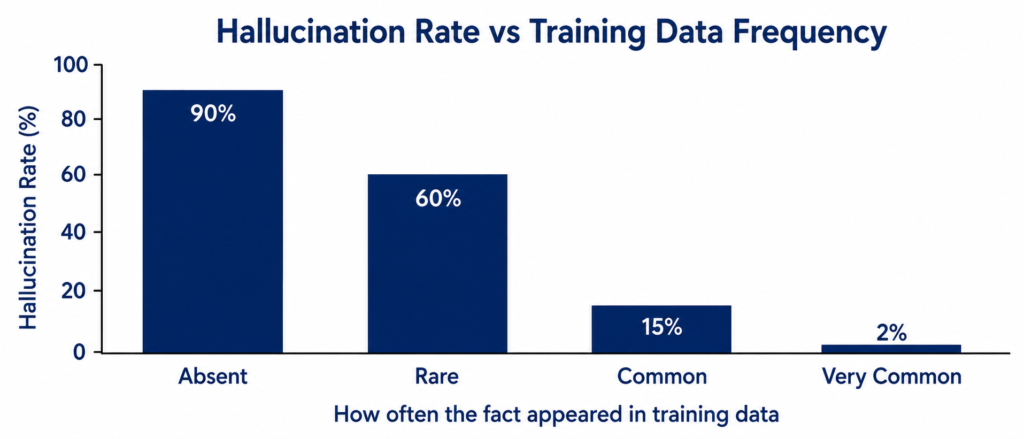
The frequency of a fact in training data directly affects how reliably a model retrieves it.
Reliability by training data frequency:

Very common fact (appears millions of times):
  "The capital of France is Paris"
  → Model generates this correctly virtually every time
  → Pattern is so strong that noise cannot override it

Moderately common fact (appears thousands of times):
  "The population of France is approximately 68 million"
  → Usually correct, occasional errors
  → Multiple slightly different numbers in training data

Rare fact (appears tens to hundreds of times):
  "The exact year a specific minor academic paper was published"
  → High hallucination risk
  → Model generates a plausible year, not the real one

Absent fact (never in training data):
  "A specific private company's internal revenue figure"
  → Almost certain hallucination
  → Model generates whatever sounds plausible for that context
This is why legal citations are so dangerous to ask about. Most specific case citations are rare in training data. The model has enough pattern knowledge to know what a legal citation looks like — but not enough factual knowledge to know which specific cases are real.
Part 2 — The Different Types of Hallucinations
Not all hallucinations are the same. Researchers classify them into distinct categories because each type has different causes and different fixes.
Type 1 — Factual Hallucination
The model states something false as if it were true.
Examples:
- Citing a scientific paper that does not exist
- Giving a wrong birth date for a real person
- Stating a historical event happened in the wrong year
- Inventing a statistic and presenting it as established fact
Severity: High — these can cause real harm in legal, medical, academic, and journalistic contexts.
Type 2 — Entity Hallucination
The model invents an entity — a person, organization, product, or place — that does not exist.
Examples:
- Inventing a professor at a real university who does not work there
- Creating a real-sounding but nonexistent company
- Generating a book title and author that do not exist
Severity: Very high — these are especially hard to catch because the invented entities sound completely plausible.
Type 3 — Reasoning Hallucination
The model produces logically flawed reasoning that sounds correct.
Example:

Question: "If all bloops are razzles and all razzles are lazzles,
           are all bloops definitely lazzles?"

Correct answer: Yes — by transitivity.

Hallucinated reasoning (actual GPT-3 style error):
"Not necessarily, because bloops and lazzles are different
 categories and may have different properties..."

The model generates text that sounds like careful reasoning
but reaches the wrong conclusion.
Severity: Medium-high — dangerous in any context requiring logical inference, including medical diagnosis support, legal reasoning, and scientific analysis.
Type 4 — Instruction Hallucination
The model claims to follow an instruction it did not actually follow.
Example:
User: "Summarize this text in exactly 3 bullet points."

Model output:
- First point covering the introduction
- Second point about the main argument
- Third point with supporting evidence
- Fourth point about the conclusion

The model says it followed the instruction.
It generated four bullet points instead of three.
It did not notice the discrepancy.
Severity: Low to medium — frustrating and unreliable, but rarely dangerous on its own.
Type 5 — Temporal Hallucination
The model applies knowledge from one time period incorrectly to another.
Example: Asking about the current CEO of a company and receiving the name of someone who held that role three years ago — stated as current fact with no uncertainty marker.
Severity: Medium — common and frequently causes outdated information to be acted upon as current.
WARNING: Temporal hallucinations are significantly underestimated by users. Because the information was correct at some point, it passes casual fact-checking. Always verify time-sensitive information — leadership roles, regulations, prices, and statistics — against current sources regardless of how confidently a language model states them.
Part 3 — How Researchers Are Fixing Hallucinations
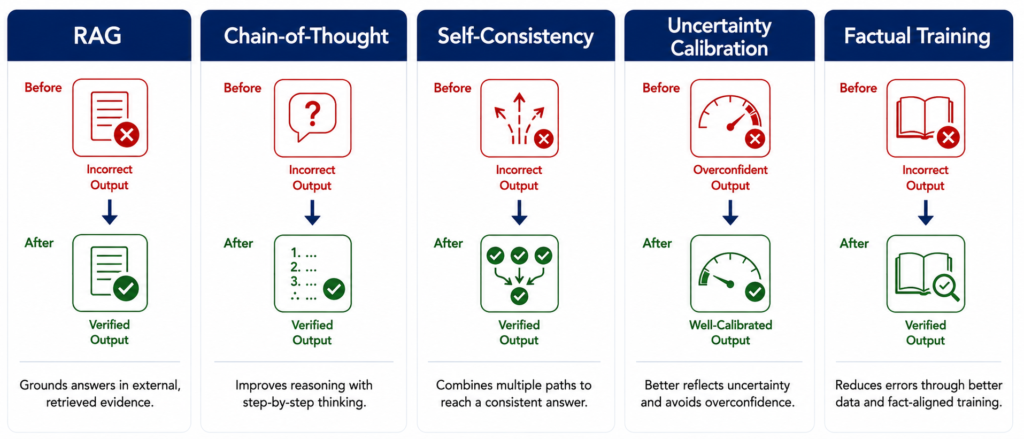
This is the most active area of research in language model development right now. No single solution has solved the problem — but several techniques together are reducing it significantly.
Fix 1 — Retrieval-Augmented Generation (RAG)
The core idea:
Instead of relying on the model’s internal parametric memory, give it access to an external knowledge source at inference time. The model retrieves relevant documents and generates its response based on what it retrieved — not what it vaguely remembers from training.
Standard Generation (no RAG):

User question ——→ Language Model ——→ Response
                  (relies purely on
                   training memory)

RAG Pipeline:

User question ——→ [Retrieval System] ——→ Relevant documents
                        ↓
              Language Model reads documents
                        ↓
              Response grounded in retrieved text
              with citations to source documents
How retrieval works technically:
python
import numpy as np
from sentence_transformers import SentenceTransformer

# Step 1: Encode your knowledge base into vector embeddings
encoder = SentenceTransformer('all-MiniLM-L6-v2')

knowledge_base = [
    "The Eiffel Tower was completed in 1889.",
    "Abraham Lincoln was born on February 12, 1809.",
    "Python was created by Guido van Rossum in 1991.",
]

# Convert each document to a dense vector
doc_embeddings = encoder.encode(knowledge_base)

def retrieve_relevant_docs(query: str, top_k: int = 2) -> list:
    """
    Find the most relevant documents for a given query
    using cosine similarity between query and document embeddings.
    """
    # Encode the query into the same vector space
    query_embedding = encoder.encode([query])

    # Compute cosine similarity between query and all documents
    similarities = np.dot(doc_embeddings, query_embedding.T).flatten()
    similarities /= (
        np.linalg.norm(doc_embeddings, axis=1) *
        np.linalg.norm(query_embedding)
    )

    # Return the top-k most similar documents
    top_indices = np.argsort(similarities)[::-1][:top_k]
    return [knowledge_base[i] for i in top_indices]

# Example retrieval
query = "When was the Eiffel Tower built?"
docs = retrieve_relevant_docs(query)

print("Retrieved documents:")
for doc in docs:
    print(f"  - {doc}")

# These retrieved documents are then passed to the LLM
# alongside the original question, grounding the response
# in verified information rather than training memory
Output: Retrieved documents: - The Eiffel Tower was completed in 1889. - Python was created by Guido van Rossum in 1991.
RAG effectiveness:
| Metric | Without RAG | With RAG |
|---|---|---|
| Factual accuracy on domain-specific questions | ~60-70% | ~85-92% |
| Citation accuracy | ~30% | ~88% |
| Outdated information rate | High | Near zero (with current KB) |
| Hallucination on out-of-KB questions | Still occurs | Still occurs |
PRO TIP: RAG does not eliminate hallucinations — it reduces them for questions that can be answered from the knowledge base. If you ask a RAG system something outside its knowledge base, it will still hallucinate. The fix is knowing the boundaries of your retrieval corpus and building the system to say “I don’t have information about this” when retrieval returns nothing relevant.
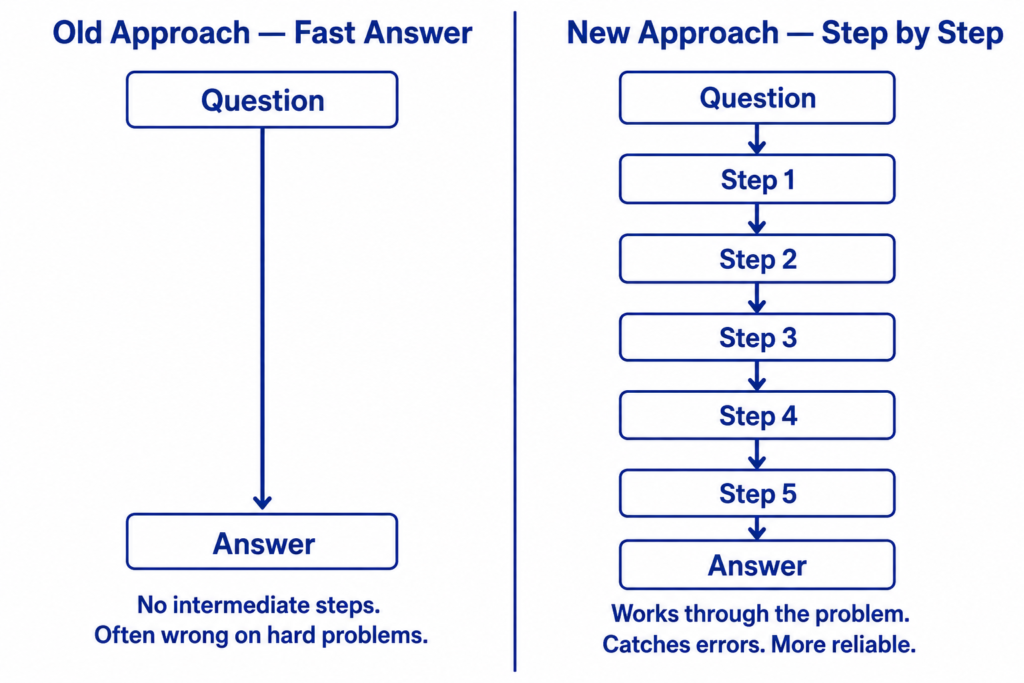
Fix 2 — Chain-of-Thought Prompting
The core idea:
Forcing the model to show its reasoning step by step before giving a final answer significantly reduces hallucinations on reasoning and factual tasks.
Without chain-of-thought:

Question: "A store sells apples for $0.50 each and oranges
           for $0.75 each. If I buy 4 apples and 3 oranges,
           how much do I spend?"

Model output: "$3.25"   ← Wrong (correct is $4.25)
              Generated quickly, no intermediate steps shown

With chain-of-thought:

Question: Same question + "Think step by step."

Model output:
  "Step 1: Cost of apples = 4 × $0.50 = $2.00
   Step 2: Cost of oranges = 3 × $0.75 = $2.25
   Step 3: Total = $2.00 + $2.25 = $4.25
   Answer: $4.25"   ← Correct

The model is less likely to hallucinate when it must
commit to intermediate reasoning steps that can be checked.
Why it works mathematically:
Each intermediate step constrains the probability distribution for the next step. Instead of jumping directly from question to answer across a large inferential gap — where noise accumulates — the model takes many small steps where each one is individually verifiable.
Fix 3 — Self-Consistency Sampling
The core idea:
Generate the same question multiple times with different random seeds. If most runs agree, the answer is probably correct. If runs disagree significantly, flag the response as uncertain.
python
def self_consistent_answer(question: str, n_samples: int = 5) -> dict:
    """
    Generate multiple answers and check for consistency.
    High agreement = more reliable answer.
    Low agreement = likely hallucination risk — flag for human review.
    """
    answers = []

    for i in range(n_samples):
        # Generate answer with different temperature each time
        # (In practice, this calls your LLM API n_samples times)
        answer = generate_answer(question, temperature=0.7, seed=i)
        answers.append(answer)

    # Count how often each answer appears
    from collections import Counter
    answer_counts = Counter(answers)
    most_common_answer, count = answer_counts.most_common(1)[0]
    confidence = count / n_samples

    return {
        "answer": most_common_answer,
        "confidence": confidence,         # 1.0 = all agree, 0.2 = high disagreement
        "all_answers": answers,
        "flag_for_review": confidence < 0.6   # Flag if less than 60% agreement
    }

# High confidence result (probably correct):
# { "answer": "1889", "confidence": 0.8, "flag_for_review": False }

# Low confidence result (hallucination risk):
# { "answer": "1832", "confidence": 0.4, "flag_for_review": True }
Fix 4 — Uncertainty Quantification
The core idea:
Train models to express calibrated uncertainty — to say “I am not sure” when they are not sure, rather than stating everything with equal confidence.
Well-calibrated vs poorly-calibrated model:
Poorly calibrated (current state of most LLMs):

Model says "I am 90% confident" → Actually correct 60% of the time
Model says "I am 50% confident" → Actually correct 55% of the time
→ Confidence scores are meaningless — too high across the board

Well-calibrated model:

Model says "I am 90% confident" → Actually correct 90% of the time
Model says "I am 50% confident" → Actually correct 50% of the time
→ When the model says it is uncertain, you can believe it
→ When the model says it is confident, you can (mostly) believe it
How calibration is measured — Expected Calibration Error (ECE):
ECE = Σ (|B_m| / n) × |accuracy(B_m) − confidence(B_m)|

Where:
  B_m    = a bucket of predictions with similar confidence scores
  |B_m|  = number of predictions in that bucket
  n      = total predictions

Lower ECE = better calibrated model

Current LLM calibration ECE scores (approximate):
  GPT-4:         ~0.08  (reasonably good)
  GPT-3.5:       ~0.15  (moderate)
  Smaller models: ~0.20-0.35 (poor)

A perfect oracle would have ECE = 0.0
Fix 5 — Factual Consistency Training
The core idea:
During RLHF fine-tuning, specifically reward the model for factual accuracy and penalize it for confident false statements — not just for being unhelpful.
This sounds obvious. The challenge is that human raters often cannot tell when a model is hallucinating, because hallucinations are designed by their nature to sound plausible. Recent approaches use automated fact-checking tools or external knowledge bases to supplement human judgment during the rating process.
Part 4 — Protecting Yourself From Hallucinations Right Now
While researchers work on long-term fixes, here is what every user should do today:
For any factual claim from an AI:
- Verify specific dates, names, statistics, and citations independently
- Never use AI-generated citations without checking they exist
- Treat any claim about specific people, organizations, or events as unverified until confirmed
For professional use:
- Legal, medical, and financial information from AI should always be verified by a qualified professional
- Use RAG-based systems when available for domain-specific queries — they are significantly more reliable
- Ask the model to express its uncertainty: “How confident are you in this? What sources would confirm it?”
Prompting strategies that reduce hallucinations:
Instead of:
"What were the main findings of the Smith et al. 2019 study on X?"
→ High hallucination risk — model will invent findings if it does not know

Try:
"I am looking for research on X. What general findings does the
literature suggest? Do not cite specific papers — I will find
the primary sources myself."
→ Lower risk — model gives general patterns without specific citations

Or:
"Explain the concept of X. If you are uncertain about any specific
facts, say so explicitly rather than guessing."
→ Prompts the model to surface its own uncertainty
PRO TIP: The single most effective prompting strategy for reducing hallucinations is to separate the model’s role from the verification role. Use the AI to help you think, draft, and explore — then verify specific claims through primary sources before relying on them. Do not ask AI to be your fact database. Ask it to be your thinking partner.
READ MORE: How ChatGPT Actually Works: A Simple Explanation for Non-Tech People
Frequently Asked Questions
Why do AI models not just say “I don’t know” when they don’t know something?
Because they were not explicitly trained to do this in proportion to their actual uncertainty. The base training objective — predict the next token — rewards generating plausible text, not acknowledging knowledge gaps. RLHF training helps by rewarding honesty, but the tendency to generate confident-sounding text is deeply embedded in the base model. It requires specific calibration training to overcome, and no current model has fully solved it.
Are newer models like GPT-4o less likely to hallucinate than older ones?
Yes, meaningfully so — but not by enough to remove the need for verification. GPT-4 hallucinated significantly less than GPT-3.5 on factual benchmarks. GPT-4o improved further. The trend is positive. But even the best current models in 2026 hallucinate on obscure facts, specific citations, and tasks requiring precise numerical or logical reasoning. The improvement is real — the problem is not solved.
Does RAG completely fix hallucinations?
No. RAG significantly reduces hallucinations for questions that fall within the knowledge base. For questions outside the knowledge base, the model still relies on parametric memory and can still hallucinate. RAG also introduces new failure modes — retrieving irrelevant documents and then generating responses based on them, or failing to retrieve the right document and defaulting to training memory. It is a major improvement, not a complete solution.
Can hallucinations happen in images and audio too?
Yes. Image generation models hallucinate visually — generating anatomically impossible hands, text that looks like writing but means nothing, and faces that blend features of real people incorrectly. Audio models can hallucinate words that were not in the input. Video generation models hallucinate physics and motion. The hallucination problem is not specific to text — it is a general property of generative models that produce outputs based on learned statistical patterns rather than verified facts.
Is there a way to completely prevent AI hallucinations?
Not with current architectures. The fundamental issue is that language models encode knowledge statistically rather than symbolically — there is no lookup table to verify against. Research directions like neuro-symbolic AI — combining neural networks with formal knowledge bases and logical reasoning systems — may eventually reduce hallucinations fundamentally. But that represents a significant architectural change from current transformer-based models. In the near term, mitigation through RAG, calibration, and careful prompting is the realistic answer.
How do I know if an AI is hallucinating versus just being wrong?
The distinction is mostly about confidence and detectability. All hallucinations are errors, but not all errors are hallucinations. A hallucination specifically refers to confidently stated false information that is plausible-sounding and difficult to detect without external verification. If the model says “I think the year was probably around 1950 but I am not certain,” that is an honest uncertain answer — not a hallucination. If it says “The event occurred in 1952” with no uncertainty marker and 1952 is wrong, that is a hallucination.
Conclusion
AI hallucinations are not a bug waiting to be patched. They are a structural consequence of how language models work — systems that generate statistically plausible text without any mechanism to verify whether what they generate is factually true.
The lawyer who submitted fake cases trusted a system he did not understand. Understanding hallucinations — why they happen, what types to watch for, and where researchers are in fixing them — is not just interesting. It is practically necessary for anyone using AI in professional, academic, or high-stakes contexts.
The research is moving fast. RAG, chain-of-thought, self-consistency, and better calibration training are all reducing hallucination rates meaningfully. But no current system has solved the problem, and the overconfidence that makes hallucinations dangerous is still present in every major language model available today.
Use AI. Use it extensively. But verify what matters. The gap between what AI sounds like it knows and what it actually knows is still wide enough to cause serious harm when it goes unnoticed.
If this article changed how you think about AI reliability, share it with someone who trusts AI output without checking it. And leave a question in the comments — this is one of the most actively evolving areas in AI research and we cover new developments regularly.

Author: AI Learner Tech
AI Learner Tech is a premier research and educational hub dedicated to mastering Artificial Intelligence, Machine Learning, and Computer Vision. We bridge the gap between complex academic theories and real-world industrial applications. Join our community to access high-quality tutorials, open-source projects, and expert insights. Website: ailearner.tech