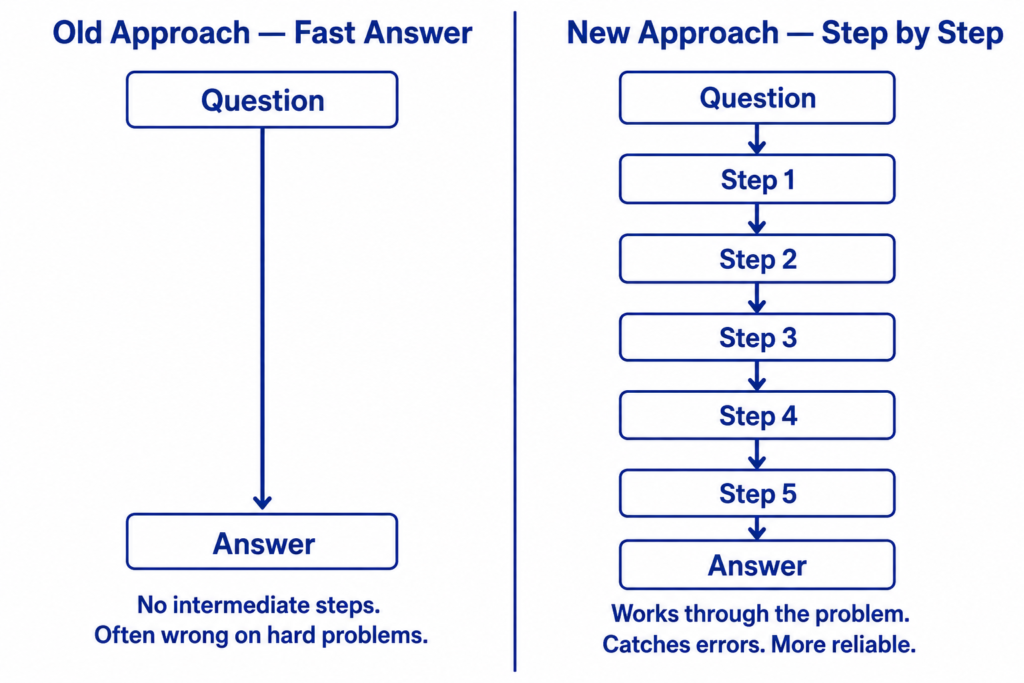
Foundation Models in 2026 are powering almost every major AI system today. Every time you use ChatGPT, Claude, or Google’s AI search — you are using the same thing underneath.
It is called a foundation model.
And right now, almost nobody outside of AI research can explain what it actually is.
That matters. Because foundation models are not just one part of modern AI. They are the engine behind nearly every AI product built in the last three years. Understanding them means understanding why AI suddenly got so good — and where it is heading next.
By the end of this article, you will know:
- What a foundation model actually is — in plain English
- Why it is fundamentally different from older AI systems
- How it gets trained — the three stages explained simply
- Which major foundation models exist in 2026 and how they compare
- What the real limitations are and what researchers are working on
- Why this technology is changing who holds power in the AI world
No maths degree needed. No coding background required. Just curiosity.
First — What Was AI Like Before Foundation Models?
To understand why foundation models changed everything, you need to see what came before them.
Before 2018, every AI system was built for one specific job.
You wanted an AI to detect spam emails? You collected thousands of spam emails, labeled them, and trained a model specifically on that data. That model could detect spam — and nothing else.
You wanted an AI to recognize faces in photos? Different dataset, different model, trained from scratch.
You wanted an AI to translate English to French? Again — separate dataset, separate model, separate team, separate budget.
Every single AI task needed its own model. Every model started from zero. The knowledge one model learned could not transfer to another.
This worked. But it was slow, expensive, and limited.
Then something changed.
Researchers realized that a model trained on an enormous amount of general data — not labeled, not task-specific, just raw text from the internet, books, and code — developed surprisingly broad capabilities on its own. Not because anyone programmed them in. But because the model learned the structure of human knowledge just by learning to predict text.
That insight is the foundation of everything that followed.
So What Exactly Is a Foundation Model?
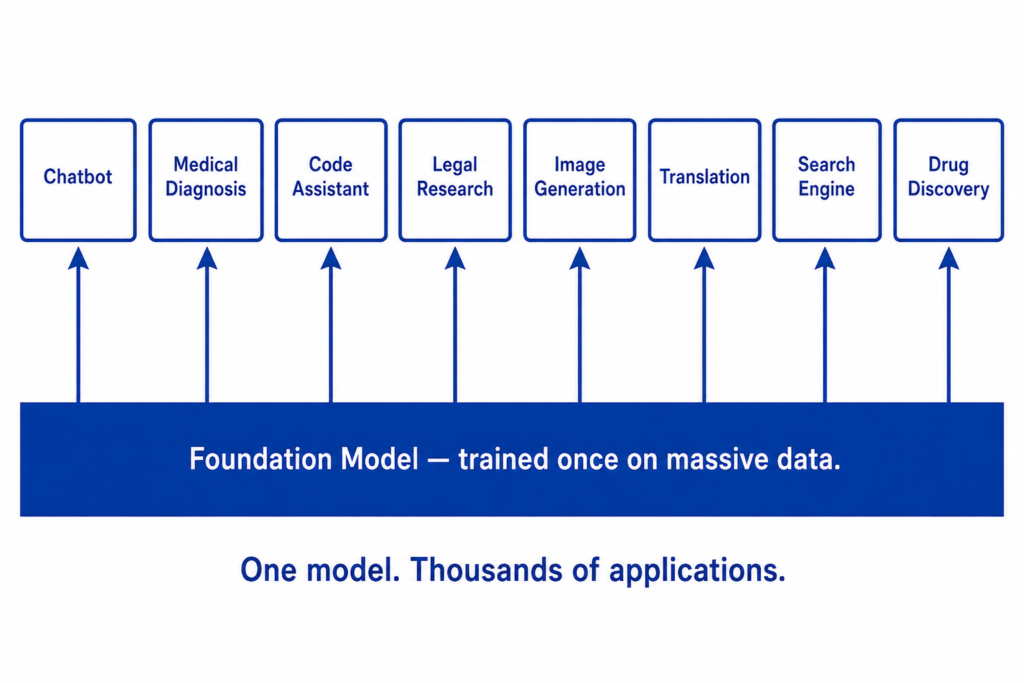
A foundation model is a large AI model trained on a huge, broad dataset — and then adapted for many different tasks.
Think of it like this.
Imagine two ways to train a chef.
Old way: Hire a specialist for every dish. One chef who only knows how to make pasta. Another who only makes sushi. Another for desserts. Each one learns their job from scratch.
Foundation model way: Train one chef deeply on everything — every cuisine, every technique, every ingredient, every kitchen tool. Then when you need pasta, you give them a week of pasta-specific practice. When you need sushi, a week of sushi practice. The deep general knowledge transfers. The specialization is fast and cheap.
The foundation model is that deeply trained chef. Broad knowledge first. Specific adaptation second.
Three things make a model a foundation model:
- Scale — trained on far more data than any previous AI system
- Generality — learns from broad, mixed data rather than one specific task
- Adaptability — can be specialized for hundreds of different applications without retraining from scratch
The Surprising Thing That Happens at Scale
Here is something that genuinely surprised the researchers who built these systems.
When you train a model on enough data, it develops abilities that nobody taught it.
This is called emergence — when a new capability appears that was never explicitly in the training.
A model trained purely to predict the next word in a sentence learns, as a side effect, to:
- Translate between languages it was never told were separate languages
- Write working code in programming languages nobody labeled as code
- Answer questions about topics that never appeared in Q&A format in training
- Summarize documents even though summarization was never a training objective
Nobody programmed these abilities in. They appeared on their own past certain scale thresholds.
How emergence looks in practice:

Model size          What capability appears
─────────────────────────────────────────────────
Under 1 billion     Basic text completion only
Around 7 billion    Follows simple instructions
Around 70 billion   Multi-step reasoning appears
175 billion+        Translation, coding, few-shot learning
1 trillion+         Complex reasoning, nuanced writing,
                    advanced problem solving

Key point: these did not gradually improve.
They appeared — like a light switching on.
This is one of the most debated phenomena in AI research right now. Why does capability suddenly appear at scale? Nobody has a complete answer. But the pattern has been observed consistently across different model architectures and training approaches.
How a Foundation Model Actually Gets Built
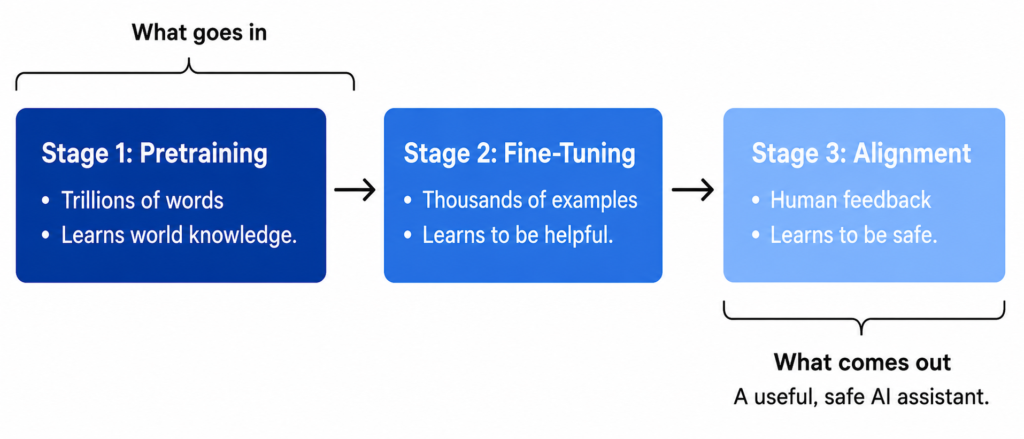
Building a foundation model happens in three stages. Each one is distinct and important.
Stage 1 — Pretraining: Reading Everything
This is where the foundation gets built.
The model reads an almost unimaginable amount of text — billions of web pages, millions of books, years worth of scientific papers, code repositories, news articles, and multilingual content.
Its only job during this stage is simple: predict what word comes next.
That sounds too simple to matter. But here is the thing.
To predict the next word reliably across billions of sentences on every topic imaginable, the model has to learn an enormous amount about the world. It cannot predict what comes after “the capital of France is” without learning geography. It cannot predict what comes after “the function returns” without learning programming. It cannot predict what comes after “the patient presented with” without learning medicine.
The model learns all of this as a side effect of learning to predict text.
What the model sees during pretraining:

"The Eiffel Tower is located in ___"
→ Model predicts: "Paris"
→ Correct: yes → tiny update to reinforce this pattern

"Water boils at ___ degrees Celsius at sea level"
→ Model predicts: "100"
→ Correct: yes → tiny update

"def calculate_average(numbers): return ___"
→ Model predicts: "sum(numbers) / len(numbers)"
→ Correct: yes → tiny update

This happens billions of times.
Geography, science, and coding learned simultaneously —
none of it explicitly labeled or separated.
How much does this cost?
Training a frontier foundation model in 2026 costs between $50 million and $500 million in computing power alone.
That number is why only a handful of organizations can do it.
KEY FACT: GPT-3 was trained on roughly 300 billion words. To put that in human terms — if you read 8 hours a day, every day, it would take you over 3,000 years to read the same amount of text. The model processes it in weeks.
Stage 2 — Fine-Tuning: Learning to Be Useful
After pretraining, the model is knowledgeable but not helpful.
Ask it a question and it might respond by continuing the text in unexpected directions rather than actually answering. It has no concept of being an assistant.
Fine-tuning fixes this.
Human writers create thousands of examples of ideal conversations — good questions paired with good answers, instructions paired with properly followed responses. The model trains on these examples and learns what helpful behavior looks like.
This stage is much smaller and cheaper than pretraining. But it dramatically changes how the model behaves in practice.
There is also a smarter version of fine-tuning called LoRA — Low-Rank Adaptation. Instead of retraining the entire model (which is expensive), LoRA only trains a tiny fraction of the parameters — less than 1% in some cases — and achieves similar results.
Why LoRA matters in simple terms:

Full fine-tuning:
  Retrain all 70 billion parameters
  Requires the same hardware as the original training
  Costs tens of thousands of dollars

LoRA fine-tuning:
  Only train about 50 million parameters (less than 0.1%)
  Runs on a single consumer GPU
  Costs a few hundred dollars
  Performance: nearly identical to full fine-tuning

This is why small teams and startups can now
specialize foundation models for their own use cases —
without the budget of a large tech company.
Stage 3 — Alignment: Learning to Be Safe
This stage shapes the model’s values and behavior.
Human raters compare pairs of responses and indicate which one is better — more helpful, more honest, less harmful. The model learns from thousands of these comparisons.
The goal is to make the model not just capable but trustworthy — one that follows instructions, declines harmful requests, and expresses uncertainty when it genuinely does not know something.
This is called RLHF — Reinforcement Learning from Human Feedback.
The Major Foundation Models in 2026
There are two types of foundation models available today — closed models and open models. The difference matters practically.
Closed models are owned by one company. You access them through an API — you send your text in, you get a response back. You never see the model itself.
Open models release their weights publicly. Anyone can download them, run them on their own computer, and modify them however they want.
Closed models available in 2026:
| Model | Company | What It Is Best At |
|---|---|---|
| GPT-4o | OpenAI | General tasks, speed, multimodal |
| Claude 3.5 Sonnet | Anthropic | Long documents, careful reasoning |
| Gemini 1.5 Pro | 1 million token context, multimodal | |
| Grok 2 | xAI | Real-time data, coding |
Open models available in 2026:
| Model | Company | Size Options |
|---|---|---|
| Llama 3.1 | Meta | 8B, 70B, 405B parameters |
| Mistral Large | Mistral AI | ~123B parameters |
| Qwen 2.5 | Alibaba | 7B to 72B parameters |
| Falcon 2 | TII UAE | 11B parameters |
Which one should you use?
Use a closed model when:
  + You need the best possible performance
  + You do not handle sensitive private data
  + You want someone else to maintain and update it
  + You are building a prototype or small product

Use an open model when:
  + Your data is private and cannot leave your servers
  + You need to customize the model's behavior deeply
  + You are running at high volume where API costs add up
  + You want full control over what the model does
What Makes Foundation Models Multimodal
The original foundation models only handled text.
Current ones handle text, images, audio, video, and code — all within the same model.
This is called being multimodal — working across multiple types of input.
How does one model handle such different types of data?
The answer is simpler than it sounds.
Every type of input gets converted into the same format — a sequence of numbers called embeddings — before reaching the main model. An image gets broken into small patches and each patch becomes a number. An audio clip gets broken into short time segments and each segment becomes a number. Text was always numbers.
Once everything is in the same number format, the model processes it all the same way.
How multimodal input works:

Your photo  → [Vision Encoder] → numbers
Your words  → [Text Encoder]  → numbers   →  Foundation Model  → Response
Your audio  → [Audio Encoder] → numbers

The foundation model itself does not know or care
whether a number came from a word, a pixel, or a sound.
It just processes sequences of numbers.
The meaning comes from how the encoders were trained.
What this enables in practice:
- Take a photo of a maths problem and get the solution explained step by step
- Upload a graph and ask questions about the data in it
- Describe a sound you heard and ask what might be causing it
- Show a screenshot of broken code and get a fix with explanation
PRO TIP: When using a multimodal model, the quality of your image matters as much as the quality of your question. A blurry photo of a document gives a worse result than a clear scan. The model can only work with the information the image actually contains — it cannot read text that is illegible or understand objects that are out of frame.
The Economics Nobody Talks About
Foundation models have created a power structure in AI that most people do not think about.
Training a frontier foundation model costs between $100 million and $500 million.
That means the organizations that can build them are:
- OpenAI (backed by Microsoft)
- Google DeepMind
- Anthropic (backed by Amazon and Google)
- Meta AI
- A handful of well-funded national AI programs
Everyone else — every startup, every university, every hospital, every government agency, every small business — builds on top of models they do not own.
This creates a real dependency.
If OpenAI changes its pricing, thousands of products break their budgets overnight. If a model gets deprecated, products built on it stop working. If a model’s values are adjusted through alignment training, every application using it changes behavior — without the application owner deciding that.
WARNING: One organization’s decisions about what a foundation model will and will not do — embedded through alignment training — become the default behavior for thousands of downstream applications serving billions of users globally. This is not a hypothetical concern. It has already happened multiple times as major models updated their safety policies between versions.
This is why open models like Llama and Mistral matter beyond their technical performance. They give organizations the option to build without that dependency.
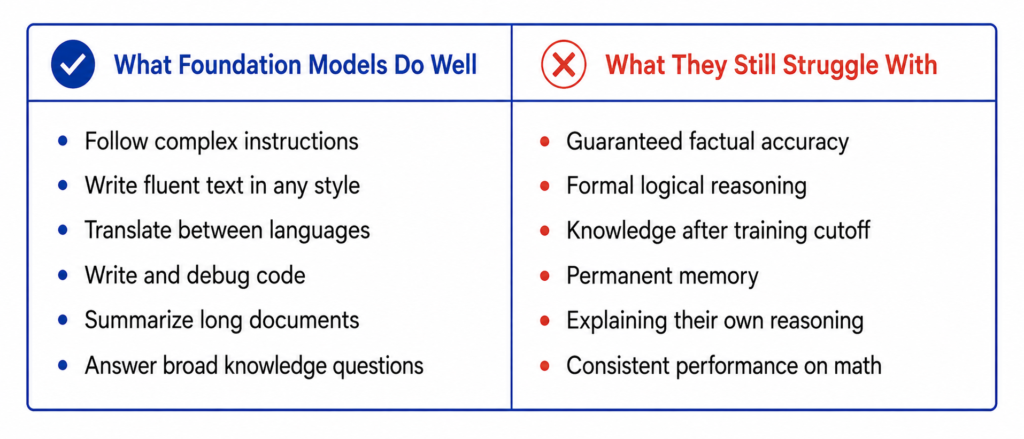
What Foundation Models Still Cannot Do
For all their capability, foundation models have clear limits in 2026.
They do not truly reason.
They are extraordinarily good at recognizing patterns in text and continuing those patterns in ways that look like reasoning. But they do not follow logical rules the way a formal system does. They can make reasoning errors that no careful human would make — and they make them confidently.
They hallucinate.
Sometimes they generate information that is false but sounds completely plausible. They have no internal alarm that goes off when they are making something up. This is not a minor issue — it is a structural consequence of how they work.
READ MORE: AI Hallucinations: Why Language Models Lie and How Researchers Are Fixing It
Their knowledge goes stale.
Training data has a cutoff date. Anything that happened after that date is outside the model’s knowledge unless it has access to real-time search.
They forget within conversations.
There is a limit to how much text a model can consider at once — called the context window. Older models had a limit of about 4,000 words. Current models handle up to 1 million words. But once a conversation exceeds that limit, early parts are dropped. The model has no permanent memory between separate conversations.
What researchers are actively working on:
| Problem | What Is Being Tried |
|---|---|
| Hallucinations | Retrieval-augmented generation, better calibration |
| Reasoning gaps | Neuro-symbolic AI, process reward models |
| Stale knowledge | Real-time search integration, streaming updates |
| Memory limits | External memory systems, longer context training |
| High inference cost | Mixture-of-Experts, model distillation, quantization |
| Interpretability | Mechanistic interpretability research |
Frequently Asked Questions
What is the difference between a foundation model and ChatGPT?
ChatGPT is a product. A foundation model is the engine inside it. GPT-4o is the foundation model that powers ChatGPT — it is the trained neural network with billions of parameters. ChatGPT is the interface, the safety layers, the memory features, and the business product built around that model. The distinction matters because many different products can be built on the same foundation model — ChatGPT is just one of them.
Do I need a powerful computer to use a foundation model?
For closed models like GPT-4o or Claude — no. You access them through the internet and the computing happens on their servers. Your laptop or phone is fine. For open models that you run locally — it depends on the size. A 7 billion parameter model can run on a good laptop. A 70 billion parameter model needs a dedicated GPU. A 405 billion parameter model needs a server with multiple GPUs. Most individuals and small teams use closed models or the smaller open models.
Can foundation models be fine-tuned on private company data?
Yes — and this is one of the most practically valuable things companies do with them. A law firm can fine-tune an open model on their case documents. A hospital can fine-tune on anonymized clinical notes. A retailer can fine-tune on their product catalog and customer service history. The result is a model that performs much better on that specific domain than a general foundation model would. The key consideration is data privacy — if you are using a closed model’s fine-tuning API, your data passes through their servers.
How is a foundation model different from a search engine?
A search engine retrieves existing documents that match your query. It finds things that were already written. A foundation model generates new text based on patterns learned during training. It creates things that were never written before. Search is retrieval. Foundation models are generation. In 2026, most major search engines use both — retrieving documents and using a foundation model to synthesize and explain the results.
Why do some foundation models refuse to answer certain questions?
Because of the alignment training in Stage 3. Human raters indicated that certain types of responses were harmful, and the model learned to decline those requests. Different models have different refusal behaviors because different organizations made different decisions about what counts as harmful. This is a values-embedded-in-technology situation — the values of the organization that trained the model get baked into every product built on top of it.
Are foundation models going to keep getting bigger?
Not necessarily. The field is shifting from “make it bigger” to “make the training smarter.” Research has shown that a smaller model trained on better data often outperforms a larger model trained on lower quality data. Current developments focus more on data quality, training efficiency, and architectural improvements than simply adding more parameters. The era where raw size was the main driver of progress appears to be transitioning.
Conclusion
Foundation models changed the structure of AI.
Before them, every AI task needed its own model, its own data, its own team. Progress was slow. Knowledge did not transfer.
After them, one model trained on broad data becomes the starting point for everything. Medical AI. Legal AI. Coding assistants. Creative tools. Search. Translation. The same foundation, adapted in different directions.
That shift is why AI capability improved so dramatically between 2020 and 2026. Not because of one breakthrough — but because of a structural change in how AI systems are built.
Understanding foundation models means understanding the infrastructure of modern AI. The three training stages. The emergent capabilities that appear at scale. The open versus closed divide. The limitations that still exist. The power dynamics that come with building everything on a small number of privately owned models.
This is the technology shaping the next decade. Knowing how it works puts you in a different position than most people — able to evaluate claims about AI clearly, make better decisions about which tools to use, and understand what is actually happening when something goes wrong.
If this article gave you a clearer picture of the AI systems you use every day, share it with someone who still thinks of AI as a mystery. And drop a question in the comments — there is genuinely no such thing as a too-basic question on a topic this important.

Author: AI Learner Tech
AI Learner Tech is a premier research and educational hub dedicated to mastering Artificial Intelligence, Machine Learning, and Computer Vision. We bridge the gap between complex academic theories and real-world industrial applications. Join our community to access high-quality tutorials, open-source projects, and expert insights. Website: ailearner.tech