The Most Debated Question in Science Has No Agreed Answer — Yet
AGI Timeline discussions exploded in 2023 when Geoffrey Hinton — the man who essentially invented modern deep learning and won a Nobel Prize for it — quit Google and told the world he was scared. Not of robots. Not of job loss. He was scared because he believed Artificial General Intelligence might be closer than almost anyone was admitting publicly.
That same year, Sam Altman told a US Senate committee that AGI — an AI system that matches or surpasses human cognitive ability across virtually all tasks — could arrive “within our lifetimes.” Elon Musk said 2029. Some researchers at DeepMind say 2040 at the earliest. Others say never, in any meaningful sense.
Welcome to the AGI timeline debate — the most consequential, most contested, and most confusing conversation happening in science right now.
In this guide, you’ll get a clear breakdown of what AGI actually means, why the timeline predictions vary so wildly, what the world’s top labs and scientists are actually saying, and what the realistic markers are that will tell us we’re getting close. No hype. No doom. Just the clearest picture available.
READ MORE: What Is Artificial Intelligence? The Ultimate Beginner’s Guide for 2026
First: What Does AGI Actually Mean?
Before arguing about when AGI will arrive, we need to be precise about what it is — because a huge part of why timelines vary so wildly is that researchers aren’t even agreeing on the definition.
Artificial General Intelligence (AGI) refers to an AI system capable of performing any intellectual task that a human can perform — not just one specific task, but the full range: reasoning, learning new skills from minimal examples, planning, creativity, emotional understanding, common sense, and adapting to entirely new situations.
This is fundamentally different from what AI does today. Current AI systems are narrow — extraordinarily good at specific tasks but helpless outside them. GPT-4 can write poetry but can’t drive your car. A self-driving car system can navigate roads but can’t write a poem. An AGI could do both — and learn a new skill you never trained it on.
Here’s a useful way to think about the spectrum:
| Level | Name | Description | Current Example |
|---|---|---|---|
| Level 1 | Narrow AI | Excels at one specific task | ChatGPT, AlphaFold, DALL-E |
| Level 2 | Broad AI | Handles multiple related tasks | GPT-4o, Gemini Ultra, Claude 3 |
| Level 3 | AGI | Matches humans across all cognitive tasks | Does not exist yet |
| Level 4 | Superintelligence | Surpasses humans across all domains | Theoretical only |
KEY FACT: OpenAI’s own internal definition of AGI is “a highly autonomous system that outperforms humans at most economically valuable work.” That’s a deliberately practical definition — and it sets a lower bar than the full philosophical definition. Which definition you use changes the timeline estimate significantly.
Why Do AGI Timeline Predictions Vary So Wildly?
Here’s something that should make you skeptical of any single confident prediction: the range of expert estimates for AGI spans from 2027 to “never.” That’s not a small margin of error. That’s a fundamental disagreement about the nature of intelligence itself.
The reasons for this variation break down into three core disagreements:
Disagreement 1: What Problem Are We Actually Solving?
Some researchers believe AGI is primarily a scaling problem — that if we just build bigger models with more data and more compute, general intelligence will emerge naturally. This view tends to produce optimistic near-term timelines.
Others believe AGI requires entirely new architectures — that current deep learning approaches, no matter how scaled, have fundamental limitations that prevent genuine general reasoning. This view tends to produce much longer or more uncertain timelines.
Disagreement 2: How Close Are Current Models to General Intelligence?
Watch a GPT-4 or Claude solve a complex multi-step reasoning problem and it looks remarkably capable. Ask it a slightly different version of the same problem and it fails in ways a child wouldn’t. Is that gap small and closing fast — or is it a fundamental chasm?
Researchers genuinely disagree. The optimists see incremental progress compounding rapidly. The skeptics see a system that’s very good at pattern matching but lacks the underlying causal reasoning that general intelligence requires.
Disagreement 3: Does “More Capable” Equal “More General”?
Every year, AI systems get better at benchmarks. But critics point out that benchmark performance and genuine generalization are different things. An AI that scores 90% on a reasoning test may have learned the test’s specific patterns rather than developing the underlying reasoning ability.
PRO TIP: When evaluating AGI predictions, always ask: what specific capability does this person think is the key bottleneck? A researcher who thinks the bottleneck is compute will give a different timeline than one who thinks it’s a new mathematical framework. The bottleneck assumption drives the timeline far more than most people realize.
What the World’s Top Labs and Scientists Are Actually Predicting
Let’s get specific. Here is what leading voices are actually on record saying — not paraphrased, but their documented public positions:
| Who | Organization | Prediction | Key Condition |
|---|---|---|---|
| Sam Altman | OpenAI CEO | AGI possible “in a few years” (stated 2024) | Continued compute scaling |
| Demis Hassabis | Google DeepMind CEO | AGI within “maybe a decade” (2023) | Requires new algorithmic breakthroughs |
| Yann LeCun | Meta AI Chief Scientist | Current AI architecture cannot reach AGI | Fundamentally new approach needed |
| Geoffrey Hinton | Former Google, Nobel Laureate | Faster than most expect, possibly 20 years | Alarmed by pace of progress |
| Yoshua Bengio | Mila, Turing Award Winner | Decades away, possibly never as commonly defined | Consciousness and understanding are unsolved |
| Elon Musk | xAI founder | 2029 for AGI, 2031 for superintelligence | Grok scaling assumptions |
| Ray Kurzweil | Google engineer, futurist | 2029 | Singularity hypothesis, exponential scaling |
What’s immediately striking is the pattern: the researchers doing the most hands-on technical work tend to be more cautious than the CEOs and entrepreneurs. Yann LeCun — who arguably understands the mathematics of current AI more deeply than almost anyone — is the most skeptical voice of all, arguing that large language models are fundamentally the wrong approach for AGI.
The Evidence for an Optimistic Timeline
The case for AGI arriving sooner rather than later rests on several genuinely impressive data points.
Scaling Laws Have Been Surprisingly Consistent
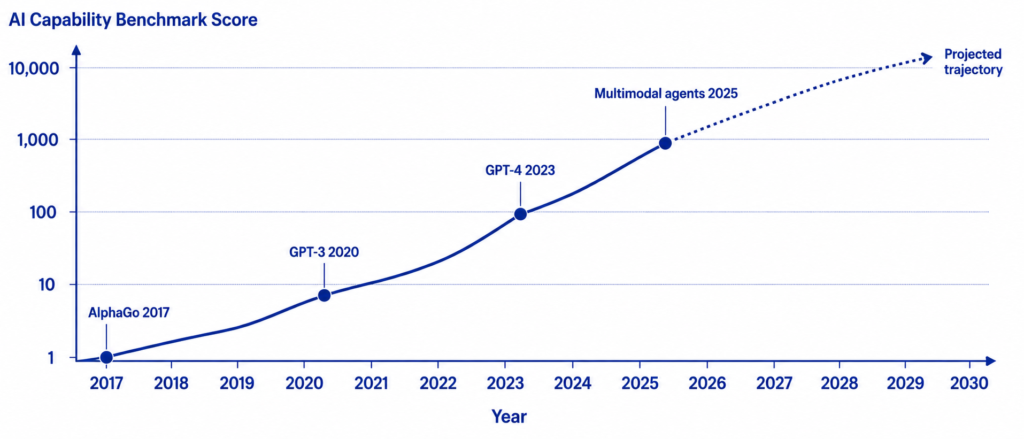
Since 2020, researchers have documented that AI model performance improves predictably as you increase compute, data, and model size — following mathematical scaling laws. This predictability is what gives optimists confidence: if the curve keeps holding, they can extrapolate forward.
Emergent Capabilities Keep Surprising Researchers
Repeatedly, as models cross certain size thresholds, they suddenly acquire abilities that weren’t present before — and weren’t explicitly trained. This phenomenon, called emergent capabilities, has appeared in areas like multi-step arithmetic, analogical reasoning, and code generation. Nobody fully understands why it happens, which makes it both exciting and unpredictable.
The Pace of Progress in 2022–2026 Was Unprecedented
Consider what changed in just four years:
- 2022: GPT-3 could write coherent paragraphs
- 2023: GPT-4 passed the bar exam in the top 10% of scores
- 2024: AI systems were conducting genuine scientific experiments autonomously
- 2025–2026: Multimodal systems could navigate complex real-world tasks across text, vision, and action
KEY FACT: According to Epoch AI’s 2025 research report, the amount of compute used to train frontier AI models has doubled approximately every 6 months since 2020 — a pace faster than Moore’s Law ever was for transistors. If even a fraction of that rate continues, the systems of 2030 will be orders of magnitude more capable than those of today.
The Evidence for a Pessimistic Timeline
The case that AGI is decades away — or may require a complete architectural revolution — is equally serious and deserves equal weight.
Large Language Models Don’t Truly Understand Anything
This is the core argument of skeptics like Yann LeCun and Gary Marcus. Current AI systems are extraordinarily good at statistical pattern matching across vast datasets. But understanding — knowing why something is true, not just that it appears frequently — may require something fundamentally different.
Classic demonstration: ask an LLM a question framed in an unusual way and it often fails even if it answers the standard version perfectly. That’s not how human understanding works. A human who understands a concept can handle any reasonable rephrasing.
Common Sense and Physical World Reasoning Remain Unsolved
Humans build a rich model of how the physical world works — called intuitive physics — before age three. We know that objects don’t disappear when hidden, that heavy things fall, that you can’t push a rope. Current AI systems still struggle badly with this kind of grounded reasoning.
Robotics researchers encounter this constantly: an AI that can beat world champions at chess cannot figure out how to pick up an oddly shaped object it’s never seen before.
The Evaluation Problem Is Real
Every time a new benchmark is proposed to test AI “general” reasoning, AI systems eventually reach human performance — and then researchers realize the benchmark was measuring something narrower than they thought. This cycle has repeated so many times that many researchers have become genuinely skeptical about whether any current benchmark actually measures the kind of flexible, generalizable intelligence that deserves to be called AGI.
WARNING: Be skeptical of any claim that a specific AI system has “achieved AGI” or “passed the AGI threshold.” As of 2026, no scientific consensus exists on what that threshold is or how to measure it. Companies have strong financial incentives to claim progress toward AGI — always look for the specific benchmark or evaluation being cited and ask whether it actually measures general intelligence.
The Milestones That Will Actually Signal AGI Is Near
Rather than picking a year, researchers have proposed concrete capability milestones that would signal genuine progress toward AGI. These are more useful than timeline guesses:
Milestone 1: Robust Novel Problem Solving
An AI that can solve genuinely new problems — ones that require combining knowledge in ways never seen in training data — without significant human guidance. Not benchmark performance. New problems, from scratch.
Milestone 2: Efficient Few-Shot Skill Acquisition
A human can learn to drive a new type of vehicle after a few minutes of instruction, because they transfer existing skills. An AGI-level system should acquire genuinely new skills from minimal examples, across domains it wasn’t trained on.
Milestone 3: Autonomous Scientific Discovery
End-to-end: an AI system that identifies a scientific question, designs experiments, runs them, interprets results, updates its model, and publishes a peer-reviewed paper — with human validation only at the final step. AlphaFold was impressive but it solved one specific pre-defined problem. This milestone is broader.
Milestone 4: Sustained Autonomous Agency
Operating independently over weeks or months to complete complex, multi-step goals in the real world — adapting to unexpected obstacles without human intervention at each step. Current agentic AI systems still require frequent correction.
Milestone 5: Self-Directed Learning
Perhaps the most demanding: an AI that identifies its own knowledge gaps, decides what to learn, acquires that knowledge, and verifiably integrates it — without being told what to learn or how.
PRO TIP: Watch for these milestones in research papers and lab announcements — not in press releases. When multiple independent research groups report genuine progress on several of these simultaneously, that’s when the AGI timeline discussion becomes urgent rather than theoretical.
What Happens in the Years Leading Up to AGI?
One thing most researchers do agree on: AGI won’t arrive as a sudden switch. There will be a period — possibly lasting years — of increasingly capable systems that blur the line between narrow AI and true general intelligence.
Here’s what that transition period likely looks like:
2026 — 2028: The "Almost General" Phase
├── AI agents handle complex multi-step professional tasks autonomously
├── Systems demonstrate strong cross-domain transfer learning
├── Coding, research assistance, and scientific analysis at expert human level
└── Persistent failures in physical world reasoning and true novelty

2028 — 2032: The "Capability Crossover" Phase
├── First demonstrations of genuine novel problem solving in controlled settings
├── Autonomous scientific contributions verified by human researchers
├── Debate intensifies: "Is this AGI?" with no clear consensus
└── Major economic and social disruption accelerates regardless of label

2032 — 2040: The "Resolution" Phase
├── Either: consensus emerges that AGI has been achieved in meaningful sense
├── Or: fundamental limitation discovered, new architectural approach required
└── Or: goalposts shift — AGI redefined as something still further away
This framework — borrowed loosely from AI researcher Yoshua Bengio’s public talks — is more useful than a single year prediction because it acknowledges that the transition, not the arrival, is what we need to prepare for.
The AGI Safety Question You Can’t Separate From the Timeline
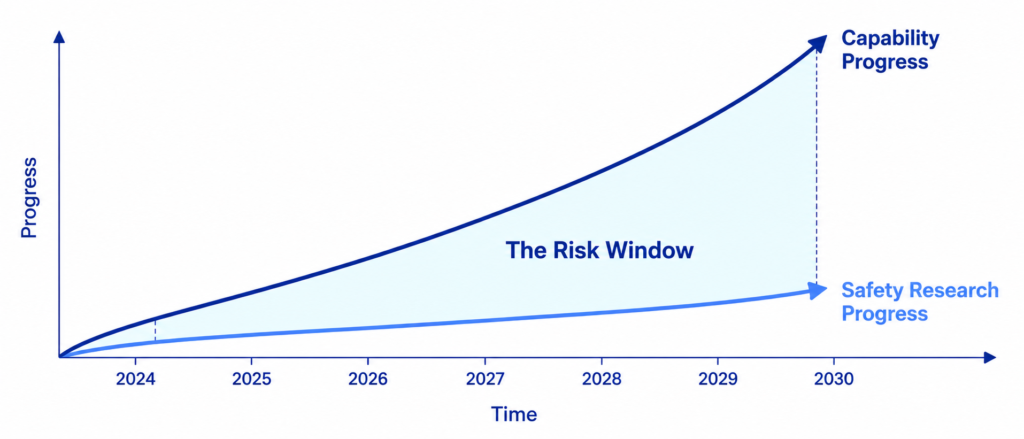
Any honest discussion of AGI timelines must address this: the faster AGI arrives, the less time humanity has to develop the safety frameworks, alignment techniques, and governance structures needed to ensure it goes well.
Anthropic — the company behind Claude — was founded explicitly on this concern. Its researchers believe AGI-level systems may arrive sooner than most safety solutions will be ready. That’s not pessimism; it’s the reason they consider safety research as urgent as capability research.
The core safety challenges that need solving before AGI arrives:
- Value alignment — ensuring an AGI pursues goals that are genuinely good for humanity, not just technically aligned with its training signal
- Interpretability — being able to look inside an AGI and understand what it’s actually doing and why
- Corrigibility — designing systems that remain correctable and can be shut down even if they become very capable
- Distributional robustness — ensuring the system behaves safely in situations far outside its training distribution
WARNING: The timeline debate is not just academic. If AGI arrives in 2030 and safety research is still years behind, the consequences could be severe and irreversible. This is why researchers like Stuart Russell, Yoshua Bengio, and Geoffrey Hinton argue that slowing capability development to allow safety research to catch up is a serious policy option — not a fringe position.
FAQ: AGI Timeline Questions Answered
Q1: What is the most widely accepted AGI timeline among AI researchers?
There is no consensus — and that itself is the most honest answer. A 2022 survey by AI Impacts asked hundreds of researchers to estimate when there was a 50% chance of AGI arriving. The median answer was around 2059, but the range was enormous — from 2029 to “never.” More recent surveys suggest the median estimate has moved closer due to rapid progress since 2022, but deep disagreement remains. Treat any single confident prediction with skepticism.
Q2: Is GPT-5 or any current model close to AGI?
Not by any rigorous definition as of 2026. Current frontier models like GPT-5, Gemini Ultra, and Claude are extraordinarily capable within their trained domains and show genuine improvements in reasoning. But they still fail on tasks requiring genuine novelty, consistent physical world reasoning, and truly autonomous long-horizon planning. They are closer than GPT-3 was — but the distance remaining is significant and poorly understood.
Q3: Will AGI be a single moment or a gradual transition?
Almost certainly gradual. The history of AI has been one of incremental progress punctuated by surprising jumps. Most researchers expect AGI to emerge as a fuzzy threshold that different people will call at different times, rather than a single system that clearly crosses an obvious line on a specific date. The debate about whether AGI has “arrived” will likely last years after the systems in question exist.
Q4: What would AGI actually be able to do that current AI cannot?
The key differences: genuine novel problem solving in domains it was never trained on; acquiring new skills from minimal examples with human-like efficiency; understanding why things are true rather than just pattern-matching to likely answers; sustained autonomous operation over long time horizons without human correction; and robust common-sense reasoning about the physical world. Current systems fail or behave unpredictably on all of these.
Q5: Should I be worried about AGI arriving?
Concern is reasonable — dismissal or panic are both wrong responses. The researchers who understand this most deeply are neither casually optimistic nor apocalyptic. They are urgently working on safety, alignment, and governance because they believe the stakes are genuinely high and the window to get it right is real. The most productive response is to stay informed, support sensible AI governance, and if you work in tech — consider whether your skills could contribute to safety research.
Q6: What is the difference between AGI and superintelligence?
AGI is AI that matches human cognitive capability broadly. Superintelligence is AI that surpasses human cognitive capability across all domains — potentially by enormous margins. Most researchers consider superintelligence a plausible consequence of AGI, because a system that matches human intelligence would presumably be able to improve its own design. The timeline from AGI to superintelligence, if it happens, is one of the most uncertain and consequential questions in the entire field.
The Honest Answer Is: We Don’t Know — And That’s Exactly Why It Matters
The AGI timeline question has no reliable answer today. Anyone who tells you confidently that AGI will arrive in 2029, or 2045, or never — is expressing a belief, not reporting a scientific consensus. The variables are too many, the unknowns too deep, and the definition too contested.
What we do know: the capabilities of AI systems are advancing faster than most people predicted even five years ago. The economic and strategic pressures to keep accelerating are enormous. And the safety frameworks needed to handle genuinely general AI are still being built.
That combination — rapid progress, high stakes, unfinished safety work — is precisely why this debate deserves your attention now, not when the headlines force it. Share this article with someone who thinks AGI is “just science fiction,” leave your own timeline prediction in the comments, and read our deep-dive on to understand what’s actually being done to make sure this transition goes well.

Author: AI Learner Tech
AI Learner Tech is a premier research and educational hub dedicated to mastering Artificial Intelligence, Machine Learning, and Computer Vision. We bridge the gap between complex academic theories and real-world industrial applications. Join our community to access high-quality tutorials, open-source projects, and expert insights. Website: ailearner.tech