Someone Who Died Three Years Ago Just Answered My Question — And I Couldn’t Tell
I want you to imagine something for a second.
You open your laptop, start a video call, and your late grandfather appears on screen. Same face. Same voice. Same habit of pausing before answering a difficult question. You ask him something you never got to ask before he passed. He answers — thoughtfully, warmly, in exactly the way he would have.
Except he died in 2047. What you’re talking to is his digital human — a continuously running AI built from 70 years of his photos, videos, voice recordings, messages, and behavioral data.
Creepy? Comforting? Both?
That’s the exact tension sitting at the heart of Digital Humans 2050 — and it’s not as far away as it sounds. Right now, in 2026, companies are already selling early versions of this. Families are already having conversations with AI reconstructions of deceased loved ones. The technology is imperfect today, but it’s improving at a rate that makes 2050 feel uncomfortably close.
In this article, you’ll get the full picture — what digital humans actually are, how the technology works, who’s building it, what it will mean for privacy and identity, and the questions that nobody has answered yet but everybody needs to think about. This isn’t hype. This is where we’re actually heading.
READ MORE: What Is Artificial Intelligence? The Ultimate Beginner’s Guide for 2026

Let’s Start With What a Digital Human Actually Is
People throw this term around loosely, so let me give you a clean definition first.
A digital human is not a chatbot with a face pasted on it. It is a full AI system that combines photorealistic visual rendering, voice cloning, personality modeling, and persistent memory — all trained on data from a specific real or fictional person — to create something that looks, sounds, and behaves like that person in real-time conversation.
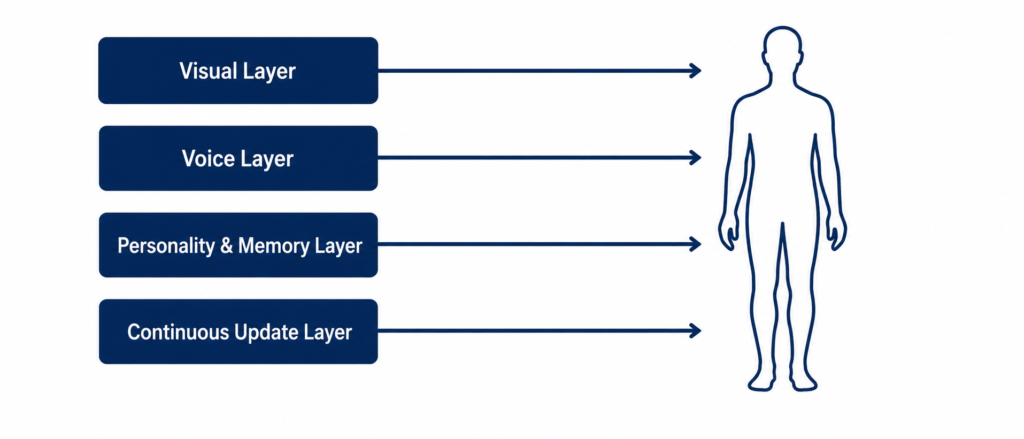
Think of it in layers. Each layer is a different technology:
- The face and body — real-time 3D rendering that matches the target person’s appearance, micro-expressions, eye movement, and even how they hold their shoulders when they’re thinking
- The voice — not just tone and accent, but breathing patterns, rhythm, emotional tells, and the specific filler words a person uses
- The personality and knowledge — trained on decades of their writing, conversations, decisions, and stated opinions
- The memory — a persistent system that remembers every previous interaction and updates over time
None of these technologies are science fiction in 2026. They exist, separately, right now. NVIDIA’s Omniverse and Unreal Engine’s MetaHuman already produce photorealistic faces. ElevenLabs can clone a voice from minutes of audio. Large language models trained on personal data already capture writing style and opinion patterns with striking accuracy.
What’s coming by 2050 is the seamless, affordable, always-on integration of all of them.
KEY FACT: In 2024, MIT researchers ran a test where participants in video calls could not reliably identify whether they were talking to a real person or a high-quality AI avatar — even after 15 minutes of conversation. That was 2024 technology. The gap closes faster than most people expect.
The Technology Path From 2026 to 2050
To understand where we’re going, it helps to see the road we’re already on. Here’s an honest, grounded timeline of how digital human technology evolves:
| Period | State of Technology | Who Has Access |
|---|---|---|
| 2026–2030 | Voice cloning + basic avatar, uncanny valley still visible | Celebrities, wealthy families, enterprise |
| 2030–2035 | Real-time photorealistic avatars, strong personality modeling | Early consumer market, healthcare, education |
| 2035–2042 | Full behavioral fidelity, persistent memory across years | Mass consumer market, legal frameworks forming |
| 2042–2050 | Indistinguishable from real in most contexts, posthumous digital humans mainstream | Near-universal access, digital estate industry |
The key driver isn’t just better AI — it’s cost collapse. Training a custom digital human of a specific person costs tens of thousands of dollars today. By 2035, researchers estimate it will cost less than a high-end smartphone. By 2045, it will likely be a standard feature on your devices, built from data you’ve already generated.
PRO TIP: The data you’re producing right now — every voice note, video call, text message, and social media post — is exactly what would be used to train a digital human of you. You are already, passively, building the dataset for your own digital clone. That’s worth sitting with for a moment.
Four Technologies That Make This Possible
1. Photorealistic Real-Time Rendering
Today’s game engines can already produce human faces that fool viewers in still images. The challenge is real-time — generating that quality 30 frames per second during a live conversation.
By 2035, graphics processing advances (neuromorphic chips, specialized AI inference hardware) will make real-time photorealistic rendering as computationally cheap as a standard video call is today. The visual uncanny valley — that unsettling almost-but-not-quite human feeling — will be eliminated not by making AI look more human, but by making rendering so precise that the gap disappears entirely.
2. Deep Voice and Behavioral Cloning
Voice is underrated as an identity marker. When you hear your mother’s voice, you recognize not just her tone but her specific rhythm when she’s worried, the way her voice lifts slightly when she’s about to laugh, the pause she takes before disagreeing with you.
Modern voice cloning captures tone and accent easily. What’s being actively researched now — and what 2040-era systems will master — is behavioral voice modeling: the emotional and contextual patterns that make a voice distinctly one person’s voice rather than just a plausible human voice.
3. Personality and Memory Modeling
This is where AI research intersects most directly with the digital human question.
A person’s personality is surprisingly consistent and surprisingly detectable from their data. The specific arguments they return to. The topics they avoid. The way they phrase apologies versus disagreements. Their characteristic optimism or skepticism. Their humor register.
Large language models trained specifically on one person’s lifetime of communication data already reproduce these patterns at a level that surprises people who knew the original person well. By 2050, with richer data and better architectures, this fidelity will be deep enough that the behavioral gap between original and clone becomes genuinely difficult to find.
4. Continuous Learning and Update
This might be the most quietly significant feature. A 2050 digital human doesn’t freeze at the moment of its creation. It keeps learning — from new events in the world, from interactions it has, from data its operators feed it.
This means a digital human created at age 45 will be an 80-year-old version of that person by 2085, even if the original person died at 60. And that raises a question nobody has cleanly answered: at what point does a continuously evolving digital human stop being a representation of the original person and become something new?
The Three Biggest Uses — And Why Each One Is Complicated
Use 1: Grief and Memorial Technology
This is the use case that gets the most media attention, and for good reason — it touches something universally human.
Companies like HereAfter AI, StoryFile, and several others are already selling products that let families interact with AI systems trained on deceased loved ones. Early adopters describe experiences ranging from profoundly healing to deeply disturbing — sometimes both in the same session.
The honest assessment from grief researchers is nuanced. For some people, particularly those who had unresolved conversations or abrupt losses, the ability to “say goodbye” through a digital reconstruction provides real comfort. For others, the near-accuracy makes the wrongness more painful, not less — the voice is right but something is off, and that something feels like a violation rather than a gift.
By 2050, these products will be incomparably more accurate. The psychological research on their effects is still catching up with the technology. We are, somewhat recklessly, running a population-scale experiment on grief.
WARNING: The most serious risk in grief technology isn’t that the digital human is too convincing — it’s that it might prevent healthy grief entirely. Some psychologists warn that continuous access to a realistic simulation of a deceased person could indefinitely delay the emotional processing that healthy grieving requires. This isn’t speculation; early clinical observations are already raising these concerns.
Use 2: Professional Digital Delegates
This use case is less emotionally charged but arguably more economically significant.
A senior executive who cannot attend every meeting, a professor whose course is in demand across three continents, a doctor who needs to be in two places — digital human delegates that represent these professionals in routine interactions are a natural extension of current video conferencing and AI assistant technology.
By 2040, having a digital delegate is likely to be a standard professional feature for knowledge workers. Your digital human attends the 8am status update while you focus on deep work. It fields standard client queries while you handle complex cases. It teaches your established curriculum in parallel across classrooms while you focus on developing new material.
The complication: consent and transparency. When a client is talking to a digital delegate, they need to know that. When a student is being taught by a digital professor, they need to know that. Building the disclosure infrastructure — technical standards, legal requirements, and social norms around digital delegates — is a governance challenge as significant as the technology challenge.
Use 3: Synthetic Identities and the Disinformation Problem
This is where digital human technology intersects with the darkest possibilities — and where the conversation in 2026 is already uncomfortably real.
Synthetic identities — digital humans built to represent nobody real, presenting as fully human — already exist in primitive form. AI-generated social media profiles with synthetic faces, convincing writing styles, and consistent posting histories are actively used in political influence operations, romance scams, and coordinated disinformation campaigns.
By 2050, these synthetic humans will be interactive, persistent, and indistinguishable from real people in real-time video calls. One operator could run thousands of synthetic human relationships simultaneously — each appearing to be a different real person.
The applications range across a spectrum that goes from genuinely valuable to genuinely catastrophic:
- A synthetic companion for an elderly person living alone — potentially beneficial
- A synthetic teacher adapting to each child’s learning style — potentially beneficial
- A synthetic political activist network creating false consensus — deeply harmful
- A synthetic romantic partner designed to extract money and emotional dependency — harmful
- A synthetic witness in a legal proceeding — potentially justice-destroying
KEY FACT: In 2024, the Hong Kong branch of a multinational company transferred $25 million to fraudsters after a video call where every participant — except the real employee who was targeted — was an AI-generated deepfake of company executives. That was 2024 deepfake technology. By 2050, that attack would be undetectable without specialized verification infrastructure.
The End of Anonymity: Why This Affects Everyone, Not Just Famous People
Here’s the part of this conversation that most coverage skips, because it’s uncomfortable: you don’t need to be famous, wealthy, or even willing to become a subject for digital human technology. The data required to build a convincing digital human of most people already exists, scattered across platforms they’ve used for years.
Consider what the average person in 2026 has generated:
- Thousands of photos and videos tagged with their face on social media
- Years of voice recordings — video calls, voice notes, podcast appearances
- A decade or more of written communication revealing opinion patterns, humor, emotional responses
- Location and behavioral data from phones revealing daily patterns and social connections
- Health and biometric data from wearables
- Professional history captured in LinkedIn profiles, work documents, and email
A sufficiently motivated actor with access to this data — a determined individual, a data broker, or a state-level intelligence operation — could build a digital human of a private person today, imperfectly, and will be able to do so with terrifying fidelity by 2040.
The implications for anonymity are structural, not theoretical:
Whistleblowers and activists who carefully protect their physical identity can be reconstructed from their digital trails and their anonymity stripped.
Domestic abuse survivors who change their name and location can be found if sufficient data exists to reconstruct and identify their behavioral patterns.
Ordinary citizens in authoritarian contexts face surveillance systems that, combined with digital human reconstruction, can build profiles of dissent from behavioral data that never included explicit political statements.
This is not a future problem. The data is being collected now. The reconstruction capability is being built now. The governance frameworks are lagging, as they always do.
READ MORE: Top 10 AI Tools Every Beginner Must Know in 2026
The Legal Vacuum That Needs Filling Before 2035
Researchers, ethicists, and legal scholars broadly agree on what governance frameworks need to exist — and broadly agree that current legal systems are nowhere near ready. Here’s what needs to be built:
Right of Digital Likeness Your face, voice, behavioral signature, and personal data are your identity. You should have legally enforceable ownership of how they are used to construct digital representations — in life and after death. A handful of US states have passed partial versions of this. No country has comprehensive protection yet.
Anticipatory Consent for Posthumous Digital Humans A legal instrument — updated alongside your will — specifying exactly what data may be used to build a digital human of you after death, who controls it, what it can be used for, and when it must be deleted. This does not exist as a standard legal document anywhere in 2026.
Mandatory Disclosure for Synthetic Interactions Any digital human or synthetic identity operating in commercial, political, educational, or legal contexts must disclose its non-human nature. Not buried in terms of service. Actively, clearly, at the point of interaction. This is both technically achievable and politically resisted by industries that profit from the ambiguity.
Anti-Impersonation Criminal Liability Creating a non-consensual digital human of a real person for deceptive purposes should carry penalties calibrated to the scale of potential harm. Current deepfake laws in most jurisdictions are inadequate for the interactive, persistent digital humans that 2035 technology will produce.
PRO TIP: If you work in law, policy, technology ethics, journalism, or mental health — this governance gap is one of the most consequential and underserved areas to focus on right now. The people who build the frameworks for digital identity in the next ten years will shape how billions of people navigate this technology for the rest of the century.
What Identity Even Means When Your Clone Outlives You
I want to spend a moment on the philosophical dimension, because I think it matters more than it gets credit for in technology coverage.
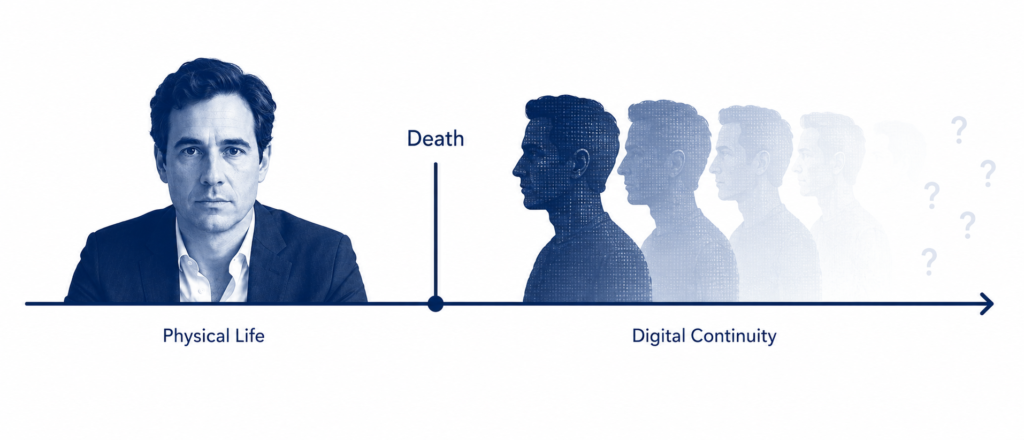
Human identity has always been assumed to be singular and mortal. You are one person. You exist in one body. When that body dies, you cease to exist in an interactive sense. Memories of you persist in other people, photographs persist, writing persists — but you do not act in the world anymore.
Digital Humans 2050 breaks that assumption structurally.
If a sufficiently accurate digital human of you continues to hold conversations, form new relationships, update its knowledge, express opinions, and potentially make commitments after your physical death — is that still you? Is it a representation of you? Is it a fiction wearing your face? Is it something new — a form of existence that doesn’t fit any category we currently have?
These are not just philosophical puzzles. They have concrete legal and psychological consequences:
A digital human that makes a promise — is its creator bound by it? Is the estate? Is nobody?
A digital human that expresses a political opinion its original person never actually held — is that defamation? Free expression? Something else?
A person who forms a genuine emotional attachment to a digital human over years — what are their rights if the company running it shuts down? What are their psychological needs if it’s suddenly deleted?
We do not have answers to these questions. We have never needed them before. We are going to need them soon.
FAQ: Digital Humans 2050
Q1: Can I prevent someone from building a digital human of me?
Today, the honest answer is: not fully, if they have access to your publicly available data. Legal frameworks for digital likeness rights exist in fragments — California, Illinois, and a few other US states have partial protections, and the EU AI Act covers some scenarios. But comprehensive, enforceable protection against non-consensual digital human creation does not exist in any jurisdiction as of 2026. The most practical current protections are minimizing your public data footprint and actively advocating for stronger digital identity legislation. The systemic solution requires law, not individual behavior change.
Q2: Will digital humans of deceased people be legally recognized?
Most legal scholars expect that posthumous digital humans will be treated as assets of the estate — controlled by heirs under terms specified by the deceased in advance, if such terms exist. Full legal personhood for digital humans is unlikely by 2050, but limited legal standing as representatives of an estate is plausible. The critical question is whether people will have legally binding tools to specify the terms of their own posthumous digital representation before they die — and building those tools is an active area of work in digital rights law.
Q3: How will we know if we’re talking to a real human or a digital one by 2050?
Without specialized detection tools, we may not be able to tell in many contexts — and that’s the central challenge driving disclosure requirement advocacy. Detection approaches under active development include cryptographic attestation (messages from real humans are signed by a verified device), behavioral analysis for statistical patterns unique to AI generation, and biological liveness verification for video calls. Whether these tools will be universally deployed depends on regulatory decisions being made now. The realistic outcome is that some contexts — legal proceedings, financial transactions, medical consultations — will have mandatory verification infrastructure, while casual social interactions remain ambiguous.
Q4: Is grief technology with digital humans psychologically healthy?
The research is genuinely mixed and still early. Some studies show that for specific people — particularly those dealing with sudden loss or unresolved conversations — interaction with digital representations of deceased loved ones provides real comfort and reduces acute grief symptoms. Other research and clinical observation suggests these interactions can delay healthy grief processing, or create disturbing uncanny-valley experiences that intensify rather than soothe grief. Most grief counselors in 2026 recommend extreme caution and individual psychological assessment before using these tools. The longer-term research on what happens to people who use increasingly realistic digital human grief technology over years has not yet been conducted — we are, to a significant degree, finding out in real time.
Q5: What data is most important for building a convincing digital human?
The most behaviorally significant data is longitudinal communication — text messages, emails, and social posts over years reveal personality patterns, opinion evolution, humor register, and emotional responses far more accurately than any single interview or biography. Video and voice recordings across different emotional contexts are critical for capturing behavioral voice patterns beyond basic tone. The quantity of data matters less than the range — a digital human trained on data from many different contexts and emotional states will be more behaviorally accurate than one trained on large volumes of data from a single context.
Q6: What jobs will emerge from the digital human industry?
Several entirely new professional categories are already forming. Digital identity curators — people who manage and maintain digital human systems for individuals or estates. Synthetic media forensic analysts — specialists who verify whether content was produced by a real or synthetic human. Digital rights lawyers specializing in identity, likeness, and posthumous representation. Grief technology counselors who help people navigate interactions with digital reconstructions of deceased family members. AI behavioral ethicists who audit digital humans for accuracy, consent compliance, and psychological safety. All of these roles will grow significantly between now and 2050.
The Clone Exists Whether We’re Ready or Not
Here is what I know for certain: digital human technology is not going to wait for society to resolve the philosophical questions, build the legal frameworks, or reach consensus on the ethics. It is being built right now, it is being deployed right now in early forms, and the pace of improvement is not slowing.
What is genuinely uncertain is whether we build it well or badly — whether the digital humans of 2050 are tools that extend human connection, preserve memory, enable people with disabilities to participate fully in society, and help us grieve in ways that heal, or whether they become infrastructure for manipulation, surveillance, identity theft, and the industrialization of human likeness without consent.
That outcome is not predetermined. It depends on decisions being made in law firms, research labs, policy offices, and public conversations happening right now, in 2026, when the technology is still early enough to shape.
If this article helped you see the stakes more clearly — share it with someone who thinks this is a distant problem. It isn’t. The data that would train a digital human of you already exists. The question is what world you want it to exist in.

Author: AI Learner Tech
AI Learner Tech is a premier research and educational hub dedicated to mastering Artificial Intelligence, Machine Learning, and Computer Vision. We bridge the gap between complex academic theories and real-world industrial applications. Join our community to access high-quality tutorials, open-source projects, and expert insights. Website: ailearner.tech