A Paralyzed Man Typed 40 Words Per Minute Using Only His Thoughts — In 2024
Brain-Computer Interfaces in 2040 are no longer science fiction. In 2024, a participant in Neuralink’s first human trial moved a computer cursor, played chess online, and typed faster than most people do with two hands — all by simply thinking. He hadn’t typed physically in years. The chip in his brain changed that.
Now imagine what that technology looks like by 2040, after 16 more years of research, miniaturization, cost reduction, and refinement. Imagine it being non-surgical. Imagine it fitting in a device smaller than a coin. Imagine millions of people using Brain-Computer Interfaces in 2040 as naturally as smartphones today.
Brain-Computer Interfaces (BCIs) — devices that create a direct communication channel between the human brain and external computers or AI systems — are no longer the domain of neuroscience labs and science fiction writers. They are real, they are advancing fast, and by 2040 they will likely be a mainstream medical device for millions and a consumer product for early adopters.
In this guide, you’ll learn exactly how BCIs work, what the technology will realistically look like by 2040, who will use them, what the genuine risks are, and what questions we need to answer before putting chips in human heads becomes routine. This is the honest picture — not hype, not panic.
READ MORE: What Is Artificial Intelligence? The Ultimate Beginner’s Guide for 2026
What Exactly Is a Brain-Computer Interface?
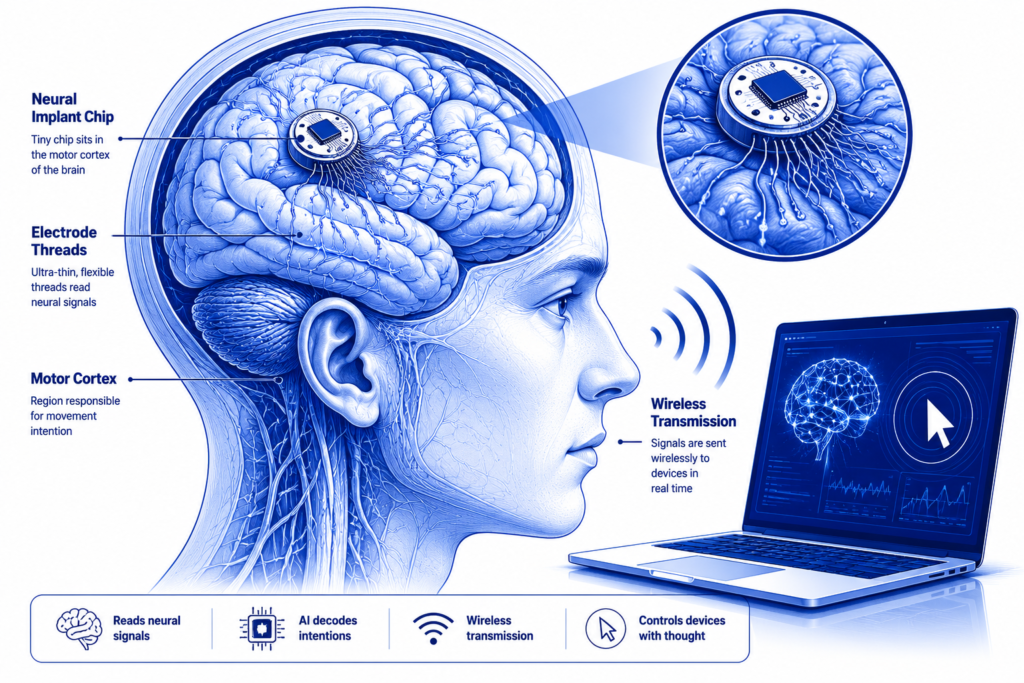
A Brain-Computer Interface is a system that reads electrical signals from the brain, translates them into commands a computer can understand, and — in more advanced versions — sends signals back into the brain.
Your brain runs on electricity. Every thought, movement, sensation, and memory is the result of neurons firing electrical signals across synapses. A BCI is essentially a device that eavesdrops on — or participates in — that electrical conversation.
BCIs come in three broad categories based on how they connect to the brain:
| Type | How It Works | Signal Quality | Invasiveness | Example |
|---|---|---|---|---|
| Non-invasive | Sensors placed on scalp surface | Low — skull blocks signals | None — wearable | EEG headsets, consumer focus bands |
| Partially invasive | Electrodes placed on brain surface, under skull | Medium — closer to neurons | Surgical — requires opening skull | ECoG grids used in epilepsy treatment |
| Fully invasive | Electrodes inserted directly into brain tissue | High — reads individual neurons | Surgical — penetrates brain tissue | Neuralink N1 chip, BrainGate |
The tradeoff is consistent: the more invasive the device, the better the signal quality, but the higher the surgical risk and the greater the ethical complexity.
KEY FACT: The brain generates roughly 100 terabytes of electrical signal data per day. Current BCIs can read only a tiny fraction of that — a few hundred to a few thousand neurons at a time. The human brain has approximately 86 billion neurons. We are, as of 2026, reading the first few pages of a library with billions of books.
How Do BCIs Actually Read Your Thoughts?
This is the question everyone asks — and it deserves a clear, non-mystical answer.
BCIs don’t read “thoughts” in the narrative sense. They don’t extract your inner monologue or your memories like files from a hard drive. What they read are motor intention signals — the electrical patterns your brain generates when you intend to make a physical movement.
Here’s the process, step by step:
Step 1 — Signal Detection Tiny electrodes — in the case of Neuralink, over 1,000 hair-thin threads thinner than a human hair — sit near neurons in the motor cortex (the brain region that controls movement). When those neurons fire, the electrodes detect the electrical change.
Step 2 — Signal Amplification The raw electrical signals from neurons are extraordinarily weak — measured in microvolts (millionths of a volt). Onboard chips amplify and clean these signals in real time.
Step 3 — Decoding This is where AI enters the picture. Machine learning models — trained on thousands of recorded movement intentions — translate patterns of neural firing into specific commands: move cursor left, select this item, type this letter.
Step 4 — Output The decoded command is sent wirelessly to a connected device — a computer, a robotic arm, a communication app — which executes the action.
# Simplified pseudocode showing how a BCI signal decoder works
# This is conceptually how researchers convert brain signals to commands

import numpy as np
from sklearn.discriminant_analysis import LinearDiscriminantAnalysis

class BCIDecoder:
    def __init__(self):
        # Classifier trained on thousands of labeled neural signal examples
        # Each example: "when these neurons fired in this pattern,
        # the person intended to move the cursor UP"
        self.model = LinearDiscriminantAnalysis()

    def preprocess_signal(self, raw_electrode_data):
        """
        raw_electrode_data: shape (n_electrodes, time_samples)
        Returns cleaned feature vector for classification
        """
        # Step 1: Bandpass filter — keep only relevant neural frequencies
        # Motor intention signals live in the 300–3000 Hz range
        filtered = self.bandpass_filter(raw_electrode_data, low=300, high=3000)

        # Step 2: Extract firing rate features per electrode
        # Count how many times each electrode "spiked" per 50ms window
        firing_rates = self.compute_firing_rates(filtered, window_ms=50)

        # Step 3: Normalize — account for baseline differences between sessions
        normalized = (firing_rates - firing_rates.mean()) / firing_rates.std()

        return normalized.flatten()  # Single feature vector

    def decode_intention(self, raw_signal):
        """Translate neural signal into a motor command."""
        features = self.preprocess_signal(raw_signal)

        # Model predicts which movement intention produced this signal
        # Possible outputs: 'cursor_up', 'cursor_down', 'select', 'idle'
        predicted_command = self.model.predict([features])[0]
        confidence = self.model.predict_proba([features]).max()

        # Only act if confidence is high enough — reduces false triggers
        if confidence > 0.85:
            return predicted_command
        else:
            return 'idle'  # Uncertain — do nothing
The key insight from this code: a BCI decoder is not magic. It’s a pattern-recognition problem — one that AI has become very good at. The challenge is that neural patterns vary between people, change over time as the brain adapts, and degrade as electrodes age inside brain tissue.
PRO TIP: The AI inside a BCI needs to continuously recalibrate as the brain changes. Neurons shift position slightly over time. The interface between metal electrodes and biological tissue evolves. Modern BCIs run daily or even real-time recalibration — a process called adaptive decoding — to maintain accuracy.
Where BCI Technology Stands in 2026
Before projecting to 2040, it’s worth being precise about where we actually are today.
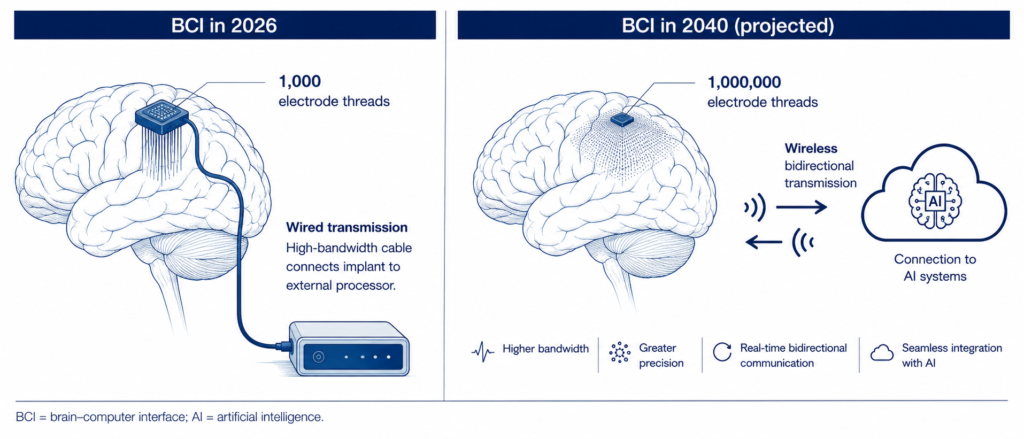
Neuralink (N1 chip): As of 2026, Neuralink has implanted its N1 chip in a small number of human patients through clinical trials. The chip reads from over 1,000 electrodes in the motor cortex, transmits wirelessly, and has demonstrated reliable cursor control and text entry via thought. Battery lasts approximately a day and charges inductively through the skull.
Synchron (Stentrode): A different approach — the Stentrode is delivered through a blood vessel (no open brain surgery required) and sits in a vein adjacent to the motor cortex. Lower signal quality than Neuralink but dramatically lower surgical risk. Approved for human trials in the US and Australia.
BrainGate consortium: Academic research collaboration that has demonstrated the most complex BCI tasks to date — including a paralyzed patient using a BCI to control a robotic arm to feed themselves, and another using it to produce speech at near-conversational speeds.
Non-invasive consumer devices: Companies like Emotiv, Muse, and Neurosity sell EEG headsets for consumer use. Signal quality is too low for precise thought-to-text, but they can detect broad mental states — focus, relaxation, stress — with reasonable accuracy.
| System | Approach | Best Demonstrated Capability | Status (2026) |
|---|---|---|---|
| Neuralink N1 | Invasive implant | 40 WPM typing via thought | Human trials ongoing |
| Synchron Stentrode | Minimally invasive vascular | Basic device control | Human trials, US + Australia |
| BrainGate | Invasive research arrays | Robotic arm control, speech synthesis | Academic research only |
| Emotiv/Muse | Non-invasive EEG | Mental state detection | Consumer market |
| Kernel Flow | Non-invasive fNIRS | Cognitive state monitoring | Early commercial |
What BCIs Will Realistically Look Like in 2040
Projecting 14 years forward in any fast-moving technology field requires humility. But based on current research trajectories, here is what leading neuroscientists and engineers consider realistic — not guaranteed, but plausible — for 2040.
Miniaturization and Non-Surgical Implantation
The most important development expected in the next decade is eliminating the need for open brain surgery. Research is active on several fronts:
- Endovascular delivery (like Synchron’s approach) allows implants to be guided through blood vessels — no skull drilling
- Injectable neural mesh — ultra-flexible electrode arrays injected in liquid form that self-assemble around neurons
- Focused ultrasound interfaces — non-invasive devices that use precisely targeted ultrasound to both read and stimulate specific brain regions through the intact skull
By 2040, the expectation among many researchers is that the surgical risk barrier will have dropped dramatically — potentially to outpatient procedures similar to placing a cardiac stent.
Bidirectional Communication
Today’s BCIs are mostly one-directional — reading from the brain. The next major frontier is reliable two-way communication: sending information back into the brain with enough precision to create artificial sensations.
This opens up capabilities that are genuinely transformative for medicine:
- Restoring touch sensation to prosthetic limbs (the limb’s sensors send signals back to the brain)
- Treating depression and PTSD by stimulating specific neural circuits
- Delivering precise sensory experiences — navigation cues, warnings, notifications — directly to perception
Wireless, High-Bandwidth Neural Streaming
Current BCIs transmit data from a few hundred to a few thousand electrodes. Research groups are working toward high-density arrays that could eventually read from millions of neurons simultaneously, transmitted wirelessly in real time.
KEY FACT: DARPA’s Neural Engineering System Design (NESD) program has explicitly set a research goal of recording from 1 million neurons simultaneously with minimal invasiveness by the early 2030s — compared to roughly 3,000 neurons for the most advanced current implants. That’s a 300x increase in resolution, which would unlock capabilities that current BCIs can only gesture toward.
Real-World Applications by 2040: Who Will Use BCIs and Why
Medical Applications (Most Certain)
These are the highest-confidence predictions because clinical need is clear and regulatory pathways are being built now:
- Motor restoration — People with paralysis from spinal cord injury, ALS, or stroke controlling computers, robotic limbs, and communication devices with thought
- Speech restoration — Patients who have lost the ability to speak producing synthesized speech at conversational speeds via neural signals
- Seizure prediction and prevention — Implants that detect the neural patterns preceding an epileptic seizure seconds before it occurs and automatically deliver targeted stimulation to prevent it
- Treatment-resistant depression — Closed-loop deep brain stimulation that monitors emotional state in real time and adjusts stimulation to interrupt depressive neural patterns
- Memory prosthetics — Devices that assist memory encoding in patients with hippocampal damage from injury or Alzheimer’s disease
Professional and Performance Applications (Likely)
These applications exist in a middle ground — not purely medical, not purely consumer:
- Surgical precision enhancement — Surgeons using BCIs to control robotic instruments with thought-speed reflexes and sub-millimeter precision
- High-stakes operator control — Military pilots, air traffic controllers, or nuclear plant operators using BCIs to monitor cognitive state and reduce human error
- Accelerated skill learning — BCIs combined with neurofeedback to optimize brain states for faster skill acquisition
Consumer Applications (Possible but Contested)
This is where projections become more speculative and ethical debates intensify:
- Thought-based device control — Controlling phones, smart home devices, computers without physical input
- Augmented memory — Recording experiences and recalling them with perfect fidelity
- Direct brain-to-brain communication — Sharing concepts or feelings between two people with BCIs (demonstrated in extremely primitive form in research settings)
- Cognitive enhancement — Stimulating focus, creativity, or learning ability on demand
WARNING: The line between medical treatment and cognitive enhancement is both legally and ethically fraught. A BCI that helps a paralyzed person communicate is a medical device. A BCI that makes a healthy person think faster or remember more precisely is something else — and the regulatory frameworks for that second category barely exist yet.
The Risks Nobody Talks About Enough
BCI coverage tends to focus on the extraordinary capabilities. The risks deserve equal space.
Biological Risks
- Foreign body response — The brain’s immune system attacks implanted electrodes over time, forming scar tissue that degrades signal quality and may cause inflammation
- Infection — Any penetrating brain device creates a pathway for infection; intracranial infections are among the most dangerous and difficult to treat
- Device failure — A malfunctioning BCI in a patient who depends on it for communication or motor control is a medical emergency
- Long-term tissue damage — We simply do not have 20 or 30-year data on what happens to brain tissue adjacent to electrodes over a lifetime
Privacy and Security Risks
This is where the conversation gets genuinely alarming. Neural data is the most intimate data that exists. It reflects not just actions but intentions, emotions, cognitive states, and potentially subconscious processes.
- Neural data hacking — A BCI is a networked device. Networked devices get hacked. The consequences of someone accessing your neural data stream are categorically more serious than a hacked email account.
- Coercive monitoring — Could employers require BCI data to verify worker focus and productivity? Could courts subpoena neural recordings as evidence?
- Thought surveillance — In authoritarian contexts, mandatory BCI use would create the most comprehensive surveillance system ever conceived.
WARNING: As of 2026, there is no international legal framework specifically protecting neural data. Some US states (Colorado, Minnesota) have passed basic neurorights legislation, and Chile became the first country to add neurorights to its constitution in 2021. But comprehensive protection for brain data is years behind the technology. This gap needs to close before BCIs go mainstream.
Cognitive and Identity Risks
- Dependency — If you rely on a BCI for communication, movement, or memory, what happens when it malfunctions, runs out of power, or the company discontinues support?
- Identity and agency — If a device is influencing your cognitive state or emotional experience, where does the device end and “you” begin? This is not a philosophical puzzle for 2040 — it’s a design requirement for the engineers building these systems right now.
- Inequality — If BCIs provide genuine cognitive advantages and cost tens of thousands of dollars, we will have created a world divided between the neurologically enhanced and everyone else.
The Ethics of Living With a Chip in Your Head
Rafael Yuste, a neuroscientist at Columbia University who led the NeuroRights Foundation, has argued that brain data deserves a category of protection that doesn’t exist yet in any legal system — mental privacy, the right to a cognitive space that no technology can access without explicit, revocable consent.
The ethical framework researchers are trying to build around BCIs includes five proposed neurorights:
- Mental privacy — Your neural data cannot be collected, sold, or accessed without your explicit consent
- Personal identity — Your sense of self cannot be altered by a device without your knowledge
- Free will — No device can influence your decisions or behavior covertly
- Equal access — Cognitive-enhancement technologies must not create new class divisions
- Protection from bias — Neural data cannot be used to discriminate in employment, insurance, or legal proceedings
These are not implemented anywhere comprehensively. They are goals on a horizon that the technology is approaching faster than the law.
PRO TIP: If you’re interested in working in the BCI field, the most underserved and urgently needed expertise is not engineering — it’s ethics, policy, and law. The technical people are plentiful. The people who can translate between neuroscience, technology, and human rights law are extraordinarily rare and desperately needed.
READ MORE: How ChatGPT Actually Works: A Simple Explanation for Non-Tech People
What a Day in 2040 With a BCI Might Actually Look Like
Let’s ground all of this in something concrete. Here’s a realistic, conservative — not science-fiction — portrait of what a BCI user’s day might look like in 2040, based on current research trajectories:
6:30 AM — Maya, 34, wakes up. Her BCI — implanted via a 45-minute outpatient vascular procedure two years ago — automatically syncs with her phone. A gentle notification vibrates in her peripheral awareness (a sensation delivered directly to sensory cortex): her calendar has three meetings today.
8:00 AM — Commuting, Maya uses thought-navigation: she intends to open her email and it opens. She dictates a reply by thinking the words — her BCI translates motor speech intentions (the neural patterns that would produce speech) into text at 60 words per minute.
11:00 AM — Maya’s colleague James, who has ALS and cannot move or speak, joins the video call. He communicates entirely through his BCI — typing via thought, his synthetic voice reading his words aloud. Without this device, he would be completely locked in.
3:00 PM — Maya’s BCI detects rising stress markers in her neural signals. Her system quietly activates a focus protocol — gentle biofeedback guidance that she chose and configured herself. She feels calmer within minutes.
10:00 PM — Before sleeping, Maya reviews her neural privacy dashboard — a standard feature of all licensed BCI devices under the 2033 Neural Data Protection Act. She confirms what data was recorded, what was shared with her doctor, and revokes a data-sharing agreement with an app she no longer uses.
This is not utopia. James still has ALS. Maya still has stress. But the technology is woven into daily life as naturally as a smartphone — with the same conveniences and many of the same concerns about data, dependency, and corporate power.
FAQ: Brain-Computer Interfaces in 2040
Q1: Will BCI implants be safe enough for healthy people to use by 2040?
For minimally invasive approaches (endovascular delivery like Synchron’s Stentrode), the risk profile may reach acceptable levels for non-medical use by the late 2030s, particularly as long-term safety data accumulates from medical applications. Fully penetrating brain implants for healthy individuals will almost certainly still require compelling medical justification in most countries due to the irreversibility and biological risks involved. Non-invasive devices will be widely available and require no such justification.
Q2: Can BCIs really read your private thoughts?
Not in the way people fear — yet. Current and near-future BCIs read motor intention signals from specific brain regions. They cannot extract memories, read inner monologue, or access subconscious thought. However, as electrode density increases and AI decoding improves, the boundary of what is technically readable will expand. This is exactly why neurorights legislation needs to be established now, not after the technology matures.
Q3: How long do brain implants last before needing replacement?
Current devices like Neuralink’s N1 have not been deployed long enough for definitive long-term data. The main degradation mechanism is the brain’s immune response coating electrodes with scar tissue over months to years. Newer electrode materials (flexible polymers, carbon nanotubes) aim to reduce this reaction. Researchers are targeting implants that function reliably for 10+ years, but 2026 data does not yet confirm that timeline.
Q4: What happens to a BCI user if the company goes bankrupt?
This is one of the most important and least-discussed questions in the field. A person who depends on a BCI for communication or movement faces a genuine medical crisis if device support ends. Researchers and advocates are pushing for regulatory requirements that companies must maintain device functionality and data portability for a minimum period — similar to rules for implanted cardiac devices. As of 2026, no comprehensive regulation of this type exists for neural devices.
Q5: Will BCIs be covered by health insurance?
For medical applications — motor restoration, epilepsy treatment, communication for locked-in patients — insurance coverage in most developed countries is likely by the late 2030s, following the same path as cochlear implants and deep brain stimulators before them. For enhancement applications, coverage is far less certain and will depend on how regulatory agencies classify these uses.
Q6: What is the difference between Neuralink and other BCI companies?
Neuralink’s key differentiator is the scale of its electrode array (1,000+ electrodes vs dozens for most competitors) and its robotic surgical insertion system. Synchron differentiates on safety — vascular delivery avoids open brain surgery. BrainGate is an academic consortium focused on research rather than commercialization. By 2040, the field is likely to consolidate around a few dominant platforms, similar to how the smartphone market evolved — but which companies those will be is genuinely impossible to predict.
The Chip in Your Head Is Coming — The Question Is Whether We’re Ready
Brain-Computer Interfaces in 2040 will not look like a dystopian nightmare or a techno-utopian fantasy. They will look like medicine — imperfect, expensive, life-changing for some, broadly inaccessible for many, and tangled in ethical questions that engineers alone cannot answer.
The person who benefits most from BCI technology in 2040 will not be a biohacker or a tech executive. It will be someone with ALS who can speak again. Someone with paralysis who can use their hands again. Someone with treatment-resistant depression who feels relief for the first time in years. That is where this technology earns its place.
The path to those outcomes runs through honest scientific work, careful regulation, and a genuine public conversation about what we want from devices that connect directly to human minds. That conversation needs to start now — not after the technology is already in millions of heads.
If this article gave you a clearer picture of what’s actually coming, share it with someone who’s only heard the hype — or only heard the fear. Drop your questions and thoughts in the comments below. And if you want to understand the AI systems that will power the next generation of BCIs, read our guide on AI Reasoning Breakthroughs: How Machines Are Learning to Think Step by Step.

Author: AI Learner Tech
AI Learner Tech is a premier research and educational hub dedicated to mastering Artificial Intelligence, Machine Learning, and Computer Vision. We bridge the gap between complex academic theories and real-world industrial applications. Join our community to access high-quality tutorials, open-source projects, and expert insights. Website: ailearner.tech