NASA’s Rover Has Been on Mars for Years — Nobody Drove It There
Perseverance landed on Mars on February 18, 2021. It crossed 25 kilometers of alien terrain. It drilled into rocks. It made oxygen from thin Martian air. It flew a helicopter named Ingenuity — the first powered flight on another planet in human history.
Not a single human was within 225 million kilometers of any of it.
That’s the quiet story of AI and space exploration that doesn’t get told loudly enough. While everyone debates when Elon Musk will put boots on Mars, machines are already there — working, surviving, making decisions, and doing it without anyone holding their hand.
The question isn’t really whether AI will play a role in colonizing Mars. It already is. The more honest question is this: given how lethal Mars is to human biology, given how good autonomous machines are getting, and given how much cheaper it is to send a robot than a person — will humans even arrive before AI systems have already done most of the hard work?
This article makes the case that they won’t. Not because humans don’t matter, but because the practical math of Mars colonization points overwhelmingly toward machines going first, doing the dangerous groundwork, and waiting for us to catch up.
READ MORE: What Is Artificial Intelligence? The Ultimate Beginner’s Guide for 2026
Mars Is Trying to Kill You — And It’s Very Good at It
Before getting into what AI can do on Mars, spend a moment with what Mars actually is. Because the case for machines going first is really a case built on Mars’s hostility to human life — and that hostility is extreme in ways that go beyond what most people realize.
The average surface temperature on Mars is minus 60 degrees Celsius. On a warm summer day near the equator it might reach 20 degrees Celsius briefly — before dropping to minus 73 at night. The atmosphere is 95% carbon dioxide and 0.16% of Earth’s pressure, meaning a human without a suit would have their blood boil and their lungs collapse simultaneously. Radiation from cosmic rays hits the surface continuously because Mars has no global magnetic field and almost no atmospheric shielding.
Then there’s the dust. Martian dust storms can engulf the entire planet for months. The dust itself is toxic — perchlorates in the soil that, if inhaled or ingested, cause thyroid damage. And Earth-to-Mars communication has a time delay of between 3 and 22 minutes depending on orbital positions — meaning if something goes wrong, Houston cannot help you in real time. Ever.
Sending a human to Mars is not an adventure. It is an engineering project to keep a fragile biological organism alive in an environment that is actively working to end it — for the entire journey of seven months there, years on the surface, and seven months back.
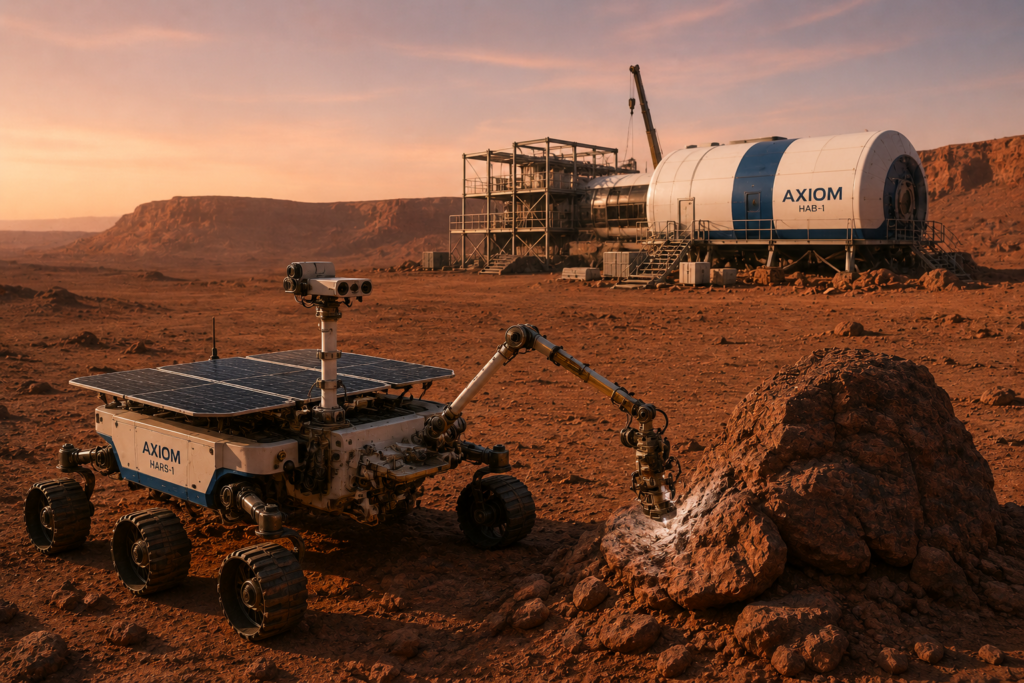
Sending a robot? The robot doesn’t breathe. It doesn’t need water. Radiation damages its electronics, but not catastrophically for years. Dust is annoying but manageable. And it costs, conservatively, 50 to 100 times less per kilogram to launch than human-rated systems with all their life support requirements.
The practical case for machines first writes itself.
KEY FACT: According to NASA’s own research, a single crewed Mars mission requires launching approximately 500 metric tons of material — life support systems, food, medical equipment, return propellant. A comparable robotic mission requires roughly 1 to 5 metric tons to accomplish the same scientific goals. The cost difference is not incremental. It is civilizational.
What AI Is Already Doing in Space Right Now
Here’s something worth establishing before discussing 2040 projections: AI in space exploration is not a future ambition. It’s current operations.
Autonomous Navigation Perseverance and its predecessor Curiosity use onboard AI to navigate Martian terrain without real-time human input. The communication delay makes this a necessity — a rover waiting for a human to say “turn left” before every decision would cover about 200 meters per day. With autonomous hazard detection, Perseverance covers over a kilometer on a good sol (Martian day).
Scientific Target Selection Perseverance carries a system called AEGIS — Autonomous Exploration for Gathering Increased Science — that uses computer vision and machine learning to identify scientifically interesting rock targets and prioritize them without waiting for scientists on Earth to review images. It made decisions about where to point its laser spectrometer autonomously, in real time.
Orbital AI Systems The ExoMars Trace Gas Orbiter uses AI to analyze atmospheric chemistry data. Satellites in Earth orbit use machine learning to process terabytes of imagery daily — more data than human analysts could review in years. The James Webb Space Telescope’s observation scheduling is handled by automated planning algorithms because the complexity of coordinating instrument time is too great for manual management.
Spacecraft Fault Management Modern spacecraft continuously monitor thousands of subsystems and respond autonomously to anomalies. When the Voyager 1 spacecraft — now over 24 billion kilometers from Earth — experienced an unexpected thruster issue in 2023, the round-trip communication time was 45 hours. The spacecraft managed its own fault response without human guidance. It had to.
| Mission/System | AI Application | What It Does Without Humans |
|---|---|---|
| Perseverance Rover | AEGIS targeting, AutoNav | Picks science targets, navigates terrain |
| Ingenuity Helicopter | Autonomous flight control | Plans and executes all flight decisions |
| James Webb Telescope | Observation scheduling | Prioritizes and sequences all observations |
| Deep Space Network | Signal processing | Routes and processes communications |
| ExoMars TGO | Atmospheric analysis | Processes spectroscopy data autonomously |
| Starlink Satellites | Collision avoidance | Autonomously adjusts orbits to avoid debris |
The Three Jobs AI Has to Do Before Humans Land
If we accept that machines will go first, there’s a specific sequence of tasks they need to accomplish to make human habitation on Mars viable. Think of it as three phases — and each one is already being engineered.
Phase One: Scout, Map, and Understand
This is the phase we are currently in, and AI is doing it right now.
The goal is complete, high-resolution understanding of Mars — its geology, its weather patterns, its subsurface water ice deposits, its radiation environment across different latitudes and altitudes, its dust cycle, its accessible resources.
Why does this matter for human colonization? Because you cannot build a habitat on Mars without knowing exactly where you’re building it. A site near accessible water ice is survivable. A site in a dust storm corridor is not. A site inside a lava tube provides natural radiation shielding. A site on exposed plains does not.
The AI systems doing this work — orbiters, rovers, atmospheric probes — are accumulating the environmental intelligence that human mission planners will eventually use to select a landing site with the same care a city planner uses when choosing where to build infrastructure.
PRO TIP: The most important Mars data being collected right now isn’t the geology. It’s the subsurface radar data from ESA’s Mars Express and NASA’s SHARAD instrument — mapping exactly where underground water ice deposits are. A Mars colony needs water not just to drink, but to electrolyze into oxygen to breathe and hydrogen for fuel. Water location is everything.
Phase Two: Build the Infrastructure
This is where it gets genuinely interesting — and where the gap between current capability and what’s needed in the next 15 years is most visible.
Before humans land on Mars, someone needs to build:
- Pressurized habitat modules that can withstand Martian pressure differentials
- An oxygen production system running continuously before any human takes their first breath
- A power supply — solar arrays or a small nuclear reactor — that can operate through dust storms
- A fuel production facility for the return journey (you cannot bring return fuel from Earth — it’s too heavy)
- Food production capability — at least partial, given the impracticality of shipping seven years of food
- Communication infrastructure — relay satellites in Mars orbit for continuous contact with Earth
Autonomous construction robots, 3D printing systems using local Martian regolith (soil), and AI-managed resource extraction systems are the tools for this phase. None of these are speculative. ICON, the Austin-based construction company, has already demonstrated large-scale 3D printing with regolith-like material on Earth for NASA. The technology needs adaptation and scaling — not invention.
# Conceptual pseudocode: how an autonomous Mars habitat
# construction AI might manage the build sequence

class MarsHabitatBuilder:
    def __init__(self):
        self.resources = {
            'regolith': 'abundant',    # Surface soil for 3D printing
            'water_ice': 'subsurface', # Location mapped by orbital radar
            'solar_power': 'variable', # Reduced during dust storms
            'co2': 'atmospheric'       # 95% of Mars atmosphere
        }
        self.build_priority = []

    def assess_conditions(self, weather_data, power_levels):
        """
        AI checks daily conditions before deciding what to build.
        Construction sequence adapts to available power and weather.
        """
        dust_storm_risk = weather_data['dust_opacity'] > 0.5
        power_sufficient = power_levels['available_kwh'] > 10

        if dust_storm_risk:
            # During storms: pause outdoor construction,
            # run indoor manufacturing and system checks
            return 'indoor_manufacturing_mode'

        if power_sufficient:
            # Normal operations: continue priority build sequence
            return 'full_construction_mode'

        return 'low_power_mode'  # Minimal ops, recharge priority

    def execute_build_sequence(self):
        """
        Autonomous construction follows a dependency-aware sequence.
        Each module must be completed before the next begins.
        No human approval needed for each step — mission params set on Earth.
        """
        sequence = [
            'deploy_solar_arrays',       # Power first, everything else second
            'establish_water_extraction', # Water before oxygen production
            'build_oxygen_generator',    # O2 before any sealed habitat
            'print_habitat_shell',       # Regolith-printed outer structure
            'install_life_support',      # Internal systems
            'verify_all_systems',        # Full diagnostic before human arrival
            'transmit_ready_signal'      # Tell Earth: habitat is ready
        ]

        for task in sequence:
            conditions = self.assess_conditions(
                self.get_weather(), self.get_power()
            )
            if conditions != 'low_power_mode':
                self.execute_task(task)
                print(f"Completed: {task}")
            else:
                print(f"Paused: {task} — waiting for better conditions")
The logic here is not fictional. It’s essentially the task structure NASA’s Artemis lunar program is using to think about pre-deploying assets before crewed missions. Mars is the same principle at larger scale and longer distance.
Phase Three: Maintain, Repair, and Keep Humans Alive
This is arguably the most underappreciated phase — and the one where AI capability matters most for human survival.
The first human Mars mission will not have a hardware store. It will not have spare parts warehoused nearby. It will not be able to call a maintenance crew. Every system that keeps colonists alive — the oxygen generator, the water recycler, the power grid, the pressurized habitat — needs to be monitored continuously, diagnosed proactively, and repaired autonomously when possible.
This requires AI systems that can:
- Predict component failures before they happen, using sensor data and degradation models
- Diagnose the cause of anomalies faster than a human engineer could
- Guide human colonists through repairs step-by-step with clear instructions
- In some cases, direct robotic systems to perform repairs that humans cannot safely do
The ISS already uses early versions of this — CIMON (Crew Interactive Mobile Companion), IBM Watson-powered, assists astronauts with procedural guidance and system monitoring. Mars will need this capability at ten times the depth, because the consequences of a maintenance failure are not a delayed experiment. They’re death.
The Problem With Humans on Mars — And What AI Solves
Let me be direct about something that space agencies are diplomatically cautious about: humans are genuinely terrible at some of the things Mars colonization requires.
Humans need to sleep eight hours every twenty-four. They get anxious in isolation. They make errors under stress — exactly the kind of errors that in a pressurized habitat on Mars are catastrophic. They have conflicting opinions. They have personal relationships that affect professional decisions. In a crew of six people sharing 200 square meters for three years, human psychology is one of the most dangerous variables in the mission.
AI systems don’t have any of these problems. They work continuously. They don’t panic. They make consistent decisions based on data. They don’t develop cabin fever. They don’t need to be psychologically screened and monitored.
This is not an argument against humans going to Mars — it’s an argument for being honest about what role humans should play and what role AI should play. The answer, almost certainly, is that AI handles infrastructure, maintenance, resource management, and decision-support while humans handle exploration, science, and the things that still genuinely require human judgment and adaptability.
KEY FACT: A 2023 NASA Human Research Program study found that cognitive performance in astronauts on long-duration missions degrades significantly after month four — precisely when a Mars mission would be reaching its most demanding phase. Autonomous AI systems are not subject to this degradation. This is a concrete, documented reason why critical systems on a Mars mission should be AI-managed rather than human-dependent.
SpaceX, NASA, ESA: What Each Is Actually Building Toward
The landscape of Mars-bound development is more active than most people realize. Here’s what’s actually in progress:
SpaceX Starship The vehicle designed to carry both cargo and humans to Mars. Starship’s autonomous landing and refueling systems are AI-dependent — the precision required for propulsive landing on Mars with variable surface winds and no GPS cannot be human-piloted in real time. Every Starship landing is an autonomous AI operation. The Mars architecture includes sending uncrewed cargo Starships first to pre-position fuel and supplies before any human mission.
NASA’s Moon to Mars Architecture NASA’s current roadmap uses the Moon as a testbed — the Artemis program is explicitly designed to develop and prove autonomous habitat technology, life support systems, and AI-managed infrastructure on the lunar surface before committing to Mars. Techniques proven on the Moon, 3 light-seconds from Earth, get adapted for Mars, where the communication delay makes real-time human oversight impossible.
ESA’s Robotic Precursor Missions The European Space Agency’s roadmap includes robotic missions explicitly described as “precursor” activities for human exploration — meaning their purpose is to gather data and demonstrate technology for eventual human missions, not to replace them. The Rosalind Franklin rover (delayed but still in development) will drill two meters into the Martian subsurface specifically looking for biosignatures and water-ice mapping.
Private Sector AI Infrastructure Companies outside traditional aerospace are increasingly relevant. ICON’s construction 3D printing. Blue Origin’s power systems. Axiom Space’s modular habitat design. The commercial space ecosystem around Mars is developing faster than the government programs.
| Organization | Key Mars-Related AI Development | Timeline |
|---|---|---|
| SpaceX | Autonomous Starship landing, cargo pre-deployment | 2028–2032 cargo missions |
| NASA | AI habitat management, autonomous rovers | Artemis proving ground 2027+ |
| ESA | Robotic precursor science missions | Rosalind Franklin 2028 |
| ICON | Autonomous regolith 3D printing | Earth demos complete, lunar tests planned |
| Intuitive Machines | Autonomous lunar landers (Mars adaptation) | Active operations 2025+ |
The AI Systems That Will Make or Break Mars Colonization
Across all the phases described above, five specific AI capabilities are load-bearing — meaning if any one of them doesn’t work reliably, the colonization timeline breaks down.
Autonomous Long-Range Navigation Rovers and construction robots need to operate across kilometers of terrain without getting stuck, damaged, or lost. Current Mars rovers cover roughly a kilometer per Martian day. Construction robots will need to cover much more ground, carry heavy loads, and navigate to precise locations. This requires terrain modeling, path planning, and real-time hazard avoidance at a level significantly beyond what Perseverance currently does.
Predictive Maintenance at Life-Critical Scale Every life support system needs continuous AI monitoring with enough predictive capability to catch failures before they happen. The model here is aviation — modern aircraft AI systems can predict component failures days before they occur using sensor degradation patterns. Mars life support needs the same fidelity with even less margin for error.
In-Situ Resource Utilization (ISRU) Management Extracting water from subsurface ice, producing oxygen from CO2, processing regolith into construction material — each of these requires sophisticated process control AI managing chemical reactions, equipment health, and output quality continuously. This is industrial process management AI adapted for an alien environment.
Autonomous Medical Diagnosis and Treatment A Mars colony cannot have a doctor on call from Earth. The communication delay alone makes telemedicine impossible for emergencies. AI-driven diagnostic systems that can assess symptoms, cross-reference against medical databases, recommend treatments, and guide colonists through medical procedures are not optional — they are survival infrastructure.
Communication and Data Routing Managing the relay satellite network, optimizing communication windows, prioritizing data transmission, and maintaining coordination between surface assets — all of this requires autonomous network management AI. The bandwidth constraints are severe and the communication windows are limited.
WARNING: The biggest single risk in any Mars colonization timeline is not the rocket technology or the AI capability individually — it’s integration failure. A life support AI that works perfectly in isolation, connected to sensors that have drifted out of calibration, feeding decisions to a construction robot with a firmware bug, in an environment that differs from simulation in one unexpected way — the chain of integrated systems failing together is what kills people. Redundancy, testing, and conservative mission architecture matter more than headline capability numbers.
What This Means for the Humans Who Eventually Arrive
None of the above is an argument that humans won’t go to Mars, or that humans don’t matter in the story. It’s an argument about sequence and role.
The most likely realistic scenario for the first human Mars landing — drawing from what NASA, SpaceX, and the broader research community actually plan — looks something like this:
Uncrewed cargo missions deliver pre-positioned equipment starting around 2028–2030. Autonomous systems begin habitat construction, resource extraction, and system verification over the following two to four years. By the time the first human crew lands, they are arriving at a site that has already been prepared — power running, oxygen being produced, water extracted, habitat pressure-tested.
The humans who land first will be scientists, engineers, and explorers doing things that AI genuinely cannot do — the kind of science that requires human judgment, intuition, and adaptability in the field. Geological fieldwork. Biological investigation. The kind of creative problem-solving that arises when reality differs from every simulation you ran back on Earth.
They will also be supervising, directing, and maintaining the AI systems that keep them alive. That relationship — human as director and AI as infrastructure — is the realistic model for early Mars habitation.
READ MORE: Digital Humans 2050: AI Clones, Virtual Identities and the End of Anonymity
FAQ: AI and Mars Colonization
Q1: Has AI already been used to make autonomous decisions on Mars?
Yes — and this is underreported. Perseverance’s AEGIS system selects scientific targets autonomously without waiting for Earth approval. AutoNav allows the rover to traverse terrain by making independent path-planning decisions. Ingenuity’s helicopter executes all flight operations autonomously because the communication delay makes real-time piloting impossible. Autonomous decision-making on Mars is not a future goal — it’s current operational practice.
Q2: What is the biggest technical barrier to AI-managed Mars colonization?
The most significant technical barrier is not any single AI capability — it is reliable operation in a novel environment. Every AI system is trained on data from known conditions. Mars will present conditions that differ from simulations in ways that are difficult to predict in advance. Building AI systems that fail gracefully — that degrade safely when they encounter situations outside their training — is harder and less glamorous than building systems that perform well in nominal conditions. Robust failure handling is the engineering challenge that matters most.
Q3: How does the Mars communication delay affect AI system design?
The delay of 3 to 22 minutes each way fundamentally changes system architecture. Any Mars system that requires human approval for routine decisions will be paralyzed or dangerously slow. This means Mars AI systems must be designed for much higher autonomy than comparable Earth systems — making consequential decisions independently, logging reasoning for later human review, and escalating to human decision-making only for situations explicitly flagged as requiring it. The communication delay is the single biggest driver of Mars AI autonomy requirements.
Q4: Could AI systems on Mars develop unexpected behaviors over time?
This is a real concern in the AI safety literature and it applies directly to long-duration autonomous systems. An AI managing Mars life support for years, without regular software updates and continuous human oversight, operating in conditions that drift from its training distribution — could develop unexpected responses to novel situations. This is a key reason why AI safety research is directly relevant to space exploration, not just abstract future scenarios. Interpretable AI systems whose decision-making can be audited remotely are a genuine engineering priority for long-duration space missions.
Q5: What role will AI play in selecting the Mars colony landing site?
Site selection is one of the most consequential decisions in the entire program — and AI systems are central to it. Machine learning analysis of orbital radar data identifies subsurface water ice deposits. Computer vision processing of surface imagery maps terrain stability and dust storm frequency. Climate models predict temperature and radiation exposure at different latitudes and altitudes. The eventual human decision on where to land will be informed by an AI synthesis of more data than any human team could analyze manually. The final decision remains human — but the information foundation is entirely AI-generated.
Q6: When will the first humans actually land on Mars?
Most credible estimates from people inside the programs cluster around the late 2030s to early 2040s for a first crewed landing, with SpaceX’s internal targets more optimistic and NASA’s more conservative. The honest caveat is that every Mars mission in history has run behind its original schedule due to the genuine difficulty of the engineering involved. What matters more than a specific year is the sequence: uncrewed cargo first, autonomous habitat construction second, human crew third. That sequence is the plan regardless of which year the crew actually arrives.
The Machines Will Be Waiting When We Get There
Mars colonization has always been talked about as a human story — the first bootprints on alien soil, the moment humanity becomes a multi-planetary species, the photograph that redefines what our civilization is capable of.
That story is real and it matters. But the chapter before it — the years when autonomous machines are quietly, methodically making Mars survivable for the humans who follow — that chapter is already being written. Perseverance is writing it right now, one autonomous decision at a time, 225 million kilometers away.
The machines will be there first. They will drill the wells, print the walls, fill the tanks with oxygen, and run diagnostics for years before a single human puts on a Mars suit. When the first astronauts finally step out onto that rust-red surface, they will be stepping into a place that AI systems spent years preparing for them.
That’s not a diminishment of the human achievement. It’s how the human achievement becomes possible.
If this changed how you think about AI’s role in exploration, share it with someone who still imagines Mars colonization as a pure human adventure story. And if you want to understand the AI systems that will actually power those autonomous Mars machines, our guide on is exactly where to go next.

Author: AI Learner Tech
AI Learner Tech is a premier research and educational hub dedicated to mastering Artificial Intelligence, Machine Learning, and Computer Vision. We bridge the gap between complex academic theories and real-world industrial applications. Join our community to access high-quality tutorials, open-source projects, and expert insights. Website: ailearner.tech