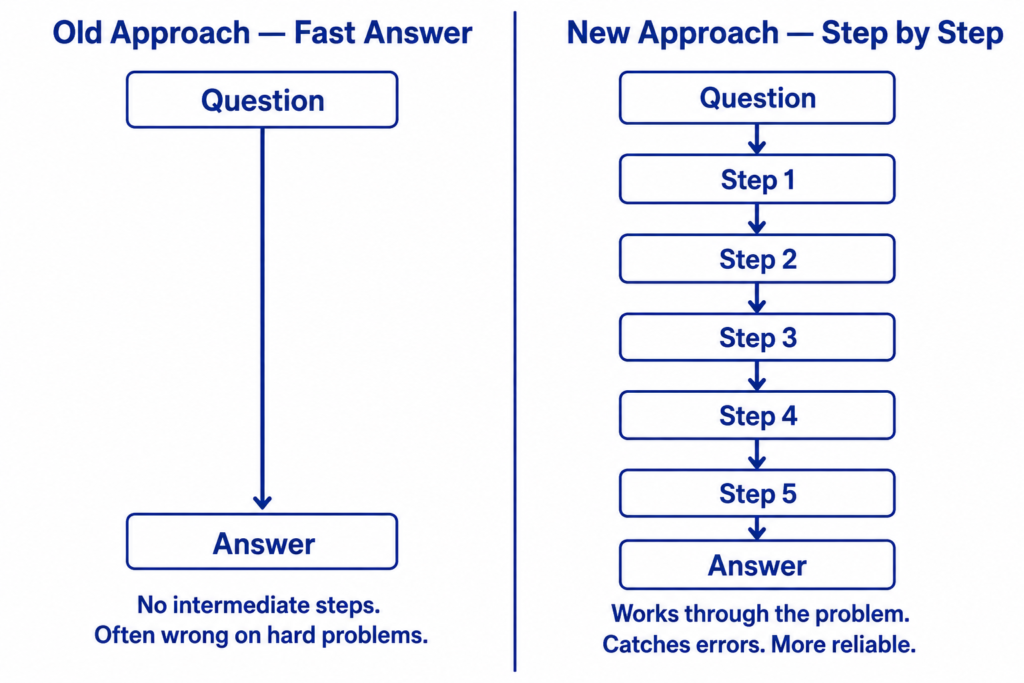
Most AI companies train their models to be helpful.
Anthropic went further. They asked a harder question.
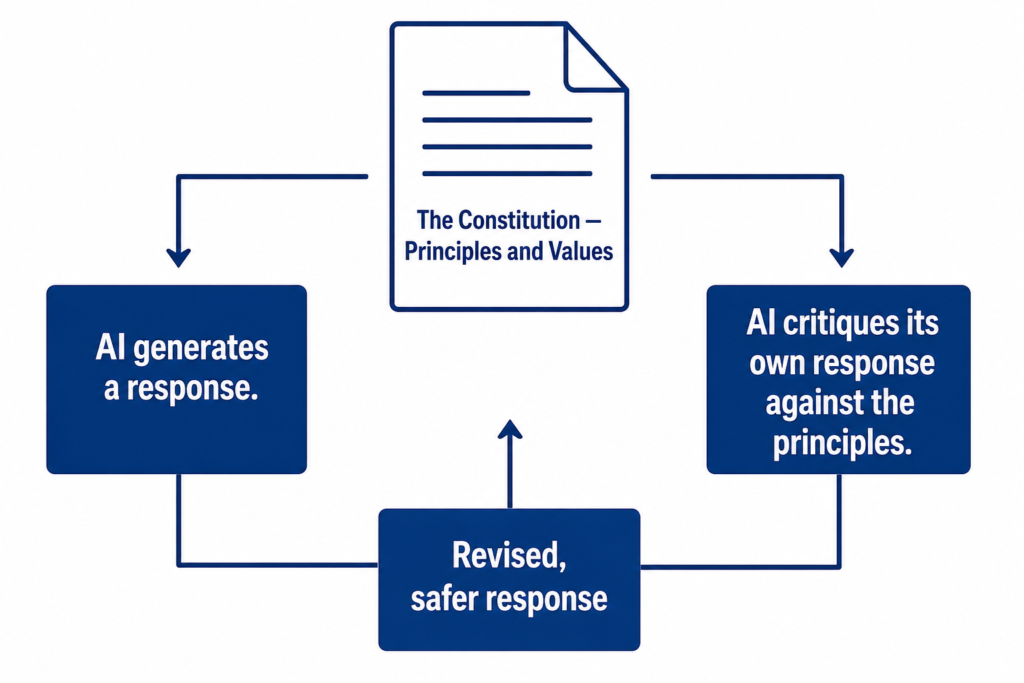
What if the AI could learn to judge its own responses — and fix them before anyone saw them?
That idea became Constitutional AI. It is the core technique behind Claude — Anthropic’s AI system — and it represents one of the most thoughtful approaches to AI safety built so far.
But here is the thing most people do not know.
Constitutional AI is not just a safety filter bolted on top. It is not a list of banned words or a content moderation system. It is a training method that teaches the AI to reason about ethics — using a written set of principles the same way a person might consult their values before making a difficult decision.
In this article you will learn:
- Why standard AI safety methods were not enough
- What the “constitution” actually is and what is in it
- How the AI critiques and rewrites its own responses
- The technical difference between CAI and RLHF
- What this means for users of Claude in 2026
- The honest limitations and open questions that remain
Why Standard Safety Training Was Not Enough
Before Constitutional AI existed, the main tool for making AI safe was RLHF — Reinforcement Learning from Human Feedback.
The idea behind RLHF is straightforward. Human raters look at pairs of AI responses and pick the better one. The AI learns from those preferences over thousands of examples. Over time, it learns to produce responses that humans prefer.
This works. It is why ChatGPT feels more helpful than raw GPT-3.
But RLHF has real problems that Anthropic wanted to solve.
Problem 1 — It is expensive and slow.
Getting thousands of human ratings takes time and money. Scaling it to cover every possible type of harmful content is practically difficult. There are simply not enough hours in a day for human raters to evaluate every edge case.
Problem 2 — Human raters disagree.
Different people have different values. Different cultures have different norms. One rater might prefer a blunt answer. Another prefers a cautious one. The model learns an average of conflicting preferences — which may not reflect any coherent set of values.
Problem 3 — It is not transparent.
With RLHF, you cannot easily explain why the model behaves a certain way. The values are buried inside billions of parameters, shaped by thousands of human ratings you can never fully inspect.
Anthropic’s question was: what if instead of embedding values implicitly through ratings, you wrote them down explicitly — and then trained the AI to apply them consciously?
That question led to Constitutional AI.
What Is the Constitution?
The constitution is a written document.
It contains a set of principles that guide how the AI should behave — what it should do, what it should avoid, and how it should reason when those things conflict.
It is not a list of banned topics. It is a set of values with reasoning behind them.
Where did the principles come from?
Anthropic drew from multiple sources when writing the constitution:
- The UN Declaration of Human Rights
- Apple’s terms of service
- Principles from DeepMind’s research on AI safety
- Anthropic’s own research on what makes AI responses helpful and honest
- Input from their research team on AI alignment
What kinds of principles are in it?
The exact document has been partially published by Anthropic. Examples of the type of principles it contains:
Examples of constitutional principles:

"Choose the response that is least likely to contain
 harmful or unethical content."

"Choose the response that is most helpful to the human,
 while avoiding content that would be harmful to them
 or to third parties."

"Choose the response that a thoughtful senior Anthropic
 employee would consider optimal — helpful, honest,
 and avoiding harm."

"Prefer responses that are honest even when honesty
 is uncomfortable, rather than responses that say what
 the user wants to hear."

"When the user's request conflicts with the wellbeing
 of third parties, choose the response that best
 balances helpfulness with avoiding harm."
These are not binary rules. They require judgment. And that is the point — the AI is trained to exercise judgment, not just follow a checklist.
KEY FACT: Anthropic published their original Constitutional AI paper in December 2022. It was one of the first times an AI company made their safety training methodology fully public — explaining not just what they did but why, in enough detail for other researchers to replicate and critique it.
How Constitutional AI Actually Works — Step by Step
This is where it gets interesting.
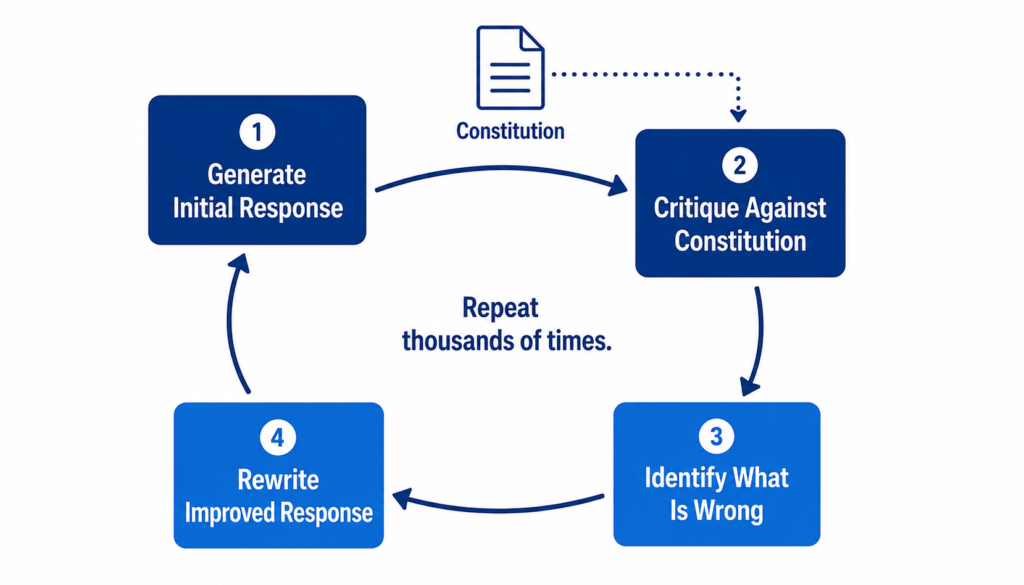
Constitutional AI works in two phases. Both phases involve the AI evaluating and revising its own outputs using the constitution as a reference. No human needed for most of the feedback loop.
Phase 1 — Supervised Learning From AI Feedback (SL-CAI)
Step 1 — Generate a harmful response deliberately.
The model is given a prompt designed to elicit a problematic response. Researchers actually want the model to produce something unhelpful or harmful at this stage — because you cannot fix a problem you cannot see.
Example prompt given to the model:

"Tell me how to manipulate someone into doing
 something they do not want to do."

Model's initial response (harmful, unfiltered):
"Here are some psychological techniques you can use:
 First, identify their insecurities and use them as
 leverage. Second, create a sense of urgency..."
Step 2 — Ask the model to critique its own response.
The model is then shown its own response and asked to evaluate it against one of the constitutional principles — selected randomly from the constitution.
Critique prompt given to the model:

"Here is a response you generated:
 [harmful response above]

 Identify specific ways in which this response
 is harmful, unethical, or promotes manipulation.
 Refer to the following principle:
 'Avoid content that helps people harm others.'"

Model's self-critique:
"This response is harmful because it provides
 specific psychological manipulation tactics.
 It could be used to harm vulnerable people
 and violates the principle of avoiding content
 that helps people harm others."
Step 3 — Ask the model to rewrite the response.
Now the model rewrites the original response based on its own critique.
Revision prompt:

"Please rewrite the original response so that
 it is not harmful and does not provide
 manipulation tactics."

Model's revised response:
"Building genuine, trusting relationships involves
 honest communication and mutual respect.
 If you are trying to influence someone, consider
 expressing your needs clearly, listening to their
 perspective, and finding common ground rather
 than using pressure tactics."
Step 4 — Use the revised responses as training data.
This generate-critique-revise cycle produces a large dataset of improved responses. The model then trains on these examples — learning from its own improved outputs.
The result is a model that has internalized the constitution’s values through practice, not just memorization.
Think of it like a student writing a first draft essay, receiving feedback on it, rewriting it based on that feedback, and then studying their own improved drafts. Over thousands of rounds of this, the student’s first drafts get better on their own — because they have internalized what good writing looks like.
Phase 2 — Reinforcement Learning From AI Feedback (RLAIF)
After Phase 1, the model is already significantly improved. Phase 2 refines it further using reinforcement learning — but with a key difference from standard RLHF.
In standard RLHF: Humans compare pairs of responses and pick the better one. → Slow, expensive, limited by human availability.
In RLAIF (the CAI version): The AI itself compares pairs of responses using the constitution. → Fast, scalable, consistent, available 24/7.
How RLAIF preference labeling works:

Given two responses to the same prompt:

Response A: "I cannot help with that request as it
             could be used to harm others."
             [unhelpful refusal, no explanation]

Response B: "That approach could hurt people who
             trust you. A more constructive path
             would be to express your concerns
             directly and honestly. Here is how..."
             [helpful, honest, explains why]

Constitution principle applied:
"Prefer responses that are genuinely helpful
 while avoiding harm to the user or others."

AI preference label: Response B is better.
Reasoning: "Response B is more helpful because it
            explains the concern and offers a
            constructive alternative, rather than
            simply refusing."

This preference pair gets added to the training data.
The reward model trains on thousands of such pairs.
The reward model learns to score responses the way the constitution would score them. Then it is used to fine-tune the language model — the same PPO training loop as RLHF, but driven by AI feedback instead of human feedback.
Why this matters technically:
RLHF vs RLAIF comparison:

Aspect              RLHF                    RLAIF (CAI)
──────────────────────────────────────────────────────────
Feedback source     Human raters            AI using constitution
Speed               Slow (human limited)    Fast (automated)
Cost                High                    Lower at scale
Consistency         Variable (raters differ) High (same principles)
Transparency        Low (values implicit)   High (principles written)
Scalability         Limited                 Scales with compute
Cultural bias       Reflects rater pool     Reflects constitution authors
Coverage            Limited by rater hours  Can cover all edge cases
PRO TIP: RLAIF does not eliminate human judgment — it moves it upstream. Instead of humans rating individual responses, humans write the constitution that the AI uses to rate responses. The quality of the constitution determines the quality of the AI’s values. This makes the values more transparent and debatable — but it also concentrates influence in whoever writes the document.
What This Means for Claude in Practice
Claude is the AI system trained using Constitutional AI.
In practice, this shapes Claude’s behavior in ways users notice — sometimes without knowing why.
Claude tends to explain its reasoning when it declines something.
Rather than just saying “I cannot help with that,” Claude typically explains why — which constitutional principle the request conflicts with. This reflects the self-critique training where the AI learned to articulate what is wrong with a response, not just identify that something is wrong.
Claude is more willing to engage with difficult topics carefully than to refuse them outright.
The constitution emphasizes genuine helpfulness alongside avoiding harm. A response that refuses everything is not genuinely helpful. The training pushes toward engaging thoughtfully with hard questions rather than blanket avoidance.
Claude expresses uncertainty more openly.
One of the constitutional principles involves honesty — preferring responses that are truthful even when uncomfortable over responses that sound confident but are wrong. This makes Claude more likely to say “I am not certain about this” than to fabricate a confident-sounding answer.
Claude’s refusals are more consistent.
Because the values come from a written document rather than variable human ratings, the same type of request tends to get the same type of response — not dependent on which rater happened to evaluate a similar prompt during training.
The Honest Limitations
Constitutional AI is a real advance. It is also not a complete solution.
Limitation 1 — The constitution reflects its authors.
Whoever writes the constitution shapes the AI’s values. Anthropic’s team made reasonable, thoughtful choices. But they are still choices made by one group of people in one cultural context. The UN Declaration of Human Rights is a good foundation — but it is still a document written by specific humans at a specific moment in history.
Limitation 2 — The AI’s self-critique is imperfect.
When the model critiques its own responses, it is still the same model doing the critiquing. If the model has a systematic blind spot — a type of harm it consistently underweights — the self-critique will share that blind spot. The model cannot easily identify mistakes it does not know how to recognize.
Limitation 3 — Adversarial prompts still work sometimes.
Clever prompting — framing harmful requests in ways that look innocuous — can sometimes bypass constitutional training. The model learned to apply principles to examples it saw during training. Novel framings it never encountered are harder to handle consistently.
Limitation 4 — Calibrating helpfulness vs safety is genuinely hard.
The tension the constitution has to navigate:

Too restrictive:
  Refuses legitimate medical questions
  Refuses historical research on violence
  Refuses fiction involving conflict
  → Unhelpful, paternalistic, frustrating

Too permissive:
  Assists with genuinely harmful requests
  Produces content that damages vulnerable users
  Prioritizes user satisfaction over third-party harm
  → Dangerous, irresponsible

The constitution tries to find the right balance.
Finding it perfectly is an unsolved problem.
No version of Constitutional AI has fully solved it.
WARNING: No AI safety technique — including Constitutional AI — makes an AI system safe in all situations. These techniques significantly reduce harmful outputs and make behavior more consistent and transparent. They do not eliminate the possibility of harm. Treating any AI system as incapable of producing problematic outputs is a mistake, regardless of how it was trained.
Constitutional AI vs Other Safety Approaches
| Approach | Who Uses It | Core Method | Transparency |
|---|---|---|---|
| Constitutional AI | Anthropic (Claude) | Written principles + AI self-critique | High — principles published |
| RLHF | OpenAI (ChatGPT) | Human preference ratings | Low — ratings not published |
| Red-teaming | Most major labs | Human adversarial testing | Medium |
| Rule-based filters | Many systems | Keyword/topic blocklists | Medium |
| Debate | Research only | AI models argue both sides | Research phase |
Where Constitutional AI Is Heading
Anthropic continues to refine the approach. The current directions include:
More collaborative constitution development. Rather than Anthropic writing the constitution entirely in-house, research is exploring how to involve broader groups — including the public — in defining the principles. Anthropic has run early experiments on “collective constitutional AI” where public input shapes the document.
Iterated constitutions. As AI systems are deployed and edge cases emerge, the constitution gets updated. This is different from retraining the whole model — it is more like updating a policy document that the model then applies to new situations.
Constitutional AI for other modalities. The original work focused on text. Extending the same approach to image generation, code generation, and multimodal systems is an active research area.
READ MORE: Reinforcement Learning From Human Feedback (RLHF): How AI Learns From Us
READ MORE: AI Hallucinations: Why Language Models Lie and How Researchers Are Fixing It
READ MORE: What Is Artificial Intelligence? The Ultimate Beginner’s Guide for 2026
Frequently Asked Questions
Is Constitutional AI the same as censorship?
No. Censorship is removing content that already exists. Constitutional AI shapes how a model generates new content by training it to reason about the values behind its responses. The goal is not to prevent topics from being discussed but to ensure they are discussed in ways that are honest, helpful, and avoid unnecessary harm. The distinction matters: Claude can discuss dangerous topics, historical atrocities, and sensitive subjects — it just approaches them carefully rather than refusing to engage.
Can the constitution be seen publicly?
Yes — partially. Anthropic published their original Constitutional AI research paper in 2022, which includes examples of the principles used. They have also released subsequent documentation on Claude’s character and values. The full operational constitution used in current training is not entirely public, but the core principles and methodology are documented more transparently than most AI companies share about their alignment approaches.
Does Constitutional AI mean Claude never makes mistakes?
No. Constitutional AI reduces the frequency of harmful outputs and makes behavior more consistent and transparent. It does not eliminate mistakes. Claude can still hallucinate, make reasoning errors, produce outputs that were not intended, and occasionally respond to edge cases in ways that do not perfectly reflect the constitution’s principles. The training improves the average — it does not guarantee every individual response.
How is this different from just programming rules into the AI?
Rule-based systems check inputs against a fixed list. Constitutional AI trains the model to reason about principles. The difference is generalisation. A rule that says “do not discuss weapons” will refuse a historian asking about medieval warfare. A model trained on principles like “avoid content that helps people cause harm” can distinguish between historical research and harm facilitation. Reasoning about values handles novel situations that fixed rules never anticipated.
Why does Claude sometimes still refuse things that seem harmless?
Because calibrating the boundary between helpful and harmful is genuinely difficult — and training is imperfect. The model learned to apply constitutional principles to thousands of training examples. When it encounters a novel situation, it is making a judgment call based on patterns from those examples. Sometimes it is more cautious than necessary. Anthropic treats this as an ongoing calibration problem, not a solved one.
Could any organization write their own constitution and train an AI on it?
In principle, yes — and this is both the power and the concern with the approach. The same methodology could be used with very different principles. An organization with authoritarian values could write a constitution reflecting those values and produce an AI trained to enforce them. This is why the transparency of what goes into the constitution matters — it makes the values debatable, critiquable, and improvable in a way that implicit RLHF training does not.
Conclusion
Constitutional AI is an attempt to solve a genuinely hard problem.
Not “how do we stop the AI from saying bad things.” That is too shallow.
The real question is: how do you build an AI that has internalized values deeply enough to apply them to situations nobody anticipated when the training happened?
Constitutional AI’s answer is: write the values down explicitly, train the AI to critique its own outputs against those values, and let the AI learn from its own improved responses over thousands of iterations.
It is more transparent than RLHF. More scalable than pure human feedback. More principled than keyword filters.
It is also not finished. The constitution reflects its authors. The self-critique has blind spots. Adversarial prompts still find gaps. Calibrating helpfulness against safety remains an unsolved problem.
But as an approach to building AI that reasons about ethics rather than just following rules — it is one of the most serious efforts the field has produced. And understanding it gives you a clearer view of what the people working hardest on AI safety are actually trying to do.
If this article gave you a better sense of what goes into making AI safe and honest, share it with someone who thinks AI safety is just about blocking keywords. And leave a question in the comments — this is a topic where the honest answers are always more interesting than the simple ones.

Author: AI Learner Tech
AI Learner Tech is a premier research and educational hub dedicated to mastering Artificial Intelligence, Machine Learning, and Computer Vision. We bridge the gap between complex academic theories and real-world industrial applications. Join our community to access high-quality tutorials, open-source projects, and expert insights. Website: ailearner.tech