A Bank Got Robbed Last Night — Nobody Wore a Mask, Nobody Fired a Shot
Somewhere in the world, right now, an AI system is scanning millions of IP addresses looking for a port left open by a misconfigured server. It found one three seconds ago. It is now testing 40,000 password combinations per minute against the login endpoint. It does not sleep. It does not get frustrated. It does not leave fingerprints.
The person who set it running is probably asleep.
This is not a movie plot. This is the operational reality of cybersecurity in 2026. AI-powered attacks are not coming — they are here, they are running continuously, and they are scaling in ways that make the hacking of ten years ago look like someone trying to pick a lock by hand while attackers today have a robot that tries every key ever made in under a minute.
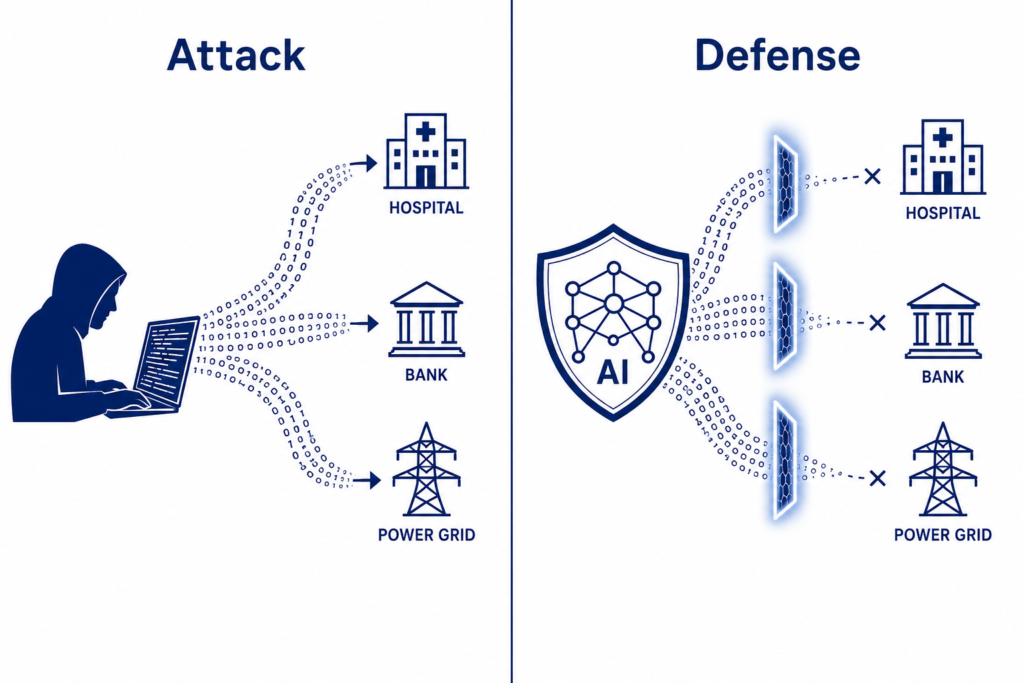
The only reason our digital infrastructure hasn’t completely collapsed under this pressure is that defenders are using the same weapon. AI-powered security systems are detecting, blocking, and responding to attacks at machine speed — because human-speed response is no longer fast enough to matter.
What follows is the honest, complete picture of both sides of this arms race. Not hype about killer robots. Not naive reassurance that everything is fine. The actual technology, the actual threats, the actual defenses, and what ordinary people and organizations need to understand right now.
READ MORE: What Is Artificial Intelligence? The Ultimate Beginner’s Guide for 2026
What Changed: Why Cybersecurity Became an AI Problem
To understand why AI is central to both sides of this fight, you need to understand what changed in the last five years — because the threat landscape of 2026 is genuinely different from 2019, not just bigger.
Volume crossed human capacity. A mid-size enterprise network generates millions of security events per day. Log files, connection attempts, user behavior anomalies, software alerts. A human security team — even a large one — can meaningfully review perhaps a few thousand of these per day. The rest go unanalyzed. Attackers know this. They hide in the noise.
Attack complexity crossed human detection thresholds. Modern advanced persistent threats (APTs) — the technical term for sophisticated, long-running attacks — are designed to look like normal network traffic. An attacker who has studied your network for months knows what normal looks like. They move slowly, mimic legitimate user behavior, and exfiltrate data in quantities indistinguishable from routine file access. No human analyst reviewing logs can spot this. Pattern recognition at scale, across millions of events, with temporal correlation over weeks — that’s an AI problem.
The attacker’s time-to-exploit collapsed. In 2019, the average time between a software vulnerability being publicly disclosed and attackers actively exploiting it was around 15 days. By 2024, AI-assisted vulnerability scanners reduced that to hours in some cases. Defenders who previously had days to patch critical vulnerabilities now have hours — and not every organization patches within hours.
Phishing became indistinguishable. This one affects every person reading this, not just security professionals. AI-generated phishing emails — trained on the writing style of the person they’re impersonating, referencing real recent events, containing no spelling errors, formatted correctly for the platform — are now passing tests that previously caught 90% of phishing attempts. The “bad grammar” tell is gone.
KEY FACT: The 2024 Verizon Data Breach Investigations Report found that the median time for a phishing victim to click a malicious link dropped to under 60 seconds after email delivery — faster than most security teams can issue a warning. The human is no longer the slow link in the attack chain. The human is increasingly the primary target, and AI is the weapon aimed at them.
The Attacker’s Toolkit: How AI Is Used to Hack
Let’s be specific about what AI-powered attacks actually look like technically. This matters because understanding the attack is the first step to understanding the defense.
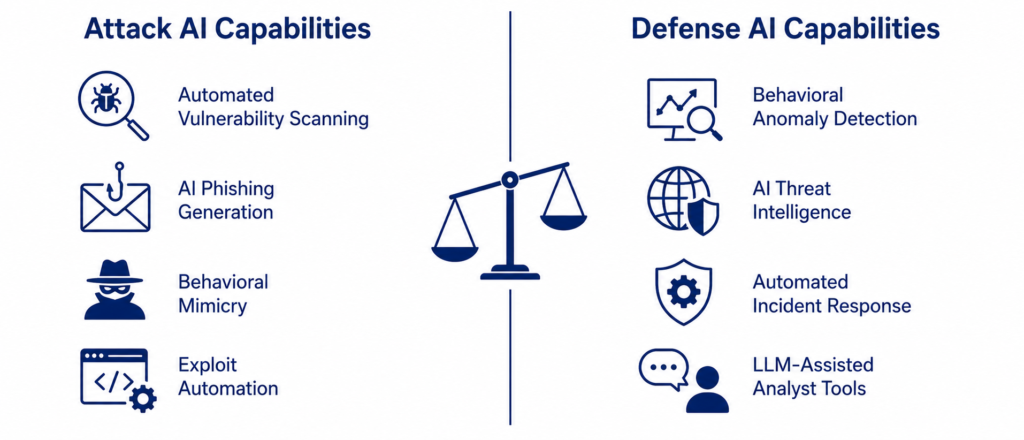
Automated Vulnerability Discovery
Traditional penetration testing — the process of probing a system for weaknesses before attackers do — was expensive and manual. A skilled security researcher might test a system comprehensively over days or weeks.
AI systems now do a version of this continuously and at scale. Large language models fine-tuned on security research literature and vulnerability databases can read code and identify potential security flaws — buffer overflows, injection points, authentication bypasses — without running the code. Graph neural networks trained on known vulnerability patterns can scan codebases orders of magnitude larger than any human can review.
The same capability that helps defenders find their vulnerabilities before attackers do is available to attackers. The asymmetry runs both ways.
# Educational example: how an AI vulnerability scanner
# might analyze code for common security weaknesses
# This represents DEFENSIVE security tooling — used by security teams
# to find vulnerabilities in their OWN code before attackers do

import re
from dataclasses import dataclass
from typing import List

@dataclass
class VulnerabilityFinding:
    severity: str       # 'CRITICAL', 'HIGH', 'MEDIUM', 'LOW'
    vuln_type: str      # e.g., 'SQL Injection', 'Path Traversal'
    line_number: int
    description: str
    recommendation: str

class AIVulnerabilityScanner:
    """
    Simplified example of pattern-based vulnerability detection.
    Real systems use ML models trained on millions of CVEs (known vulnerabilities).
    """

    # Patterns that suggest SQL injection vulnerability
    # Real scanners use trained ML classifiers, not just regex
    SQL_INJECTION_PATTERNS = [
        r'query\s*=\s*["\'].*\+\s*\w+',         # String concatenation in query
        r'execute\s*\(\s*["\'].*%s.*["\']',       # Unsafe string formatting
        r'cursor\.execute\s*\(.*\+',              # Direct concatenation
    ]

    # Patterns suggesting hardcoded credentials — a common critical finding
    HARDCODED_CRED_PATTERNS = [
        r'password\s*=\s*["\'][^"\']{4,}["\']',  # Hardcoded password
        r'api_key\s*=\s*["\'][a-zA-Z0-9]{20,}',  # Hardcoded API key
        r'secret\s*=\s*["\'][^"\']{8,}["\']',    # Hardcoded secret
    ]

    def scan_file(self, code: str, filename: str) -> List[VulnerabilityFinding]:
        findings = []
        lines = code.split('\n')

        for line_num, line in enumerate(lines, 1):
            # Check for SQL injection patterns
            for pattern in self.SQL_INJECTION_PATTERNS:
                if re.search(pattern, line, re.IGNORECASE):
                    findings.append(VulnerabilityFinding(
                        severity='CRITICAL',
                        vuln_type='SQL Injection',
                        line_number=line_num,
                        description=f'Potential SQL injection at line {line_num}. '
                                   f'User input appears to be concatenated directly into query.',
                        recommendation='Use parameterized queries or prepared statements. '
                                      'Never concatenate user input into SQL strings.'
                    ))

            # Check for hardcoded credentials
            for pattern in self.HARDCODED_CRED_PATTERNS:
                if re.search(pattern, line, re.IGNORECASE):
                    findings.append(VulnerabilityFinding(
                        severity='HIGH',
                        vuln_type='Hardcoded Credentials',
                        line_number=line_num,
                        description=f'Possible hardcoded credential at line {line_num}.',
                        recommendation='Move credentials to environment variables '
                                      'or a secrets management system like Vault or AWS Secrets Manager.'
                    ))

        return findings

# Example usage — security team scans their own codebase
scanner = AIVulnerabilityScanner()
sample_code = '''
def get_user(username):
    # VULNERABLE: direct string concatenation into SQL
    query = "SELECT * FROM users WHERE name = '" + username + "'"
    cursor.execute(query)

# VULNERABLE: hardcoded API key
api_key = "sk-prod-a8f3k2j9m1n4p7q2r5s8t1"
'''

findings = scanner.scan_file(sample_code, "app.py")
for f in findings:
    print(f"[{f.severity}] {f.vuln_type} at line {f.line_number}")
    print(f"  Recommendation: {f.recommendation}\n")
PRO TIP: The same scanner above — used defensively by security teams to find their own vulnerabilities — can be repurposed offensively. This dual-use nature is the central challenge of AI security tooling. A model that reads code and finds SQL injection vulnerabilities does not know whether it is serving the owner of the code or someone who wants to exploit it.
AI-Powered Phishing and Social Engineering
This is where AI’s language capability collides with cybersecurity in the most immediately dangerous way for ordinary people.
Traditional phishing worked on volume — send millions of badly written emails, hope a small percentage bite. AI phishing works on precision. Using publicly available information (LinkedIn profiles, company websites, recent news, social media), a large language model can generate:
- An email that reads as coming from your actual manager, referencing your real current project
- A voice call that sounds exactly like your bank’s automated system, with your actual account number mentioned
- A text message that appears to come from a colleague’s real phone number, asking you to click a link for a document you’ve been working on together
The technical term for voice-based AI impersonation is vishing (voice phishing). In 2024, a finance worker at a Hong Kong multinational transferred $25 million after a video call where every participant — except him — was an AI-generated deepfake of his colleagues and executives. He recognized their faces. He heard their voices. He transferred the money.
WARNING: The single most important thing to understand about AI-powered social engineering is that it has eliminated the traditional tells. Spelling errors, awkward phrasing, wrong email domains — these were the signs your spam filter and your own instinct used to catch phishing. AI-generated attacks have none of these tells. The defense is not better grammar detection. It is process: call back on a known number, verify through a second channel, follow the policy regardless of urgency.
Automated Exploit Development
When a new software vulnerability is disclosed — a flaw in Windows, a bug in a popular web framework, a misconfiguration in a cloud service — the race begins. Defenders need to patch. Attackers need to build a working exploit before defenders patch.
AI systems trained on historical exploit code and vulnerability databases are now dramatically compressing the time required to go from “vulnerability disclosed” to “working exploit in the wild.” What previously required a skilled human security researcher days or weeks of work can now be assisted by AI systems that suggest exploit approaches, generate proof-of-concept code, and help chain together multiple smaller vulnerabilities into a complete attack path.
Large language models have demonstrated the ability to take a CVE (Common Vulnerabilities and Exposures) description — the public disclosure of a vulnerability — and generate working exploit code with measurably higher success rates than random approaches. This is documented in academic security research, not speculation.
The Defender’s Toolkit: How AI Stops the Attacks
The defensive side of this equation is equally sophisticated — and in some specific domains, AI defense is genuinely pulling ahead of AI offense.
Behavioral Anomaly Detection
This is the most mature and widely deployed AI security application. Rather than trying to recognize specific known attacks — the signature-based approach that antivirus software has used for decades — behavioral AI learns what normal looks like for a specific network, user, or system, and flags deviations.
What “normal” looks like for a network is extraordinarily complex. What time does this user typically log in? From which IP addresses? Which files do they access? How large are their typical file transfers? How do they interact with email — do they forward externally rarely, or frequently? Do they access the finance systems, or only the marketing tools?
A behavioral AI that has learned all of this — across thousands of users simultaneously — can detect an account compromise within minutes of an attacker logging in, because the attacker’s behavior patterns don’t match the legitimate user’s. The attacker may have the correct password. They don’t have the correct behavior signature.
| Detection Method | How It Works | What It Catches | Limitation |
|---|---|---|---|
| Signature Detection | Matches known attack patterns | Known malware, known exploits | Misses new/modified attacks |
| Behavioral AI | Learns normal, flags deviation | Insider threats, account takeover, novel attacks | Requires training period, false positives |
| Network Traffic AI | Analyzes packet patterns at speed | Lateral movement, data exfiltration | Encrypted traffic harder to analyze |
| NLP Phishing Detection | Reads email content for manipulation patterns | Spear phishing, BEC attacks | AI-generated phishing is harder to catch |
| Vulnerability AI | Scans code for security flaws | Unpatched vulnerabilities before exploitation | Only covers known vulnerability classes |
AI-Powered Threat Intelligence
Cybersecurity threat intelligence — understanding who is attacking, how, with what tools, and toward what targets — has historically been slow and fragmented. Security researchers at different organizations share information through formal channels that operate on timescales of days to weeks.
AI systems now scrape, analyze, and correlate threat intelligence from thousands of sources simultaneously — security researcher blogs, dark web forums, malware repositories, government advisories, incident reports — and produce actionable intelligence in near-real-time.
When a new ransomware variant appears in a hospital network in Germany at 3am local time, an AI threat intelligence system can identify the malware family, correlate it with known threat actor tools and infrastructure, generate indicators of compromise (the technical fingerprints of the attack), and push those indicators to defensive systems at hospitals, banks, and critical infrastructure globally — before any human analyst has written a single word of analysis.
This speed matters because ransomware attacks specifically target the gap between detection and response. The faster defenders can share intelligence, the smaller that gap becomes.
Large Language Models in Security Operations
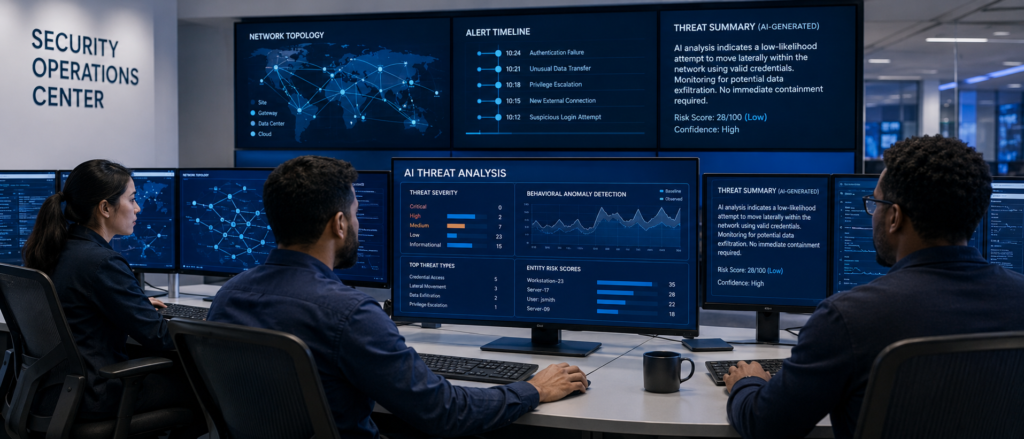
The security operations center (SOC) — the team responsible for monitoring and responding to security events — has a profound analyst shortage. There are simply not enough trained security analysts to process the volume of events that modern networks generate, and training new ones takes years.
Large language models are changing what a single analyst can accomplish. Rather than manually writing detection rules, querying databases, and cross-referencing alerts, analysts can describe what they’re looking for in natural language and have AI systems translate that into technical queries, run them across logs, correlate the results, and summarize findings.
# Example: AI-assisted security query generation
# Shows how a security analyst describes a threat in plain English
# and an LLM-powered tool translates it to executable queries

class AISecurityAssistant:
    """
    Simplified example of how LLMs assist security analysts.
    Real systems integrate with SIEM platforms like Splunk, Microsoft Sentinel.
    """

    def analyze_threat_description(self, analyst_description: str) -> dict:
        """
        Analyst types: "Find any users who logged in at unusual hours,
        then accessed finance files, then sent large email attachments"

        AI translates this to structured queries across multiple log sources.
        """

        # In reality, this calls an LLM API with security context
        # The LLM understands the intent and generates appropriate queries

        # Example output structure the LLM would generate:
        generated_queries = {
            'login_anomaly_query': """
                SELECT user_id, login_time, source_ip
                FROM auth_logs
                WHERE HOUR(login_time) NOT BETWEEN 7 AND 19
                AND login_time > NOW() - INTERVAL 7 DAYS
                ORDER BY login_time DESC
            """,

            'file_access_query': """
                SELECT user_id, file_path, access_time, action
                FROM file_access_logs
                WHERE file_path LIKE '%/finance/%'
                AND user_id IN (/* results from login anomaly query */)
            """,

            'email_exfil_query': """
                SELECT sender, recipients, attachment_size_mb, send_time
                FROM email_logs
                WHERE attachment_size_mb > 10
                AND recipients NOT LIKE '%@company.com'
                AND sender IN (/* users from previous queries */)
            """,

            'correlation_summary': """
                Correlate all three query results to find users appearing
                in ALL THREE patterns — these are highest priority for review.
                Generate a timeline for each matching user.
            """
        }

        threat_summary = {
            'queries': generated_queries,
            'mitre_techniques': [
                'T1078 - Valid Accounts',        # Using legitimate credentials
                'T1530 - Data from Cloud Storage', # Finance file access
                'T1048 - Exfiltration Over Alt Protocol'  # Large email attachments
            ],
            'recommended_actions': [
                'Disable accounts pending investigation',
                'Preserve relevant log data',
                'Check for data exfiltration to external cloud services',
                'Interview users with legitimate after-hours access patterns'
            ]
        }

        return threat_summary
The practical impact: an analyst using AI assistance can investigate an alert in 15 minutes that would previously take 2 hours. That doesn’t mean AI replaces analysts — it means each analyst can handle four to eight times the workload, the gap between alert generation and human response narrows, and the quality of investigations improves because analysts spend time on judgment rather than query syntax.
Automated Incident Response
When an attack is detected, the first 15 minutes of response are the most critical — and historically the most human-bottlenecked. Someone has to be awake, has to receive the alert, has to understand it, and has to begin taking action. At 3am on a Saturday, that chain has gaps.
AI-driven security orchestration and automated response (SOAR) platforms are changing this. Pre-defined playbooks — sequences of response actions for specific attack types — are executed automatically by AI systems the moment certain conditions are met.
Account showing signs of compromise → automatically suspend account, require re-authentication, notify security team, preserve logs.
Server showing signs of ransomware behavior → automatically isolate from network, snapshot current state, alert on-call team, begin forensic collection.
These responses happen in seconds. Not minutes. Not hours. The attack’s window — the time between initial compromise and the moment defenders respond — shrinks from the industry average of hours or days to under a minute.
The Arms Race Dynamic: Why Neither Side Is Winning
Here is the uncomfortable truth that security professionals will tell you privately: this is not a war that either side wins. It is a continuous arms race with no end state, where the equilibrium shifts depending on which side has better AI at any given moment.
Three dynamics make this race structurally different from traditional cybersecurity:
Asymmetric economics still favor attackers. A single successful ransomware attack against a hospital can yield millions of dollars. The cost to attempt the attack — including AI tools, infrastructure, time — might be thousands of dollars. Defense must succeed every time. Attack only needs to succeed once. AI has made attacks cheaper without changing this fundamental asymmetry.
AI lowers the skill floor for attackers more than defenders. Building defensive AI security infrastructure requires significant expertise, budget, and integration with existing systems. Deploying offensive AI tools — commercial penetration testing tools repurposed offensively, jailbroken LLMs for phishing generation, rented attack infrastructure — is accessible to much less sophisticated actors. The democratization of AI offense has outpaced the democratization of AI defense.
The data advantage shifts. Attackers have access to breach data — billions of stolen credentials, leaked internal documents, harvested behavioral data — that they use to train and improve their AI systems. Defenders have access to network telemetry and historical incident data. Both are valuable. Neither is complete. The side that aggregates better training data for its AI systems gains a meaningful advantage.
KEY FACT: The cybersecurity company CrowdStrike reported in its 2024 Global Threat Report that the average breakout time — the time from initial compromise to an attacker moving laterally to other systems — dropped to 62 minutes in 2023, down from 84 minutes the previous year. In some cases, AI-assisted attackers achieved breakout in under 2 minutes. Human incident response teams cannot match this speed. AI detection and response systems can.
Nation-State AI Hacking: The Stakes Nobody Talks About Enough
Consumer and corporate cybersecurity gets most of the public attention. The more alarming story — and the one with the largest potential consequences — is nation-state AI-powered attacks against critical infrastructure.
Power grids. Water treatment facilities. Hospital networks. Financial clearing systems. Air traffic control. These systems were not designed with the assumption that an attacker would have unlimited computational resources, perfect patience, and AI-assisted tools for finding vulnerabilities and evading detection.
Several well-documented nation-state attack campaigns — attributed by intelligence agencies and private security firms to specific state actors — have demonstrated the combination of advanced persistent access and AI-assisted operational security that makes these attacks extraordinarily difficult to detect and remove.
The specific details of active nation-state AI capabilities are classified. What is publicly known:
- Volt Typhoon (attributed to China-linked threat actors): A long-running intrusion campaign into US critical infrastructure that used “living off the land” techniques — using legitimate system tools rather than custom malware — to avoid detection. The kind of behavioral analysis required to spot this at scale is an AI problem.
- AI-assisted disinformation operations: Multiple intelligence agencies have documented the use of AI-generated content in influence operations designed to destabilize foreign governments and erode public trust in institutions.
- Satellite and space system targeting: Multiple nations have demonstrated capabilities to disrupt satellite communications and navigation systems that modern AI-dependent infrastructure relies on.
WARNING: The most dangerous AI-enabled attack against critical infrastructure is not the dramatic movie version — a hacker typing furiously while sirens blare. It is the quiet version: a patient, AI-assisted intrusion that establishes persistent access in critical systems months or years before it is used, waiting for a geopolitical moment when activating it creates maximum leverage. This is not hypothetical. Security agencies across multiple countries have found such pre-positioned access and have not always been able to determine how long it was there.
What Organizations and Individuals Can Actually Do
The picture I’ve painted is realistic but not hopeless. There are concrete steps that both organizations and individuals can take that genuinely improve security posture against AI-powered attacks.
For Organizations:
Deploying AI-powered security tooling is no longer optional for organizations handling sensitive data or operating critical services. The specific stack matters less than the principle: you need AI-assisted detection because human-speed detection is insufficient. The main categories to prioritize are:
- Behavioral AI for user and entity behavior analytics (UEBA)
- AI-assisted email security that goes beyond signature detection
- Automated vulnerability scanning on a continuous rather than periodic basis
- AI-driven incident response automation for the most common attack scenarios
Beyond tooling, the organizational process changes that AI enables matter as much as the technology:
- Reduce mean time to detect (MTTD) and mean time to respond (MTTR) as measurable organizational goals
- Treat AI security tools as force multipliers for human analysts, not replacements — the analyst shortage is real and AI assistance is the near-term answer
- Run red team exercises that use AI-powered attack tools — if you don’t know what AI-assisted attacks against your systems look like, your defenses are calibrated to a threat that no longer exists
For Individuals:
The threat model for ordinary people has changed specifically around social engineering and credential compromise. The technical defenses that matter most are:
- Hardware security keys or app-based MFA for any account that matters — AI-generated phishing can steal passwords, but cannot steal a physical hardware key
- Password managers with unique passwords — AI-assisted credential stuffing uses breach data to try stolen passwords across multiple sites
- Extreme skepticism about urgency — AI social engineering attacks almost always create artificial urgency (“your account will be closed,” “we need the transfer today”). Urgency is the primary tell that remains when grammar and formatting are perfect
- Verification through a second channel — before clicking a link, transferring money, or providing credentials based on any electronic communication, verify through a known good channel: call the person back on a number you already have, not one they provided
FAQ: AI and Cybersecurity
Q1: Is AI-powered hacking something only sophisticated nation-states can do?
No — and this is the most important thing to understand about the current threat landscape. AI tools that significantly amplify attack capability are available to organized crime groups, small hacking teams, and increasingly to individuals with relatively modest technical skill. Commercial penetration testing tools, open-source AI models fine-tuned on security data, and attack-as-a-service platforms all use AI under the hood. The skill floor for conducting AI-assisted attacks has dropped dramatically. The volume of AI-assisted attacks has risen correspondingly.
Q2: Can AI actually write malware and exploit code automatically?
Yes, to varying degrees of sophistication. Large language models can generate exploit code for known vulnerabilities, assist in modifying existing malware to evade signature detection, and help chain together multiple smaller vulnerabilities into complete attack paths. The capability is not unlimited — truly novel zero-day exploit development still requires significant human expertise — but AI assistance meaningfully lowers the bar and accelerates the timeline for many types of attack code development. This is one of the most actively researched areas in both offensive and defensive security AI.
Q3: How does AI detect cyberattacks better than traditional security tools?
Traditional signature-based security — antivirus, firewall rules, intrusion detection signatures — works by recognizing patterns of known attacks. It fails against new attacks, modified malware, and attackers who have studied the defensive signatures and crafted attacks to avoid them. AI behavioral detection works differently: it learns what normal looks like for your specific network and users, then flags deviations regardless of whether they match known attack patterns. This catches novel attacks, insider threats, and sophisticated adversaries who specifically evade signature detection. The tradeoff is that AI behavioral detection requires a training period and generates false positives that human analysts must review.
Q4: What is AI-powered ransomware and how is it different from regular ransomware?
AI-enhanced ransomware is different from traditional ransomware in several ways. It can move through a network more efficiently by predicting which systems and files are most valuable to encrypt for maximum leverage. It can adapt its behavior to evade specific defensive tools it detects during reconnaissance. It can generate personalized ransom notes using information gathered during the intrusion — referencing specific business names, contacts, and data found on the compromised systems — making them more psychologically effective. Some advanced ransomware operators use AI to optimize the timing of activation to maximize damage before detection.
Q5: Is my small business at risk from AI-powered attacks?
Yes — arguably more than large enterprises in some ways. Large enterprises have security teams, AI-powered defenses, and incident response procedures. Small businesses typically have none of these. AI-powered attacks are not more targeted at large organizations — they are more scalable, which means they hit every vulnerable target, large and small. Ransomware operators specifically target small and medium businesses because they often have valuable data, inadequate backups, and less resilient operations — making them more likely to pay a ransom. The most effective defenses for small businesses are cloud email security with AI filtering, hardware MFA on all accounts, and regular tested backups stored offline.
Q6: What careers exist at the intersection of AI and cybersecurity?
This intersection is one of the fastest-growing areas of employment in technology. Specific roles include: AI security researcher (developing AI-powered defensive tools and studying AI-powered attack techniques), machine learning security engineer (building and maintaining the AI systems that power security products), threat intelligence analyst with AI specialization (using AI tools to analyze threat data at scale), red team AI specialist (conducting AI-assisted penetration testing to find vulnerabilities before attackers do), and AI security policy analyst (working on governance, regulation, and standards for AI in security contexts). All of these roles command significant salary premiums over their non-AI equivalents.
The Arms Race Has No Finish Line — But It Has a Direction
I want to end with something honest rather than something reassuring, because the honest version is actually more useful.
AI-powered cybersecurity is not a problem that gets solved. The arms race between AI-powered attack and AI-powered defense will continue indefinitely, each side incorporating new capabilities as they emerge, the equilibrium shifting as one side temporarily pulls ahead then the other catches up. There is no version of this story where the security problem goes away.
What there is: a version where defenders consistently have tools good enough to detect, contain, and respond to AI-powered attacks faster than those attacks can cause irreversible damage. That outcome is achievable. It requires sustained investment in defensive AI, genuine organizational change in how security operations work, clear regulatory frameworks for AI in critical infrastructure, and international cooperation on norms for state-level cyber operations.
None of that is automatic. All of it is being actively worked on.
The security researchers, AI engineers, and policy makers building those defenses are doing work that matters to everyone who uses any digital system — which, in 2026, means everyone. If this article gave you a clearer picture of what they’re up against, share it with someone who thinks cybersecurity is someone else’s problem. Drop your questions in the comments — particularly if you’ve encountered AI-powered phishing attempts yourself, because those real-world observations matter. And for the broader picture of where AI capabilities are heading, read our guide on Frontier AI Models 2026: GPT-5, Gemini Ultra, Claude — Full Technical Comparison.

Author: AI Learner Tech
AI Learner Tech is a premier research and educational hub dedicated to mastering Artificial Intelligence, Machine Learning, and Computer Vision. We bridge the gap between complex academic theories and real-world industrial applications. Join our community to access high-quality tutorials, open-source projects, and expert insights. Website: ailearner.tech