Scientists Just Achieved What Took 70 Years to Attempt — And AI Helped
December 5, 2022. Lawrence Livermore National Laboratory, California.
Physicists fired 192 laser beams at a pellet of hydrogen fuel smaller than a peppercorn. For a fraction of a second, that pellet produced 3.15 megajoules of energy from 2.05 megajoules of laser input. For the first time in human history, a fusion reaction produced more energy than it consumed.
The room reportedly went quiet before the cheering started.
Fusion energy — the same process that powers the sun, the dream that has been “30 years away” for the past 70 years — had just crossed a threshold that many physicists spent their entire careers believing they’d never see. And woven throughout the experiment, quietly doing the work that no human team could have done fast enough, was artificial intelligence.
The plasma control systems. The laser timing optimization. The target geometry modeling. The real-time diagnostics interpreting petabytes of sensor data from an event that lasted nanoseconds. All of it AI-assisted.
This article is about why fusion and AI are not just coincidentally connected — they are fundamentally dependent on each other. Why fusion cannot reach commercial scale without AI. Why AI’s energy appetite makes fusion essential. And why the two together form the most important technological partnership in the race to solve climate change before 2050.
READ MORE: How AI Research Will Look in 2040: Predictions From the World’s Top Scientists
What Fusion Energy Actually Is — In Plain Language
Before connecting fusion to AI, the physics needs to be clear. Because “fusion” is one of those words that gets used constantly and understood rarely.
Every atom has a nucleus at its center — a tight cluster of protons and neutrons. Nuclear fusion is what happens when two atomic nuclei are forced close enough together that they merge into a single heavier nucleus, releasing energy in the process.
The sun does this with hydrogen. At the sun’s core — temperatures of 15 million degrees Celsius and pressures 250 billion times Earth’s atmospheric pressure — hydrogen nuclei slam together fast enough to overcome their natural electromagnetic repulsion and fuse into helium. The mass of the resulting helium is slightly less than the mass of the two hydrogen atoms that formed it. That missing mass becomes pure energy, following Einstein’s E=mc². One gram of fusion fuel produces roughly the same energy as 8,000 tonnes of coal.
Zero carbon emissions. No long-lived radioactive waste. Fuel from seawater and lithium — effectively unlimited. No risk of runaway chain reaction. No weapons-grade materials.
The problem is reproducing what the sun does naturally, here on Earth, in a controlled and sustained way.
KEY FACT: The fuel for fusion — deuterium and tritium, both isotopes of hydrogen — is effectively inexhaustible. Deuterium can be extracted from seawater at roughly 1 gram per 30 liters. At fusion energy densities, the deuterium in a bathtub of seawater contains as much energy as 300 litres of petrol. The entire ocean of Earth contains enough fusion fuel to power human civilization for billions of years.
Why Fusion Has Taken 70 Years and Still Isn’t Done
The joke in the energy industry is that fusion power is always “30 years away” — a joke that was already old in the 1990s. Understanding why it has taken so long explains exactly why AI changes the equation.
The fundamental challenge is heating plasma — a superheated gas of ionized atoms — to approximately 100 million degrees Celsius (roughly six times hotter than the sun’s core) and holding it together long enough for fusion reactions to occur and produce net energy.
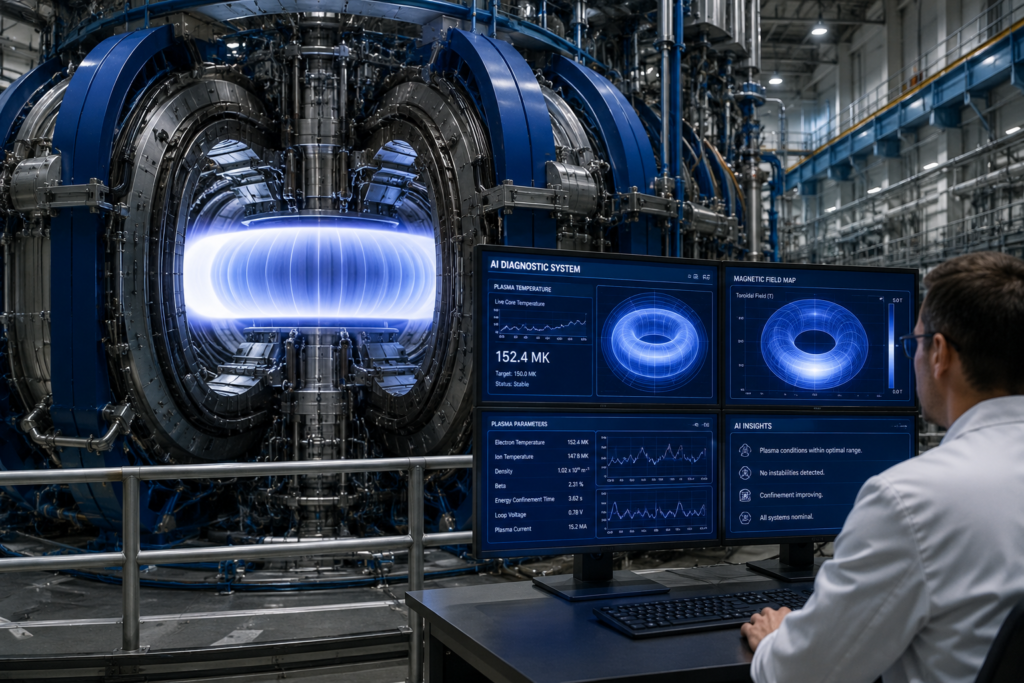
A hundred million degrees. For context, every material known to science melts at a few thousand degrees. Nothing can physically contain a plasma that hot. The solution is to not use physical walls — instead, use powerful magnetic fields to create an invisible “bottle” that keeps the plasma suspended in the center of the chamber, never touching anything solid.
This is called a tokamak — a donut-shaped magnetic confinement device. The plasma circulates around the inside of the donut, held by magnetic fields, while fusion reactions occur.
The engineering challenges compound on each other:
- Plasma is inherently unstable — it wants to touch the walls, and when it does, the reaction dies
- Maintaining the precise magnetic field geometry requires controlling hundreds of independent electromagnets simultaneously
- The plasma undergoes thousands of different instability modes, each developing on timescales of microseconds
- Heating the plasma to fusion temperatures requires injecting enormous amounts of energy with perfect timing
- The diagnostic systems must interpret what’s happening inside a plasma too hot to touch with any physical sensor
This is not a problem that human operators can solve in real time. The response times required are thousands of times faster than any human reflex. The number of interdependent variables exceeds what any human mind can hold simultaneously.
It is, structurally, an AI problem wearing the costume of a physics problem.
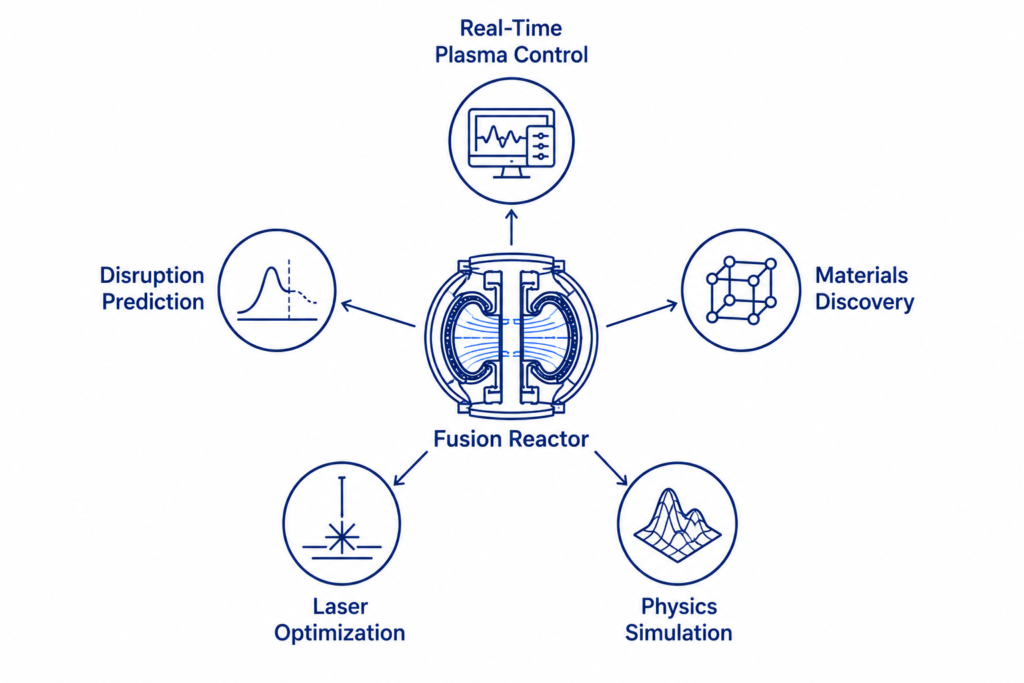
Five Ways AI Is Directly Enabling Fusion
1. Real-Time Plasma Control
The most critical AI application in fusion is the one that’s already operational at existing research tokamaks: real-time plasma control.
In 2022, DeepMind published a landmark paper in Nature demonstrating that a deep reinforcement learning system could control the plasma shape inside the TCV tokamak at the Swiss Plasma Center. The AI learned to manipulate 19 magnetic coils simultaneously to create and maintain specific plasma configurations — including complex shapes that had never been held stably before.
What made this genuinely significant was not just that AI could do what human control systems already did. It was that AI discovered control strategies that human engineers hadn’t considered — holding plasma geometries that were theoretically possible but practically beyond previous control systems to maintain.
The AI’s reaction time: microseconds. A human operator’s practical reaction time: hundreds of milliseconds. For plasma instabilities that develop and propagate in under a millisecond, human control is not a slower version of AI control. It is not control at all.
# Conceptual structure of a plasma control AI system
# Based on the architecture described in DeepMind's 2022 Nature paper

import numpy as np

class PlasmaControlAgent:
    """
    Reinforcement learning agent that controls tokamak magnetic coils
    to maintain target plasma shape and stability.

    State space: ~90 variables describing plasma position, shape,
                 temperature, current, and magnetic field geometry
    Action space: voltage adjustments across 19 magnetic coil circuits
    Reward: how closely current plasma shape matches target configuration
    """

    def __init__(self, n_coils=19, state_dim=90):
        self.n_coils = n_coils        # Number of controllable magnets
        self.state_dim = state_dim    # Plasma state measurements

        # Neural network: maps plasma state -> coil voltage adjustments
        # Trained via reinforcement learning in physics simulation
        # then transferred to real hardware
        self.policy_network = self.build_policy_net(state_dim, n_coils)

    def observe_plasma_state(self, sensor_readings):
        """
        Collect real-time measurements from plasma diagnostics.
        This happens every ~50 microseconds during operation.

        Sensors include: magnetic probes, interferometers,
                         soft X-ray cameras, Thomson scattering
        """
        # Normalize sensor readings to expected ranges
        normalized = (sensor_readings - self.state_mean) / self.state_std
        return normalized

    def compute_coil_action(self, plasma_state):
        """
        Given current plasma state, compute optimal coil voltage adjustments.
        Entire computation must complete in under 100 microseconds.
        """
        # Forward pass through policy network
        # Output: voltage delta for each of 19 magnetic coils
        coil_voltages = self.policy_network.forward(plasma_state)

        # Safety clip: never apply more than max safe voltage change
        coil_voltages = np.clip(coil_voltages, -self.max_delta, self.max_delta)

        return coil_voltages

    def control_loop(self, target_plasma_shape):
        """Main control loop — runs continuously during plasma operation."""
        while self.plasma_is_active():
            # 1. Read current plasma state (every 50 microseconds)
            state = self.observe_plasma_state(self.read_sensors())

            # 2. Compute required coil adjustments
            action = self.compute_coil_action(state)

            # 3. Apply to hardware — before plasma instability develops
            self.apply_coil_voltages(action)

            # 4. Log for analysis — human scientists review later
            self.log_state_action(state, action)
2. Plasma Disruption Prediction and Prevention
The most expensive failure mode in a tokamak is a disruption — a sudden loss of plasma confinement that can damage reactor walls, waste hours of setup work, and in large reactors, potentially damage components worth millions of dollars.
Disruptions announce themselves through subtle patterns in plasma behavior — changes in magnetic field geometry, small oscillations in plasma current, shifts in temperature gradients — that precede the actual disruption by tens to hundreds of milliseconds.
Humans cannot reliably read these signals in real time. Machine learning systems can.
Research groups at MIT, Princeton, and the ITER organization (the international fusion project) have trained neural networks on historical plasma data — thousands of shots from operating tokamaks — to recognize the precursor patterns that indicate disruption risk. These systems can now predict disruptions hundreds of milliseconds in advance with over 90% accuracy, giving control systems enough time to either correct the instability or perform a controlled shutdown rather than a catastrophic disruption.
This is a direct enabler of commercial fusion: a reactor that disrupts unpredictably cannot operate reliably enough for power generation. A reactor with AI disruption prediction can run continuous, stable operations.
PRO TIP: The disruption prediction problem is a perfect illustration of why AI is not just “helpful” for fusion — it is structurally necessary. The signal that predicts a disruption is buried in hundreds of simultaneous measurements, develops over milliseconds, and differs subtly between plasma configurations. No human expert, no matter how experienced, can process this in real time. This is not a task where AI is faster than humans. It is a task humans cannot do at all.
3. Accelerating Materials Discovery
The reactor walls, structural components, and superconducting magnets in a fusion reactor face conditions unlike anything in conventional engineering. They must withstand intense neutron bombardment, extreme heat fluxes, and decades of operational stress.
Materials that work in current experimental reactors may not last long enough in a commercial power plant. Finding better materials through traditional experimental methods — synthesize, test, measure degradation, iterate — would take decades.
AI-accelerated materials discovery is compressing that timeline dramatically. Machine learning models trained on existing materials databases can predict the properties of novel materials — neutron resistance, heat tolerance, mechanical strength under irradiation — without synthesizing them first. This filters the search space from millions of candidate materials to hundreds worth actually making and testing.
Google DeepMind’s GNoME project, published in late 2023, discovered 2.2 million new stable crystal structures — more than the entire previous history of materials science combined. Many of these have properties relevant to fusion applications. This kind of discovery could not have happened at human pace.
4. Optimizing Laser Timing at the National Ignition Facility
The laser fusion approach — inertial confinement, as used at Lawrence Livermore — requires 192 laser beams to hit a millimeter-scale target simultaneously, with each beam arriving within picoseconds of each other and delivering exactly the right energy profile.
The optimization problem of coordinating the timing, power, and pulse shape of 192 independent laser systems to achieve maximum compression of the fuel target is a high-dimensional optimization problem that AI handles far more effectively than human operators or traditional control algorithms.
Before AI-assisted optimization, achieving the precise laser conditions required for ignition required months of iterative manual adjustment. AI systems now optimize beam timing and power profiles in hours — a compression of the experimental iteration cycle that contributed directly to the December 2022 ignition achievement.
5. Physics Simulation and Experimental Design
Before running an expensive and time-consuming experiment on a real tokamak, researchers simulate the plasma behavior in computational models. These simulations are extraordinarily computationally expensive — a single high-fidelity plasma simulation can take weeks on a supercomputer.
AI surrogate models — neural networks trained on the outputs of thousands of previous simulations — can predict the results of new simulation conditions in seconds rather than weeks. This allows researchers to explore thousands of experimental configurations in the time it previously took to test a handful, dramatically accelerating the pace of fusion research.
The Machines That Are Doing This Right Now
The fusion-AI partnership is not a future project. Real machines, in operation today, are demonstrating it.
| Facility | Country | Type | Key AI Application | Notable Achievement |
|---|---|---|---|---|
| National Ignition Facility | USA | Laser (ICF) | Laser timing optimization | First fusion ignition 2022 |
| KSTAR | South Korea | Tokamak | Plasma control AI | 100M°C plasma for 30 seconds, 2024 |
| TCV Tokamak | Switzerland | Tokamak | DeepMind RL plasma control | Novel plasma shapes achieved 2022 |
| JET | UK | Tokamak | Disruption prediction ML | Record energy output before closure |
| Commonwealth Fusion SPARC | USA | Compact tokamak | AI-designed HTS magnets | High-temperature superconductor record 2021 |
| ITER | France | Tokamak (intl.) | Integrated AI diagnostics | Under construction, first plasma ~2027 |
| Helion Energy | USA | FRC device | ML-optimized compression | $500M Microsoft energy purchase agreement |
Two entries on that table deserve particular attention.
KSTAR — the Korean Superconducting Tokamak Advanced Research facility — maintained a plasma temperature of 100 million degrees Celsius for 30 seconds in early 2024. That’s not ignition-level performance yet, but it demonstrates sustained high-performance plasma operation with AI-assisted control systems managing the stability continuously.
Helion Energy signed a power purchase agreement with Microsoft in 2023 — the first commercial fusion energy contract in history. Microsoft agreed to buy electricity from Helion’s first commercial fusion plant, expected around 2028. This is not science. It is a commercial transaction. Fusion has crossed from research into early commercialization, and AI-assisted plasma control is a central part of Helion’s technical approach.
The Other Direction: Why AI Needs Fusion
The partnership runs both ways — and the AI-to-fusion direction is, in some ways, the more urgent story for the near term.
Training a frontier AI model today requires staggering amounts of electricity. GPT-4’s training run consumed roughly 50 gigawatt-hours of electricity. That’s the annual electricity consumption of about 4,600 average American households, used in a single training run. And GPT-4 will not be the largest model trained this year, or next year.
The data center industry is on a trajectory that, by 2030, could account for 8–10% of global electricity consumption — up from roughly 2% today. The AI companies driving this demand know it. Microsoft, Google, and Amazon have all announced nuclear energy agreements specifically to power AI data centers with low-carbon, reliable electricity.
But nuclear fission — today’s nuclear power — has its own constraints: long construction timelines, significant waste concerns, public opposition. Fusion is different on all three counts: faster in construction (especially compact designs), minimal long-lived waste, and significantly more public acceptance.
KEY FACT: Microsoft’s 2023 agreement with Helion Energy was not primarily about environmental responsibility. It was about securing a guaranteed supply of abundant, carbon-free, always-on electricity for AI computing infrastructure. The world’s largest AI company is betting money — real contracted money — on fusion power being online this decade. That is not a prediction. It is a transaction.
The feedback loop becomes visible:
AI enables better fusion research → fusion achieves commercial viability faster → fusion electricity powers AI training → AI systems become more capable → AI enables even better fusion research.
This is a genuinely virtuous cycle. Not guaranteed, not without obstacles, but structurally self-reinforcing if the engineering works.
READ MORE: Quantum AI: When Quantum Computing Meets Machine Learning — What Changes?
ITER: The $22 Billion Bet on Fusion
No discussion of fusion is complete without ITER — the International Thermonuclear Experimental Reactor being built in southern France by a 35-nation consortium including the US, EU, China, India, Russia, Japan, and South Korea.
ITER is the largest fusion experiment in human history. It will produce a plasma ten times larger than any previous tokamak, generating 500 megawatts of fusion power from 50 megawatts of heating input — a 10x energy gain. It will not generate electricity (DEMO, the follow-on project, will do that), but it will prove the physics and engineering at the scale required for commercial power plants.
AI is embedded throughout ITER’s design:
- The plasma control system will handle more than 45,000 control signals simultaneously
- Disruption prediction must protect the most expensive fusion machine ever built
- Remote maintenance robots — because no human can work inside an irradiated reactor — will be guided by AI vision and planning systems
- The data management system will process terabytes of diagnostic data per experimental shot
ITER’s first plasma is targeted for around 2027. Full fusion power experiments around 2035. The schedule has slipped from original projections, but the engineering is real and the machine is being built.
WARNING: ITER’s cost — now estimated above $22 billion — and schedule delays have fed legitimate criticism that government-led fusion is too slow for the climate urgency we face. This criticism has directly fueled the private fusion boom: companies like Commonwealth Fusion Systems, TAE Technologies, Helion, and General Fusion have collectively raised over $6 billion in private capital by promising faster, cheaper paths to commercial fusion. The competition between the big international approach and the startup approach is healthy. Both may succeed on different timelines.
The Private Fusion Boom and What AI Has to Do With It
The last five years have seen an explosion in private fusion companies — more than at any previous point in the field’s history. AI is central to why this is happening now rather than ten years ago.
Commonwealth Fusion Systems (CFS) spun out of MIT and uses high-temperature superconducting (HTS) magnets — a technology that reached practical viability partly through AI-assisted materials optimization — to build a dramatically more compact tokamak called SPARC. Their commercial plant, ARC, is designed to be about the size of a large building rather than the stadium-scale of ITER. They tested the world’s most powerful fusion magnet in 2021 and are building SPARC now.
TAE Technologies has been operating fusion experiments since 1998 and uses a different confinement approach — a field-reversed configuration — combined with Google’s machine learning infrastructure to optimize plasma performance. Their collaboration with Google was explicit: AI exploring the parameter space of plasma configurations far faster than human researchers could.
Helion Energy is the furthest along commercially, with the Microsoft power purchase agreement and a technical approach that also uses a field-reversed configuration with AI-assisted compression timing.
What unites these companies beyond their specific technical approaches is the recognition that AI-assisted experimental iteration is the key competitive advantage. The traditional fusion research model — run an experiment, wait for human experts to analyze the results, design the next experiment, wait — operated on timescales of months per iteration. AI-assisted analysis collapses that to days or hours. More iterations per year means faster progress, which matters enormously when you’re competing for investment and trying to beat a climate deadline.
The Road to 2050: What Has to Happen
If “fusion powering the world by 2050” is the target — and an increasing number of serious people are treating it as a real target, not a slogan — here is the honest sequence of what needs to go right:
2026–2030: Prove Commercial Viability Helion, CFS, or another private company demonstrates sustained net energy fusion at a scale relevant to power generation. ITER achieves first plasma. At least one company signs additional power purchase agreements beyond the Helion-Microsoft deal. AI-assisted plasma control becomes standard across all major fusion experiments.
2030–2037: First Commercial Plants The first commercial fusion power plant produces electricity to a grid. Not necessarily cheaply — early nuclear fission was expensive too — but demonstrably. Engineering lessons from first plants inform second-generation designs. AI systems for plant operation, maintenance prediction, and fuel cycle management are validated in real operations.
2037–2045: Scale and Cost Reduction The learning curve that made solar power 90% cheaper over 20 years applies to fusion. Standardized plant designs reduce construction costs. Supply chains for exotic materials — high-temperature superconductors, tritium breeding blankets — mature. Fusion becomes cost-competitive with other low-carbon sources.
2045–2050: Grid Integration at Scale Fusion plants are being built on every continent. Their always-on generation profile complements intermittent renewables. The global electricity grid is transitioning away from fossil fuels with fusion as the baseload foundation. AI systems manage the integration of fusion plants into complex grids alongside solar, wind, and storage.
PRO TIP: The 2050 timeline for fusion making a meaningful contribution to global electricity generation is ambitious but has more credible support behind it than any previous fusion timeline. The difference is private capital, AI-accelerated research, and the commercial urgency of climate commitments. None of those factors existed at previous points when fusion was “30 years away.” The joke may finally be running out of runway.
What Fusion + AI Means for Climate Change
The climate math is stark. Global electricity demand will roughly double by 2050 as transportation, heating, and industry electrify. That doubled demand needs to come from sources that emit no CO₂. Renewables — solar and wind — are essential and will do the heavy lifting, but they have a fundamental limitation: they only generate when the sun shines and the wind blows.
Grid-scale storage — batteries — can bridge gaps of hours or days. But a week-long winter calm with no solar and low wind across a continent requires either fossil fuel backup or an always-on low-carbon source. Today, that means nuclear fission. By 2050, it could mean fusion.
Fusion has a generation profile that complements renewables almost perfectly. It produces electricity continuously, adjusting output as needed, with no carbon emissions and no dependence on weather. It uses fuel that is effectively unlimited. It produces no long-lived radioactive waste. Its byproduct — helium — is actually useful.
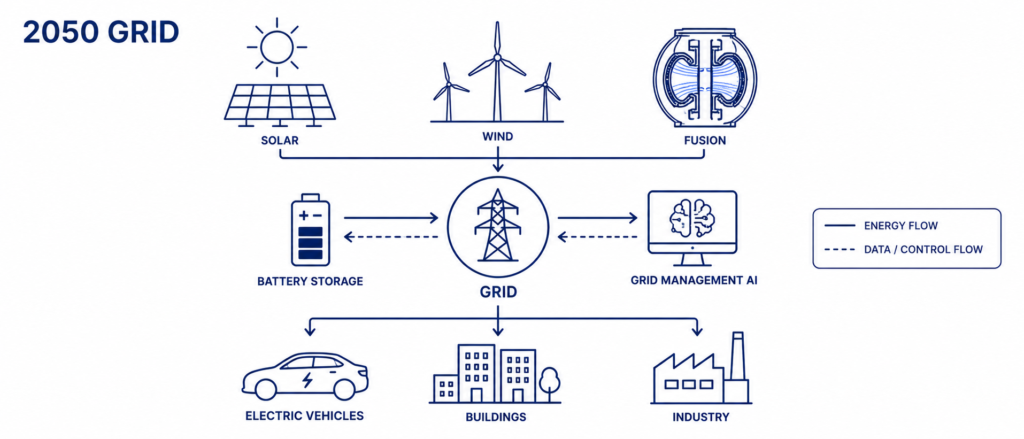
The energy system of 2050 that most climate scientists hope for looks something like this: solar and wind providing the majority of electricity on good days, battery storage smoothing hourly and daily variation, and fusion providing the always-on baseload that makes the whole system reliable across seasons and weather events.
AI manages all of this simultaneously — optimizing when fusion plants ramp up versus when they step back for renewable abundance, predicting grid demand, allocating storage, and coordinating a power system of vastly greater complexity than anything that exists today.
FAQ: Fusion Energy and AI
Q1: Did fusion energy actually achieve ignition and what does that mean?
Yes — on December 5, 2022, the National Ignition Facility at Lawrence Livermore National Laboratory achieved fusion ignition for the first time in history, producing 3.15 megajoules of energy from 2.05 megajoules of laser input. Ignition means the fusion reaction produced more energy than the energy used to trigger it. This is the critical physics milestone the field had been pursuing for decades. It does not mean commercial fusion power is imminent — the laser facility itself consumed far more than 2.05 megajoules to operate — but it proves the fundamental physics works at the conditions required for net energy gain.
Q2: What is the difference between nuclear fusion and nuclear fission?
Fission splits heavy atoms apart — uranium or plutonium — releasing energy. This is how current nuclear power plants work, and it produces long-lived radioactive waste. Fusion combines light atoms — hydrogen isotopes — releasing energy from the mass difference. Fusion produces no long-lived radioactive waste, uses abundant fuel from seawater and lithium, and carries no risk of a runaway chain reaction. The challenge is that fusion requires extreme conditions — temperatures six times hotter than the sun’s core — to initiate the reaction, while fission can be triggered at room temperature.
Q3: Why has fusion taken so long and why might it succeed now?
The timeline has been long for three interconnected reasons: the plasma physics is genuinely hard, the engineering required is at the frontier of what materials science and electromagnetics can achieve, and the pace of experimental iteration has been slow. What’s changed is AI-accelerated research, high-temperature superconducting magnets that enable more compact and cost-effective designs, and private capital creating competitive urgency that government programs historically lacked. The “30 years away” joke was true when the pace of progress was one iteration per year. AI-assisted research is enabling dozens of iterations per year.
Q4: How does AI control a plasma and why can’t humans do it?
Plasma in a fusion reactor undergoes thousands of simultaneous instabilities, each developing on timescales of microseconds and requiring coordinated responses from dozens of magnetic coil systems. A human operator’s reaction time is hundreds of milliseconds — thousands of times too slow. The number of interdependent variables exceeds what any human mind can process simultaneously. AI systems — specifically reinforcement learning agents trained on plasma simulations and operational data — can respond to plasma state changes in microseconds, coordinating magnetic field adjustments across the entire reactor simultaneously. This is not a task where AI is faster than humans. It is a task that is structurally impossible for humans at the required timescales.
Q5: Which private fusion company is closest to commercial power generation?
As of 2026, Helion Energy has the most visible commercial progress — a power purchase agreement with Microsoft for electricity from their first commercial plant, targeted around 2028. Commonwealth Fusion Systems is building their SPARC experiment, which will be followed by their commercial ARC plant. Both have raised significant private capital and have credible technical approaches. Which company will achieve commercial operation first is genuinely uncertain — fusion engineering at this scale has consistently encountered unexpected challenges — but the race is real and the competition is producing faster progress than the field has ever seen.
Q6: What role will AI play in operating commercial fusion power plants?
A commercial fusion plant will require AI across every operational dimension: real-time plasma control to maintain continuous fusion reactions, predictive maintenance to prevent equipment failures in a highly complex machine, radiation monitoring and safety systems, fuel cycle management (particularly tritium breeding and processing), and grid integration — managing when and how much power the plant delivers to match grid demand. The operational AI systems for fusion plants will likely be among the most sophisticated industrial AI deployments in existence, managing a machine that operates at conditions found nowhere else on Earth.
The Sun Has Been Running for Five Billion Years — We’re Learning to Do It Too
Fusion is not a new idea. It is the oldest energy source in the universe. Stars have been running it since the first one ignited, a few hundred million years after the Big Bang. The physics is proven, tested, and reliable at the most extreme scales imaginable.
What has been hard is doing it here, on a planet, inside a machine, in a controlled way, at a cost that makes sense. That hardness has not gone away. The plasma is still extraordinarily difficult to contain. The engineering margins are still extraordinarily thin. The road from today’s experiments to a world powered by fusion is still long.
But it is shorter than it has ever been — and AI is the primary reason why. Not the only reason. Not a magic solution. But the tool that makes the real-time control possible, the experimental iteration fast enough, the materials discovery broad enough, and the commercial timeline credible enough that “fusion by 2050” has gone from punchline to plausible.
The partnership between fusion and AI is, at its core, a partnership between the hardest physics problem humans have ever tried to solve and the most powerful computational tools humans have ever built. That partnership deserves attention — not because it is guaranteed to succeed, but because if it does, the consequences for climate, for energy security, and for what kind of civilization we can build in the second half of this century are profound.
If this article changed how you think about where our energy future is heading, share it with someone still dismissing fusion as perpetually distant. Leave your thoughts on which aspect of this story matters most to you in the comments. And if you want to understand the AI systems driving this and every other frontier of science, read our guide on Quantum AI: When Quantum Computing Meets Machine Learning — What Changes? — because the deep physics of how we compute and how we generate energy are converging faster than anyone expected.

Author: AI Learner Tech
AI Learner Tech is a premier research and educational hub dedicated to mastering Artificial Intelligence, Machine Learning, and Computer Vision. We bridge the gap between complex academic theories and real-world industrial applications. Join our community to access high-quality tutorials, open-source projects, and expert insights. Website: ailearner.tech