In 2023, a security researcher at a major firm sent a test phishing email to 100 employees.
He sent two versions.
The first was written by a human — carefully crafted, professional, with just the right amount of urgency. The second was written by GPT-4 in 11 seconds, personalized using each employee’s LinkedIn profile, job title, and recent company news pulled from public sources.
The human-written email fooled 14% of employees.
The AI-written email fooled 54%.
That gap — between what a skilled human attacker can do and what an AI-assisted attacker can do — is widening every month. And unlike the deepfakes or hallucinations that dominate AI safety discussions, this threat is not theoretical. It is already happening at scale.
This article is not about making you afraid. It is about making you informed.
What this covers:
- Why AI fundamentally changes the economics of cyber attacks
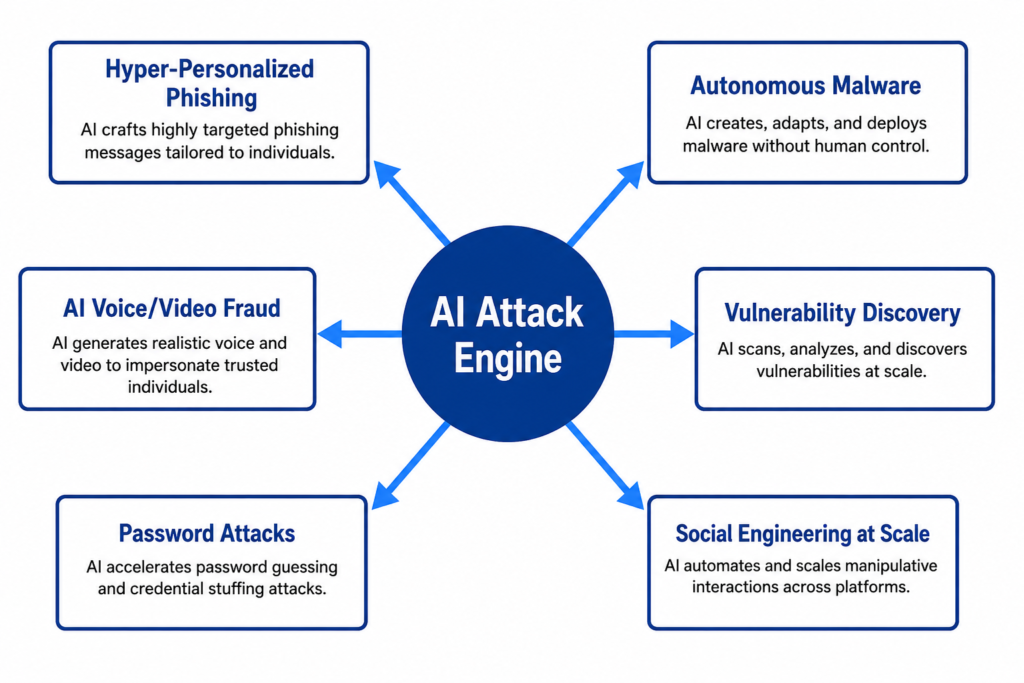
- The six most dangerous AI-powered attack types in 2026
- How each attack works technically — not just the concept
- What defenders are doing to fight back
- The practical steps that actually reduce your risk
- Where this arms race is heading next
Why AI Changed Cyber Attacks Forever
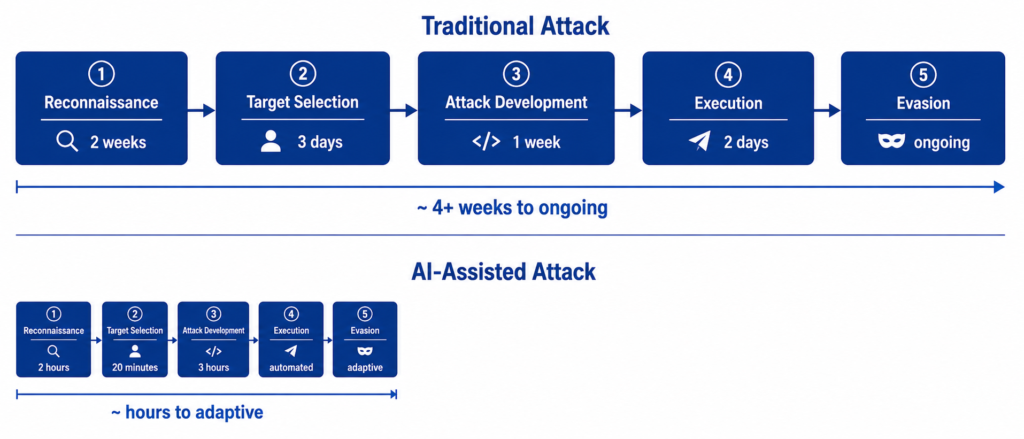
Cyber attacks have always been limited by one thing: human time.
Writing a convincing phishing email takes a skilled attacker 30 to 60 minutes. Researching a target’s personal details, professional relationships, and recent activities to make an attack convincing takes hours. Finding vulnerabilities in software requires expertise that takes years to develop. Running large-scale attacks while avoiding detection requires a team.
AI removes most of these constraints.
What cyber attacks looked like before AI:

Time to craft one convincing spear-phishing email:    45 minutes
Cost of employing a skilled attacker:                 $80,000+ per year
Number of targets one attacker could hit per day:     5 to 10
Success rate of generic phishing emails:              3 to 14%
Time to discover a zero-day vulnerability:            weeks to months

What AI-assisted attacks look like in 2026:

Time to craft one convincing spear-phishing email:    8 seconds
Cost of running an AI attack tool:                    $10 to $50 per month
Number of targets one attacker can hit per day:       tens of thousands
Success rate of AI-personalized phishing emails:      30 to 60%
Time to discover common vulnerability classes:        hours
This is not a capability upgrade. It is a category shift.
Previously, sophisticated targeted attacks — the kind that used personal research, custom malware, and careful social engineering — were reserved for nation-state actors with large budgets and skilled teams. They targeted banks, governments, and critical infrastructure.
In 2026, that level of sophistication is available to anyone with a credit card and a willingness to misuse widely available tools.
KEY FACT: The World Economic Forum’s 2025 Global Cybersecurity Outlook report identified AI-enhanced phishing and AI-generated malware as the two fastest-growing threat categories. Security teams that previously dealt with thousands of attack attempts per day are now dealing with millions — all of them more targeted and convincing than anything they faced three years ago.
Threat 1 — Hyper-Personalized Phishing at Scale
Phishing is the oldest trick in cybercrime. It is also, because of AI, the most dangerous it has ever been.
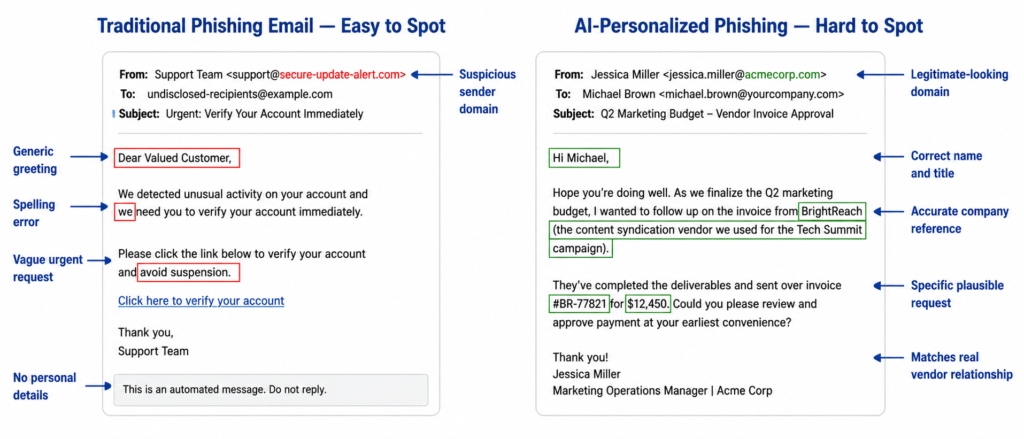
Traditional phishing is easy to spot with practice. “Dear Valued Customer, your account has been suspended.” Generic language. Obvious urgency. No personal details.
AI-powered spear phishing works differently:
How AI personalized phishing works step by step:

Step 1 — Target data collection (automated):
  Scrape LinkedIn: job title, company, connections,
                   recent posts, work history
  Scrape Twitter/X: interests, opinions, recent events
                    they commented on
  Scrape company website: recent news, product launches,
                          executive names, office locations
  Check public data breaches: known email format,
                               previous passwords

Step 2 — Context synthesis (AI language model):
  "Write a phishing email to [name], a Senior Finance
   Manager at [company] who recently commented on
   LinkedIn about their new ERP system rollout.
   Reference the rollout. Impersonate their IT vendor.
   Request credentials for the new system migration.
   Match the email style of formal corporate communications."

Step 3 — Output (8 seconds later):
  A personalized email that:
  - Uses the target's actual name and job title
  - References real recent events at their company
  - Impersonates a vendor they actually work with
  - Uses professional language matching their industry
  - Contains a plausible, specific reason for the request

Step 4 — Scale: repeat for 50,000 targets simultaneously
The result is emails that pass casual inspection even from security-aware employees — because they contain accurate personal and professional details that only a targeted attacker would know.
What makes AI phishing particularly dangerous:
- It adapts to context. If the target recently posted about a conference, the email references the conference.
- It generates multiple variants and tests which performs better before sending at scale.
- It can generate entire fake email threads — making the phishing email appear to be part of an ongoing conversation.
WARNING: The tell that once identified phishing — generic language and impersonal details — is no longer reliable. In 2026, if an email arrives with accurate personal details, a plausible business context, and professional language, that is not evidence it is legitimate. It may be evidence it was AI-generated for you specifically. Verify through independent channels regardless of how convincing it looks.
Threat 2 — Autonomous Malware That Adapts
Traditional malware is static. It is written once, deployed, and detected when security tools learn to recognise its signature.
AI-powered malware is different because it changes.
Polymorphic malware has existed for years — malware that changes its code to avoid signature-based detection. AI takes this to a new level.
Traditional polymorphic malware:
  Changes variable names, reorders instructions
  Produces code with a different signature
  Still recognizable by behavioral analysis:
  "This code, whatever it looks like, does the
   same suspicious things."

AI-powered adaptive malware:
  Observes the target environment before acting
  Identifies what security tools are running
  Modifies its behavior to avoid triggering those
  specific tools
  Chooses attack timing based on when monitoring
  is likely to be lowest (nights, weekends)
  Communicates in ways that blend with normal traffic

The difference:
  Old malware evades signature detection.
  AI malware evades behavioral detection.
LLM-assisted exploit development is a related threat.
Security researchers have demonstrated that large language models can assist with vulnerability discovery — finding weaknesses in code, suggesting how they could be exploited, and generating proof-of-concept exploit code. The same tools researchers use defensively are being used offensively.
# This is an illustration of how LLMs assist in
# vulnerability analysis — NOT exploitation code.
# This represents what security researchers do defensively
# to understand attack surfaces.

# A researcher might describe a vulnerability like this:

vulnerability_description = """
Buffer overflow in a C function that uses strcpy()
without bounds checking. The input buffer is 256 bytes.
The return address is stored 264 bytes from the start
of the buffer.
"""

# An LLM can explain the attack surface:
# "The attacker can overflow the buffer with 264 bytes
#  of padding followed by a new return address, redirecting
#  execution to attacker-controlled code."

# Understanding this is how defenders write patches.
# The same understanding is what attackers exploit.
# AI has made this analysis faster for both sides.
What defenders are doing:
Moving away from signature and behavioral detection alone toward AI-vs-AI detection — using machine learning models to detect the subtle statistical signatures of AI-generated malware, even when the malware’s surface behavior appears normal.
Threat 3 — AI Social Engineering and Fake Identity Campaigns
Social engineering — manipulating people rather than systems — has always been the most effective attack vector. Humans are easier to exploit than well-patched software.
AI makes social engineering scalable in ways that were previously impossible.
Fake identity infrastructure:
Building a convincing fake professional identity in 2026:

Before AI (weeks of work):
  Create email account
  Build LinkedIn profile manually
  Find a face photo to use as profile picture
  Write a convincing work history
  Slowly build connections to appear legitimate

After AI (hours):
  Generate a photorealistic face of a nonexistent person
  Generate a complete, coherent professional history
  Generate publications, articles, and posts
  Use an AI persona to engage with real professionals
  over weeks to build credibility
  Then — introduce the attack

Attack scenarios:
  - "Recruiter" building relationships with employees
    before requesting sensitive information
  - "Journalist" cultivating a source relationship
    before asking for internal documents
  - "Vendor" building rapport before sending
    a malicious contract or invoice
  - "New colleague" joining remote-first companies
    where nobody meets in person
The “long game” attack is specifically enabled by AI.
A human attacker cannot maintain dozens of fake professional relationships simultaneously over months — it requires too much time and attention. An AI system can maintain hundreds of convincing, responsive fake personas concurrently, each tailored to its specific target, waiting for the right moment.
KEY FACT: In 2024, the FBI issued a warning about North Korean state actors using AI-generated fake identities to get hired as remote contractors at US technology companies — gaining insider access to systems, code repositories, and intellectual property. The fake identities passed resume screening, video interviews, and background checks.
Threat 4 — AI-Accelerated Vulnerability Discovery
Finding security vulnerabilities in software is skilled, time-consuming work.
AI is making it significantly faster — on both sides of the attack/defence divide.
How AI finds vulnerabilities:
Traditional vulnerability research:
  Human researcher reads source code manually
  Looks for patterns associated with known vulnerability
  classes (buffer overflows, SQL injection, etc.)
  Tests hypotheses manually
  Time per critical vulnerability: days to weeks

AI-assisted vulnerability research:
  Feed code to an LLM with security training
  Ask: "Identify potential security issues in this code,
        focusing on input validation, memory management,
        and authentication logic."
  LLM identifies candidate vulnerabilities across
  thousands of lines of code in minutes
  Human researcher verifies and tests flagged areas
  Time per critical vulnerability: hours

Combined AI + fuzzing:
  AI generates targeted test inputs designed to
  trigger edge cases in specific code paths
  Fuzzer executes millions of variations
  AI analyses crashes to identify exploitable conditions
  Time: can find novel vulnerabilities in hours
        that traditional fuzzing would take months
Why this matters asymmetrically:
Software defenders have to protect everything. Attackers only have to find one vulnerability.
AI that accelerates vulnerability discovery helps attackers disproportionately — because finding the single exploitable flaw in a large codebase is harder than systematically searching for any flaw.
Defenders are responding by using the same AI tools to find their own vulnerabilities first — automated code review, AI-assisted penetration testing, and continuous vulnerability scanning are becoming standard practice at organizations that can afford it.
Threat 5 — Password and Authentication Attacks
Passwords are weakening as a security mechanism — AI is accelerating that weakening.
AI-powered password cracking:
Traditional password crackers use wordlists and rules. They try “password123”, then “Password123”, then “P@ssword123”. Predictable patterns.
AI password crackers learn the actual statistical patterns in how humans choose passwords:
How humans actually pick passwords (what AI learns):

Pattern analysis from leaked password databases:
  60% of passwords contain a word from a dictionary
  40% end in a number
  30% substitute letters with similar-looking numbers
      (@ for a, 3 for e, 0 for o)
  25% include a birth year
  20% include a name (often a family member or pet)
  15% include a favorite sports team or hobby
  Common structure: Word + Number + Special character

AI-powered cracker vs traditional cracker:
  Same hash (hashed password to crack)
  Same time limit (1 hour)

  Traditional cracker: tries ~1 billion generic combinations
  AI cracker: generates passwords matching the statistical
              profile of real human passwords first,
              then falls back to generic combinations

  Result: AI cracker finds more passwords in the same time
          because it spends more time in the right areas
          of the password space
Credential stuffing at AI scale:
When a data breach exposes millions of username/password pairs, attackers test them across hundreds of other services — because people reuse passwords.
AI makes this attack smarter. Rather than testing all credentials against all services, AI models predict which credential/service combinations are most likely to work — prioritizing based on the site’s value, the user’s likely demographics, and patterns from previous successful stuffing attacks.
What actually protects you:
Effectiveness of password-related security measures:

Measure                          Attack reduction
─────────────────────────────────────────────────
Longer password (12+ chars)         High
Unique password per site            Very high — stops stuffing
Password manager                    Very high — enables uniqueness
Multi-factor authentication (MFA)   Extremely high
Hardware security key (FIDO2)       Near total for phishing
Biometrics alone                    Moderate — spoofable
SMS-based 2FA                       Low-moderate — SIM swappable
PRO TIP: The single most effective thing an individual can do against AI-powered credential attacks is use a password manager to generate and store unique random passwords for every account, combined with app-based or hardware MFA. Not because it makes cracking impossible — but because it forces attackers to compromise each account individually rather than using one stolen password across many accounts.
Threat 6 — AI-Generated Disinformation and Influence Operations
This threat sits at the intersection of cybersecurity and information warfare.
AI makes the mass production of convincing disinformation — fake news articles, fabricated quotes from real people, coordinated social media campaigns — cheap and fast.
What AI-powered influence operations look like:
Structure of an AI-driven influence campaign:

Phase 1 — Content generation:
  Generate thousands of articles and posts
  Vary writing style, perspective, and outlet names
  to appear as independent sources agreeing with
  the same narrative
  Generate fake supporting evidence (statistics,
  quotes attributed to real experts, fake studies)

Phase 2 — Distribution infrastructure:
  Operate networks of AI-persona social media accounts
  built up over months for credibility
  Post organic-looking content to build followings
  before switching to campaign content

Phase 3 — Amplification:
  Coordinate engagement (likes, shares, replies)
  between persona accounts to create the appearance
  of organic popularity
  Target real users likely to share and amplify
  based on psychological profiling of public data

Phase 4 — Erosion of trust:
  Even if debunked, the campaign achieves its goal:
  "you cannot trust what you read online"
  is itself a win for actors trying to paralyse
  democratic information systems
This category is less about stealing data and more about weaponizing uncertainty. When people cannot trust what is real, decision-making degrades — in organizations, in elections, and in public health.
How Defenders Are Responding
The attack side is not the only side using AI.
AI-powered threat detection:
Security operations centers that once relied on human analysts reviewing logs are deploying AI models that process millions of events per second — detecting anomalies, correlating signals across multiple systems, and flagging attacks that no human could catch in time.
Traditional security monitoring:
  Human analyst reviews logs
  Processes: ~1,000 events per shift
  Detects: attacks that match known patterns
  Response time: minutes to hours

AI security monitoring:
  ML model processes entire network traffic
  Processes: millions of events per second
  Detects: statistical anomalies and novel attack patterns
  Response time: seconds to minutes
  Limitation: generates false positives that
               humans still need to investigate
AI red-teaming:
Before attackers find vulnerabilities, AI systems systematically probe defenses — testing every input, every API endpoint, every authentication flow for weaknesses. Continuous automated penetration testing is becoming standard at security-mature organizations.
Behavioral biometrics:
Rather than relying on passwords alone, systems learn how each individual user behaves — typing rhythm, mouse movement patterns, navigation habits. Deviations from this baseline, even with correct credentials, trigger additional verification.
This is particularly effective against credential stuffing — a stolen password does not come with the stolen user’s behavioral profile.
The Practical Steps That Actually Reduce Risk
For individuals:
- Password manager + unique passwords — eliminates credential stuffing risk entirely
- App-based MFA on every important account — stops most phishing attacks even when credentials are stolen
- Verify unexpected requests independently — call back on known numbers, confirm through separate channels
- Update software immediately — AI vulnerability discovery means the window between disclosure and exploitation is shrinking
For organizations:
- Security awareness training that includes AI phishing — employees need to see examples of what AI-personalized attacks look like, not just generic phishing
- AI-assisted email filtering — traditional spam filters trained on old phishing are inadequate
- Zero trust architecture — assume any credential could be compromised, verify continuously rather than at the perimeter
- Incident response planning — not if but when; organizations with practiced response plans suffer significantly less damage
READ MORE: What Is Artificial Intelligence? The Ultimate Beginner’s Guide for 2026
Frequently Asked Questions
Are small businesses and individuals at risk from AI cyber attacks, or just large organizations?
Both — but in different ways. Large organizations are targeted by sophisticated AI-assisted attacks for high-value data and financial fraud. Individuals and small businesses are targeted at scale by lower-sophistication but high-volume AI attacks — because they typically have weaker defenses and attackers can hit millions of them simultaneously for relatively low returns per target that add up. The AI phishing study in the introduction tested regular employees, not executives. Everyone is in scope.
How do I tell if a phishing email was written by AI?
You often cannot — and that is precisely the problem. Grammatical errors and generic language, which once identified phishing, are no longer reliable tells. Focus instead on the request itself: does it ask for credentials, money, or sensitive information? Does it create urgency that discourages verification? Would the sender actually need this from me via email? Treat any unusual request as suspicious regardless of how well-written or personalized it appears.
Is AI making cybersecurity jobs obsolete?
The opposite — the demand for cybersecurity professionals is growing faster than supply and AI is a significant reason why. AI handles high-volume, pattern-based detection work. But understanding complex attack campaigns, making judgment calls about ambiguous situations, communicating risk to leadership, designing security architectures, and conducting forensic investigations all require human expertise. AI is changing what the job involves, not eliminating it.
What is zero trust architecture and do I need it?
Zero trust is a security model based on the principle “never trust, always verify” — rather than assuming everything inside your network perimeter is safe, you continuously verify every user, device, and connection regardless of where it is. For large organizations with sensitive data, it is becoming the standard approach. For individuals, the equivalent principle is: do not assume a device or account is secure just because it is yours — use MFA, keep software updated, and treat unusual behavior on your accounts as suspicious until explained.
How are AI systems used to defend against AI attacks?
Several ways. Anomaly detection models learn what normal network traffic looks like for a specific organization and flag deviations. Natural language models trained on phishing examples detect AI-generated phishing better than rule-based filters. Automated vulnerability scanners find weaknesses before attackers do. Behavioral models detect account takeovers even when credentials are correct. The fundamental challenge is that both sides have access to similar underlying technology — the advantage goes to whoever deploys it more effectively.
What should I do if I think I have been phished?
Act immediately: change your password for the affected account and any accounts using the same password, enable MFA if you have not already, check for any unauthorized actions on the account (emails sent, settings changed, payments made), notify your organization’s IT/security team if it involved a work account, and if financial information was involved, contact your bank. The faster you act, the more contained the damage. Do not wait to be certain — act on suspicion and investigate from a secure position.
Conclusion
The phishing study that opened this article is not alarming because AI wrote a good email. It is alarming because the gap between what one person can do alone with AI assistance and what previously required a team of skilled professionals has effectively closed.
Cyber attacks were always a problem of scale — defenders had to protect everything while attackers only needed one entry point. AI has made the attacker’s task dramatically cheaper and faster while the defender’s task has grown proportionally harder.
But the technology cuts both ways.
The same AI capabilities powering attacks are powering defenses. AI threat detection, AI vulnerability scanning, behavioral biometrics, and AI-assisted security operations are all real and improving. The organizations and individuals who adopt AI-assisted defenses will be significantly more resilient than those who do not.
The arms race is not going away. But understanding it — knowing what the threats actually look like, why they work, and what specifically reduces risk — puts you in a fundamentally different position than someone who hears “AI cybersecurity” and thinks only of abstract danger.
The threats are specific. The defenses are specific. Neither side has won yet.
If this article helped you understand something that felt abstract before, share it with someone who thinks cybersecurity is only relevant to IT departments. And leave a question in the comments — this is one of the fastest-evolving areas in technology and we cover new developments as they emerge.

Author: AI Learner Tech
AI Learner Tech is a premier research and educational hub dedicated to mastering Artificial Intelligence, Machine Learning, and Computer Vision. We bridge the gap between complex academic theories and real-world industrial applications. Join our community to access high-quality tutorials, open-source projects, and expert insights. Website: ailearner.tech