In January 2024, a finance employee at a multinational company in Hong Kong attended a video conference call with his CFO and several colleagues.
He transferred $25 million.
Every person on that call — the CFO, the colleagues, all of them — was a deepfake. The real people had no idea the meeting was happening. The entire video conference was AI-generated in real time, using publicly available footage to clone their faces and voices.
Nobody noticed until after the money was gone.
This is not a future threat. It happened. It will happen again. And the technology creating these fakes is getting better every month while the average person’s ability to detect them is not keeping pace.
This article is a practical guide to understanding and detecting deepfakes in 2026 — for anyone who watches videos, receives voice messages, or makes decisions based on what they see and hear.
What this covers:
- How deepfakes are actually generated — the technology behind them
- Specific visual tells in AI-generated faces and what causes them
- How to detect deepfake video beyond just looking carefully
- Voice cloning — how it works and how to catch it
- Technical detection tools and how reliable they actually are
- What to do when you genuinely cannot tell
First — How Deepfakes Are Actually Made
You cannot detect something you do not understand.
Deepfakes are not simple photo edits or filters. They are generated by a type of neural network called a GAN — Generative Adversarial Network. Two networks compete against each other:
How a GAN produces deepfakes:

Generator network:          Discriminator network:
"I will create a fake       "My job is to tell real
 face that looks real."      from fake."

Round 1:
  Generator produces a blurry, obvious fake.
  Discriminator catches it immediately. Generator loses.

Round 50,000:
  Generator produces something more convincing.
  Discriminator catches subtle artifacts. Generator loses.

Round 500,000:
  Generator produces a face indistinguishable from real
  to the discriminator.
  Training stops. Generator wins.

What you get at the end:
  A network that can produce photo-realistic fake faces —
  because it was specifically trained to fool a detector.
The arms race is built into the architecture.
Every time a detection method improves, deepfake generators train against it and get better at avoiding detection. This is not a problem waiting to be solved. It is structurally ongoing.
Three main types of deepfake in 2026:
Face swap — One person’s face replaced with another’s in a video. The most common type. Used in the Hong Kong fraud case above.
Face synthesis — An entirely new face generated from scratch — a person who does not exist. Used in profile pictures, fake social media identities, and disinformation campaigns.
Voice cloning — A person’s voice replicated from as little as three seconds of audio. Can generate that person saying anything, in their own voice, with their own accent and cadence.
Each type has different tells. We will cover all three.
KEY FACT: In 2024, the number of deepfake videos online increased by over 900% compared to 2019 according to Deeptrace Labs research. The cost of generating a convincing deepfake dropped from requiring a specialist team and expensive hardware to under $10 using consumer cloud services. The barrier to creating them has effectively disappeared.
Part 1 — Detecting AI-Generated Faces in Images
Still images are the place to start — they give you time to look carefully.
The Eyes: The Most Reliable Tell
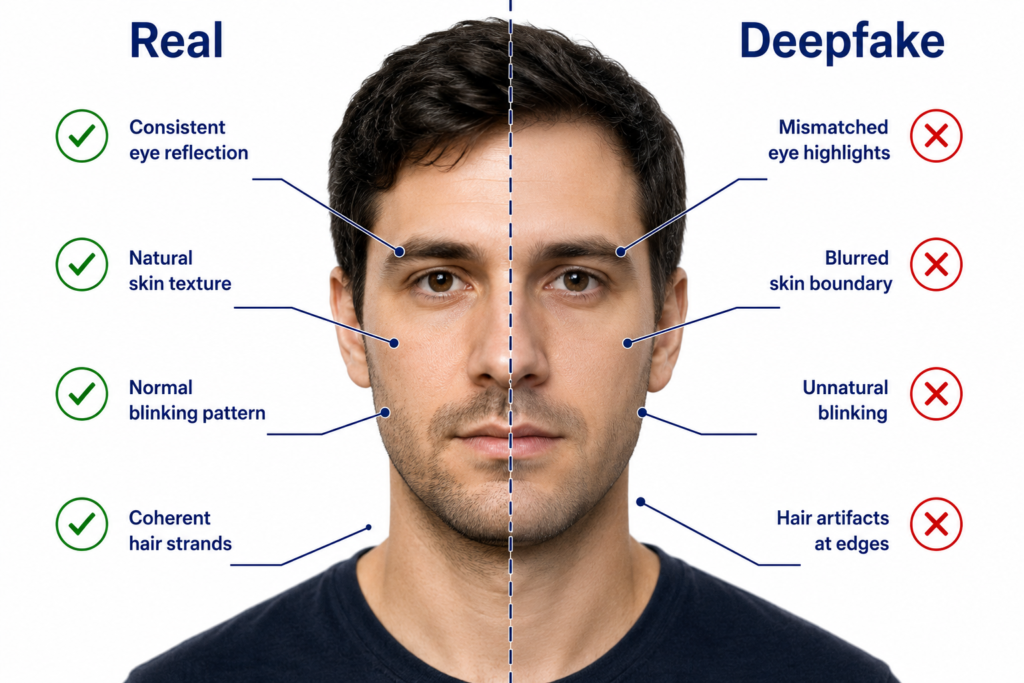
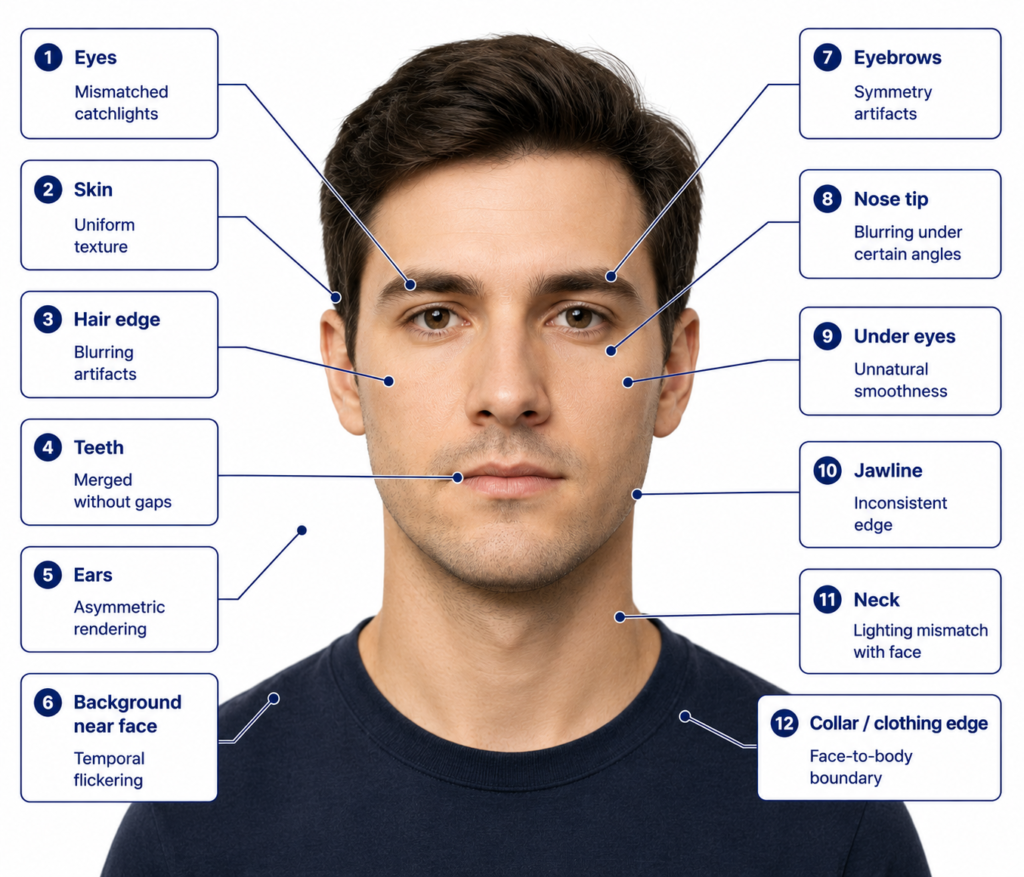
Eyes are disproportionately difficult for AI to generate consistently. Pay attention to three things:
Catchlights — the small reflections of light sources in the eye.
In a real photograph, both eyes reflect the same light sources. In a deepfake, the catchlights are often different between the two eyes — different positions, different shapes, sometimes missing from one eye entirely.
What to look for in catchlights:

Real photograph:
  Left eye:  small white oval, upper-right position
  Right eye: same small white oval, same position
  → Both eyes in the same room, same lighting

Deepfake indicator:
  Left eye:  round catchlight, center position
  Right eye: rectangular catchlight, lower-left
  → Two different light environments composited
Iris texture — the pattern inside the colored part of the eye.
Human irises have complex, asymmetric patterns. AI-generated irises often show a circular symmetry that real irises do not have — or they show blurring at the iris-pupil boundary that looks slightly smeared.
Blinking and eye movement — in video specifically.
Early deepfakes blinked rarely or not at all. Current models have improved, but blinking patterns in deepfakes are often irregular — either too frequent, too uniform, or with blinks that do not fully close.
The Skin: What Texture Reveals
Human skin up close is irregular. Pores vary in size and distribution. Blemishes, hair follicles, and subtle colour variations exist. AI skin tends toward a characteristic smoothness — not the smoothness of heavy makeup, but an uncanny uniformity that looks slightly plastic.
Look at the boundary between skin and hair.
This edge is one of the hardest things for deepfake generators to render correctly. In real photos the boundary is complex — individual hair strands overlapping skin, slight skin colour variation at the hairline. In deepfakes, this boundary often shows:
- A blurring where hair meets skin
- Hair strands that fade into the background unnaturally
- A slight halo effect around the head against backgrounds
The Teeth and Mouth Area
Ask the person to smile — or look at photos where they are smiling.
Teeth are difficult for AI. Problems to look for:
- Teeth that blend together without visible gaps between individual teeth
- Unnaturally perfect or unnaturally symmetrical teeth
- Lip edges that blur or become inconsistent when the mouth opens
- A mouth that does not quite sync with the rest of the face’s expression
Accessories and Background
Glasses are difficult for deepfakes. Look for:
- Lens reflections that do not match the background light sources
- Frames that blur or distort at the edges where they meet the face
- Inconsistent reflections between the two lenses
Earrings, necklaces, and hair accessories often show artifacts — blurring, asymmetry, or shapes that shift slightly between frames in video.
Backgrounds directly behind the head often show subtle wavering or blurring in deepfake videos — especially near the hair boundary. This is called “temporal flickering” — the background pixels near the face change slightly between frames because the face-generation network is not fully consistent.
Part 2 — Detecting Deepfake Video
Still images give you time. Video is harder because the fake only needs to fool you for a fraction of a second per frame.
But video also creates new opportunities for detection — because consistency across time is harder to fake than a single frame.
Temporal Consistency: The Tell Video Creates
A single deepfake frame might look perfect. Across 30 frames per second over a 60-second video, small inconsistencies accumulate and become visible.
What to watch for across time:
- Facial boundary flickering — the edge of the face against the background shifts slightly between frames. Pause the video and step through frame by frame if you can.
- Lighting inconsistency — real faces reflect environmental light consistently. In deepfakes, the lighting on the face sometimes shifts subtly in ways that do not match the background or the rest of the scene.
- Micro-expression lag — genuine human expressions involve many small muscles moving in a coordinated sequence. Deepfakes often capture the broad expression correctly but miss the micro-movements — the slight tightening around the eyes before a genuine smile, the forehead movement accompanying raised eyebrows.
- Head pose artifacts — deepfake quality degrades at extreme angles. When a person turns their head significantly to the left or right, or looks up and down sharply, artifacts often appear at the facial boundary and on the features that are partially occluded.
Frame-by-frame analysis technique:

If you have access to the video file:

1. Use VLC Media Player — press E key to advance one frame at a time
2. Watch specifically the hair-face boundary
3. Watch the area around the mouth when speaking
4. Watch for background consistency near the head

If the video is only available streamed:
  Most browsers allow 0.25x playback speed
  YouTube: settings → playback speed → 0.25
  This makes temporal artifacts significantly more visible
Lip Sync Analysis
In deepfake video, the words being spoken are often generated separately from the face movements. The lip sync is then attempted by a second model.
This process rarely achieves perfect synchronization.
What to notice:
- Slight delays between the audio and the visible lip movement
- Consonants that are difficult to distinguish visually (B/P, F/V, M) showing incorrect mouth shapes
- The jaw moving without the lips forming the shapes the sounds require
- Teeth appearing and disappearing at the wrong moments
A useful test: mute the video and try to lip read what is being said. If the mouth shapes do not match what the audio says, that is a strong signal.
The Blinking Test
Real people blink at irregular intervals — roughly every 3 to 8 seconds, but with significant random variation. Blinks are also not instantaneous — the full close-and-open takes about 150 to 400 milliseconds.
Count blinks during any 30-second segment. If blinking is very regular — like a metronome — that is unnatural. If there are very few blinks over 30 seconds, that is also suspicious. If blinks happen but the eyelids do not fully close, that is a strong deepfake indicator.
PRO TIP: Video calls are higher risk than recorded video because people are less likely to scrutinize them carefully in real time. If you receive an unexpected video call from someone asking you to take an important action — transfer money, share credentials, approve something urgently — apply the same skepticism you would to a suspicious email. Call the person back on a number you already have saved. Do not use a number they give you during the call.
Part 3 — Detecting Cloned Voices
Voice cloning has become the most accessible form of deepfake in 2026.
Tools that clone a voice from a short audio sample are available for free. A motivated bad actor needs three seconds of someone’s voice — a voicemail, a public speech clip, a podcast appearance — to generate that person saying anything.
This is already being used in:
- “Grandparent scams” — cloning a grandchild’s voice to fake an emergency call
- CEO fraud — cloning an executive’s voice for phone calls instructing wire transfers
- Political disinformation — generating fake statements from politicians
- Emotional manipulation — using a deceased person’s voice to target grieving family members
What Cloned Voices Sound Like
Current voice cloning is very good. In blind listening tests, many cloned voices fool human listeners. But specific artifacts still exist.
Prosody flatness — natural speech has emotional rhythm. Emphasis shifts. Pace varies with the meaning of what is being said. Cloned voices often have slightly mechanical prosody — emphasis in the wrong places, a consistent pace that does not vary the way genuine speech does.
Breath and pause patterns — real speakers breathe. You can hear this. They also pause in characteristically human ways — before a difficult word, mid-thought when changing direction, after a strong statement. Cloned voices often have unnaturally placed pauses or pauses that are too short and too regular.
Background environment mismatch — real audio contains room acoustics. The subtle echo of a voice recorded in a kitchen sounds different from a voice recorded in a tiled bathroom. Cloned voices sometimes have background acoustics that do not match what the scenario should produce.
Emotional climax moments — voices genuinely change timbre under real emotion. The slight break in a voice under distress, the brightness of genuine laughter in the voice quality, the lower pitch of someone genuinely exhausted — these are hard to clone because they require the model to have captured that emotional state in the training audio.
Audio analysis technique using free tools:

Audacity (free, open source audio editor):

1. Import the suspicious audio file
2. View → Show Spectrogram
3. What you are looking for:

Real speech spectrogram:
  Irregular energy distribution
  Natural formant transitions (smooth curves)
  Breath sounds between phrases
  Variable energy level

Cloned voice spectrogram:
  Unusually clean — too little background noise
  Formant transitions that are slightly too smooth
  Missing breath sounds
  Unnaturally consistent energy level

This is not foolproof — good clones pass visual inspection.
But obvious clones often show as unnaturally clean spectrograms.
The Verification Protocol for Voice Calls
If you receive a call from someone you know and something about it feels wrong — or if the call involves a request for money, information, or urgent action:
Step 1 — Do not act on the call itself. Tell them you will call back.
Step 2 — Hang up completely. Do not stay on the line and “verify” using information they give you during the call.
Step 3 — Call the person back using a number you already have — from your contacts, from their official website, from a business card. Not a number given during the suspicious call.
Step 4 — Ask a verification question that only they could answer — something not findable from their public social media or professional profiles.
This protocol stops the vast majority of voice cloning fraud — not because you detected the fake, but because you refused to act on it without independent verification.
WARNING: The most effective deepfake attacks do not try to withstand scrutiny. They create urgency. “I need this now.” “There is no time to call back.” “This is confidential.” Urgency is the attack vector — not the quality of the fake. Any communication that pressures you to act immediately without verification is a red flag regardless of whether you can detect the deepfake technically.
Part 4 — Technical Detection Tools
Beyond the human visual and audio checks above, several technical tools exist for deepfake detection.
Microsoft’s Video Authenticator
Analyses video frame by frame and produces a confidence score for whether each frame is AI-generated. It looks for subtle fading and grayscale elements that the human eye cannot detect.
Accuracy in 2026: Around 86% on standard deepfake datasets. Drops to 68-72% on high-quality deepfakes from the latest generation of generators.
Intel’s FakeCatcher
Uses a technique called rPPG — remote photoplethysmography. Real human faces show subtle colour variations caused by blood flowing through blood vessels under the skin. This signal is invisible to the eye but detectable computationally.
Deepfake faces do not have blood flowing through them. The rPPG signal is absent or inconsistent.
How rPPG detection works:

Real face:
  Blood pumps through face with each heartbeat
  Skin color changes ~0.1-0.5% with each pulse
  This variation is spatially coherent — all face
  regions pulse together with the heartbeat

Deepfake face:
  No blood flow
  No heartbeat-correlated color variation
  Or — inconsistent variation that does not
  match a biological heartbeat pattern

FakeCatcher measures this signal across 32 face
regions simultaneously. If the signal is absent
or spatially incoherent, the face is likely fake.

Reported accuracy: ~96% on known deepfake datasets.
Performance on novel deepfakes: lower, not published.
Hive Moderation API
A commercial API designed for content moderation. Classifies images and video for AI-generation probability. Used by major social media platforms for automated content screening.
Limitation: All commercial tools are trained on existing deepfake datasets. Novel deepfake generation methods that differ significantly from the training data can evade detection until the detectors are retrained.
What No Tool Can Guarantee
The fundamental limitation of all technical detectors:

Deepfake generators train by fooling detectors.
When a new detector becomes available publicly,
deepfake generators train against it.
The fake improves. The detector retrains. The cycle repeats.

Current state (mid-2026):
  Commercial detectors:     86-96% accuracy on known fakes
  Against newest generators: 65-78% accuracy
  Against adversarially-tuned fakes: 40-60% accuracy

"Adversarially tuned" means specifically optimized
to fool a specific detector — which is now possible
with consumer hardware in hours.

No detector provides certainty.
Detectors are evidence — not proof.
The Verification Mindset: Better Than Any Tool
The most reliable protection against deepfakes is not a detection tool. It is a habit of mind.
The question is not “is this real?” — which deepfakes are specifically designed to make hard to answer. The question is “do I need this to be real before acting on it?”
If the answer is yes — verify through independent channels before acting. Every time. Without exception.
This is the same principle journalists use for source verification. Not “does this source seem credible?” but “can I independently confirm what they are telling me?”
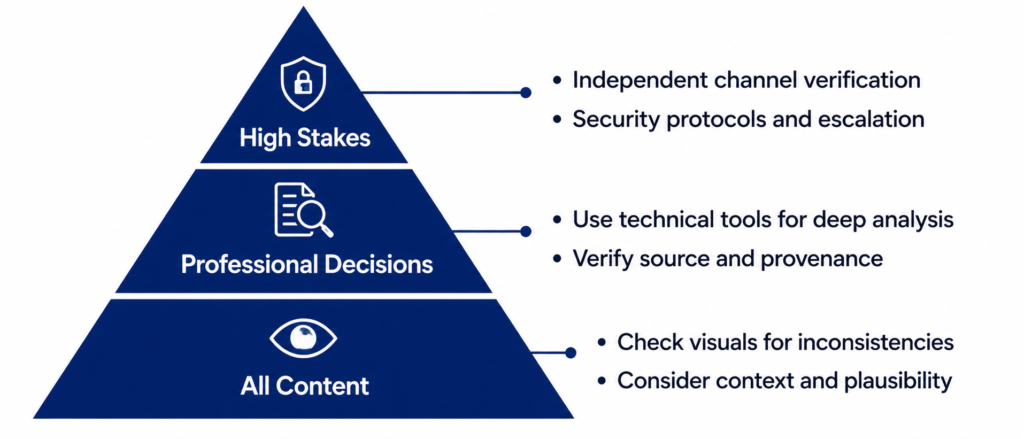
The verification hierarchy for suspicious content:

Level 1 — Low stakes (sharing information with friends):
  Visual checks from this article
  Reverse image search the face
  Check metadata if you have the file

Level 2 — Medium stakes (professional decisions):
  Run through at least one technical detection tool
  Check for the original source of the content
  Verify the person's identity through a known channel

Level 3 — High stakes (financial, legal, security):
  Do not act on the suspicious content at all
  Contact the person through a completely separate
  channel you control
  Confirm the request with a shared secret or
  in-person verification
  Involve your organization's security team
READ MORE: How ChatGPT Actually Works: A Simple Explanation for Non-Tech People
Frequently Asked Questions
Can deepfakes be detected with 100% accuracy?
No — and anyone claiming otherwise is selling something. Current detection tools achieve 86-96% accuracy on known deepfake datasets and significantly lower accuracy against the newest generation of fakes. The arms race between generation and detection is structurally ongoing. Treat detection tools as evidence that raises or lowers your confidence — not as binary proof.
Are deepfakes illegal?
It depends on jurisdiction and context. In many countries, non-consensual deepfake pornography is illegal. Using deepfakes to commit fraud is illegal under existing fraud laws. Creating deepfakes of politicians or public figures for disinformation purposes falls into legal grey areas that are actively being legislated in several countries. The EU AI Act includes provisions targeting malicious deepfakes. The UK Online Safety Act includes deepfake provisions. US federal law is still catching up — several states have deepfake-specific legislation, but federal law is fragmented.
How much audio does someone need to clone my voice?
Current leading voice cloning tools can produce a usable clone from as little as 3 seconds of audio. Better quality clones require 30 to 60 seconds. A few minutes of clean audio produces a clone indistinguishable from the original to most human listeners. This means a single voicemail, a short video clip from your social media, or a brief podcast appearance contains enough audio to clone your voice.
Should I be worried about real-time deepfakes on video calls?
Yes — increasingly so. Real-time deepfake video call tools exist in 2026. They have latency limitations — high-quality real-time deepfakes still have a slight lag and quality degradation compared to pre-rendered video. But the capability is available and used in fraud. The verification protocol in this article — hanging up and calling back on a known number — is the most reliable protection.
How do I report a deepfake?
It depends on where you found it. On social media platforms — report using the platform’s reporting tools, specifically selecting “manipulated media” or “deepfake” categories where available. For deepfakes used in fraud — contact your local law enforcement and include as much evidence as possible (the original file, metadata, where you found it, any associated communications). For deepfakes of public figures being used in disinformation — organizations like the Global Disinformation Index and NewsGuard accept reports and investigate.
Is my face safe from deepfakes if I am not famous?
Less so than five years ago. Deepfakes used to require hundreds of photos to train on — limiting targets to public figures with large photo archives. Current methods can produce usable deepfakes from as few as five to ten photos. If you have a public social media profile with photos, your face is technically accessible for deepfake generation. Most people are not targeted because targeting requires motive, not just access. But the protection of obscurity is weaker than it was.
Conclusion
The Hong Kong finance employee was not careless or unintelligent.
He was presented with something designed by sophisticated technology specifically to look real — and it did. Most people in that situation would have done the same thing.
The response to deepfakes is not to become paranoid about every video and phone call. That is not liveable. The response is targeted skepticism — applied specifically in situations where the stakes are high enough that being wrong matters.
Visual tells still exist in AI faces and videos. Voice cloning still has characteristic artifacts. Technical tools reduce the uncertainty further. But none of them are reliable enough to trust absolutely.
What is reliable is independent verification. Not “does this seem real?” but “have I confirmed this through a channel I control?” Applied in the right moments — when money is involved, when credentials are requested, when urgent action is demanded — that habit is more protective than any technology.
Deepfakes will keep getting better. The generates will keep improving. The detectors will keep training. The arms race continues.
The one thing that does not change: a convincing fake that you never act on without verification causes no harm.
If this article gave you something practical to use the next time something feels off, share it with someone who does not know what catchlights are yet. Leave a question in the comments — deepfake techniques are changing fast and we cover new developments as they emerge.

Author: AI Learner Tech
AI Learner Tech is a premier research and educational hub dedicated to mastering Artificial Intelligence, Machine Learning, and Computer Vision. We bridge the gap between complex academic theories and real-world industrial applications. Join our community to access high-quality tutorials, open-source projects, and expert insights. Website: ailearner.tech