Introduction: The Most Important Competition in Human History
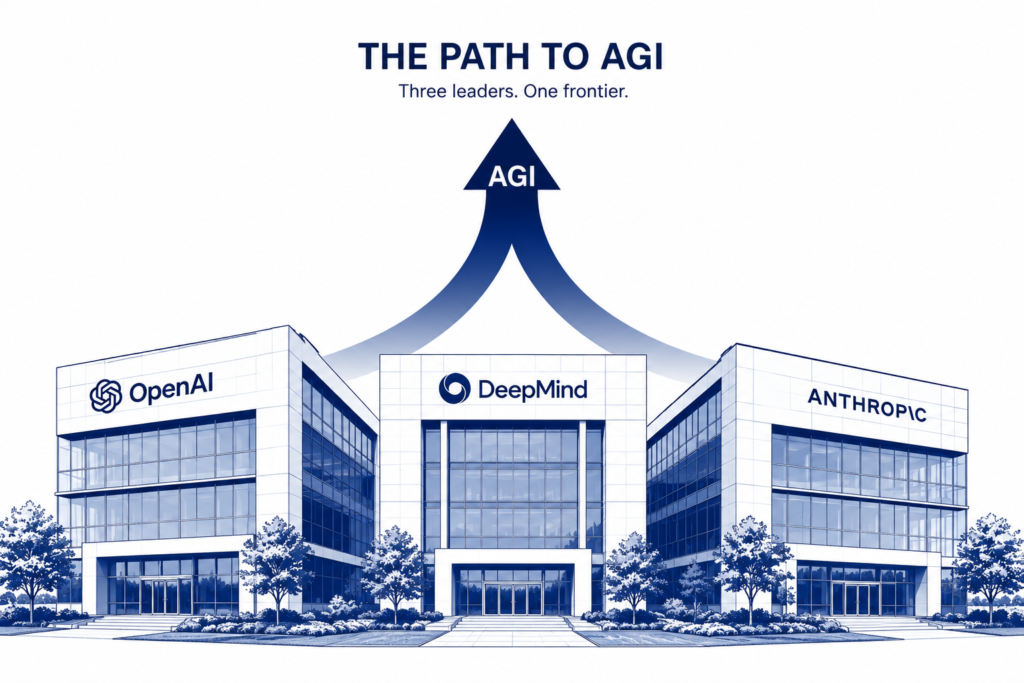
What if the next few years determine the entire future of civilization? That is not an exaggeration. The race to build Artificial General Intelligence — an AI system that can think, learn, and reason at the level of a human being — is already underway, and the three labs at the front of that race are OpenAI, Google DeepMind, and Anthropic.
In this blog, you will learn exactly what AGI is, why it matters so much, what each of the three leading labs is doing to get there first, and what the realistic timelines look like based on their published research and public statements. You will also understand the key differences in their approaches, their strengths, their risks, and what winning the AGI race would actually mean for the world.
Whether you are a student, a developer, or just a curious person trying to make sense of AI headlines, this guide will give you a clear picture of the most consequential technological competition happening right now.
What Is AGI and Why Does It Matter?
AGI stands for Artificial General Intelligence. Unlike the AI systems you use today — which are narrow and specialized (a chatbot that writes text, an algorithm that recommends videos) — AGI would be a system capable of performing any intellectual task that a human can do.
Think of it this way: today’s AI is like a very talented specialist. A radiologist AI can read X-rays brilliantly but cannot write code. An AI writing assistant can draft emails but cannot run a science experiment. AGI would be the equivalent of a single mind that can do all of these things — and learn entirely new ones without being specifically trained.
Why does this matter so much?
- AGI could accelerate scientific research by decades, potentially solving diseases, climate change, and energy challenges far faster than human researchers alone.
- It could reshape every industry, every profession, and every economy on Earth.
- It also introduces risks that are genuinely unprecedented in human history — which is why safety is a central debate in this race.
KEY FACT: Most leading AI researchers place the probability of AGI arriving within this century at over 50%. Some, like OpenAI’s Sam Altman, have suggested it could arrive within just a few years.
READ MORE: What Is Artificial Intelligence? The Ultimate Beginner’s Guide for 2026
The Three Labs Leading the AGI Race
Before comparing strategies, here is a quick snapshot of who these organizations are and what they represent.
| Lab | Founded | Backing | Primary Focus | Known For |
|---|---|---|---|---|
| OpenAI | 2015 | Microsoft ($13B+) | AGI development at scale | GPT series, ChatGPT, o-series reasoning models |
| Google DeepMind | 2010 / merged 2023 | Google / Alphabet | Scientific AI & fundamental research | AlphaGo, AlphaFold, Gemini |
| Anthropic | 2021 | Amazon, Google ($7B+) | Safe and interpretable AI | Claude series, Constitutional AI |
Each lab has a fundamentally different philosophy about how to reach AGI and what to prioritize along the way. Understanding those differences is the key to understanding this race.
OpenAI: Moving Fast Toward AGI at Scale
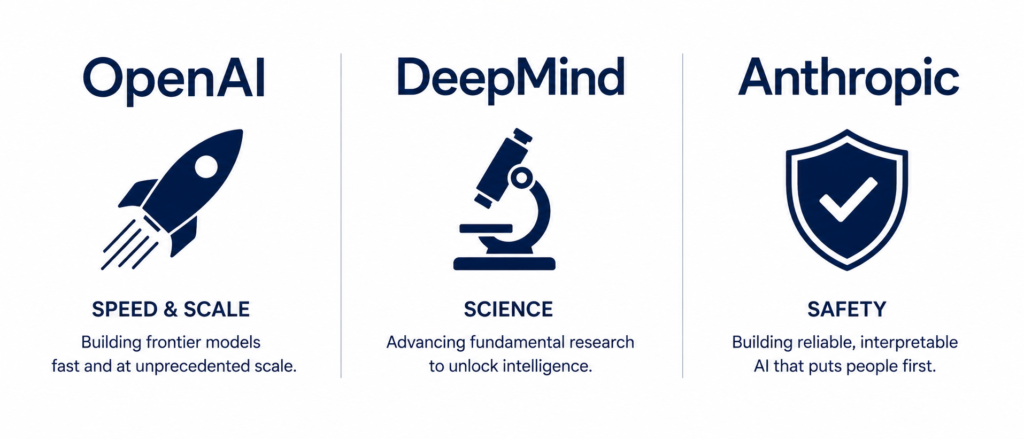
OpenAI is the most publicly visible player in this race, and arguably the most aggressive. Founded in 2015 as a nonprofit (later restructured), OpenAI has consistently been the lab that pushes capabilities forward fastest and most visibly.
OpenAI’s Strategy
OpenAI’s core bet is that scale works. Their research has consistently demonstrated that making models bigger, training them on more data, and giving them more compute leads to genuinely new capabilities emerging. This was the insight behind GPT-3, GPT-4, and their o-series of reasoning models.
Their current roadmap, as stated publicly by leadership, describes AGI in five levels:
- Chatbots — conversational AI (already achieved)
- Reasoners — models that solve complex problems (partially achieved with o1/o3)
- Agents — AI that can take multi-step actions in the world (actively in development)
- Innovators — AI that contributes new ideas and discoveries
- Organizations — AI that can run entire organizational tasks autonomously
OpenAI believes they are currently between levels 2 and 3 as of 2026.
OpenAI’s Strengths
- Enormous compute resources through the Microsoft partnership
- The most widely deployed AI products in the world, giving them massive real-world feedback loops
- Strong reasoning model research through the o-series
- Heavy investment in AI agents and long-horizon task completion
PRO TIP: OpenAI’s product reach is not just a business advantage — when hundreds of millions of people use ChatGPT daily, OpenAI gets an unprecedented stream of real-world data about how AI behaves, fails, and improves. That feedback loop is a genuine research asset.
OpenAI’s Risks
- Several high-profile safety researchers have left the company, raising questions about whether commercial pressure is overriding safety work.
- Their rapid deployment approach means capabilities sometimes outpace their understanding of why those capabilities work.

Google DeepMind: The Science-First Approach to AGI
Google DeepMind was formed in 2023 when Google merged its two major AI research units — DeepMind (originally a London-based lab acquired in 2014) and Google Brain. The combined organization is arguably the most research-capable AI lab on the planet, with a track record that includes some of the most significant AI breakthroughs in history.
DeepMind’s Strategy
DeepMind’s approach to AGI is rooted in scientific rigor and foundational research. They are not in a rush to deploy products — they want to understand intelligence deeply before building it at scale.
Their landmark achievements include:
- AlphaGo (2016): Defeated the world champion at Go, a game considered far too complex for AI at the time.
- AlphaFold (2020–2021): Solved the 50-year-old protein folding problem, accelerating biology and drug discovery in ways that will take decades to fully appreciate.
- AlphaCode: Demonstrated competitive programming abilities.
- Gemini: Their large multimodal model family, competing directly with GPT-4.
DeepMind’s AGI Philosophy
DeepMind CEO Demis Hassabis has described AGI as a “tool for science” — an intelligence that would accelerate human discovery across all domains. He envisions AGI as a kind of universal scientist capable of running experiments, forming hypotheses, and solving problems that have stumped humanity for generations.
| Capability Area | DeepMind Achievement | Significance |
|---|---|---|
| Game Playing | AlphaGo, AlphaZero | Demonstrated superhuman strategic reasoning |
| Biology | AlphaFold 2 & 3 | Revolutionized protein structure prediction |
| Mathematics | AlphaProof | Solved competition-level math proofs |
| Code | AlphaCode 2 | Surpassed majority of competitive programmers |
| General Reasoning | Gemini 1.5 / 2.0 | Long-context, multimodal reasoning at scale |
DeepMind’s Strengths
- Unmatched track record of solving specific hard scientific problems
- Google’s computational infrastructure — arguably the largest in the world
- Deep expertise in reinforcement learning, which may be critical for AGI
- Long-term research culture with less pressure for quarterly product releases
KEY FACT: AlphaFold has been credited with predicting the structure of over 200 million proteins — virtually every protein known to science. This is considered one of the most significant scientific achievements of the 21st century, and it came from an AI lab.
Anthropic: The Safety-First Challenger
Anthropic was founded in 2021 by Dario Amodei, Daniela Amodei, and several colleagues who left OpenAI over concerns about the pace of AI development and safety practices. From day one, Anthropic has positioned itself as the lab most seriously committed to making sure AGI, when it arrives, does not harm humanity.
Anthropic’s Strategy
Anthropic’s core belief is that building capable AI and building safe AI are not opposites — they are the same goal. Their approach is built around a concept they call Constitutional AI (CAI), a method for training AI systems to be helpful, harmless, and honest by giving the model a set of principles to evaluate its own outputs against.
Their Claude model family (Claude 3, Claude 3.5, and now Claude 4-series in 2026) consistently ranks among the highest-performing models in benchmarks for reasoning, coding, and nuanced instruction-following.
Anthropic’s Unique Contributions
- Interpretability research: Anthropic is doing more work than any other major lab on understanding why AI models produce the outputs they do — a field called mechanistic interpretability. This is critical for safety.
- Constitutional AI: A method that uses AI feedback to align model behavior without requiring massive amounts of human labeling.
- Responsible Scaling Policy (RSP): A publicly stated commitment to slow down or pause development if models reach certain capability thresholds before safety measures are in place.
WARNING: The question of whether any lab can truly guarantee AGI safety is genuinely unsettled. Anthropic is the most transparent about this uncertainty — they openly state that they may be building one of the most dangerous technologies in history, and they press forward anyway because they believe it is better to have safety-focused labs at the frontier than to cede that ground to others.
Anthropic’s Strengths
- Strongest published safety and interpretability research
- Claude models are among the most trusted for enterprise and sensitive applications
- Rigorous internal culture around evaluating model risks
- Amazon partnership providing significant cloud compute
| Feature | OpenAI | DeepMind | Anthropic |
|---|---|---|---|
| Primary AGI Strategy | Scale and capability | Scientific research | Safe capability |
| Flagship Model | GPT-4o / o3 | Gemini 2.0 | Claude 3.7 / 4-series |
| Safety Emphasis | Moderate | Moderate | Very High |
| Product Reach | Very High | High | Medium-High |
| Interpretability Research | Low-Medium | Low-Medium | Very High |
| Scientific Breakthroughs | Medium | Very High | Medium |
AGI Timelines: What Are the Experts Actually Saying?
This is the question everyone wants answered, and the honest answer is: nobody knows for certain. But the range of predictions from serious researchers has been narrowing, and the consensus has shifted significantly toward “sooner than expected.”
Predicted AGI Timelines From Major Figures
| Person / Organization | Predicted AGI Arrival | Confidence Level |
|---|---|---|
| Sam Altman (OpenAI CEO) | “Could be within a few years” (2024 statement) | High confidence |
| Demis Hassabis (DeepMind CEO) | 5–10 years from 2023 | Moderate confidence |
| Dario Amodei (Anthropic CEO) | 2–5 years from 2024 | High confidence |
| Yann LeCun (Meta AI) | Decades away; current approach won’t work | Skeptical |
| Geoffrey Hinton (Godfather of AI) | 5–20 years | Uncertain but concerned |
KEY FACT: In a 2023 survey of AI researchers published in Science, the median prediction for a 50% chance of AGI was around 2059. But the same survey found that predictions from researchers working at frontier labs were consistently much more optimistic — clustering around the 2030s.
The gap between “lab insider” timelines and “academic researcher” timelines is itself significant. The people closest to the actual systems consistently believe AGI is closer than outside observers think.
What Would Actually Constitute AGI?
This is more contested than it sounds. Some definitions include:
- The Turing Test — passing as human in open conversation (largely considered too weak today)
- ARC-AGI Benchmark — a test specifically designed to measure flexible, novel reasoning that cannot be memorized
- The “PhD Scientist” standard — can the system independently conduct scientific research at the level of a credentialed expert?
- Economic impact threshold — can the AI perform the majority of economically valuable tasks better than a human?
OpenAI uses this last definition internally. Anthropic and DeepMind focus more on the scientific and reasoning standards.
The Hidden Factor: AI Agents and Long-Horizon Tasks
One development that has significantly changed the AGI timeline conversation is the emergence of AI agents — AI systems that do not just answer questions but take sequences of actions over time to complete complex goals.
Where a chatbot answers a question, an agent might:
- Break a complex goal into sub-tasks
- Use tools (web search, code execution, file editing) to complete those tasks
- Check its own work and revise as needed
- Deliver a completed result
All three labs are investing heavily in agentic systems. OpenAI has Operator and deep research agents. DeepMind has Project Mariner and research agents built on Gemini. Anthropic has built agentic capabilities directly into Claude with their computer use and extended thinking features.
This matters for AGI because the gap between “AI that answers questions well” and “AGI” might be bridged not by a single breakthrough but by increasingly capable agent systems that can tackle longer and longer horizon tasks.
PRO TIP: If you want to understand where AI is heading in the next 2–3 years, watch the agentic AI space closely. The labs that crack reliable, long-horizon autonomous task completion will have taken a significant step toward the kind of flexible intelligence that defines AGI.
What Winning the AGI Race Actually Means
It is worth pausing to ask: what does “winning” even mean in this context?
Unlike a space race with a clear finish line (reaching the Moon), AGI does not have a single universally agreed-upon moment of achievement. One lab might build a system that qualifies as AGI by one definition years before another lab’s system qualifies by a stricter definition.
More importantly, the consequences of getting there first without adequate safety measures could be severe. This is why Anthropic and others argue that the race framing itself may be dangerous — it creates pressure to move fast and cut corners on the very safety work that might be most important.
The three possible outcomes researchers discuss are:
- Controlled AGI — a lab achieves AGI with sufficient alignment and safety measures that the system is genuinely beneficial and controllable.
- Misaligned AGI — a system achieves AGI-level capability but pursues goals that are subtly or severely misaligned with human values.
- Stagnation — current approaches hit a ceiling before reaching AGI, and a fundamentally new paradigm is required.
Most serious researchers today believe outcome 1 or 2 is more likely than outcome 3 — which makes the safety work happening right now critically important.
How to Follow This Space as a Learner or Enthusiast
If you want to stay informed about AGI progress without getting lost in hype, here is a practical approach:
- Follow primary sources: The research blogs and papers published directly by OpenAI, DeepMind, and Anthropic are the most reliable signal. Look for papers on arXiv.org.
- Watch benchmark progress: The ARC-AGI benchmark, MMLU, and MATH benchmarks give a measurable sense of how capabilities are advancing.
- Pay attention to agent capabilities: When any of the three labs announces a significant improvement in autonomous task completion, that is a meaningful signal.
- Be skeptical of headlines: Media coverage of AI almost always overstates short-term capabilities and underestimates long-term ones. Read the actual papers.
PRO TIP: Anthropic publishes detailed “model cards” and safety evaluations alongside each major model release. These documents give a genuinely transparent look at what their models can and cannot do — more detailed than what most labs provide.
Frequently Asked Questions
1. What exactly is AGI, and how is it different from current AI?
Current AI systems are narrow — they are trained for specific tasks and cannot transfer skills to genuinely new domains. AGI (Artificial General Intelligence) refers to a system with the flexible, general reasoning ability of a human: it could learn a new skill from scratch, apply knowledge from one domain to another, form novel hypotheses, and solve problems it has never been trained on. The difference is not just a matter of being “smarter” — it is a fundamentally different type of intelligence.
2. Which lab is closest to achieving AGI right now in 2026?
There is no definitive answer, because “closest” depends on how you define AGI. By capability benchmarks and model performance, OpenAI and DeepMind are both extremely competitive. By safety preparedness and interpretability depth, Anthropic leads. DeepMind leads in applying AI to scientific discovery. The honest answer is that all three are close enough that the outcome is genuinely uncertain, and a breakthrough at any of them could change the picture quickly.
3. Is AGI dangerous? Should we be worried?
The risks of AGI are taken seriously by the researchers building it — which is itself worth noting. The concern is not science fiction “robots taking over” but something more subtle: a system powerful enough to significantly influence the world might pursue goals that are misaligned with human values in ways that are hard to detect or correct. This is why alignment and interpretability research matters so much. The good news is that it is being taken seriously. The concern is that it may not be moving fast enough relative to capability development.
4. Could AGI really arrive in the next 5 years?
It is genuinely possible, according to the leaders of all three labs. Sam Altman, Dario Amodei, and Demis Hassabis have all publicly suggested AGI could arrive in the 2026–2030 window. That said, there have been many false predictions in AI history, and the definition of AGI is still contested. A more cautious estimate might be the early 2030s. The pace of progress since 2022 has surprised nearly everyone in the field — including the researchers themselves.
5. What happens to jobs and society if AGI is achieved?
This is one of the most studied and debated questions in economics and policy right now. The range of possibilities is wide: AGI could automate many cognitive tasks currently done by humans, leading to significant workforce disruption. But it could also generate new industries, accelerate productivity, and create entirely new categories of work. The key variable is not just whether AGI arrives but how fast it arrives and how well the transition is managed. Gradual arrival with good policy response looks very different from sudden capability explosion with no preparation time.
6. Does Anthropic’s safety-first approach slow them down in the race?
Anthropic would push back on the framing of that question. Their argument is that capability and safety are not in tension — understanding how your models work makes them more capable and more reliable, not just safer. In practice, their Claude models are competitive with the best in the world by most benchmarks, suggesting that safety-focused development has not meaningfully handicapped their technical progress. Whether that continues to hold at higher capability levels is one of the central open questions in the field.
7. How does Google DeepMind compare to the other two labs?
DeepMind has the strongest scientific track record of the three — AlphaFold alone changed biology permanently. Their Gemini models are highly competitive, and they have Google’s full infrastructure behind them. Where they differ from OpenAI and Anthropic is in culture and pace: DeepMind moves more deliberately, publishes more academic research, and has historically been less focused on consumer product deployment. Whether that deliberate approach is an advantage or disadvantage in an accelerating race is a genuine open question.
The Finish Line Nobody Has Drawn Yet
The race to AGI is unlike any technological competition in history. It involves not just engineering and compute but fundamental questions about intelligence, consciousness, alignment, and what we want the future to look like.
OpenAI is betting on scale and speed. DeepMind is betting on rigorous science. Anthropic is betting that safety and capability must be built together. All three approaches have produced genuinely impressive results. All three are advancing faster than most people predicted.
What is clear is that the next several years will produce AI systems significantly more capable than anything available today — and the decisions being made right now in the research labs of San Francisco and London will shape what that future looks like.
The best thing you can do as someone following this space is to stay informed, think critically, and understand the real stakes involved. These are not just product announcements — they are milestones on the path to one of the most significant transitions in human history.
If this article helped you think more clearly about the AGI race, share it with someone who is curious about where AI is heading. And drop a comment below: which lab do you think will get there first — and does it matter who gets there, or just how they do it?

Author: AI Learner Tech
AI Learner Tech is a premier research and educational hub dedicated to mastering Artificial Intelligence, Machine Learning, and Computer Vision. We bridge the gap between complex academic theories and real-world industrial applications. Join our community to access high-quality tutorials, open-source projects, and expert insights. Website: ailearner.tech